Specialty Guides: Build a Weekly Documentation Review Process With AI
Learn how to optimize your clinic workflow using a weekly documentation review process with AI medical scribes. Save time and ensure clinical accuracy today.
The Hidden Burden of Clinical Administrative Work
For many doctors and private practitioners, the end of the patient day doesn’t mean the end of work. Instead, it signals the beginning of ‘pajama time’—hours spent hunched over a keyboard trying to recall the specifics of morning consultations. This lag in documentation often leads to rushed notes, inconsistent details, and a lingering sense of medico-legal anxiety. Whether you are in a high-volume university clinic or a specialized private practice, the pressure to maintain high-quality records while avoiding burnout is a constant struggle.
This guide provides a comprehensive roadmap for transforming your workflow. We will explore how to move beyond the traditional, time-consuming methods of charting by implementing a weekly documentation review process with AI. You will learn about various note formats that extend far beyond the standard SOAP note, strategies for maintaining rigorous quality control, and a step-by-step rollout plan that ensures patient privacy and clinic efficiency. This is designed for GPs, specialists, and telehealth providers who want to reclaim their time without compromising care.
What a medical scribe solves in modern practice
The real cost of clinical documentation isn’t just measured in minutes; it is measured in cognitive load. When a clinician is forced to divide their attention between a patient and a computer screen, the therapeutic alliance suffers. Manual charting often leads to ‘note debt,’ where the delay between the encounter and the documentation increases the risk of omitting critical clinical nuances or medication adjustments. These gaps can have real-world consequences for patient safety and billing accuracy.
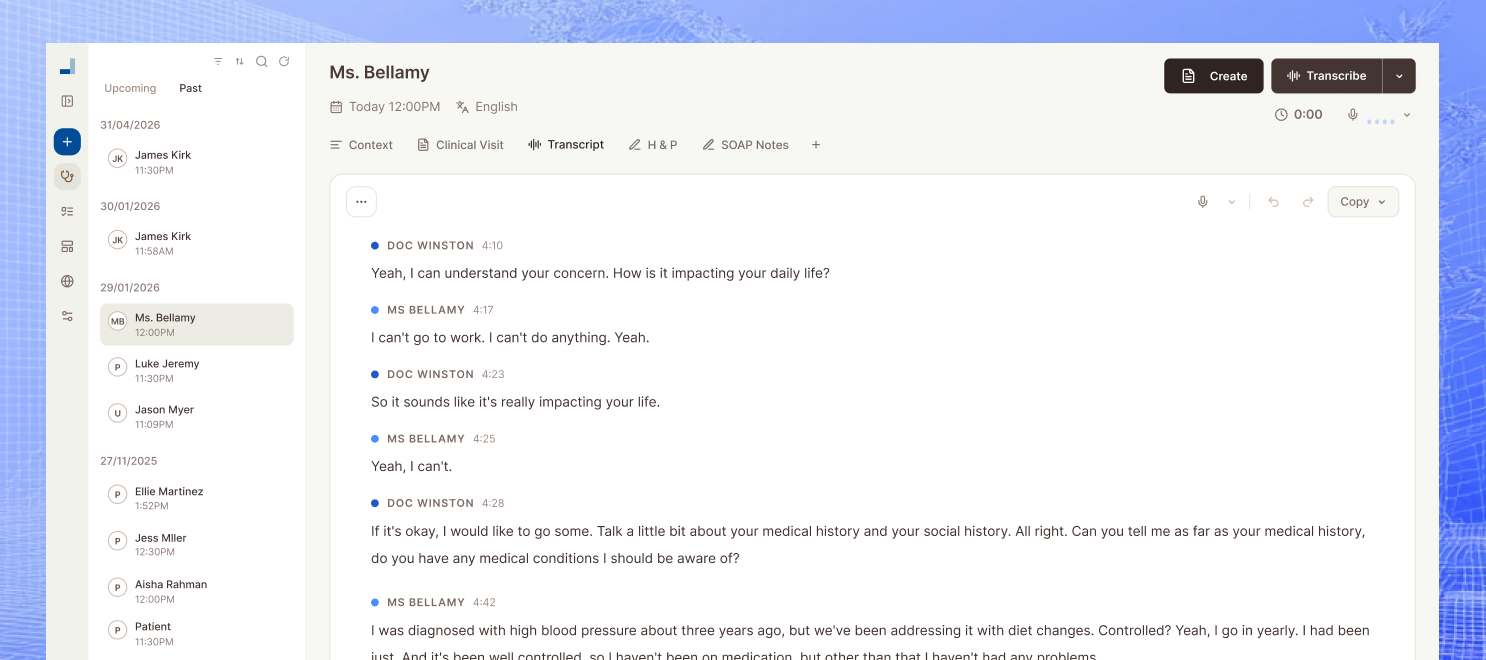
An AI medical scribe serves as an assistive partner, not a replacement for clinical judgment. It works by capturing the ambient conversation of a consult and distilling it into a structured draft in real-time. This allows the doctor to remain fully present with the patient. It is important to remember that the AI serves the clinician; the practitioner remains the final authority, responsible for reviewing, editing, and signing off on every entry to ensure absolute accuracy using a weekly documentation review process with AI.
- Reduces cognitive load by handling the initial drafting of clinical encounters.
- Eliminates ‘pajama time’ by completing notes immediately after or during the visit.
- Enhances patient engagement by allowing for better eye contact and active listening.
- Provides a consistent structure that reduces the risk of medico-legal discrepancies.
Note types you can generate beyond SOAP (H&P and more)
While the SOAP note is a staple of medical education, modern practice requires a much broader range of documentation types to ensure continuity of care. Using an AI-driven system allows clinics to generate diverse outputs tailored to specific clinical needs. For instance, a History and Physical (H&P) requires a different narrative flow than a brief follow-up note or a specialized procedure report. Having the right structure at your fingertips ensures that handovers are seamless and audits are stress-free.
Beyond daily progress notes, AI tools can streamline the creation of complex documents like consult notes, discharge summaries, and referral letters. These documents often require synthesizing large amounts of information into a concise format for other providers. By automating the extraction of key data points from the initial encounter, clinicians can ensure that the secondary documents are not only timely but also highly accurate, reflecting the exact nuances of the patient’s journey throughout the healthcare system.
- H&P and Progress Notes: Essential for inpatient and complex primary care tracking.
- Consult and Referral Letters: Professional summaries generated instantly for specialists.
- Procedure and Discharge Notes: Targeted documentation for surgical or transitional care.
- Follow-up Notes: Concise updates that focus on changes since the last encounter.
How to implement a weekly documentation review process with AI step-by-step
To begin implementing a weekly documentation review process with AI, start small by selecting a specific visit type, such as routine follow-ups or wellness exams. This allows the team to get comfortable with the technology in a lower-stakes environment before expanding to complex diagnostic cases. Configure your AI system with templates specific to your specialty—whether that’s cardiology, pediatrics, or general practice—to ensure the output matches your clinical logic and preferred terminology.
During the patient encounter, focus entirely on the person in front of you while the AI captures the conversation. Once the visit concludes, the AI provides a structured draft. Instead of letting these pile up, perform a ‘micro-review’ immediately to catch any immediate errors. This habit ensures that by the time you reach your scheduled weekly review session, the majority of the work is already high-quality and only requires a final verification.
As you move through the week, reuse these AI outputs to generate secondary documents like school forms or referral letters with a single click. By the end of the week, the ‘review’ becomes a high-level quality assurance check rather than a daunting mountain of typing. This narrative flow ensures that documentation stays current and that the clinic owner can monitor the documentation standards being met across the entire facility.
- Choose one visit type to pilot for the first seven days to build confidence.
- Customize templates by specialty to ensure the AI speaks your clinical language.
- Perform 30-second micro-reviews after each encounter to maintain real-time accuracy.
- Consolidate all notes into a final weekly audit to ensure nothing was missed.
How to keep note quality high and reduce mistakes
The most common failure points in clinical documentation are often silent: a missed medication dosage, a transposed lab value, or the phenomenon of ‘note bloat,’ where irrelevant details obscure the clinical picture. AI helps mitigate these by using structured data extraction, but the risk of errors remains if the oversight process is weak. Clinicians must establish a lightweight review habit that focuses on the ‘big three’: Mediterranean reconciliation, the assessment plan, and specific diagnostic reasoning.
Setting team standards is also vital for larger clinics. Ensure that everyone using the tool understands how to prompt the AI for specific details and how to prune unnecessary information. A periodic ‘peer-review’ of notes can also help align the documentation style across the practice, ensuring that every patient record meets the same high standard of clarity and professional rigor.
- Focus reviews on high-risk areas like medication lists and clinical assessments.
- Establish clear clinic-wide standards for note length to prevent data clutter.
- Use a daily check-in to ensure all drafts from the day have been verified.
- Implement a ‘less is more’ approach by refining AI templates periodically.
Privacy, consent, and patient trust (plain English)
Privacy is the cornerstone of the patient-provider relationship. When introducing AI transcription, it is essential to follow local regulations and institutional policies regarding data retention and encryption. While specific laws vary by region, the principle remains the same: the patient must be informed and feel secure that their health information is being handled with the utmost confidentiality.
Explaining the process to patients can be handled with a simple, transparent script. A clinician might say: ‘To help me focus entirely on you today, I’m using a secure medical tool that listens to our conversation and helps me write my notes. It’s encrypted and HIPAA-compliant. Is that okay with you?’ Most patients appreciate the extra attention they receive when the doctor isn’t staring at a computer screen.
- Always obtain verbal or written consent based on your local governing body’s rules.
- Explain the benefits to the patient, such as improved eye contact and better care.
- Ensure your AI provider uses industry-standard encryption for data in transit and at rest.
- Maintain a clear policy on how long recordings or transcripts are kept before deletion.
Rolling it out across a clinic without disruption
A successful rollout requires a phased approach rather than a ‘big bang’ implementation. Start with a two-week pilot involving a small group of ‘super-users’ who are tech-savvy. This group can identify potential friction points in the workflow—such as hardware placement or template adjustments—before the system is introduced to the entire staff. This minimizes frustration and ensures that the wider team receives proven advice.
During this pilot phase, track specific metrics to measure success. Look at the reduction in after-hours charting time, the speed of note completion, and the overall completeness of the clinical records. Use these data points to demonstrate the value of the tool to the rest of the clinic. Consistent training sessions can then align all practitioners on template usage, ensuring that the entire organization benefits from the efficiency gains.
- Phase 1: 14-day pilot with 1-2 clinicians to refine the initial workflow.
- Track ‘Time Saved’ and ‘Note Completion Rate’ as primary KPIs for success.
- Hold a weekly 15-minute briefing to share template tips and documentation wins.
- Standardize templates early to ensure consistent documentation across the clinic.
Introducing Mcoy AI
Mcoy AI is an AI medical scribe that records and transcribes patient encounters, then generates multiple clinical note types (H&P, progress notes, consult notes, follow-up notes, procedure notes, discharge summaries, referral letters, and more). With over 200+ customizable templates and an interactive AI chat, clinicians can effortlessly create various letters, forms, and secondary documents based on the primary transcript. It is designed to fit seamlessly into any clinical environment, allowing healthcare providers to focus on the patient while the technology handles the complex administrative heavy lifting.
Frequently Asked Questions
Successfully integrating and maintaining a weekly documentation review process with AI can feel like a major shift. Here are answers to the most common questions from practitioners making the transition.
How accurate are AI medical scribes in real clinics?
In real-world settings, AI medical scribes are remarkably accurate at capturing the dialogue and clinical intent of a consultation. They excel at transcribing complex medical terminology and organizing it into logical sections. However, they are assistive tools, meaning the clinician must still oversee the final output to ensure every nuance is captured correctly. Most users find that they only need to make minor edits to the drafted notes.
Do I still need to review every note?
Yes, professional responsibility dictates that the clinician must review and sign off on every note generated by an AI. While the AI does the heavy lifting of writing and formatting, the doctor is the only one who can verify the medical accuracy of the assessment and plan. The goal of the AI is to change the task from ‘writing from scratch’ to ‘editing for accuracy,’ which is significantly faster and less taxing.
What note types can an AI scribe generate besides SOAP?
Modern AI scribes are incredibly versatile and can generate a wide array of documentation beyond simple SOAP notes. This includes comprehensive History and Physical (H&P) reports, consultation notes for specialists, detailed procedure notes, and even discharge summaries. Many systems also allow you to generate referral letters or patient instruction sheets directly from the transcript of the encounter.
Will this work for telehealth and in-person consults?
Yes, AI medical scribes are designed to work across multiple modalities. For in-person visits, a smartphone or tablet can capture the ambient audio. For telehealth, the AI can often be integrated into the computer’s audio stream or join the video call as a participant. The quality of transcription remains high regardless of the setting, provided the audio is clear and background noise is minimized.
How do I explain recording/transcription to patients?
Transparency is the best approach when introducing this technology to patients. Inform them that you are using a secure, HIPAA-compliant tool to assist with documentation so that you can focus entirely on them rather than your computer. Most patients are very supportive when they realize it leads to a more engaged and attentive doctor during their visit.
How do clinics prevent note bloat?
Note bloat is prevented by using highly specific templates and setting clear parameters for the AI. You can instruct the AI to be concise and only include relevant clinical information. During your weekly review, evaluate the length of the notes and adjust your templates if you find that redundant or non-essential information is frequently appearing in the records.
How long does template setup take?
Initial template setup is usually very fast, often taking less than an hour for a standard set of specialty-specific notes. Most AI scribes come with pre-built libraries of hundreds of templates that can be used immediately or tweaked to fit your specific workflow. As you use the system, you can refine these templates in seconds to better reflect your evolving clinical style.
What’s the safest way to start if I’m skeptical?
The safest way to start is by running a ‘shadow pilot.’ Record a few sessions but continue your manual documentation as usual for a few days. Compare the AI-generated note to your own note to see where the AI excels and where it might need more guidance. This allows you to build trust in the technology’s accuracy without any risk to your current clinical workflow or patient records.
Conclusion
Implementing a weekly documentation review process with AI is a transformative step for any modern medical practice. By shifting from manual data entry to a streamlined review-and-edit workflow, clinicians can significantly reduce their administrative burden and regain their work-life balance. The key to success lies in a phased rollout, proper template customization, and a commitment to clinical oversight. Start your pilot today and see how a weekly documentation review process with AI can revitalize your practice and improve patient care. Embrace the future of documentation and take the first step toward a more efficient, burnout-free clinic.
What a serious review table should cover
| Decision area | Common mistake | Better clinic-ready approach | Metric to watch |
|---|---|---|---|
| Workflow design | Treat build a weekly documentation review process with ai as a one-off documentation task | Build a repeatable process with clear ownership and review points | Time to complete documentation |
| Team adoption | Assume every clinician will naturally use the same process | Train for consistency and define exception handling early | Active user adoption |
| Quality review | Only check notes when a problem is reported | Audit a sample of notes weekly and review edge cases | Edit rate per note |
| Operational follow-through | Leave admin actions outside the documentation workflow | Use the same encounter data for referrals, letters, and follow-up tasks | Completion rate for next-step tasks |
Related reading
If you are working through build a weekly documentation review process with ai, it helps to read this alongside Specialty Guides: How to Run a More Efficient Medical Practice in 2026, Specialty Guides: How to Improve Patient Encounters, and AI & Medicine: How to Simplify Clinical Notes for Busy Doctors. Those guides cover adjacent workflow, implementation, and evaluation questions so the decision does not sit in isolation.
FAQ
How accurate are AI medical scribes in real clinics?
Do I still need to review every note?
What note types can an AI scribe generate besides SOAP?
Will this work for telehealth and in-person consults?
How do I explain recording/transcription to patients?
How do clinics prevent note bloat?
How long does template setup take?
What’s the safest way to start if I’m skeptical?