AI & Medicine: How to Simplify Clinical Notes for Busy Doctors
How to Simplify Clinical Notes for Busy Doctors. A full guide on reducing documentation time, improving SOAP notes, and avoiding burnout.
Clinical documentation has quietly become one of the biggest sources of stress for modern doctors. What was once a supporting task has turned into a daily burden that stretches well beyond clinic hours. Many physicians now spend more time typing than talking, more time clicking than thinking. If you are a busy doctor, private practitioner, or clinic owner, simplifying clinical notes is no longer a nice-to-have. It is essential for protecting your time, your focus, and your long-term wellbeing.
This guide breaks down how to simplify clinical notes in a practical, realistic way, without compromising quality, compliance, or patient care. The goal is not to document less, but to document smarter.
Why clinical notes feel harder than ever
Clinical notes were designed to support continuity of care, communication between clinicians, and legal documentation. Over time, they have evolved into dense, repetitive records driven by billing requirements, compliance rules, and rigid EHR structures. As a result, notes have become longer, not clearer.
Many doctors feel pressure to capture everything, even when much of it adds little clinical value. This leads to bloated notes that are hard to review later and exhausting to write in the moment. The problem is not that doctors do not know how to document. The problem is that the system rewards volume over clarity.
Simplifying clinical notes starts with acknowledging that clarity is more valuable than length, and relevance matters more than completeness.
Start with a clear structure every time
One of the easiest ways to simplify clinical notes is to use a consistent structure. When every note follows the same mental framework, your brain works less and flows faster. This is why SOAP notes remain so popular across specialties.
Instead of thinking about everything you need to write, you move step by step. Subjective becomes the patient story. Objective becomes what you see and measure. Assessment becomes your clinical reasoning. Plan becomes what happens next.
The key is resisting the urge to overfill each section. Subjective does not need to be a transcript. Objective does not need every normal finding. Assessment should reflect your thinking, not copy-pasted diagnoses. Plan should be actionable and clear.
Consistency reduces cognitive load and shortens note time without lowering quality.
Document for clinical value, not for perfection
Many doctors write notes as if they are preparing for an audit rather than caring for a patient. This mindset leads to defensive documentation, excessive detail, and unnecessary repetition.
Instead, ask one simple question while writing: will this help me or another clinician understand the patient later?
If the answer is no, it likely does not need to be there. Normal findings that are unchanged from previous visits often add little value when repeated in full. Long past histories copied forward rarely help with today’s decision-making. Clinical notes should highlight what is new, what is important, and what guided your decisions.
When documentation focuses on clinical value, notes become shorter and more useful.
Reduce duplication across your notes
One of the biggest time-wasters in clinical documentation is duplication. The same information appears in multiple sections, across multiple visits, often unchanged. This not only wastes time but increases the risk of errors when outdated information is carried forward.
Look closely at where duplication happens in your workflow. Histories repeated in every visit. Medication lists retyped instead of referenced. Examination findings copied without review.
Simplifying notes means trusting your system. Use references to prior notes when appropriate. Update only what has changed. Make it clear when information is stable versus new. This approach keeps notes lean while preserving accuracy.
Use templates intentionally, not blindly
Templates can be powerful tools, but they can also be dangerous when overused. A poorly designed template creates longer notes, not faster ones. It fills pages with default text that no one reads.
The goal of a good template is guidance, not automation. It should prompt key thinking, not force unnecessary content. Short prompts often work better than long prefilled paragraphs.
Customizing templates by specialty, visit type, and clinician preference is critical. A follow-up visit does not need the same structure as a new patient consultation. A chronic disease review does not need the same detail as an acute presentation.
When templates support your thinking instead of replacing it, documentation becomes faster and clearer.
Capture the note during the encounter, not after
After-hours charting is one of the biggest contributors to doctor burnout. Notes pile up at the end of the day when energy and focus are already low. This is where errors creep in and frustration grows.
Simplifying clinical notes often means shifting documentation closer to the patient encounter. Capturing key points in real time, even as brief phrases, reduces the mental effort required later. It also improves accuracy because details are fresh.
This does not mean typing nonstop during the visit. It means capturing essential information naturally as the conversation unfolds. Many doctors find that when documentation becomes part of the encounter, it feels less like extra work.
Let technology handle the heavy lifting
This is where modern AI tools can make a meaningful difference. Instead of acting as another system to manage, the right technology should sit quietly in the background and support your workflow.
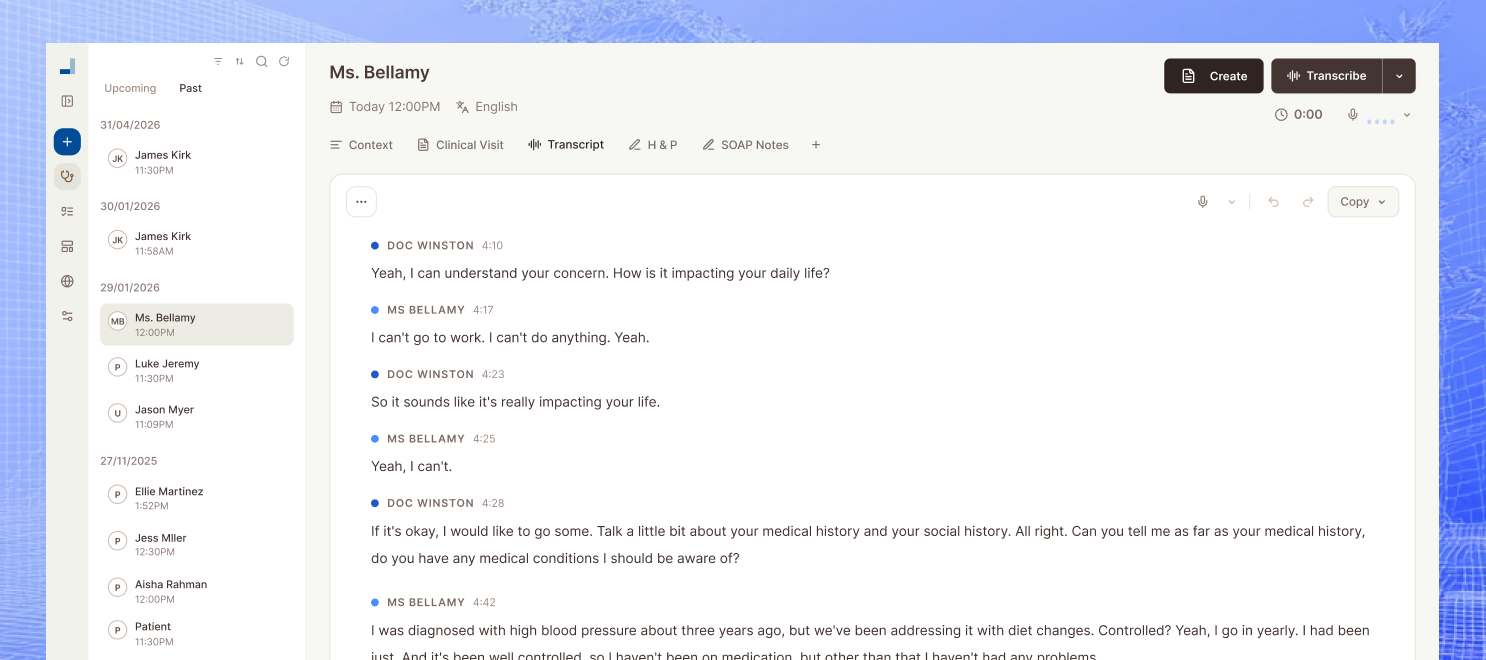
Mcoy AI is designed specifically for this purpose. It is an AI medical scribe that can record and transcribe patient encounters, then turn them into structured SOAP notes automatically. With over 200 customizable templates tailored for doctors and specialties, Mcoy AI adapts to how you practice rather than forcing you to change.
Beyond transcription, Mcoy AI allows you to chat with your encounters, extract key clinical insights, and generate documents such as letters, forms, and summaries directly from the visit. This significantly reduces administrative work while preserving your clinical voice. Doctors spend less time typing and more time focusing on care, without replacing their existing EHR.
Used thoughtfully, tools like Mcoy AI simplify clinical notes by removing manual effort, not clinical judgment.
Review notes for clarity, not length
When reviewing your notes, resist the temptation to judge them by how detailed they look. Instead, judge them by how easy they are to understand.
Ask yourself how quickly you can answer these questions when reading a note. Why did the patient come in? What did I think was happening? What did I decide to do?
If the answers are immediately clear, the note is doing its job. If you need to skim multiple paragraphs to find them, simplification is needed.
Clear notes improve continuity of care, reduce errors, and save time for everyone involved.
Build habits, not just better notes
Simplifying clinical notes is not a one-time fix. It is a habit that develops over time. Small changes compound. Shorter sentences. Fewer copied sections. Clearer assessments. More focused plans.
Over weeks and months, these habits reduce documentation time significantly. More importantly, they reduce mental fatigue. Documentation becomes a natural extension of clinical thinking rather than a separate task to dread.
Doctors who simplify their notes often report feeling more present with patients and less drained at the end of the day.
The bigger picture: protecting your clinical energy
At its core, simplifying clinical notes is about protecting your most valuable resource: your attention. Every minute spent wrestling with documentation is a minute taken from patient care, learning, or recovery.
Clear, concise notes support better medicine. They help you think more clearly, communicate more effectively, and work more sustainably. Whether through better structure, smarter templates, or supportive tools like Mcoy AI, the outcome is the same. Less friction. Less burnout. More time for what matters.
What a serious review table should cover
| Decision area | Common mistake | Better clinic-ready approach | Metric to watch |
|---|---|---|---|
| Workflow design | Treat how to simplify clinical notes for busy doctors as a one-off documentation task | Build a repeatable process with clear ownership and review points | Time to complete documentation |
| Team adoption | Assume every clinician will naturally use the same process | Train for consistency and define exception handling early | Active user adoption |
| Quality review | Only check notes when a problem is reported | Audit a sample of notes weekly and review edge cases | Edit rate per note |
| Operational follow-through | Leave admin actions outside the documentation workflow | Use the same encounter data for referrals, letters, and follow-up tasks | Completion rate for next-step tasks |
Related reading
If you are working through how to simplify clinical notes for busy doctors, it helps to read this alongside AI & Medicine: How Doctors Can Improve SOAP Notes, AI & Medicine: How to Reduce Errors in Clinical Notes, and AI & Medicine: How to Use an AI Medical Scribe - A Complete Guide for Doctors and Clinics. Those guides cover adjacent workflow, implementation, and evaluation questions so the decision does not sit in isolation.
FAQ
Does simplifying clinical notes reduce medicolegal protection?
No. Clear and relevant documentation often improves medicolegal protection. Notes that clearly explain clinical reasoning are more defensible than long, unfocused records filled with copied text.
Can shorter notes still meet billing and compliance requirements?
Yes. As long as required elements are present and accurate, notes do not need to be long. Many billing issues come from inconsistencies, not brevity.
Is AI documentation safe to use in clinical practice?
When used responsibly, AI documentation tools can be safe and effective. The key is clinician review and final sign-off. AI should assist, not replace, clinical judgment.
How long does it take to see time savings from simplifying notes?
Many doctors notice improvements within weeks. Small changes add up quickly, especially when combined with better templates or AI support.
Do I need to change my EHR to simplify documentation?
No. Most simplification strategies work within existing EHRs. Tools like Mcoy AI are designed to support EHR workflows rather than replace them.