AI & Medicine: Turn Unstructured Notes Into Structured Notes | Clinician Guide
Learn how to transform unstructured clinical notes into structured documentation. Improve accuracy, save time, and reduce burnout with this step-by-step guide.
The Crisis of Clinical Documentation
Every practitioner knows the heavy weight of the ‘pushed-off’ note—the half-scribbled observations and mental summaries that pile up by 5:00 PM. For many doctors and clinic owners, the transition from messy, unstructured notes into high-quality, structured documentation is the single biggest source of professional exhaustion. This administrative friction leads to rushed notes, increased medico-legal anxiety, and a significant loss of personal time after hours.
This comprehensive guide is designed to help general practitioners, specialists, and university clinic administrators reclaim their schedules. You will learn a clear workflow for capturing patient encounters, moving beyond basic SOAP formats, and implementing a quality control system that ensures every note is audit-ready. Whether you manage a large telehealth team or a private practice, mastering the art of structured documentation is the first step toward a more sustainable medical career.
What a medical scribe solves in modern practice
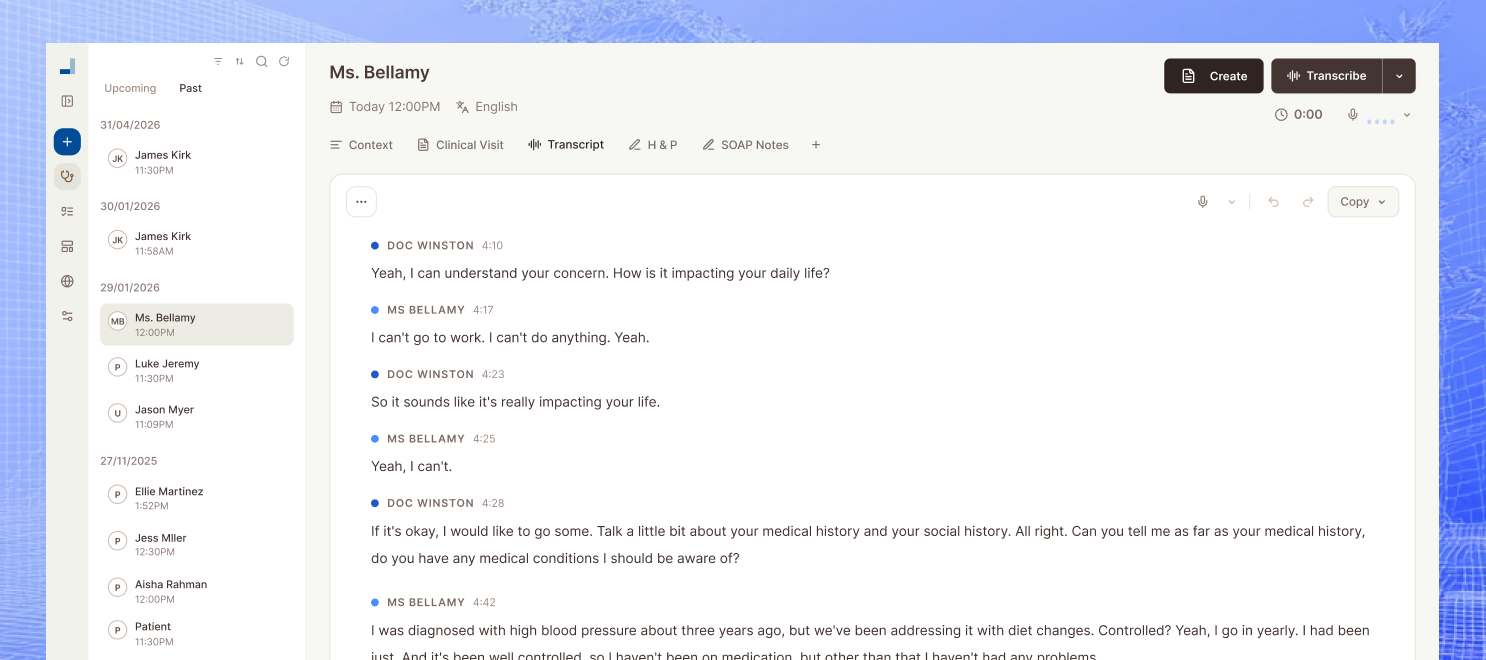
The invisible cost of clinical documentation isn’t just time; it’s cognitive load. When a clinician is forced to juggle active listening, physical examination, and manual data entry simultaneously, the quality of care can suffer. An AI medical scribe acts as an assistive layer, capturing the nuances of the conversation so the doctor can remain fully present with the patient. It transforms the chaotic flow of a live interview into a categorized, readable transcript in real-time.
It is important to understand that these tools are assistive, not autonomous. While the technology handles the heavy lifting of organization and formatting, the clinician remains the final authority and must verify every detail. By offloading the mechanical task of typing and organizing, practitioners can focus on diagnostic reasoning and patient rapport, effectively eliminating the ‘clerical burden’ that leads to physician burnout in modern healthcare settings.
- Reduces the cognitive load and mental fatigue of manual data entry.
- Eliminates the ‘second shift’ of charting late at night.
- Captures specific clinical nuances that are often forgotten after the visit.
- Ensures clinicians remain the final editor and clinical authority.
Note types you can generate beyond SOAP (H&P and more)
While the SOAP (Subjective, Objective, Assessment, Plan) format is a staple in medical training, it is often insufficient for the diverse needs of a busy clinic. Sophisticated documentation systems now allow clinicians to generate specialized outputs like History and Physical (H&P) reports, detailed consult notes, and comprehensive procedure notes. These structured formats ensure that all relevant data points—from family history to specific surgical interventions—are captured with high fidelity and professional clarity.
The value of diverse note types extends to continuity of care and audit readiness. A discharge summary requires a very different structure than a routine follow-up note, focusing on transitions of care and medication reconciliation. By utilizing templates for referral letters and progress notes, clinics can ensure that every outgoing document carries a professional standard that facilitates better communication with peers and insurance providers. This level of structure is essential for high-quality handovers and legal protection.
- H&P and Consult Notes for deeper initial investigations.
- Procedure and Follow-up Notes for ongoing treatment tracking.
- Discharge Summaries and Referral Letters for seamless care transitions.
- Structured templates ensure consistency across large clinical teams.
How to implement unstructured notes into structured notes step-by-step
Transforming your workflow begins by selecting one specific visit type to pilot rather than overhauling your entire schedule at once. Start with your most frequent encounter—perhaps routine follow-ups or initial consults—and prepare a template that aligns with your specific specialty. This targeted approach allows you to iron out the technical kinks without disrupting the entire clinic’s operations.
During the patient encounter, focus entirely on the dialogue and the physical exam. Whether you are seeing patients in-person or via a telehealth platform, the goal is to capture the natural flow of information. You don’t need to speak in ‘computer-ese’; simply talk to your patient as you normally would. Once the encounter concludes, your system will process the raw conversation and map it directly into the structured components of your chosen template.
The final phase involves a rapid review and redistribution. Take 60 seconds to scan the generated output for accuracy, making any necessary adjustments to medication dosages or specific clinical nuances. Once verified, you can immediately reuse this data to generate referral letters or patient instruction forms. This shift from ‘writing’ to ‘editing’ is what saves hours of time every day while maintaining a high standard of clinical excellence.
- Start with one common visit type to build confidence in the workflow.
- Focus on the patient while the system captures the raw data naturally.
- Rapidly review and edit notes instead of writing them from scratch.
- Reuse the structured data for letters and administrative forms instantly.
How to keep note quality high and reduce mistakes
Maintaining high-quality documentation requires an awareness of common failure points, such as note bloat or missing specific values like laboratory results. To prevent these issues, clinics should establish a lightweight review habit where the clinician checks the ‘Assessment and Plan’ section first to ensure it reflects the intended clinical logic. Using standardized templates helps prevent the inclusion of irrelevant information that often clutters traditional manual entries.
Peer review and team standards also play a vital role. If everyone in the clinic uses the same structured framework, it becomes much easier to identify errors or gaps in care. Sharing ‘best practice’ templates across the department ensures that even the most complex cases are documented with consistent quality. This group-level oversight reduces the risk of medico-legal complications and improves the overall integrity of the electronic health record (EHR).
- Prioritize the review of Assessment and Plan sections for clinical accuracy.
- Implement departmental templates to standardize the quality of outputs.
- Avoid note bloat by focusing only on relevant clinical findings.
- Develop a routine habit of checking medication and dosage accuracy.
Privacy, consent, and patient trust
When introducing recording or transcription technology into the exam room, clear communication is paramount. While consent requirements vary significantly by region, a transparent approach is always best for maintaining patient trust. Briefly explain that the tool is being used to help you stay focused on their care rather than a computer screen. Most patients respond positively when they realize they are receiving your undivided attention.
A simple way to present this is by saying: ‘I’m using an AI assistant to help me take accurate notes so I can focus entirely on you during our visit today. Is that alright with you?’ This puts the patient’s mind at ease and reinforces the doctor-patient bond. Behind the scenes, ensure that your chosen technology adheres to strict security and data retention principles, keeping patient information encrypted and private in accordance with local healthcare regulations.
- Always follow local policy and regional privacy legislation.
- Use a patient-centric script to explain the benefits of accurate documentation.
- Focus on the fact that the technology allows for better bedside manner.
- Ensure data is handled with maximum security and encryption.
Rolling it out across a clinic without disruption
A successful rollout is incremental. We recommend a two-week pilot program involving only a handful of early adopters before a clinic-wide launch. During this time, the team should track specific metrics like time saved per note, the reduction in after-hours charting, and overall note completeness. These data points provide the proof of concept needed to get buy-in from more skeptical staff members.
Training should be hands-on but brief, focusing on how to select templates and how to perform the final review. Alignment between the medical staff and administrative team is crucial to ensure that the structured notes integrate smoothly with the existing EHR billing and coding workflows. By treating the rollout as an iterative process, you can solve small challenges before they become clinic-wide obstacles.
- Run a 14-day pilot with power users to gather performance data.
- Track time-savings and note quality as primary success metrics.
- Align templates across the team for clinical and billing consistency.
- Provide brief, practical training sessions to minimize downtime.
Mcoy AI is an AI medical scribe that records and transcribes patient encounters, then generates multiple clinical note types (H&P, progress notes, consult notes, follow-up notes, procedure notes, discharge summaries, referral letters, and more). With over 200+ customizable templates and an AI chat feature to create letters, forms, and documents, it allows clinicians to spend more time with patients and less time on administrative tasks.
The future of clinical documentation and the role of structure
Moving away from the chaos of free-text entry toward a structured, reliable system is the most effective way to protect your time and your patients’ safety. By following the steps outlined in this guide—consistent template use, patient transparency, and a focused review process—you can transform your practice. Implementing a system to turn unstructured notes into structured notes is more than just a tech upgrade; it is a commitment to clinical excellence and personal well-being. Start your pilot today and experience the difference that structured, AI-assisted documentation can make in your daily workflow.
What a serious review table should cover
| Decision area | Common mistake | Better clinic-ready approach | Metric to watch |
|---|---|---|---|
| Workflow design | Treat turn unstructured notes into structured notes | clinician guide as a one-off documentation task | Build a repeatable process with clear ownership and review points |
| Team adoption | Assume every clinician will naturally use the same process | Train for consistency and define exception handling early | Active user adoption |
| Quality review | Only check notes when a problem is reported | Audit a sample of notes weekly and review edge cases | Edit rate per note |
| Operational follow-through | Leave admin actions outside the documentation workflow | Use the same encounter data for referrals, letters, and follow-up tasks | Completion rate for next-step tasks |
Related reading
If you are working through turn unstructured notes into structured notes | clinician guide, it helps to read this alongside AI & Medicine: How to Simplify Clinical Notes for Busy Doctors, AI & Medicine: How Doctors Can Improve SOAP Notes, and Practice Operations: How to Create an AI Scribe Policy for Your Practice Guide. Those guides cover adjacent workflow, implementation, and evaluation questions so the decision does not sit in isolation.
FAQ
How accurate are AI medical scribes in real clinics?
AI medical scribes currently offer very high levels of accuracy, often exceeding 90-95% in capturing the core clinical facts of a conversation. However, the accuracy can be influenced by background noise or multiple speakers talking at once. It is essential for clinicians to remember that these tools are assistive, meaning they perform best when the doctor provides a final review of the generated content to ensure every detail is perfectly captured.
Do I still need to review every note?
Yes, reviewing every note is a fundamental requirement for clinical safety and medico-legal compliance. While an AI assistant can do the heavy lifting of organizing and formatting, only the licensed clinician can verify that the assessment and plan accurately reflect their professional judgment. This review process is typically very fast, often taking less than a minute per encounter compared to the 10-15 minutes required for manual entry.
What note types can an AI scribe generate besides SOAP?
Modern systems are incredibly versatile and can generate a wide array of documentation beyond the standard SOAP format. This includes History and Physical (H&P) reports, comprehensive consult notes, discharge summaries, procedure notes, and even specialized referral letters. The ability to switch between these formats using templates ensures that the documentation always fits the specific clinical context and requirements of the encounter.
Will this work for telehealth and in-person consults?
Absolutely, these tools are designed to be flexible across different practice environments. For in-person consults, the system typically uses a mobile device or tablet microphone to capture the dialogue. For telehealth, the scribe can often integrate directly with the communication platform or capture audio from the computer’s system, ensuring that high-quality structured notes are generated regardless of where the patient is located.
How do I explain recording/transcription to patients?
The best approach is to be direct and highlight the benefit to the patient. You can say that you are using a tool to help capture accurate notes so you can focus 100% on them instead of your screen. Most patients value the increased eye contact and attention. Always ensure you have verbal or written consent according to your local regulations and let them know their privacy is fully protected by secure encryption.
How do clinics prevent note bloat?
Note bloat is prevented by using highly specific, structured templates that only prompt for relevant information. Instead of transcribing every single word spoken, a quality AI scribe summarizes the dialogue into professional medical language. Clinics can further control this by standardizing their templates to ensure that the AI focuses on clinical findings, diagnoses, and plans rather than extraneous conversational fluff.
How long does template setup take?
Setting up your initial templates is usually a very quick process, often taking less than 30 minutes. Most systems come with a wide library of pre-built templates for various specialties that you can use immediately. Customizing these to fit your specific clinic’s workflow generally involves just a few clicks to add or remove specific sections, making it easy to get started with a personalized setup.
What’s the safest way to start if I’m skeptical?
The safest and most effective way to start is by running a small-scale pilot. Choose one or two hours of your day where you see routine patients and use the scribe for just those encounters. This low-pressure environment allows you to see the quality of the outputs and understand the review workflow without the stress of a full patient load. Most skeptics find that seeing the time saved in just a few sessions is enough to prove the value.