AI & Medicine: How Doctors Can Improve SOAP Notes
Full guide on how doctors can improve SOAP notes, reduce documentation errors, and create clearer clinical records using smarter workflows and AI tools.
SOAP notes are one of the most widely used documentation formats in clinical practice, yet they are also one of the most misunderstood. Many doctors use SOAP notes daily without ever being formally taught how to optimise them for clarity, accuracy, and efficiency. Over time, this leads to bloated notes, missing clinical reasoning, and documentation that feels more like a billing requirement than a useful medical record.
This full guide explains how doctors can improve SOAP notes in a practical, real-world way. It is written for busy clinicians, private practitioners, and clinics who want better documentation without spending more time on admin. The goal is not longer notes, but clearer ones that support patient care, communication, and compliance.
Why SOAP notes still matter in modern clinical practice
Despite changes in EHR systems and documentation tools, SOAP notes remain the backbone of clinical records. They provide a structured narrative of the patient encounter, making it easier for other clinicians to understand what happened, why decisions were made, and what comes next.
Well-written SOAP notes reduce ambiguity. They help protect doctors medico-legally, support continuity of care, and make audits and billing far less stressful. Poor SOAP notes, on the other hand, often create confusion. Important details get buried, copied forward errors accumulate, and the clinical story becomes harder to follow with each visit.
Improving SOAP notes is not about rigid formatting. It is about using the structure intentionally so the note reflects how clinicians actually think.
Common problems doctors face with SOAP notes
Many SOAP notes fail not because doctors lack skill, but because of time pressure and workflow friction. When clinics are busy, notes are often written quickly at the end of the day or between patients. This leads to vague subjective sections, overly long objective data dumps, and assessments that lack clear reasoning.
Another common issue is over-documentation. Doctors may include excessive review of systems or copied examination findings that are not clinically relevant. While this might feel safer, it often makes the note harder to read and increases the risk of inconsistencies.
Finally, SOAP notes are frequently treated as a checkbox exercise for billing rather than a clinical communication tool. When that happens, the note loses its primary purpose.
Improving the Subjective section
The subjective section sets the foundation for the entire note. Yet it is often either too brief or too cluttered. An effective subjective section tells a clear story in the patient’s own context.
Instead of listing symptoms without structure, focus on the reason for visit and relevant history. Prioritise information that directly influences your assessment and plan. Not every symptom needs to be documented in detail, only those that matter clinically.
Clarity matters more than completeness. A short, well-written subjective paragraph is far more useful than a long list of copied review items. When another clinician reads the note, they should immediately understand why the patient is there and what their main concerns are.
Making the Objective section work for you
The objective section should support your assessment, not overwhelm it. One of the most common mistakes is dumping all available data into this section without filtering.
Vital signs, examination findings, and investigation results should be relevant and accurate. Avoid copying normal exams by default. If an exam was focused or limited, document it honestly. This improves credibility and reduces medicolegal risk.
Formatting also matters. Clear separation between different types of objective data makes the note easier to scan. When objective findings align closely with the subjective complaint, the entire note becomes more coherent.
Strengthening the Assessment section
The assessment is where many SOAP notes fall apart. This section should explain your clinical thinking, but it is often reduced to a diagnosis list with little context.
A strong assessment briefly connects the subjective and objective findings to your clinical impression. It does not need to be long, but it should be intentional. Even a single sentence explaining why you arrived at a diagnosis can significantly improve note quality.
For complex cases, prioritising problems helps. Listing the primary issue first and secondary concerns afterward makes the note easier to follow. This also supports safer handovers and follow-up care.
Writing clearer and more actionable Plans
The plan is one of the most important parts of the SOAP note, yet it is often written in shorthand that only the original doctor fully understands. A good plan should be clear enough that another clinician could continue care confidently.
Each problem in the assessment should have a corresponding plan. This includes investigations, treatments, referrals, and follow-up instructions. Avoid vague statements that leave room for interpretation later.
Clear plans also benefit patients. When documentation is aligned with what was discussed in the consultation, there is less confusion and fewer after-visit clarifications.
Reducing copy-paste errors in SOAP notes
Copying previous SOAP notes saves time, but it is one of the biggest sources of documentation errors. Old symptoms, resolved diagnoses, and outdated plans often persist because they were never actively reviewed.
A simple improvement is to treat each SOAP note as a fresh clinical story, even if much of the context is similar. Rewriting key parts forces active thinking and reduces autopilot documentation.
If copy-forward is used, it should be deliberate. Reviewing and editing copied sections takes far less time than correcting errors later or responding to audit queries.
Aligning SOAP notes with real clinical workflow
One reason SOAP notes feel burdensome is that they are often written after the encounter, relying on memory. Capturing information during or immediately after the consultation significantly improves accuracy.
Some doctors develop mental prompts for each SOAP section during the visit. Others summarise key points aloud, reinforcing the structure naturally. These small habits reduce omissions and make documentation faster overall.
How Mcoy AI helps doctors improve SOAP notes
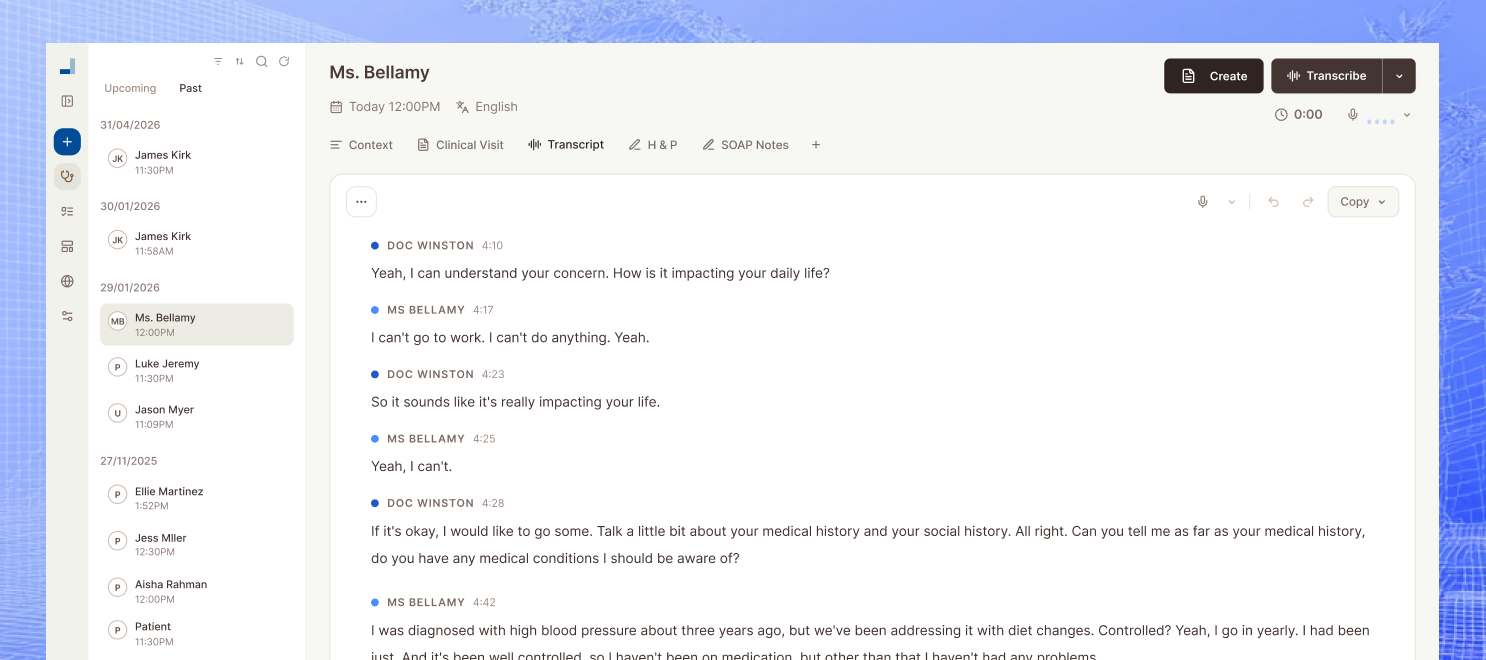
Mcoy AI is built to support doctors who want better SOAP notes without changing their existing EHR. It functions as an AI medical scribe that records and transcribes patient encounters, then structures them into high-quality SOAP notes automatically.
One of the biggest advantages of Mcoy AI is consistency. With over 200 customisable templates designed for different specialties and clinical contexts, SOAP notes are generated with the right structure every time. This reduces missed details and improves clarity across patient records.
Mcoy AI also allows doctors to interact with their notes after the encounter. Clinicians can chat with the recorded visit, refine assessments, generate referral letters, and create clinical documents without retyping information. By reducing manual documentation and repetitive admin, doctors can focus more on care while maintaining accurate, defensible SOAP notes.
Reviewing and signing SOAP notes effectively
Even with good workflows and tools, a brief review step is essential. Reading the SOAP note from the perspective of another clinician helps identify unclear language or missing context.
This does not need to take long. A focused scan of the assessment and plan often catches most issues. Over time, this habit improves documentation quality naturally.
Improving SOAP notes at a clinic level
For group practices and hospitals, variability between providers can reduce the usefulness of SOAP notes. Aligning on basic documentation standards improves communication and reduces errors.
This does not mean forcing identical writing styles. It means agreeing on what good documentation looks like and supporting clinicians with templates, training, and the right tools.
Regular feedback and light audits can help identify patterns that need improvement without creating a punitive culture.
The long-term impact of better SOAP notes
Improved SOAP notes benefit everyone involved in care. Patients receive safer, more coordinated treatment. Clinics experience fewer billing issues and compliance concerns. Doctors spend less time correcting notes after hours.
Most importantly, documentation becomes a clinical asset rather than a source of frustration. When SOAP notes clearly reflect the clinical encounter, they support better medicine, not just better paperwork.
What a serious review table should cover
| Decision area | Common mistake | Better clinic-ready approach | Metric to watch |
|---|---|---|---|
| Workflow design | Treat how doctors can improve soap notes as a one-off documentation task | Build a repeatable process with clear ownership and review points | Time to complete documentation |
| Team adoption | Assume every clinician will naturally use the same process | Train for consistency and define exception handling early | Active user adoption |
| Quality review | Only check notes when a problem is reported | Audit a sample of notes weekly and review edge cases | Edit rate per note |
| Operational follow-through | Leave admin actions outside the documentation workflow | Use the same encounter data for referrals, letters, and follow-up tasks | Completion rate for next-step tasks |
Related reading
If you are working through how doctors can improve soap notes, it helps to read this alongside AI & Medicine: How to Simplify Clinical Notes for Busy Doctors, AI & Medicine: How to Reduce Errors in Clinical Notes, and Compare & Choose: Medical Scribing Services: Are They Worth It?. Those guides cover adjacent workflow, implementation, and evaluation questions so the decision does not sit in isolation.
FAQ
What makes a good SOAP note
A good SOAP note is clear, relevant, and structured. It tells the clinical story without unnecessary detail and links assessment and plan logically.
Should SOAP notes be detailed or concise
They should be concise but complete. Relevance matters more than length.
Can AI improve SOAP note quality
Yes. AI tools that capture encounters and structure SOAP notes consistently can reduce omissions and documentation errors when reviewed by clinicians.
Do SOAP notes need to be the same for every specialty
No. The structure stays the same, but content and emphasis should be adapted to each specialty’s workflow.