Practice Operations: Training Guide for AI Scribe Adoption | Free Resources
Learn how to build a training guide for AI scribe adoption. Step-by-step workflow, note types, and privacy tips for clinics and private practices.
How to Create a Training Guide for AI Scribe Adoption
The transition from manual charting to digital assistance often feels overwhelming for busy clinicians. Many doctors spend hours after clinic finishing notes, leading to chronic burnout and a constant sense of being behind. When documentation becomes a burden, patient care and personal well-being are the first to suffer. This guide provides a blueprint for creating an internal training resource to streamline the adoption of ambient technology.
We will explore how to build a robust workflow, move beyond simple SOAP notes, and maintain high quality control. Whether you are a solo practitioner, a multi-specialty group owner, or a university clinic director, this guide outlines the rollout plan needed to ensure your team feels confident and supported. By the end of this training guide for AI scribe adoption, you will have a clear path to reclaiming your after-hours time while improving clinical accuracy.
What a medical scribe solves in modern practice
The primary cost of modern documentation isn’t just financial; it’s the cognitive load that drains a clinician’s energy throughout the day. When doctors are forced to focus on a screen instead of the patient, the quality of the therapeutic alliance diminishes. An automated scribe captures the dialogue in real-time, allowing physicians to maintain eye contact and engage deeply with the patient’s narrative without the anxiety of missing a critical detail.
It is essential to clarify that an AI medical scribe is an assistive tool, not a replacement for clinical judgment. The clinician remains the ultimate authority, responsible for reviewing and verifying every output. The scribe acts as a highly efficient secretary that organizes raw conversation into structured medical language, reducing the time spent on repetitive data entry and ensuring that notes are completed immediately after the encounter rather than at the end of a long day.
- Reduces cognitive load by handling the heavy lifting of transcription and formatting.
- Restores the patient-physician relationship by removing the digital barrier.
- Eliminates ‘pajama time’ by enabling real-time note completion.
- Serves as a collaborative assistant under the strict supervision of the licensed provider.
Note types you can generate beyond SOAP (H&P and more)
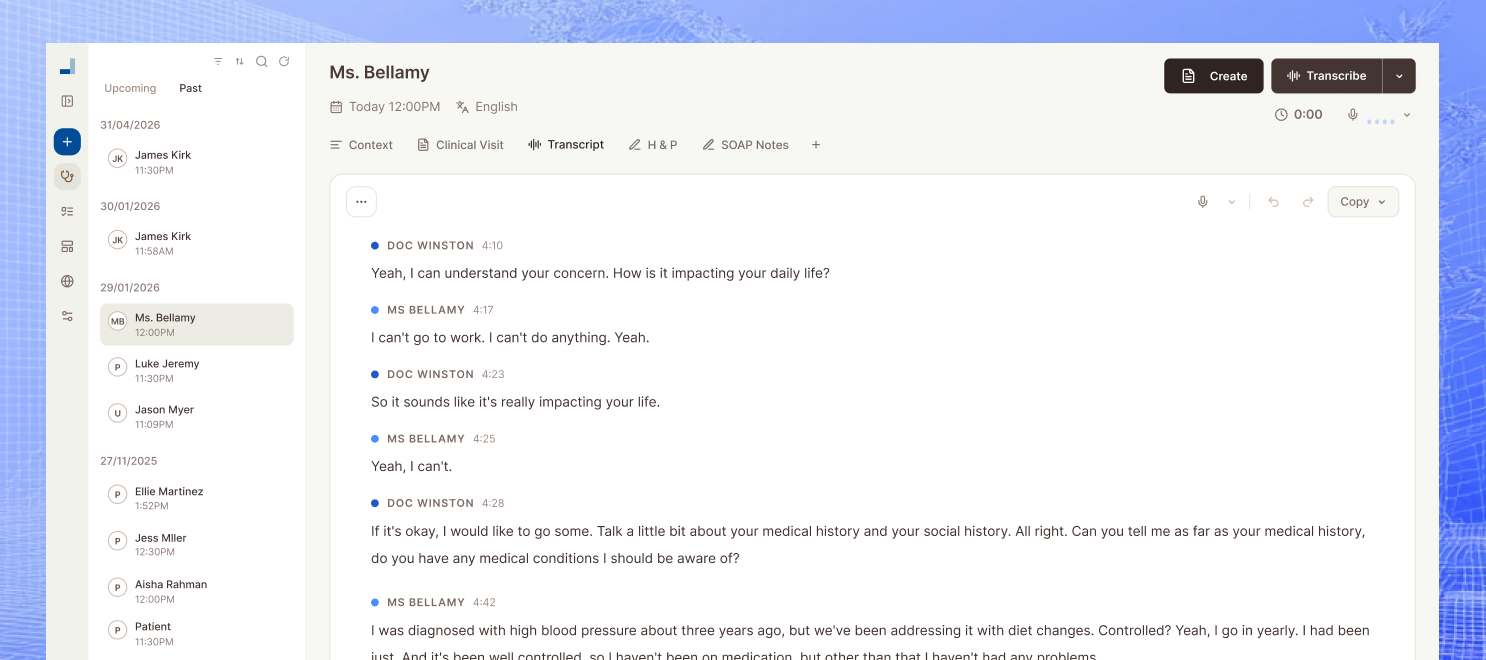
While the SOAP format is the industry standard for daily progress, complex cases and specialty visits often require more nuanced documentation. A comprehensive training guide for AI scribe adoption should teach staff how to generate History and Physical (H&P) reports, which offer a deeper dive into a patient’s long-term background and current status. These are vital for initial admissions or complex new patient consultations.
Specialized documentation like procedure notes, discharge summaries, and referral letters are equally important for continuity of care. Procedure notes require specific technical details and outcomes, while discharge summaries must capture the entire arc of a hospital stay or treatment course. Using AI to draft these ensures that no critical lab value or follow-up instruction is lost during the transition of care, making the practice more audit-ready.
Structure matters because it dictates how easily another provider can pick up the chart and understand the clinical reasoning. High-quality handover notes and consult letters are the backbone of a high-functioning referral network. When these documents are consistent and professional, it enhances the clinic’s reputation and ensures that the next provider in the care chain has exactly what they need to treat the patient effectively.
- Comprehensive H&P and progress notes for detailed patient longitudinal tracking.
- Specialized procedure notes and discharge summaries for surgical or acute settings.
- Professional referral letters and consult notes to improve inter-provider communication.
- Standardized formatting that ensures audit readiness and medico-legal protection.
How to implement training guide for AI scribe adoption step-by-step
Start your implementation by selecting one specific visit type to pilot, such as low-complexity follow-ups or routine physicals. This allows the team to get comfortable with the interface without the pressure of a complex diagnostic case. Once the basic flow is mastered, you can expand to more intricate encounters. Familiarize the staff with the specific templates relevant to your specialty, ensuring everyone knows which format to trigger for different patient needs.
During the encounter, whether it is in-person or via telehealth, the clinician simply initiates the recording. There is no need to change how you talk to the patient; in fact, the more natural the conversation, the better the context captured. Once the visit concludes, the AI generates the draft almost instantly. The clinician then performs a rapid review to ensure the assessment and plan accurately reflect their medical intent.
The real efficiency gain occurs when you reuse these outputs. A well-structured progress note can be instantly adapted into a referral letter or a patient summary for an insurance form. Encourage your team to utilize these automated secondary documents to clear their administrative inbox daily. This narrative flow ensures that the technology becomes a seamless part of the clinical day rather than an extra step to manage.
- Begin with a pilot phase targeting simple, high-frequency visit types.
- Pre-configure specialty-specific templates to save time during the review phase.
- Capture encounters naturally and review the generated drafts immediately.
- Leverage AI-generated drafts to create letters and forms with minimal extra effort.
How to keep note quality high and reduce mistakes
Preventing ‘note bloat’ and inaccuracies is a critical part of clinician training. Typical failure points include the inclusion of irrelevant social chatter or the repetition of old problem lists that haven’t been updated. Clinicians should be trained to perform a ‘targeted edit,’ focusing on the Objective and Assessment/Plan sections to ensure specific measurements and medication changes are perfectly recorded.
Establishing a team standard for note review is also vital. A lightweight habit, such as checking the note against the ‘four-eyes’ principle or a quick mental checklist, ensures that every output meets the clinic’s quality bar. When the team aligns on what a ‘good note’ looks like, the AI learns to deliver results that require fewer manual corrections over time, further increasing the practice’s overall efficiency.
- Perform a targeted edit focusing on medication dosages and clinical plans.
- Establish clear clinic-wide standards for what constitutes a high-quality note.
- Avoid note bloat by selecting templates that summarize rather than transcribe verbatim.
- Conduct weekly spot-checks during the first month to ensure accuracy and compliance.
Privacy, consent, and patient trust
Patient trust is built on transparency. While consent requirements vary significantly by region, a general best practice is to inform the patient that an AI tool is being used to help the doctor focus more on them and less on the computer. Most patients appreciate the extra attention and are happy to support a technology that improves the quality of their visit.
You might use a simple script: ‘To help me focus entirely on our conversation today, I’m using a secure AI tool that helps me write my notes. Is it okay if I record our visit for that purpose?’ This plain-English approach demystifies the technology. From a security standpoint, ensure your guide explains that the data is encrypted and handled according to modern healthcare privacy standards, prioritizing data protection at every step.
- Always follow local legal requirements regarding patient consent for recording.
- Use a simple, patient-centric script to explain the benefits of the technology.
- Ensure data is encrypted and handled within a secure, compliant framework.
- Reiterate to patients that the AI is only assisting with documentation, not making care decisions.
Rolling it out across a clinic without disruption
A successful rollout takes about two weeks. The first week should focus on technical setup and template alignment, while the second week focuses on live usage with a limited patient load. Tracking metrics such as ‘hours spent on charting’ and ‘note completion time’ provides tangible evidence of success, which helps win over any skeptical staff members or partners.
Training should not be a one-time event. Schedule a brief 15-minute huddle after the first week to share ‘power user’ tips and resolve any workflow bottlenecks. Aligning everyone on the same set of templates ensures that the medical record remains consistent, regardless of which provider saw the patient, which is essential for large clinics and university settings.
- Implement a 14-day phased rollout to minimize disruption to patient flow.
- Track time-savings and note accuracy as key metrics for success.
- Hold short feedback sessions to share best practices among the clinical team.
- Standardize templates across the organization for consistent record-keeping.
Mcoy AI is an AI medical scribe that records and transcribes patient encounters, then generates multiple clinical note types including H&P, progress notes, consult notes, follow-up notes, procedure notes, discharge summaries, referral letters, and more. It features over 200 customizable templates and an interactive AI chat to help clinicians create custom letters, forms, and documents efficiently. By focusing on the specific needs of modern medicine, it allows doctors to automate the most tedious parts of their workflow.
FAQ
Implementing new technology involves many technical and ethical questions. Below are the most common inquiries clinicians have when building their training resources.
How accurate are AI medical scribes in real clinics?
AI medical scribes are highly accurate in capturing the clinical context and terminology used during a visit. They excel at transforming conversational language into structured medical prose. however, they are not infallible and can occasionally misinterpret specific nuances or background noise. This is why the clinician’s role in reviewing and editing the final draft is a mandatory part of every workflow.
Do I still need to review every note?
Yes, reviewing every note is a fundamental requirement for medical and legal compliance. While the AI does the majority of the writing, the provider is the one responsible for the accuracy of the medical record. The goal of the tool is to move you from a ‘writer’ role to an ‘editor’ role, which is significantly faster and less mentally taxing.
What note types can an AI scribe generate besides SOAP?
Modern AI scribes are capable of generating a wide variety of documentation beyond standard SOAP notes. This includes comprehensive H&Ps, detailed procedure notes, discharge summaries, and even complex referral or insurance authorization letters. By using different templates, the AI can reorganize the same encounter data into whatever format is necessary for the specific clinical situation.
Will this work for telehealth and in-person consults?
Yes, most AI scribe solutions are designed to function seamlessly across both in-person and telehealth environments. For in-person visits, the device’s microphone captures the conversation, while for telehealth, the audio can be captured directly from the computer or mobile device. The transcription and note-generation process remains the same regardless of the visit’s physical format.
How do I explain recording/transcription to patients?
The best approach is to be direct and highlight the benefit to the patient. Explain that the tool allows you to listen more closely and spend less time typing. Using a phrase like ‘This helps me get my notes finished more accurately so I can focus on your care’ usually results in immediate patient acceptance and appreciation for the transparency.
How do clinics prevent note bloat?
Clinics prevent note bloat by selecting ‘summary’ style templates rather than verbatim transcriptions. Training clinicians to edit out non-clinical dialogue during the review process also keeps notes concise. Standardizing which sections are required—and which are optional—helps maintain a clean, readable medical record that focuses only on relevant clinical information.
How long does template setup take?
Initial template setup usually takes less than an hour if you are using pre-built specialty templates. Fine-tuning those templates to match your specific ‘voice’ or clinic preferences can happen over the first week of use. Most providers find that after five to ten encounters, the templates are perfectly calibrated to their documentation style.
What’s the safest way to start if I’m skeptical?
The safest way to start is to pilot the technology with just 2-3 non-complex patients per day. This low-pressure environment allows you to see the quality of the outputs and understand the workflow without affecting your overall clinic schedule. Once you see the time savings and accuracy firsthand, you can gradually increase usage until it covers your entire patient load.
Conclusion
Creating a training guide for AI scribe adoption is the most effective way to ensure a smooth transition to modern documentation. By focusing on structured workflows, diverse note types, and clear quality standards, practices can significantly reduce burnout and improve care quality. The goal is to move beyond the keyboard and back to the heart of medicine. Start small, use a dedicated training guide for AI scribe adoption, and watch your clinic’s efficiency soar as you reclaim your time.
What a serious review table should cover
| Decision area | Common mistake | Better clinic-ready approach | Metric to watch |
|---|---|---|---|
| Workflow design | Treat training guide for ai scribe adoption | free resources as a one-off documentation task | Build a repeatable process with clear ownership and review points |
| Team adoption | Assume every clinician will naturally use the same process | Train for consistency and define exception handling early | Active user adoption |
| Quality review | Only check notes when a problem is reported | Audit a sample of notes weekly and review edge cases | Edit rate per note |
| Operational follow-through | Leave admin actions outside the documentation workflow | Use the same encounter data for referrals, letters, and follow-up tasks | Completion rate for next-step tasks |
Related reading
If you are working through training guide for ai scribe adoption | free resources, it helps to read this alongside Practice Operations: How Clinics Can Streamline Daily Operations, Practice Operations: How Clinics Can Improve Workflow Without Changing Their EHR, and Specialty Guides: How to Run a More Efficient Medical Practice in 2026. Those guides cover adjacent workflow, implementation, and evaluation questions so the decision does not sit in isolation.
FAQ
How accurate are AI medical scribes?
AI scribes are highly accurate in capturing clinical context but require clinician oversight for final verification.
Do I need to review every note?
Yes, clinicians must review and approve all AI-generated drafts to ensure medical and legal accuracy.
Can it generate H&P notes?
Absolutely, AI scribes can generate H&Ps, procedure notes, and referral letters beyond standard SOAP notes.