Practice Operations: How Clinics Can Improve Workflow Without Changing Their EHR
Full guide on how clinics can improve workflow without changing their EHR using smarter processes and AI documentation tools.
For many clinics, workflow problems feel inseparable from their electronic health record. When things are slow, frustrating, or inefficient, the EHR often gets the blame. As a result, the first idea that comes up is replacing the system entirely.
In reality, switching an EHR is one of the most disruptive, expensive, and risky projects a clinic can take on. It involves months of planning, staff retraining, data migration, downtime, and uncertainty. Even after all that effort, many clinics find themselves facing the same problems, just inside a different system.
The good news is that most workflow issues do not require changing the EHR at all. In many cases, clinics can dramatically improve efficiency, reduce administrative burden, and improve clinician satisfaction by redesigning workflows around the EHR rather than replacing it.
This guide explains why EHR changes rarely solve workflow pain, where inefficiencies actually come from, and how clinics can improve day-to-day operations without touching their core system.
Why changing the EHR rarely fixes workflow problems
EHRs are often treated as the root cause of inefficiency, but they are usually only part of the picture. Most workflow issues come from how work flows through the clinic, not which software brand is used.
When a clinic switches EHRs, existing habits, documentation expectations, and administrative processes often remain the same. Staff still duplicate work. Doctors still finish notes after hours. Information still gets re-entered in multiple places.
In some cases, a new EHR can even make things worse. Learning curves slow clinicians down. Customisations are lost. Temporary productivity drops become permanent frustration.
Because of this, improving workflow without changing the EHR is often faster, safer, and more cost-effective.
Where clinic workflows actually break down
To improve workflow, clinics need to look beyond the EHR screen and examine how work moves through the day.
Common breakdowns include documentation being delayed until after clinic hours, repetitive data entry across systems, unclear handoffs between staff, and interruptions that fragment clinicians’ focus. Many clinics also suffer from poorly defined standards, where everyone documents differently, creating inconsistency and extra follow-up work.
Another major issue is task accumulation. Small administrative tasks pile up throughout the day and are pushed to the end, creating bottlenecks and after-hours work.
None of these problems are fixed by changing software alone.
Workflow starts with how information is captured
One of the biggest opportunities to improve clinic workflow is rethinking how information is captured during patient encounters.
In many clinics, the most important information is discussed verbally, then manually documented later. This creates a time lag that slows everything downstream. Notes are written late. Referrals are delayed. Follow-up tasks pile up.
When information is captured at the source, workflows naturally improve. Documentation becomes faster. Communication is clearer. Fewer tasks are deferred.
Improving capture does not require replacing the EHR. It requires adding smarter layers around it.
Reduce duplication before optimising speed
Many clinics try to work faster without first removing unnecessary work. This is a common mistake.
Before optimising, identify duplication. Ask where information is being entered more than once, rewritten in different formats, or copied between systems. These repeated steps are often invisible because they are routine.
Eliminating duplication has an immediate impact on workflow. It reduces time spent, errors, and frustration. Once duplication is removed, efficiency gains compound quickly.
Use standardisation to reduce decision fatigue
Workflow friction is not always about time. It is often about mental effort.
When clinicians must decide how to structure notes, letters, and follow-ups every time, cognitive load increases. Decision fatigue slows work and increases variability.
Standardised templates and clear internal standards reduce this burden. They allow clinicians to focus on clinical thinking rather than formatting and structure.
Importantly, standardisation does not mean rigidity. Good templates support flexibility while providing a consistent foundation.
Improving workflow without touching the EHR
Many of the most effective workflow improvements happen outside the EHR itself.
Clinics can introduce tools that sit alongside the EHR and remove work before information ever reaches it. These tools handle capture, structuring, and drafting, allowing the EHR to remain the system of record rather than the system of effort.
This approach avoids disruption while delivering immediate benefits.
The role of AI in workflow improvement
AI has become a practical way for clinics to improve workflow without EHR changes.
Instead of asking clinicians to type more efficiently, AI tools capture conversations, structure information, and generate documentation automatically. This reduces the amount of manual work required inside the EHR.
When AI handles the heavy lifting, clinicians interact with the EHR less, not more. They review, approve, and finalise rather than create everything from scratch.
This shift dramatically improves flow throughout the day.
How Mcoy AI fits into existing clinic workflows
This is where Mcoy AI plays an important role.
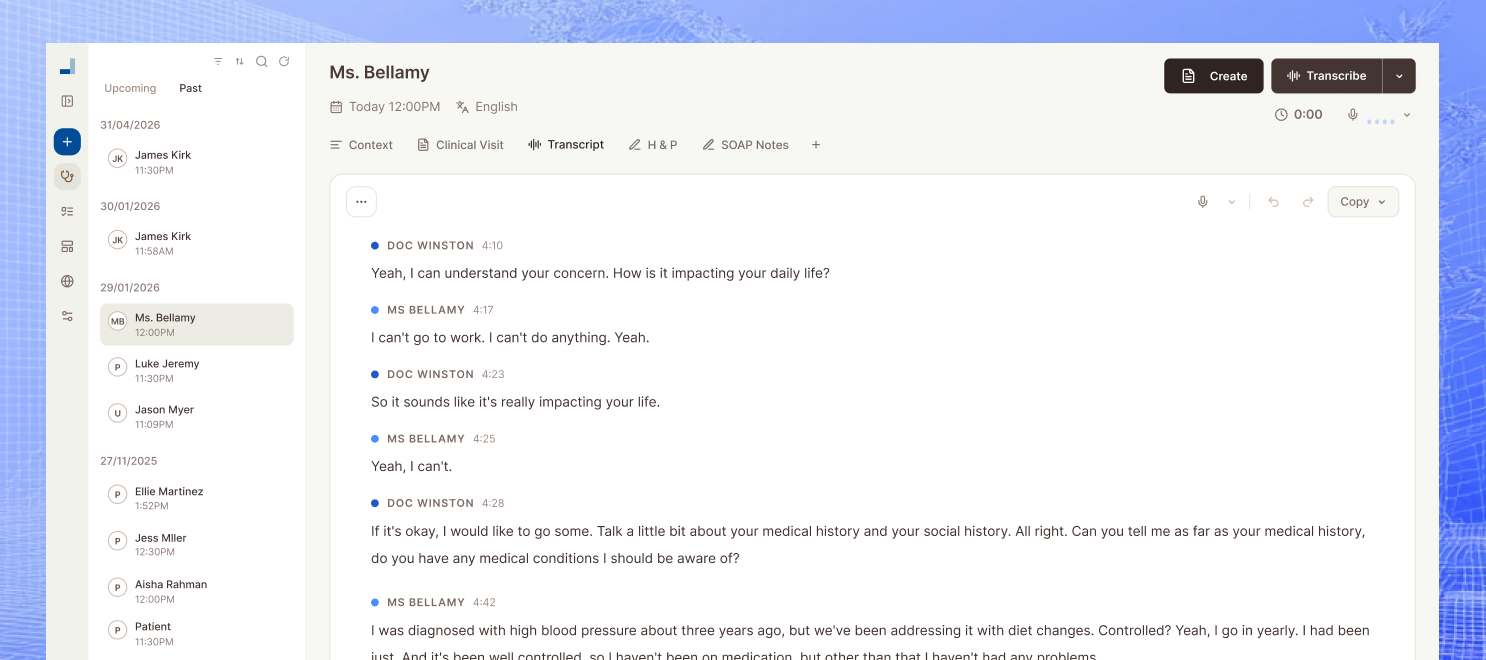
Mcoy AIis an AI medical scribe designed to work alongside existing EHRs, not replace them. It records and transcribes patient encounters, converts conversations into structured SOAP notes, and generates clinical documents using over 200 customisable templates built for different specialties.
Doctors can chat with their encounters, create referral letters, reports, and forms directly from the same consultation. Once reviewed, these outputs can be added into the EHR as final documentation.
Because Mcoy AI sits outside the EHR, clinics do not need to migrate data, retrain staff extensively, or change their core system. Workflow improves immediately, while the EHR remains the system of record.
This approach allows clinics to reduce after-hours work, improve consistency, and speed up documentation without touching their existing infrastructure.
Turn one workflow into many outputs
A major source of inefficiency in clinics is rewriting the same information in different formats. Notes, referrals, letters, and patient summaries are often created separately.
Workflow improves dramatically when one captured encounter powers multiple outputs. When this happens, downstream tasks are completed faster and with fewer errors.
Clinics that adopt this model often see reductions in turnaround time for referrals and follow-ups, which improves both patient experience and inter-provider communication.
Reduce interruptions to protect flow
Workflow is fragile. Interruptions break momentum and increase error rates.
Clinics can improve flow by reducing unnecessary interruptions during consultations and documentation. When clinicians know that documentation will be manageable later, they are less distracted during patient care.
AI-assisted capture supports this by allowing doctors to stay present, knowing that key information is being recorded accurately.
Finish work during the workday
One of the clearest signs of poor workflow is after-hours work. When notes, letters, and tasks spill into evenings, something in the system is broken.
Workflow improvements that reduce after-hours work have an outsized impact on morale, retention, and sustainability. Doctors who finish on time are more focused, engaged, and resilient.
Reducing after-hours work does not require longer appointments or fewer patients. It requires better capture, less duplication, and smarter sequencing of tasks.
Train workflows, not just staff
Many clinics try to improve efficiency by retraining staff. While training is important, it cannot fix broken workflows on its own.
Sustainable improvement comes from designing workflows that make the right thing the easy thing. When systems are intuitive, staff naturally work more efficiently without extra effort.
This is especially important in healthcare, where cognitive load is already high.
Measure small improvements
Workflow improvement does not need to be dramatic to be effective. Saving a few minutes per patient compounds into hours each week.
Clinics should measure simple indicators such as documentation time, after-hours work, and turnaround times for referrals. These metrics provide feedback and guide refinement.
Many clinics are surprised by how quickly improvements show up once workflows are adjusted.
Why keeping the EHR unchanged can be an advantage
EHR stability has value. Staff are familiar with existing systems. Processes are built around them. Changing the EHR introduces risk and distraction.
By improving workflow without changing the EHR, clinics protect continuity while gaining efficiency. This approach respects the reality of busy practices and limited change capacity.
It also allows clinics to improve incrementally rather than betting everything on a single large project.
The future of clinic workflow is layered
The most effective clinics do not rely on a single system to do everything. They use layered workflows.
The EHR remains the source of truth. AI tools handle capture and drafting. Templates ensure consistency. Humans focus on care, judgment, and relationships.
This layered approach allows clinics to evolve without disruption.
Making workflow improvement realistic
Improving clinic workflow does not require a massive transformation. It requires understanding where time and energy are lost and addressing those areas systematically.
By focusing on capture, reducing duplication, standardising intelligently, and using AI where it removes work, clinics can achieve meaningful improvements without changing their EHR.
Workflow improvement is not about technology alone. It is about respecting clinicians’ time and designing systems that support care.
When workflows improve, everything else follows.
What a serious review table should cover
| Decision area | Common mistake | Better clinic-ready approach | Metric to watch |
|---|---|---|---|
| Workflow design | Treat how clinics can improve workflow without changing their ehr as a one-off documentation task | Build a repeatable process with clear ownership and review points | Time to complete documentation |
| Team adoption | Assume every clinician will naturally use the same process | Train for consistency and define exception handling early | Active user adoption |
| Quality review | Only check notes when a problem is reported | Audit a sample of notes weekly and review edge cases | Edit rate per note |
| Operational follow-through | Leave admin actions outside the documentation workflow | Use the same encounter data for referrals, letters, and follow-up tasks | Completion rate for next-step tasks |
Related reading
If you are working through how clinics can improve workflow without changing their ehr, it helps to read this alongside Practice Operations: How Clinics Can Streamline Daily Operations, Practice Operations: How to Set Up an AI Medical Scribe in Your Clinic [Guide], and AI & Medicine: Medical Dictation Software: How It Works in Healthcare. Those guides cover adjacent workflow, implementation, and evaluation questions so the decision does not sit in isolation.
FAQ
Do clinics need to change their EHR to improve workflow
No. Many of the biggest workflow improvements happen outside the EHR through better capture and automation.
Will staff need extensive retraining
Minimal training is usually required when improvements focus on reducing work rather than adding steps.
Can AI tools work with any EHR
Most AI documentation tools are designed to work alongside existing EHRs rather than replacing them.
Is this approach suitable for small clinics
Yes. Smaller clinics often see faster benefits because workflows are simpler to adjust.
How quickly can clinics see results
Many clinics notice improvements within days or weeks, especially in documentation time and after-hours work.