Specialty Guides: Build a Template-First Documentation System: A Full Guide
Learn how to build a template-first documentation system to eliminate charting burnout. Optimize clinical workflows, H&P notes, and patient care today.
The Hidden Burden of Clinical After-Hours Charting
For many doctors and private practitioners, the end of the patient day doesn’t mean the end of work. Instead, it marks the beginning of ‘pajama time’—hours spent hunched over a keyboard catching up on clinical notes. This constant pressure to document accurately while maintaining a high patient volume leads to rushed notes, inconsistency, and a growing sense of medico-legal anxiety. When documentation feels like an afterthought, the quality of the record often suffers, creating a cycle of stress that impacts both provider well-being and patient outcomes.
This guide will teach you how to transition to a template-first documentation system. We will explore advanced note formats beyond the standard SOAP note, quality control measures, and a practical rollout plan for your clinic. Whether you are a general practitioner, a specialist in a private practice, or a provider in a busy university clinic, streamlining your workflow is the most effective way to reclaim your time and ensure excellence in every patient record.
What a medical scribe solves in modern practice
The real cost of documentation isn’t just measured in minutes; it is measured in cognitive load. Every moment a clinician spends worrying about whether they captured the right medication dosage or the specific wording of a patient’s complaint is a moment stolen from clinical reasoning. Delayed notes are often less accurate, relying on memory rather than real-time data, which can lead to missed details and potential errors in care coordination.
An AI medical scribe acts as an assistive layer in this environment. It does not replace the physician’s judgment but rather serves as a digital assistant that captures the nuances of the conversation. It is important to remember that while the technology handles the heavy lifting of transcription and formatting, the clinician remains the final authority, responsible for reviewing and signing off on every entry to ensure absolute accuracy.
- Reduces the cognitive burden of multitasking during a patient visit.
- Eliminates hours of manual data entry after clinic doors close.
- Ensures that subtle clinical details are captured in real-time.
- Shifts the focus back to the patient-provider relationship.
Note types you can generate beyond SOAP (H&P and more)
While the SOAP note is a staple of medical training, modern practice often requires a more diverse array of documentation styles. A template-first documentation system allows you to generate History and Physical (H&P) reports, progress notes, and complex consult notes with ease. Each of these serves a unique purpose in the continuum of care, from the comprehensive baseline established in an H&P to the focused updates found in a follow-up note or procedure report.
The structure of your notes matters deeply for audit readiness and continuity of care. Procedure notes and discharge summaries require specific data points that can be easily missed in a free-text environment. By utilizing specialized templates, you ensure that every handover is high-quality and that any secondary provider reading the chart has a clear, concise understanding of the patient’s status and the planned interventions.
Beyond internal records, a template-first approach simplifies external communication. Referral letters and consult summaries can be automatically synthesized from the encounter data, saving the administrative staff hours of work. This consistency not only protects the practice legally but also builds a professional reputation for thoroughness among peer networks and hospital systems.
- H&P and Progress Notes for standardized daily documentation.
- Consultation and Referral letters for seamless specialty care.
- Procedure notes and Discharge summaries for hospital-grade records.
- Professional follow-up notes that improve patient compliance.
How to implement a template-first documentation system step-by-step
The transition to a template-first documentation system should begin with a single visit type. Rather than trying to overhaul your entire workflow overnight, choose a common encounter, such as a routine follow-up or a specific specialty consultation. This allows you to test the logic of your templates and adjust the data fields without feeling overwhelmed by the complexity of your entire patient panel.
Next, you should configure your templates by specialty or encounter goal. If you are in a university clinic, you might have specific requirements for teaching or research that need to be reflected in the note structure. Capture the encounter naturally, whether it is an in-person physical exam or a telehealth session, and allow the system to map the dialogue into your pre-set fields.
Once the encounter is captured, the review process becomes a matter of editing rather than creating. Review the generated note for clinical accuracy and move quickly through the sections. This rapid review cycle ensures that the note is finished while the patient’s case is still fresh in your mind, fulfilling the goal of real-time documentation.
Finally, leverage the outputs for secondary tasks. A well-structured template allows you to reuse the clinical data to populate insurance forms, work certificates, or patient instructions. By integrating this into your daily narrative flow, you turn a single documentation event into a multi-purpose tool for practice management.
- Start with one high-frequency visit type to build confidence.
- Organize templates by clinical specialty and encounter purpose.
- Review and edit generated notes immediately to ensure accuracy.
- Reuse data outputs for letters, forms, and administrative tasks.
How to keep note quality high and reduce mistakes
Even with advanced automation, failure points like missing medications or ‘note bloat’—the inclusion of unnecessary information—can occur. Maintaining high quality requires a lightweight review habit where the clinician validates the problem list and medication dosages against the patient’s history. Standards should be set across the clinic to ensure that every provider is working from the same baseline of quality.
- Audit notes periodically for ‘clutter’ and unnecessary repetition.
- Maintain a consistent habit of verifying medication and dosage data.
- Establish clinic-wide standards for template structure and detail level.
Privacy, consent, and patient trust
Patient trust is the foundation of any documentation system. While consent requirements vary by region, it is best practice to follow local health privacy policies strictly. A simple, patient-friendly explanation goes a long way. You might say, ‘I use an AI assistant to help me stay focused on you rather than the computer; it records our talk to help me write my medical notes accurately.’
- Stay informed on local healthcare data privacy and consent laws.
- Use clear, transparent language when explaining recording tools to patients.
- Ensure your data retention and security principles align with health standards.
Rolling it out across a clinic without disruption
For a smooth rollout, implement a two-week pilot plan with a small group of early adopters. Track metrics like time saved per note and the reduction in after-hours work to demonstrate value to the rest of the team. During this phase, align your templates so that the entire clinic uses a unified voice, which makes peer review and coverage much easier during vacations or sick leave.
- Launch a 14-day pilot with a small ‘champion’ group of providers.
- Monitor time-savings and note completeness as key performance indicators.
- Hold weekly meetings to refine templates based on team feedback.
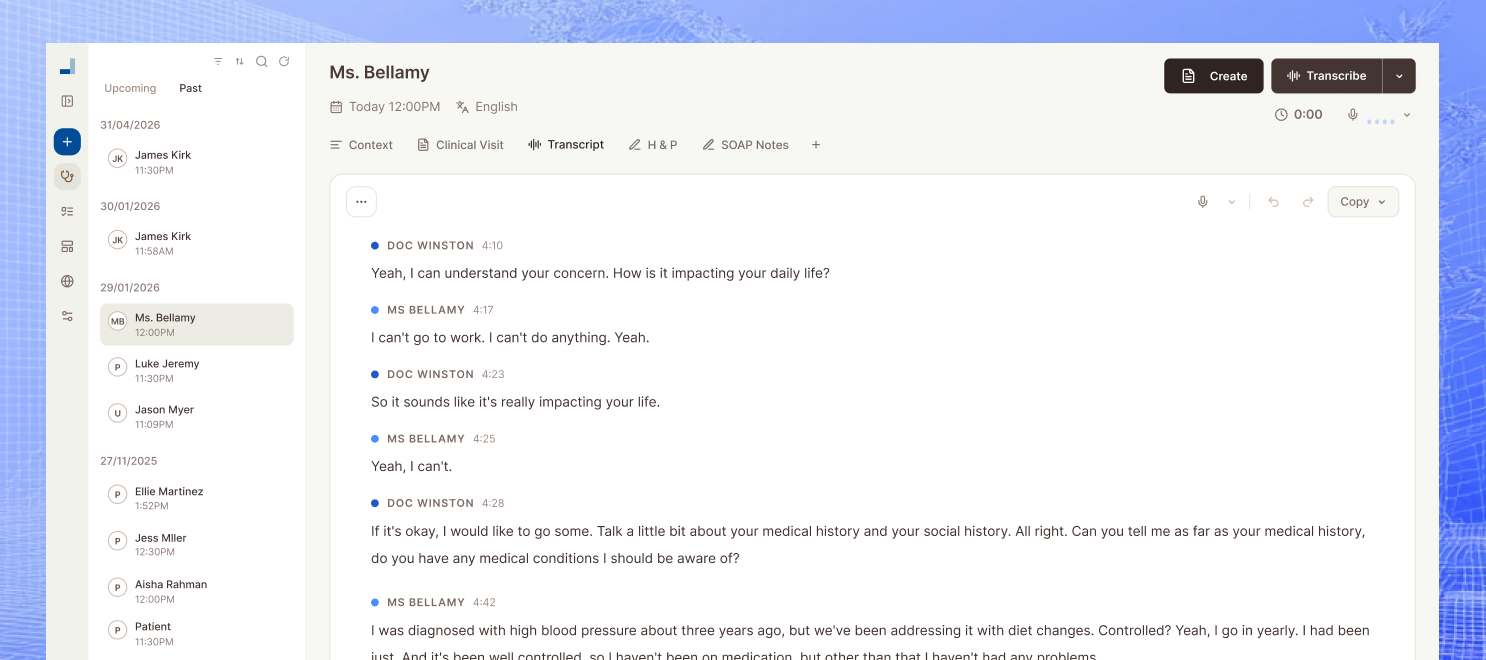
Mcoy AI is an AI medical scribe that records and transcribes patient encounters, then generates multiple clinical note types (H&P, progress notes, consult notes, follow-up notes, procedure notes, discharge summaries, referral letters, and more). With over 200+ customizable templates and an interactive AI chat, clinicians can effortlessly create letters, forms, and complex documents, ensuring that every record is tailored to their specific needs without the manual grind of traditional charting.
Conclusion
Adopting a template-first documentation system is the most effective strategy for modern clinicians to reclaim their schedule and eliminate burnout. By moving beyond basic notes and utilizing professional templates, you ensure your practice remains compliant, efficient, and patient-focused. Pilot your new workflow today and see how a specialized system can transform your daily experience. Implementing a template-first documentation system is not just about technology; it is about restoring the joy of practicing medicine.
What a serious review table should cover
| Decision area | Common mistake | Better clinic-ready approach | Metric to watch |
|---|---|---|---|
| Workflow design | Treat build a template-first documentation system: a full guide as a one-off documentation task | Build a repeatable process with clear ownership and review points | Time to complete documentation |
| Team adoption | Assume every clinician will naturally use the same process | Train for consistency and define exception handling early | Active user adoption |
| Quality review | Only check notes when a problem is reported | Audit a sample of notes weekly and review edge cases | Edit rate per note |
| Operational follow-through | Leave admin actions outside the documentation workflow | Use the same encounter data for referrals, letters, and follow-up tasks | Completion rate for next-step tasks |
Related reading
If you are working through build a template-first documentation system: a full guide, it helps to read this alongside Specialty Guides: How to Run a More Efficient Medical Practice in 2026, Specialty Guides: How to Improve Patient Encounters, and AI & Medicine: How Doctors Can Improve SOAP Notes. Those guides cover adjacent workflow, implementation, and evaluation questions so the decision does not sit in isolation.
FAQ
How accurate are AI medical scribes in real clinics?
AI medical scribes have reached a high level of accuracy, particularly in capturing the clinical context and medical terminology used during an encounter. They are designed to filter out ‘small talk’ and focus on relevant medical facts, though they perform best when the clinician speaks clearly. While the technology is excellent at 1:1 transcription, it is the clinician’s role to ensure the final synthesis matches the clinical reality.
Do I still need to review every note?
Yes, reviewing every note is a fundamental requirement for both clinical safety and legal compliance. The AI acts as a sophisticated drafter, but the clinician is the only one who can verify that the documented plan is clinically appropriate. Most providers find that reviewing a pre-generated note takes about 60 to 90 seconds, which is significantly faster than writing one from scratch.
What note types can an AI scribe generate besides SOAP?
A robust system goes far beyond the SOAP format to include History and Physicals (H&P), detailed procedure notes, consult letters, and discharge summaries. It can also generate transition-of-care documents and follow-up notes tailored to specific specialties. This flexibility allows the documentation to match the actual clinical need of the visit rather than forcing every encounter into a single box.
Will this work for telehealth and in-person consults?
Most modern documentation systems are designed to be platform-agnostic, working equally well for in-person physical exams and virtual telehealth visits. For telehealth, the system can often capture audio directly from the computer, while in-person visits use a mobile device or room microphone. The logic of the template-first approach remains the same regardless of how the patient dialogue is captured.
How do I explain recording/transcription to patients?
The best approach is transparency and focusing on the benefit to the patient. You can explain that using an AI assistant allows you to keep your eyes on them rather than a screen, ensuring better communication and more accurate records. Most patients are very supportive when they realize it means their doctor is listening more intently to their concerns.
How do clinics prevent note bloat?
Note bloat is prevented by using ‘concise’ templates that prioritize relevant data over long-winded transcriptions. Clinicians should set their templates to focus on pertinent positives and negatives rather than including every single word spoken. Regularly reviewing template outputs as a team can also help identify and remove repetitive or unnecessary sections that don’t add clinical value.
How long does template setup take?
Basic template setup can take as little as a few minutes if you are using pre-built clinical libraries. Customizing those templates to fit the specific quirks of your practice or a specialized university clinic might take an hour or two of refinement during the first week. Once the templates are set, they require very little maintenance and provide immediate time savings for every future encounter.
What’s the safest way to start if I’m skeptical?
The safest way to start is with a ‘shadow’ pilot, where you use the system on a few non-complex cases while still maintaining your old documentation method. This allows you to compare the AI-generated note against your manual one without any risk. Once you see the accuracy and the time saved, you can gradually transition more of your patient load to the new system.