AI & Medicine: How to Standardize Clinic Notes with Mcoy AI | Full Guide
Learn how to standardize clinical notes across your clinic with Mcoy AI. Improve documentation quality and clinical workflow with this expert guide.
What a medical scribe solves in modern practice
The burden of manual documentation is more than just a time-sink; it is a primary driver of physician burnout and cognitive fatigue. When practitioners spend hours after their final appointment typing up records, the quality of care often suffers as clinicians struggle to recall specific nuances of a patient interaction. This delay in charting not only leads to ‘pajama time’ work but also introduces risks regarding medico-legal compliance and billing accuracy.
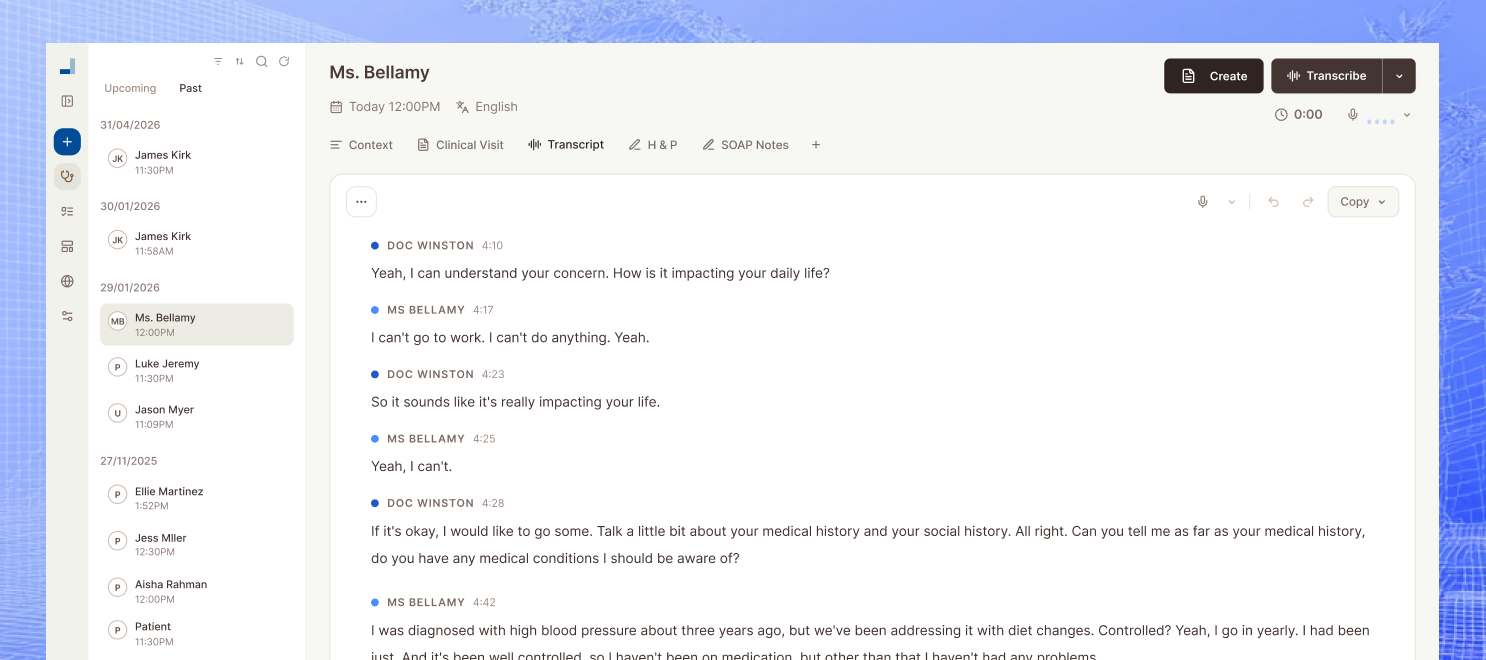
An AI medical scribe acts as an intelligent assistant that captures the dialogue of a patient encounter in real-time. By removing the need for a doctor to stare at a screen during a visit, it restores the human connection between provider and patient. It is important to remember that these tools are assistive; while they handle the heavy lifting of drafting, the clinician remains the final authority and must review the output for clinical accuracy.
- Reduces administrative burnout by automating core charting tasks.
- Enhances patient engagement by allowing for better eye contact.
- Shortens the time between the encounter and note completion.
- Provides a consistent draft that reduces the risk of missing key details.
Note types you can generate beyond SOAP (H&P and more)
While the SOAP note is a healthcare staple, modern clinical practice requires a much broader range of documentation types to ensure continuity of care. Standardizing notes across a clinic means having high-quality templates for History and Physicals (H&P), detailed progress notes, and specialized consult notes. Each of these serves a unique purpose in the patient’s longitudinal record and requires a specific structure to be useful to other members of the care team.
Beyond basic visit notes, complex workflows often demand procedure notes, discharge summaries, and formal referral letters. Developing a standardized approach to these documents ensures that when a patient moves from a university clinic to a specialist or returns for a follow-up, the transition is seamless. Quality documentation facilitates faster audits and clearer communication with insurance payers, reducing the likelihood of rejected claims.
Structure matters because it creates a predictable environment for all clinicians involved in a patient’s journey. When a clinic uses a unified format for follow-up notes and referral responses, the reading clinician can find critical information—such as medication changes or diagnostic plans—in seconds rather than digging through blocks of unformatted text.
- H&P and Progress Notes for comprehensive initial and ongoing care tracking.
- Procedure Notes and Discharge Summaries for acute or surgical interventions.
- Referral Letters and Consult Notes to bridge the gap between specialists.
- Standardized formatting to improve audit readiness and peer review.
How to implement Mcoy AI step-by-step in a real clinic
The most successful implementations of an AI medical scribe begin with a focused approach rather than a total overnight overhaul. Start by selecting one specific visit type, such as routine follow-ups or standard physical exams, to get a feel for the technology. This allows the staff to become comfortable with the interface without the pressure of complex multi-complaint cases immediately.
Once the initial phase is established, move toward setting up specialty-specific templates. A university clinic might need different structures for sports medicine versus mental health services. By pre-selecting these templates, the AI can better categorize the dialogue it captures. During the encounter, whether it is in-person or via telehealth, simply ensure the recording device is positioned to catch both the provider and patient voices clearly.
Refining the output is a critical narrative step. After the AI generates the initial draft, the clinician should perform a rapid review to verify specific values like dosages or lab results. Because the system learns the clinician’s style, these edits become faster over time. Finally, leverage the generated content to populate other necessary documents, such as patient instructions or referral forms, ensuring that information remains consistent across all platforms.
- Start with one common visit type to build staff confidence.
- Configure specialty-specific templates to ensure relevant data capture.
- Review drafts immediately after the encounter for maximum accuracy.
- Reuse clinical outputs to quickly generate letters and patient forms.
How to keep note quality high and reduce mistakes
Maintaining high standards in clinical documentation requires a proactive approach to quality control. Common failure points in AI-generated notes often involve technical data, such as specific medication dosages, laboratory values, or the inadvertent inclusion of irrelevant small talk. To combat this, clinicians should adopt a ‘signature-ready’ habit where they verify the high-stakes sections of a note—Assessment and Plan—before finalizing the entry.
Establishing clinic-wide standards for what constitutes a ‘good’ note is equally important. This includes defining expectations for problem list updates and ensuring that ‘note bloat’ is minimized by focusing on pertinent positives and negatives. Encouraging a culture of peer review where colleagues occasionally look over each other’s standardized notes can help maintain consistency across a diverse group of practitioners.
- Verify objective data like dosages and lab values during the review phase.
- Focus on pertinent details to prevent ‘note bloat’ and redundant text.
- Set clear clinic-wide expectations for daily note completion and accuracy.
- Implement a periodic peer-review process to ensure ongoing quality.
Privacy, consent, and patient trust (plain English)
Data privacy is a cornerstone of modern medicine, and patients are often more comfortable with technology when it is explained transparently. While consent requirements vary by jurisdiction, it is best practice to follow your local healthcare privacy regulations strictly. Most patients are supportive of tools that allow their doctor to focus on them rather than a keyboard, provided they know their data is encrypted and handled securely.
A simple way to explain this to a patient is: ‘I’m using an AI assistant to record our conversation today so I can focus entirely on you instead of typing. It helps me create more accurate medical records. Is that okay with you?’ This approach frames the technology as a benefit to the patient’s care experience rather than a cold administrative requirement.
- Always comply with local healthcare privacy and data retention laws.
- Frame the use of AI as a tool to improve the doctor-patient connection.
- Maintain clear records of patient consent within the EHR where required.
- Ensure the chosen platform uses high-level encryption and security protocols.
Rolling it out across a clinic without disruption
A successful rollout across a multi-provider practice requires a structured pilot phase, usually lasting about two weeks. During this time, a small group of ‘super-users’ can test various templates and workflows, identifying potential bottlenecks before the rest of the team joins. This phased approach minimizes disruption to the daily patient schedule and allows for internal troubleshooting.
Tracking specific metrics—such as the reduction in after-hours charting time and the speed of note completion—helps demonstrate the value to skeptical staff members. As the pilot concludes, use the feedback to align templates across different specialties. Training should focus not just on the software itself, but on how to integrate the captured data into the existing Electronic Health Record (EHR) system efficiently.
- Launch a 14-day pilot with a small group to refine workflows.
- Monitor time-saved metrics to encourage adoption across the team.
- Standardize templates to ensure a unified ‘voice’ for the clinic.
- Integrate AI outputs seamlessly into your current EHR charting process.
Mcoy AI is an AI medical scribe that records and transcribes patient encounters, then generates multiple clinical note types (H&P, progress notes, consult notes, follow-up notes, procedure notes, discharge summaries, referral letters, and more). With over 200+ customizable templates and an interactive AI chat, it allows clinicians to quickly create letters, forms, and complex documents based on the captured visit data, ensuring that documentation is both comprehensive and tailored to the specific needs of the practice.
Conclusion
Standardizing documentation is no longer a luxury but a necessity for the modern, high-functioning clinic. By following a structured implementation plan, clinicians can move from the stress of manual entry to a streamlined system where quality and consistency are the norm. Using Mcoy AI allows your team to focus on the patient while the technology handles the complexities of diverse note types. Start your pilot today and see how easy it is to standardize notes across a clinic using Mcoy AI to reclaim your time and improve care quality.
What a serious review table should cover
| Decision area | Common mistake | Better clinic-ready approach | Metric to watch |
|---|---|---|---|
| Workflow design | Treat how to standardize clinic notes with mcoy ai | full guide as a one-off documentation task | Build a repeatable process with clear ownership and review points |
| Team adoption | Assume every clinician will naturally use the same process | Train for consistency and define exception handling early | Active user adoption |
| Quality review | Only check notes when a problem is reported | Audit a sample of notes weekly and review edge cases | Edit rate per note |
| Operational follow-through | Leave admin actions outside the documentation workflow | Use the same encounter data for referrals, letters, and follow-up tasks | Completion rate for next-step tasks |
Related reading
If you are working through how to standardize clinic notes with mcoy ai | full guide, it helps to read this alongside AI & Medicine: How to Simplify Clinical Notes for Busy Doctors, AI & Medicine: How Doctors Can Improve SOAP Notes, and AI & Medicine: Build a Transcript-to-Note Pipeline in Your Clinic Guide. Those guides cover adjacent workflow, implementation, and evaluation questions so the decision does not sit in isolation.
FAQ
How accurate are AI medical scribes in real clinics?
AI medical scribes are highly accurate in capturing the dialogue between a provider and a patient, often catching nuances that a busy clinician might forget to type. However, they are most effective when used as a drafting tool; they are roughly 90-95% accurate with medical terminology but still require a quick human review. Accuracy also depends on audio quality, so ensuring a quiet environment for the encounter is key.
Do I still need to review every note?
Yes, the clinician remains the legally responsible party for the medical record. While the AI does the heavy lifting of transcribing and formatting, a final review is necessary to ensure specific details like medication dosages or clinical plans are 100% correct. Most practitioners find that this review takes only a fraction of the time compared to writing a note from scratch.
What note types can an AI scribe generate besides SOAP?
Advanced AI scribes can generate a wide variety of documents including History and Physicals (H&P), detailed progress notes, and specialized procedure notes. They are also capable of drafting discharge summaries, consult notes for specialists, and even formal referral letters. This flexibility makes them useful for both general and specialized medical practices.
Will this work for telehealth and in-person consults?
Yes, the technology is designed to work across multiple encounter formats. For in-person visits, it captures audio via a smartphone or tablet microphone; for telehealth, it can often be integrated via system audio or browser extensions. This ensures that your documentation remains standardized regardless of how you interact with your patient.
How do I explain recording/transcription to patients?
The best approach is to be direct and highlight the benefit to the patient. Inform them that you are using an AI assistant to capture the conversation so that you can look at them and listen more closely instead of focusing on your computer. Most patients respond positively when they realize it means their doctor is actually paying full attention to their needs.
How do clinics prevent note bloat?
Note bloat is prevented by using structured templates that prompt the AI to focus on pertinent positives and negatives rather than transcribing the entire conversation verbatim. By selecting the right template—such as a brief follow-up versus a comprehensive initial visit—the output remains concise. Clinicians can also adjust settings to prioritize brevity in the summary sections.
How long does template setup take?
Setting up basic templates usually takes just a few minutes, as most systems come with pre-built options for common specialties. Customizing those templates to fit a specific clinic’s workflow might take an hour or two of initial configuration. Once set, these templates can be used by the entire staff to ensure a uniform documentation style across every provider.
What’s the safest way to start if I’m skeptical?
The safest way to start is with a small pilot program using non-complex cases, such as routine follow-ups or wellness exams. This allows you to see the quality of the output without the pressure of a high-acuity patient. As you gain trust in the system’s ability to capture history and plans accurately, you can gradually expand its use to all visit types.