AI & Medicine: Build a Transcript-to-Note Pipeline in Your Clinic Guide
Learn how to build a transcript-to-note pipeline to automate medical charting. Reduce burnout with structured workflows and AI scribe integration.
Many modern clinicians spend more time facing a computer screen than facing their patients. The burden of after-hours charting has become a leading cause of physician burnout, often resulting in rushed notes that lack critical detail or medico-legal nuances. Whether you are a solo practitioner or managing a busy university clinic, the weight of documentation can feel like an insurmountable administrative tax on your clinical expertise.
This guide will teach you how to build a robust transcript-to-note pipeline, moving beyond basic SOAP notes to high-utility formats like H&P and specialized consult reports. We will cover the specific workflow required to ensure quality control, maintain patient privacy, and execute a seamless rollout plan across your entire practice. By the end of this article, GPs, specialists, and telehealth providers alike will have a blueprint for reclaiming their time without sacrificing clinical accuracy.
What a medical scribe solves in modern practice
The real cost of documentation is measured in more than just minutes; it is measured in cognitive load. When a doctor has to worry about remembering every specific value or medication dosage while also attempting to build rapport with a patient, the quality of care can suffer. Delayed notes often lead to “memory decay,” where the nuances of a complex encounter are lost between the final handshake and the moment the clinician finally sits down at the EMR.
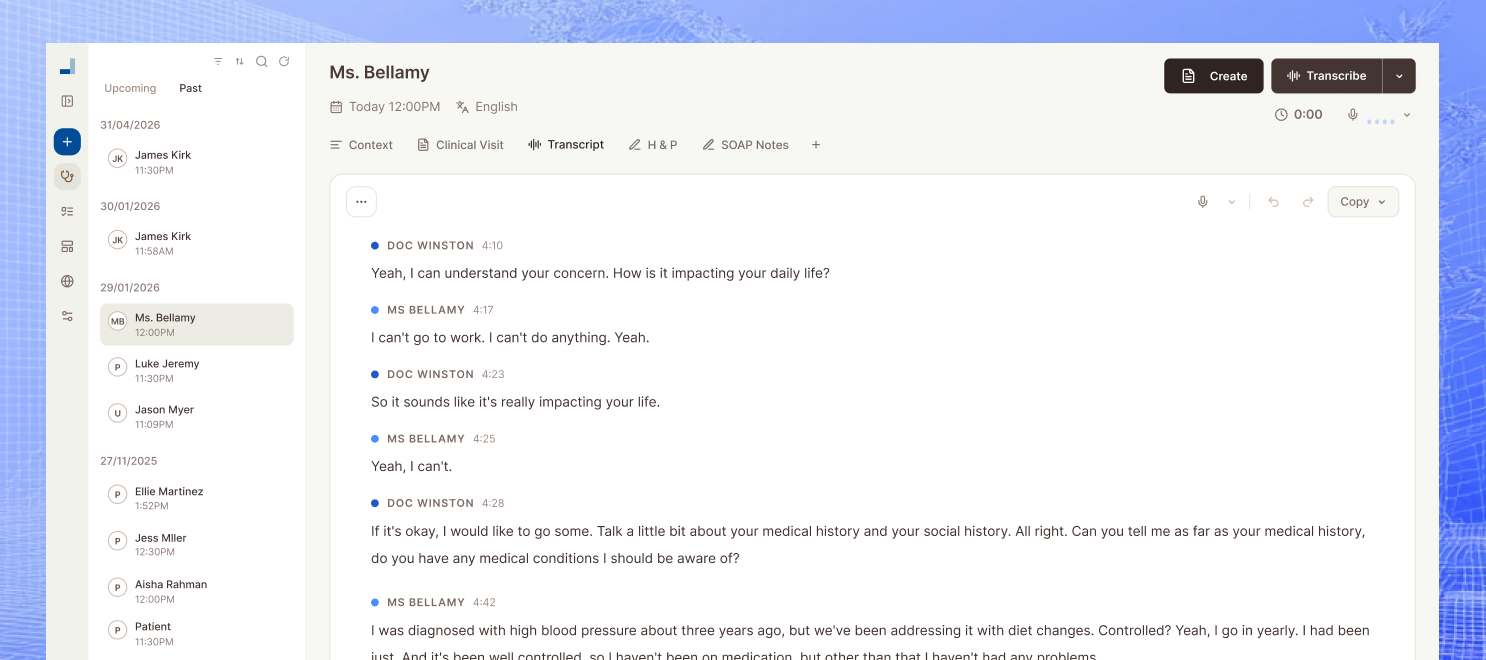
A transcript-to-note pipeline uses an AI medical scribe to act as a digital assistant that captures the raw data of an encounter. It is important to understand that these tools are assistive, not autonomous. While the technology handles the heavy lifting of transcription and organization, the clinician remains the final authority, responsible for reviewing and authenticating every entry to ensure medical accuracy.
- Eliminates the ‘pajama time’ spent on charting after clinic hours.
- Reduces cognitive load by allowing doctors to focus entirely on the patient.
- Captures specific clinical details that are often forgotten in manual typing.
- Standardizes note quality across different providers within a single clinic.
Note types you can generate beyond SOAP (H&P and more)
While the SOAP note is the industry standard, many clinical encounters require more specialized documentation. A comprehensive transcript-to-note pipeline allows for the seamless generation of History and Physical (H&P) reports, which are essential for hospital admissions and preoperative assessments. These notes require a level of structural depth that goes beyond a standard progress update, capturing full system reviews and detailed histories.
Furthermore, consult notes and referral letters are vital for the continuity of care between specialists and primary care providers. A well-structured pipeline can automatically transition the data from a patient encounter into a formal letter format, ensuring that the receiving physician has all the necessary context. This reduces the administrative friction of coordinating care and ensures your practice is always audit-ready.
Procedure notes and discharge summaries also benefit significantly from standardized AI processing. By using pre-defined structures, the pipeline ensures that mandatory fields—such as anesthesia used, blood loss, or follow-up instructions—are never omitted. This consistency is the backbone of high-quality healthcare and serves as a powerful defense in medico-legal scenarios.
- H&P and Progress Notes for comprehensive inpatient and outpatient tracking.
- Consultation and Referral letters to improve inter-provider communication.
- Procedure notes that capture specific technical details of an intervention.
- Discharge summaries that provide clear, actionable instructions for patients.
How to implement transcript-to-note pipeline step-by-step in a real clinic
To begin building your transcript-to-note pipeline, you should start small by selecting a single, high-volume visit type. This allows you to test the workflow without overwhelming your staff. Whether it is a standard check-up or a specific specialist follow-up, identifying a predictable encounter type helps you calibrate the AI’s output to your specific speaking style and clinical preferences.
Once you have selected your visit type, set up your templates by specialty. Modern systems allow you to define exactly how you want your data organized, ensuring that the transcript is parsed into the correct headings. During the encounter, whether in-person or via telehealth, simply activate the recording. You don’t need to change how you speak to the patient; the goal is to capture the natural dialogue of the clinical session.
After the encounter, the review and edit phase should take less than two minutes. The pipeline converts the raw transcript into your chosen format, and you simply scan for accuracy, making minor adjustments where necessary. Once the note is validated, you can then reuse those outputs to generate secondary documents like work excuses or referral letters, effectively turning one recording into multiple administrative assets.
- Start with one common visit type to master the workflow basics.
- Configure specialty-specific templates to ensure the output meets your standards.
- Review and finalize notes immediately to keep documentation current.
- Leverage the AI output to automatically populate forms and letters.
How to keep note quality high and reduce mistakes
Quality control is the most critical component of an automated pipeline. Typical failure points in digital documentation include missing medications, incorrect lab values, or ‘note bloat’—where excessive, irrelevant information obscures the primary clinical findings. To prevent this, clinicians must establish a lightweight review habit, scanning the ‘Assessment and Plan’ section first to ensure the core clinical logic is sound.
Standardization across the team also helps reduce mistakes. If every provider in the clinic uses the same template logic, the AI becomes more proficient at identifying the relevant data points. Encouraging a culture where notes are reviewed and closed within the same working day further ensures that any discrepancies are caught while the encounter is still fresh in the clinician’s mind.
- Focus your review on the ‘Assessment and Plan’ and ‘Medications’ sections.
- Use consistent templates to help the AI categorize data accurately.
- Avoid note bloat by setting specific length constraints for summaries.
- Establish a ‘same-day’ rule for note finalization to ensure accuracy.
Privacy, consent, and patient trust (plain English)
Informing patients about the use of a transcript-to-note pipeline is essential for building trust. While specific consent requirements vary by region, the goal is always transparency. Most patients are supportive of the technology when they realize it means their doctor will be looking at them instead of a computer screen. Keep your explanation simple and focused on the benefit to the patient’s care.
A simple script to use is: “I’m using an AI assistant today to record our conversation so I can focus on listening to you instead of typing. It helps me create more accurate medical records. Is that okay with you?” This approach frames the technology as a tool for better listening, which is something every patient appreciates. General security principles, such as choosing platforms with end-to-end encryption and strict data retention policies, should always be followed.
- Always follow local regulations regarding verbal or written patient consent.
- Frame the technology as a ‘listening tool’ rather than a ‘recording device.’
- Ensure your pipeline uses HIPAA-compliant or GDPR-compliant encryption.
- Maintain a clear policy on how long recordings are stored before deletion.
Rolling it out across a clinic without disruption
A successful rollout requires a phased approach, typically beginning with a two-week pilot program involving one or two ‘champion’ clinicians. During this period, track metrics such as time saved per note and the reduction in ‘after-hours’ work. These data points are essential for convincing skeptical staff members of the pipeline’s value. Training should focus on template alignment so that every user understands how to prompt the system for the best results.
- Select 1–2 clinicians for a 14-day pilot to iron out workflow kinks.
- Track time-savings and ‘pajama time’ reduction to measure success.
- Host a brief team training to align on template usage and voice commands.
- Gradually expand to other departments once the ROI is clearly demonstrated.
Mcoy AI is an AI medical scribe that records and transcribes patient encounters, then generates multiple clinical note types (H&P, progress notes, consult notes, follow-up notes, procedure notes, discharge summaries, referral letters, and more). With over 200 customizable templates and an integrated AI chat feature, clinicians can instantly create professional letters, forms, and complex documents from their talk-to-text data, significantly reducing the administrative burden on the entire practice.
Building a transcript-to-note pipeline is the most effective way to modernize your practice and protect your mental health. By moving the documentation process from the keyboard to a streamlined, automated system, you can return your focus to where it belongs: the patient. Start by piloting a transcript-to-note pipeline today and experience the difference that structured, AI-assisted charting can make for your clinic.
What a serious review table should cover
| Decision area | Common mistake | Better clinic-ready approach | Metric to watch |
|---|---|---|---|
| Workflow design | Treat build a transcript-to-note pipeline in your clinic guide as a one-off documentation task | Build a repeatable process with clear ownership and review points | Time to complete documentation |
| Team adoption | Assume every clinician will naturally use the same process | Train for consistency and define exception handling early | Active user adoption |
| Quality review | Only check notes when a problem is reported | Audit a sample of notes weekly and review edge cases | Edit rate per note |
| Operational follow-through | Leave admin actions outside the documentation workflow | Use the same encounter data for referrals, letters, and follow-up tasks | Completion rate for next-step tasks |
Related reading
If you are working through build a transcript-to-note pipeline in your clinic guide, it helps to read this alongside AI & Medicine: How to Simplify Clinical Notes for Busy Doctors, AI & Medicine: How Doctors Can Improve SOAP Notes, and AI & Medicine: How to Reduce Errors in Clinical Notes. Those guides cover adjacent workflow, implementation, and evaluation questions so the decision does not sit in isolation.
FAQ
How accurate are AI medical scribes in real clinics?
In most clinical settings, AI scribes are highly accurate, often capturing details that a human might miss during a busy day. They are particularly effective at documenting the chronological flow of a conversation and specific symptoms mentioned. However, because they can occasionally misinterpret medical jargon or background noise, clinician oversight is always necessary. Most users find the accuracy level far exceeds their own manual shorthand notes.
Do I still need to review every note?
Yes, reviewing every note is a fundamental requirement for both clinical safety and legal accountability. The AI acts as your draft assistant, but you are the medical professional who must verify the assessment and plan. A quick review usually takes less than 60 seconds once you are familiar with the output format. This final check ensures that all medications, dosages, and diagnoses are perfectly reflected before being synced to the EMR.
What note types can an AI scribe generate besides SOAP?
Beyond the traditional SOAP format, modern AI scribes can generate History and Physicals (H&P), detailed consultation reports, and procedure notes. They can also create discharge summaries, follow-up letters, and referral notes for other specialists. By using different templates, the same encounter data can be reformatted into whatever specific document the clinician needs for that particular patient journey.
Will this work for telehealth and in-person consults?
Yes, a transcript-to-note pipeline is highly versatile and works across various consultation environments. For in-person visits, a smartphone or tablet can capture the audio, while for telehealth, the system can integrate directly with your video conferencing software. The AI is designed to filter out the different speakers and focus on the clinical exchange regardless of the physical or digital setting.
How do I explain recording/transcription to patients?
The best way to explain it is to focus on the benefit to the patient: better eye contact and more focused care. You can say, “I’m using an AI assistant to help me take notes so I can spend more time talking with you and less time typing.” Most patients are very comfortable with this, especially when they see their doctor is actually looking at them rather than a screen during the visit.
How do clinics prevent note bloat?
Note bloat is prevented by using structured templates that tell the AI exactly what information is relevant. By setting constraints on specific sections, you can ensure the AI focuses on concise summaries rather than transcribing every single word spoken. Clinicians can also adjust their templates to prioritize high-yield clinical data, keeping the final record focused and professional.
How long does template setup take?
Initial template setup is surprisingly fast, usually taking only a few minutes. Most clinicians start with pre-built templates for their specialty and then make small tweaks as they go. Over the first few days of use, you can refine these templates based on the specific way you practice, eventually reaching a point where the output requires almost no formatting changes.
What’s the safest way to start if I’m skeptical?
The safest way to start is with a ‘shadow’ pilot. Record a few encounters that you were going to type anyway, and compare the AI’s output to your manual note. This allows you to build confidence in the system’s accuracy and efficiency without the pressure of relying on it immediately. Once you see the time saved and the quality of the draft, it becomes much easier to integrate into your live workflow.