AI & Medicine: Build a Simple Copy-Insert Workflow: Full Guide for Clinics
Learn how to build a simple copy-insert workflow to streamline your medical charting. Reduce burnout and save hours every week with these proven steps.
What a medical scribe solves in modern practice
The modern healthcare landscape is defined by an invisible weight that every clinician carries: the burden of documentation. For many, the end of the patient day doesn’t mean going home; it means ‘pajama time,’ those late-night hours spent catching up on a backlog of notes. This cognitive load leads to rushed documentation, missed clinical nuances, and, ultimately, practitioner burnout. When professional satisfaction is tied to patient interaction, spending half the day staring at a screen is a recipe for exhaustion.
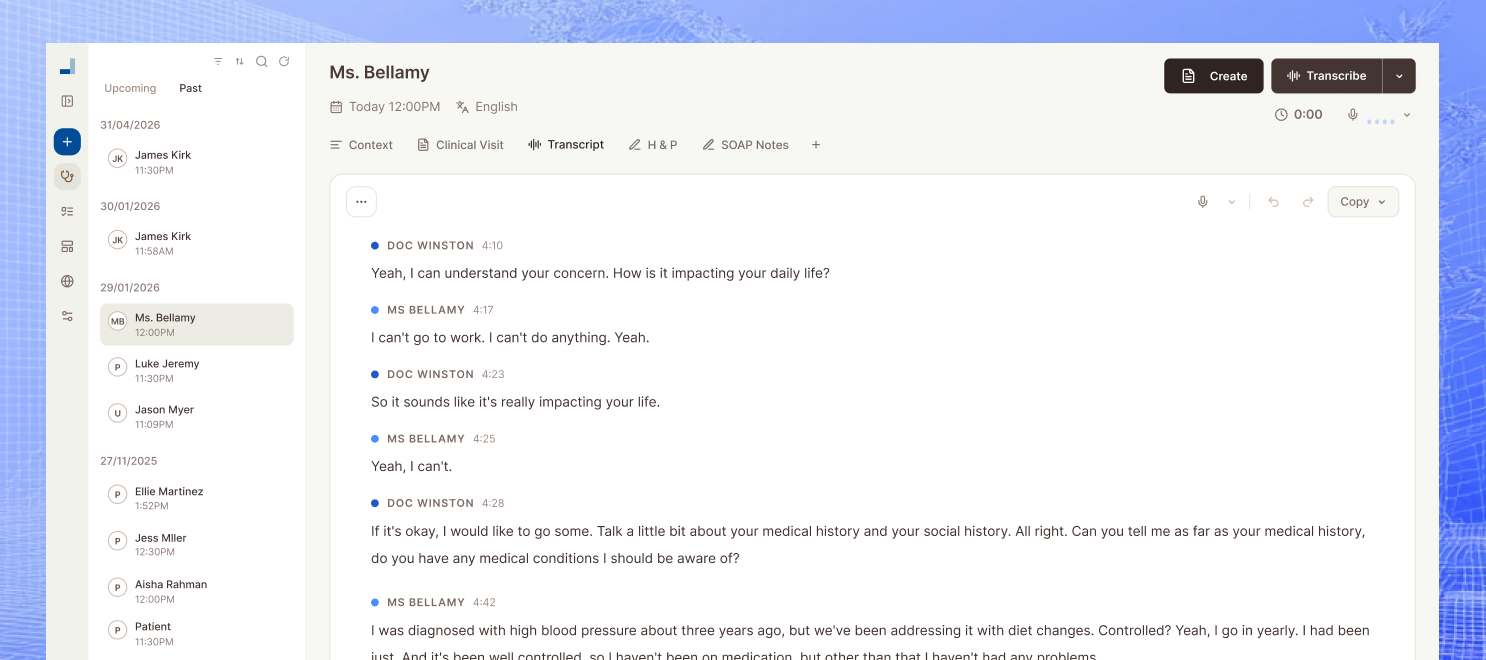
An AI medical scribe acts as a digital assistant that bridges the gap between the conversation and the electronic health record (EHR). By capturing the audio of an encounter, it allows the doctor to maintain eye contact and genuine presence. It is important to understand that these tools are assistive, not autonomous. The clinician remains the final authority, reviewing and refining the output to ensure medical accuracy while the AI handles the heavy lifting of structure and formatting.
- Significantly reduces after-hours charting and administrative burnout.
- Captures granular patient details often lost in delayed manual entry.
- Allows clinicians to focus on patient care rather than typing.
- Requires a final human review to maintain clinical safety and standards.
Note types you can generate beyond SOAP (H&P and more)
While the SOAP note is a staple of medical training, real-world practice requires a much broader vocabulary of documentation. Different encounters demand different structures to ensure continuity of care and audit readiness. For example, a new patient requires a comprehensive History and Physical (H&P), whereas a recurring patient might only need a concise follow-up note or a focused progress note. Using a rigid format for every interaction often leads to redundant or insufficient data entry.
Specialists particularly benefit from varied note types, such as detailed consult notes for referring physicians or specific procedure notes that satisfy billing requirements. Discharge summaries and referral letters are also critical for the healthcare ecosystem, ensuring that the next provider in the chain of care has exactly what they need. A flexible workflow allows you to toggle between these formats based on the clinical context, rather than forcing every narrative into a Subjective-Objective box.
- H&P and progress notes capture the initial and ongoing clinical story.
- Consultation and referral letters improve inter-provider communication.
- Procedure notes and discharge summaries ensure billing and legal compliance.
- Structured templates prevent ‘note bloat’ and improve readability.
How to implement a simple copy-insert workflow step-by-step in a real clinic
Implementing a simple copy-insert workflow begins with a narrow focus to avoid overwhelming your staff. Start by selecting one common visit type, such as routine follow-ups or wellness exams, to serve as your pilot case. This allows you to calibrate your templates without the pressure of complex multi-system cases. Once you have identified the target encounter, select a specialty-specific template that aligns with your preferred style of communication.
During the encounter, whether it is in-person or via telehealth, simply activate your transcription tool and conduct the visit naturally. You don’t need to change how you talk to patients; the AI is designed to filter out the small talk and focus on the clinical facts. After the visit is over, the scribe generates the draft in seconds. You should then perform a brief ‘quality check’ scan, making any necessary edits to medications or specific values before the final step.
The ‘Copy-Insert’ part of the workflow is where the magic happens. Instead of manually typing into your EHR, you simply copy the finalized text from your scribe interface and paste it into the appropriate fields of your patient record. This bypasses the need for complex software integrations that often break or require expensive IT support. You can also reuse these same outputs to generate quick referral letters or patient instruction forms with minimal extra effort.
- Start with one consistent visit type to build team confidence.
- Use specialty templates to ensure the output matches your clinical needs.
- Review the AI-generated draft immediately after the encounter while the details are fresh.
- Seamlessly move data into any EHR using a simple copy-and-paste method.
How to keep note quality high and reduce mistakes
High-quality documentation is not just about quantity; it’s about precision. A common failure point in automated systems is ‘note bloat,’ where the AI includes every word spoken, including irrelevant tangents. To combat this, clinicians should adopt a lightweight review habit. Spending sixty seconds checking the ‘Assessment and Plan’ section ensures that the most critical instructions are captured accurately and that the problem list is up to date.
Standardization across the clinic also helps maintain quality. When every practitioner agrees on the necessary elements for a specific note type, the AI can be tuned to look for those specific data points. This creates a cohesive record that is easy for any colleague to read and understand. Regular audits of a random sample of notes can further ensure that the workflow is meeting both clinical and medico-legal standards.
- Focus on the Assessment and Plan during your 60-second review.
- Curb note bloat by selecting templates that prioritize brevity and relevance.
- Establish clinic-wide standards for what a ‘complete’ note looks like.
- Periodically audit AI-generated notes to ensure ongoing accuracy.
Privacy, consent, and patient trust (plain English)
Maintaining patient trust is the foundation of any clinical workflow involving recording. While privacy laws vary by region, the principle remains the same: transparency is key. Most patients are supportive of technologies that allow their doctor to pay more attention to them and less to a computer screen. Following your local medical board’s guidelines on recording and data retention is essential to staying compliant.
To introduce this to a patient, use a simple script: ‘To help me stay fully focused on you today, I’m using a clinical tool that listens to our conversation and helps me write my medical notes. It’s secure and HIPAA-compliant. Is that okay with you?’ Most patients will appreciate the heads-up and the fact that you are prioritizing their care. Always ensure that the data captured is stored according to high security standards, with encryption and proper access controls.
- Always obtain verbal or written consent based on your local regulations.
- Explain the benefit to the patient (better focus, more accurate records).
- Ensure the scribe tool uses industry-standard encryption for data security.
- Document the patient’s consent within the chart to protect the practice.
Rolling it out across a clinic without disruption
A successful rollout is a marathon, not a sprint. Start with a two-week pilot involving one or two ‘tech-forward’ clinicians. During this period, track metrics such as time spent on documentation after hours and the time it takes to close a chart. These data points will be invaluable when demonstrating the value of the new workflow to more skeptical staff members or clinic owners.
Training should be hands-on and focused on the actual templates the clinicians will use. Avoid generic demonstrations; instead, show how a specific consult note is generated and moved into your specific EHR. By aligning the AI’s output with the existing habits of the clinic, you reduce resistance and ensure that the transition feels like an upgrade rather than a chore.
- Run a two-week pilot to iron out workflow kinks before a full launch.
- Track time-savings and note-completion rates to prove ROI.
- Provide template-specific training for different specialties in the clinic.
Mcoy AI is an AI medical scribe that records and transcribes patient encounters, then generates multiple clinical note types, including H&P, progress notes, consult notes, follow-up notes, procedure notes, discharge summaries, referral letters, and more. With over 200 customizable templates and an AI chat feature, clinicians can easily create letters, forms, and complex documents tailored to their specific needs, significantly reducing the administrative burden of modern practice.
Conclusion
Building a simple copy-insert workflow is the most practical way for modern clinics to reclaim their time without investing in complex software overhauls. By starting small, utilizing diverse note types beyond SOAP, and maintaining a human-in-the-loop review process, you can eliminate the ‘pajama time’ that contributes to burnout. The goal is to let technology handle the structure so you can focus on the patient. Ready to transform your clinic? Start your pilot today and see how easy it is to make documentation work for you, not against you.
What a serious review table should cover
| Decision area | Common mistake | Better clinic-ready approach | Metric to watch |
|---|---|---|---|
| Workflow design | Treat build a simple copy-insert workflow: full guide for clinics as a one-off documentation task | Build a repeatable process with clear ownership and review points | Time to complete documentation |
| Team adoption | Assume every clinician will naturally use the same process | Train for consistency and define exception handling early | Active user adoption |
| Quality review | Only check notes when a problem is reported | Audit a sample of notes weekly and review edge cases | Edit rate per note |
| Operational follow-through | Leave admin actions outside the documentation workflow | Use the same encounter data for referrals, letters, and follow-up tasks | Completion rate for next-step tasks |
Related reading
If you are working through build a simple copy-insert workflow: full guide for clinics, it helps to read this alongside AI & Medicine: How to Simplify Clinical Notes for Busy Doctors, AI & Medicine: How Doctors Can Improve SOAP Notes, and AI & Medicine: How to Chat With Your Encounters: A Clinical Guide. Those guides cover adjacent workflow, implementation, and evaluation questions so the decision does not sit in isolation.
FAQ
How accurate are AI medical scribes in real clinics?
AI medical scribes are remarkably accurate, often capturing nuances that even a human scribe might miss. However, they are trained on language patterns and can occasionally misinterpret complex medical jargon or specific values if the audio is poor. This is why a quick clinician review is always the final step in the process to ensure 100% medical accuracy before the note is finalized.
Do I still need to review every note?
Yes, reviewing every note is a mandatory clinical and legal responsibility. While the AI does the heavy lifting of drafting the narrative and organizing the data, the clinician must verify that the facts, assessments, and plans are correct. Most practitioners find this review takes less than a minute, which is still a massive time saving compared to manual typing.
What note types can an AI scribe generate besides SOAP?
Beyond the standard SOAP note, advanced AI scribes can generate History and Physicals (H&P), detailed procedure notes, consult letters, and discharge summaries. They can also create referral letters and follow-up notes tailored to specific specialties. This flexibility ensures that the documentation matches the specific clinical need of the encounter.
Will this work for telehealth and in-person consults?
Absolutely. For in-person visits, the scribe typically runs on a mobile device or tablet in the room. For telehealth, the scribe can capture the audio from your computer or the teleconferencing platform. The workflow remains virtually identical: record, review the generated draft, and copy-insert it into your EHR.
How do I explain recording/transcription to patients?
The best approach is complete transparency. Tell the patient that you are using a secure tool to help capture their story accurately so you can focus on them rather than your screen. Most patients are very receptive when they realize the technology allows for a more personal and attentive consultation.
How do clinics prevent note bloat?
Note bloat is prevented by using concise templates that instruct the AI to prioritize relevant clinical information over a verbatim transcript. Clinicians can further reduce bloat during their brief review by deleting any non-essential context that the AI may have included from the social conversation of the visit.
How long does template setup take?
Setting up basic templates usually takes just a few minutes, as most tools come with pre-built options for common specialties. Customizing a template to match your specific ‘voice’ or clinic requirements might take 10 to 15 minutes, but this is a one-time investment that saves hours in the long run.
What’s the safest way to start if I’m skeptical?
The safest way to start is with a ‘shadow’ pilot. Record a few encounters that you would normally document manually, then compare your manual note to the AI-generated one. This allows you to verify the accuracy and quality of the AI without any initial pressure, helping you build trust in the system before fully switching over.