AI & Medicine: How to Chat With Your Encounters: A Clinical Guide
Learn how to chat with your encounters to extract clinical insights, generate letters, and automate documentation with this complete medical guide.
For many clinicians, the workday doesn’t end when the last patient leaves. The burden of after-hours charting has become a primary driver of burnout, often leading to rushed notes that lack critical nuance. When you are managing a high volume of patients, especially in a university clinic or busy private practice, remembering the specific details of a complex consult can be mentally draining. This cognitive load often results in medico-legal anxiety, as clinicians worry about missing a vital piece of information in their documentation.
This guide will teach you a modern workflow for managing patient data. You will learn how to move beyond basic SOAP notes and use advanced note formats to improve care continuity. We will explore how to chat with your encounters to find key details, ensure high-quality control, and maintain patient privacy while rolling out an automated documentation plan. Whether you are a GP, specialist, or managing telehealth services, these strategies are designed to reclaim your time without sacrificing clinical accuracy.
What a medical scribe solves in modern practice
The real cost of documentation is measured in more than just hours; it is measured in cognitive load and decreased patient engagement. When a doctor is tethered to a keyboard during a visit, the therapeutic alliance suffers. Manual charting often leads to delayed notes, which can result in the loss of subtle diagnostic details that are essential for long-term patient management. This overhead is a significant financial and emotional drain on private practices.
An AI medical scribe acts as an assistive layer, capturing the conversation so the clinician can focus entirely on the patient. It is important to remember that while the technology captures and organizes data, the clinician remains the final authority and is responsible for the accuracy of every entry. It removes the mechanical task of typing, allowing the practitioner to review and refine rather than create from scratch.
- Reduces administrative burnout and after-hours documentation time.
- Enhances patient-provider eye contact and communication quality.
- Captures granular details that might be forgotten during manual entry.
- Maintains the clinician as the ultimate human-in-the-loop for accuracy.
Note types you can generate beyond SOAP (H&P and more)
While the SOAP format is a standard, it isn’t always the most efficient way to communicate specific clinical events. Comprehensive documentation requires various formats such as History and Physical (H&P), detailed procedure notes, and referral letters. Each serves a unique purpose in the ecosystem of patient care. For instance, a consult note needs to concisely convey a specialist’s findings back to a primary care provider, whereas a discharge summary must be clear enough for the patient and the next care team to follow easily.
Structure matters significantly for audit readiness and handover quality. Using the right template for the right encounter ensures that you aren’t just recording data, but organizing it in a way that is actionable. Follow-up notes should focus on changes since the last visit, while a procedure note requires a meticulous account of the steps taken and the patient’s immediate response. Standardizing these formats across a clinic improves the overall professional standard of the medical record.
- H&P and progress notes provide a detailed longitudinal record.
- Consult notes and referral letters streamline professional communication.
- Procedure notes and discharge summaries ensure safety during transitions.
- Standardized templates prepare the practice for audits and legal review.
How to implement how to chat with your encounters to find key details step-by-step in a real clinic
To begin implementing the process of how to chat with your encounters to find key details, start by selecting one specific visit type to pilot. Rather than trying to automate every encounter at once, focus on something repetitive like follow-up appointments or routine physicals. This allows the clinical team to get comfortable with the capture process without the pressure of a complex multi-system complaint. Once the team feels confident, you can expand to more detailed speciality visits.
The next step is to set up your templates. Every specialty has different priorities; a cardiologist’s note looks very different from a psychiatrist’s. By pre-configuring these templates, the system knows exactly which data points to prioritize when it processes the conversation. During the encounter, whether it is in-person or via a telehealth platform, ensure the recording device is placed centrally so both the clinician and patient are heard clearly.
After the encounter, the review and edit phase should be completed as soon as possible. Because the system has already organized the data, the clinician only needs to verify the facts and add any specific medical impressions. Finally, use the power of the captured data to generate secondary documents. The information from the encounter can be instantly repurposed into referral letters or work clearance forms, eliminating the need to re-type the same information multiple times.
- Pilot the workflow with a single, common encounter type first.
- Customize templates to match the specific needs of your specialty.
- Review and finalize notes immediately to maintain high accuracy.
- Repurpose encounter data into letters and forms to save administrative time.
How to keep note quality high and reduce mistakes
Note quality is the cornerstone of patient safety. Typical failure points in automated systems include the omission of specific medication dosages or the inclusion of irrelevant information, often called ‘note bloat.’ To prevent this, clinicians should adopt a lightweight review habit. Instead of reading every word like a proofreader, scan for key clinical markers: medications, allergies, and the final assessment and plan.
Establishing team standards is also vital for consistency. If everyone in the clinic uses the same logic for what constitutes a ‘high-quality’ note, it becomes much easier for colleagues to cover for one another. Regular brief audits of a random selection of notes can help identify if the templates need adjustment or if certain clinicians need more training on how to prompt the system for better results.
- Scan finalized notes specifically for medication and dosage accuracy.
- Avoid note bloat by using concise, specialty-specific templates.
- Implement peer reviews to maintain consistent documentation standards.
- Refine the capture process based on recurring errors or omissions.
Privacy, consent, and patient trust (plain English)
Patient privacy is non-negotiable, and consent requirements can vary significantly by region. It is essential to follow your local healthcare regulations and practice policies. Generally, patients are receptive to technology when they understand it improves the quality of care they receive. Being transparent about how their data is used and stored builds a foundation of trust that is difficult to break.
When introducing the concept to a patient, use a simple script: ‘To help me focus entirely on our conversation today and ensure our records are perfectly accurate, I use a secure assistant that records and transcribes our visit. Is that okay with you?’ Most patients appreciate the extra eye contact and the fact that their doctor isn’t staring at a screen the whole time. Always ensure that the data retention principles of the tool you use align with your clinic’s security protocols.
- Check local regulations to ensure your consent process is compliant.
- Use a transparent, simple explanation to introduce the tool to patients.
- Focus on the clinical benefit of the patient having your full attention.
- Ensure data storage and retention meet high-level security standards.
Rolling it out across a clinic without disruption
A successful rollout requires a structured approach. Start with a two-week pilot involving one or two ‘tech-forward’ clinicians. This small-group test allows you to identify any workflow bottlenecks—like poor Wi-Fi in certain exam rooms or template gaps—before the entire clinic adopts the system. It also creates internal champions who can help their colleagues during the full launch.
During the rollout, track specific metrics to measure success. Look at the reduction in after-hours charting time and the speed of note completion. If clinicians are finishing their notes by the end of the day rather than at 9 PM, the pilot is working. Training should be focused on how to interact with the encounter data effectively, ensuring that every staff member understands how to extract the information they need for their specific roles.
- Run a two-week pilot with a small group to iron out technical issues.
- Track time-saving metrics to prove the value to the whole team.
- Align templates across the practice for clinical consistency.
- Provide brief, hands-on training sessions rather than long manuals.
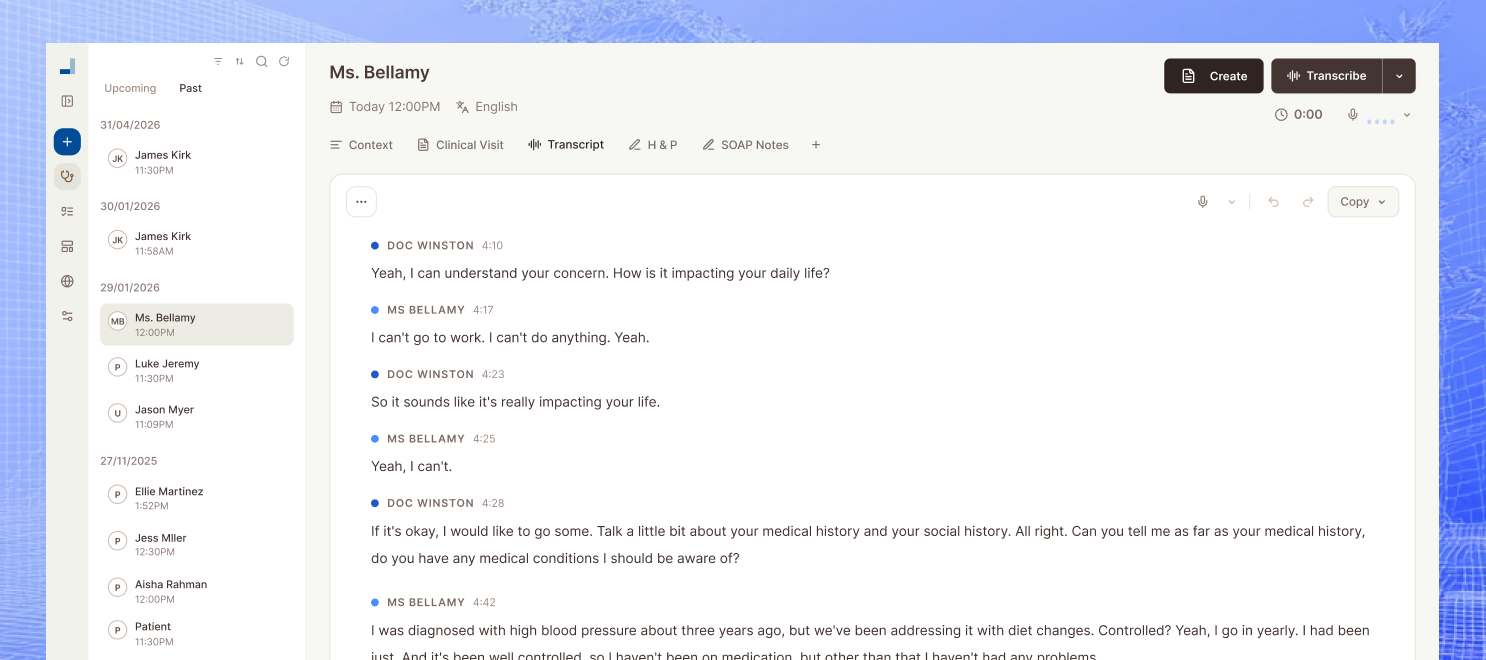
Mcoy AI is an AI medical scribe that records and transcribes patient encounters, then generates multiple clinical note types (H&P, progress notes, consult notes, follow-up notes, procedure notes, discharge summaries, referral letters, and more). With over 200+ customizable templates and a built-in AI chat, it allows clinicians to create letters, forms, and documents effortlessly. It is designed to integrate into the natural flow of a consultation, providing a helpful assistant that manages the administrative burden while the doctor focuses on the patient.
The era of manual, exhaustive charting is ending. By adopting a structured workflow that includes modern capture tools, you can significantly reduce burnout and improve the quality of your medical records. The most effective way to start is to pick one encounter type and see how to chat with your encounters to find key details for yourself. Take the first step toward a more efficient practice today.
SEO description: Learn how to chat with your encounters to find key details and automate clinical notes with this guide to using an AI medical scribe efficiently.
What a serious review table should cover
| Decision area | Common mistake | Better clinic-ready approach | Metric to watch |
|---|---|---|---|
| Workflow design | Treat how to chat with your encounters: a clinical guide as a one-off documentation task | Build a repeatable process with clear ownership and review points | Time to complete documentation |
| Team adoption | Assume every clinician will naturally use the same process | Train for consistency and define exception handling early | Active user adoption |
| Quality review | Only check notes when a problem is reported | Audit a sample of notes weekly and review edge cases | Edit rate per note |
| Operational follow-through | Leave admin actions outside the documentation workflow | Use the same encounter data for referrals, letters, and follow-up tasks | Completion rate for next-step tasks |
Related reading
If you are working through how to chat with your encounters: a clinical guide, it helps to read this alongside AI & Medicine: How to Simplify Clinical Notes for Busy Doctors, AI & Medicine: How Doctors Can Improve SOAP Notes, and Specialty Guides: Build a Daily AI Documentation Workflow [Full Guide]. Those guides cover adjacent workflow, implementation, and evaluation questions so the decision does not sit in isolation.
FAQ
How accurate are AI medical scribes in real clinics?
AI medical scribes are highly accurate at capturing the nuances of clinical dialogue, often picking up details that a busy clinician might overlook. However, the accuracy can be influenced by background noise or the clarity of the speakers. Because they are designed as assistants, they provide a strong foundation that the clinician then verifies. Most users find that the draft produced requires only minimal adjustment to be perfect.
Do I still need to review every note?
Yes, the clinician is legally and professionally responsible for the clinical record. While the AI does the heavy lifting of transcribing and formatting, it is essential to review the note for clinical accuracy before signing off. This review process takes a fraction of the time compared to writing the note from scratch. Most practitioners find a quick 30-second scan is sufficient for standard visits.
What note types can an AI scribe generate besides SOAP?
Modern AI scribes are capable of generating a wide range of documents including History and Physicals (H&P), procedure notes, consult letters, and discharge summaries. They can also create referral letters and follow-up instructions by pulling data directly from the encounter. This flexibility ensures that the documentation fits the specific clinical context rather than forcing everything into a SOAP format. The use of specialized templates makes this process seamless.
Will this work for telehealth and in-person consults?
Yes, these tools are designed to work across various practice environments. For in-person visits, a smartphone or tablet can capture the audio. For telehealth, the system can often integrate directly with the video platform or capture the audio from the computer’s output. The core technology remains the same, transforming the spoken word into structured medical data regardless of the medium.
How do I explain recording/transcription to patients?
The best approach is to be brief and emphasize the benefit to the patient. You might say that the tool allows you to listen more closely to them without being distracted by your computer. Most patients are very supportive when they realize it means their doctor is fully present during the visit. Always offer them the option to opt out if they feel uncomfortable.
How do clinics prevent note bloat?
Clinics prevent note bloat by using concise, specialty-specific templates that only prompt the AI to extract relevant information. By setting clear parameters for what should be in the ‘Assessment’ or ‘Plan,’ for example, you can avoid long, rambling notes. Regular template reviews help ensure that the output remains sharp and focused on what is medically necessary. Training clinicians to speak clearly about their findings also helps.
How long does template setup take?
Initial template setup is usually very fast, often taking only a few minutes per template. Most systems come with pre-built libraries for common specialties that you can use immediately or tweak to your liking. As you use the system, you may find small adjustments are needed to perfect the style, but you can be up and running within a single afternoon. The long-term time savings far outweigh this small initial investment.
What’s the safest way to start if I’m skeptical?
The safest way to start is with a ‘shadow’ pilot. Record a few encounters that you were going to document manually anyway, and compare the AI-generated note to your own. This allows you to verify the accuracy and see the time-saving potential without any risk to your current workflow. Once you see the quality of the output, you can gradually move toward using it as your primary documentation method.