Practice Operations: How to Create Shared Templates for Group Practices
Learn how to build shared clinical templates for group practices to save time and ensure documentation consistency across your entire medical team.
Introduction
For many clinicians in group practices and university clinics, the end of the patient day doesn’t mark the end of work. Instead, it signals the beginning of ‘pajama time’—hours spent hunched over a laptop completing after-hours charting. This documentation burden leads to clinician burnout, rushed notes that lack detail, and persistent medico-legal anxiety. When multiple providers are involved, the problem scales: inconsistent note formats make it difficult for partners to provide seamless follow-up care.
This guide provides a comprehensive roadmap for implementing shared templates for group practices. We will explore how to transition from disorganized SOAP notes to a structured workflow involving H&Ps, consult notes, and discharge summaries. Whether you are a GP, a specialist, or managing a high-volume telehealth service, mastering these templates will help you regain control over your clinical documentation while ensuring the highest quality of patient care and privacy compliance.
What a medical scribe solves in modern practice
The real cost of medical documentation isn’t just the minutes spent typing; it is the cognitive load and the loss of face-to-face connection with the patient. When a clinician is focused on a screen to ensure every detail is captured, the therapeutic alliance suffers. Furthermore, delayed notes often result in forgotten nuances, which can compromise patient safety and audit readiness in a busy group environment.
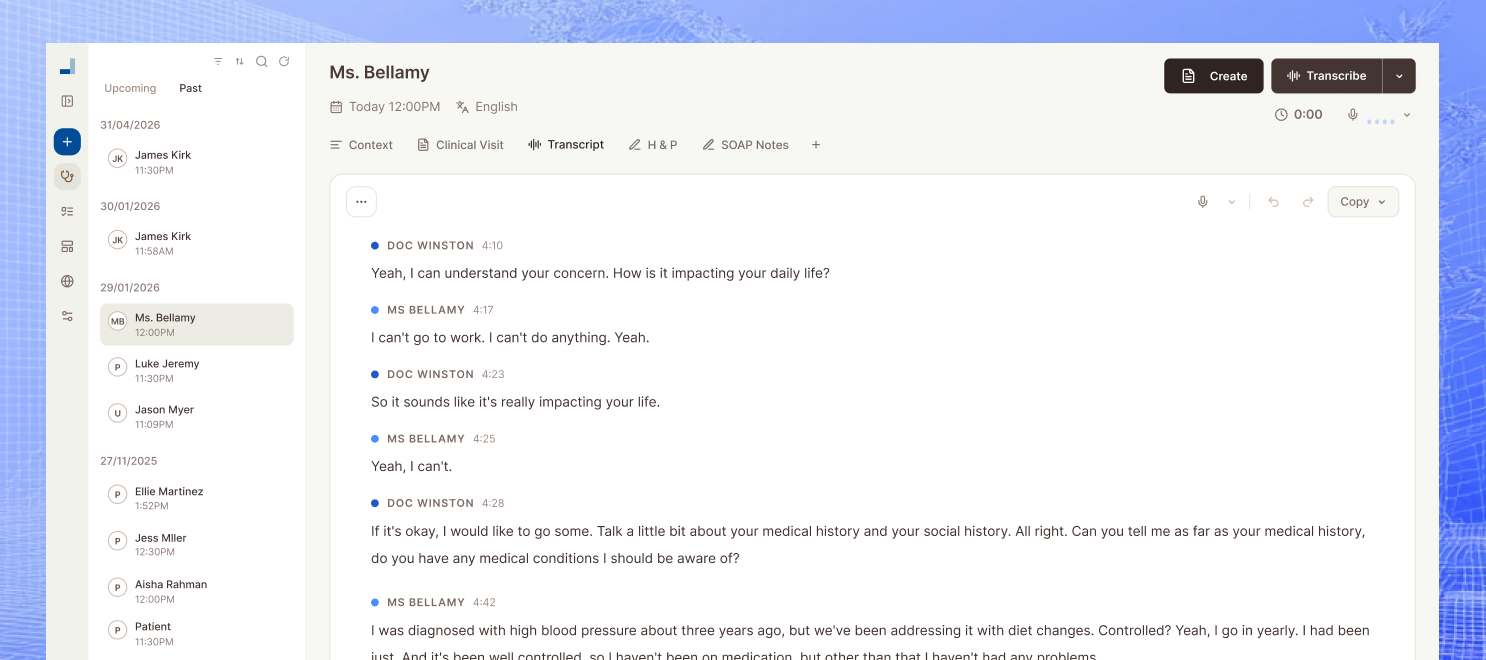
An AI medical scribe serves as an assistive partner in the exam room, capturing the nuances of the conversation so the doctor can focus on the human in front of them. It is important to note that these tools are not autonomous; the clinician remains the final authority and must review and sign off on every entry. By handling the heavy lifting of transcription and initial drafting, the scribe allows for more accurate, real-time documentation that is ready for review immediately after the encounter.
- Reduces cognitive load by allowing clinicians to focus on the patient during the exam.
- Eliminates after-hours charting by generating drafts in real-time.
- Improves note accuracy by capturing details that might be forgotten hours later.
- Acts as a supportive assistant rather than a replacement for clinical judgment.
Note types you can generate beyond SOAP (H&P and more)
While the SOAP note is a staple of medical training, group practices often require more specialized documentation to ensure continuity of care. Using shared templates allows a team to standardize complex records such as History and Physical (H&P) reports, consult notes for specialists, and detailed procedure notes. This level of standardization ensures that any provider in the practice can pick up a file and immediately understand the patient’s trajectory.
Beyond daily progress notes, sophisticated templates can handle discharge summaries and referral letters with ease. When every member of a group practice uses the same structure for a follow-up note or a referral, it creates a professional and reliable image for the clinic. This uniformity is vital for audit readiness and ensures that critical information—like medication changes or follow-up instructions—is never buried in a wall of unformatted text.
- H&P and Consult Notes: Provide deep context for new patients or specialist evaluations.
- Procedure and Progress Notes: Track interventions and daily adjustments in care.
- Referral Letters and Discharge Summaries: Facilitate professional handovers and care transitions.
- Audit Readiness: Standardized formats make internal and external reviews much smoother.
How to implement shared templates for group practices step-by-step
Starting a new documentation workflow can feel overwhelming, so the first step is to select one specific visit type to pilot within the group. For example, your practice might decide to start with all new patient physicals or standard follow-ups. By focusing on a single high-frequency encounter, the team can iron out the kinks in the template structure without disrupting the entire clinic schedule.
Once the visit type is selected, the lead clinicians should collaborate to set up templates by specialty. In a university clinic, this might involve inputs from various departments to ensure the shared templates for group practices meet everyone’s needs. These templates act as the framework that the AI will follow, ensuring that specific data points—like social determinants of health or specific orthopedic tests—are always prompted and captured.
During the encounter, whether in-person or via telehealth, the clinician simply captures the conversation. There is no need to change how you talk to the patient; the technology should adapt to your natural style. After the visit is over, the primary task is to review and edit the generated draft. This review process usually takes less than a minute if the template is well-constructed and the capture was clear.
Finally, the value of the shared template extends beyond the medical record. The data captured can be instantly reused to generate referral letters or patient education forms. This ‘write once, use many’ approach significantly cuts down on administrative tasks and ensures that the information sent to outside specialists is perfectly aligned with the clinical note.
- Pilot with a single visit type to minimize initial disruption.
- Collaborate on specialty-specific templates to ensure team-wide buy-in.
- Focus on review and editing rather than manual data entry.
- Repurpose note data for letters and forms to save additional admin time.
How to keep note quality high and reduce mistakes
Even with advanced technology, note quality depends on oversight. Common failure points in clinic documentation include missing medication dosages, incorrect laboratory values, or the dreaded ‘note bloat’ where irrelevant information is carried forward. Shared templates help mitigate this by providing a clean, forced structure that prevents irrelevant data from cluttering the record.
Establishing a lightweight review habit is essential for every provider in the group. Instead of waiting until the end of the day, clinicians should aim to sign off on notes between patients. Teams should also set periodic standards for documentation quality, meeting briefly to discuss if templates need updates to reflect changes in local regulations or new clinical guidelines.
- Implement a ‘review as you go’ habit to ensure immediate accuracy.
- Periodically update templates to remove outdated sections and prevent bloat.
- Verify critical data points like medications and dosages manually.
- Establish practice-wide standards for what constitutes a high-quality note.
Privacy, consent, and patient trust (plain English)
Privacy is the cornerstone of the patient-doctor relationship. When implementing new documentation tools, it is vital to follow local regulations regarding consent, which can vary significantly by region. Clinics should always consult their legal counsel or professional body, but the general principle is transparency. Patients are generally very supportive of tools that allow their doctor to look at them instead of a computer screen.
A simple script can help: “To make sure I’m giving you my full attention and capturing everything accurately, I’m using an AI assistant to help me with my notes today. It records our conversation and turns it into a medical record, and then I review it for accuracy. Is that okay with you?” Most patients appreciate the honesty and the focus on their care.
- Always obtain verbal or written consent based on your local requirements.
- Explain the benefits to the patient: better eye contact and more accurate records.
- Maintain clear internal policies on how long recordings are kept and how they are deleted.
- Ensure all tools used meet high standards for data encryption and security.
Rolling it out across a clinic without disruption
A successful rollout requires a structured two-week pilot plan. Phase one involves training a few ‘super-users’ who are comfortable with technology. These individuals can then mentor their colleagues, answering practical questions and troubleshooting template issues in real-time. This peer-to-peer training is often more effective than formal seminars.
During the rollout, track specific metrics such as the reduction in after-hours charting time and the speed of note completion. If clinicians find they are leaving at 5:00 PM instead of 7:00 PM, the adoption rate will skyrocket. Regular check-ins during the first month allow the practice to align templates across different users, ensuring the shared library remains high-quality and relevant.
- Use a pilot group of tech-savvy clinicians to lead the implementation.
- Measure time saved and note completeness to demonstrate ROI to the team.
- Schedule brief weekly feedback loops to refine the template library.
- Standardize training so every new hire understands the practice’s documentation style.
Mcoy AI is an AI medical scribe that records and transcribes patient encounters, then generates multiple clinical note types (H&P, progress notes, consult notes, follow-up notes, procedure notes, discharge summaries, referral letters, and more). It features 200+ customizable templates and an AI chat to create letters, forms, and documents, allowing clinicians to focus more on patient care and less on administration.
Conclusion
In conclusion, moving toward shared templates for group practices is the most effective way to eliminate the documentation bottleneck. By standardizing workflows, ensuring high-quality outputs, and maintaining a focus on patient privacy, clinics can drastically reduce burnout and improve the quality of care. The transition from manual charting to an AI-assisted environment is not just a technological upgrade; it’s a commitment to a more sustainable and focused way of practicing medicine. Start your pilot today and see how much time your team can save with efficient shared templates for group practices.
What a serious review table should cover
| Decision area | Common mistake | Better clinic-ready approach | Metric to watch |
|---|---|---|---|
| Workflow design | Treat how to create shared templates for group practices as a one-off documentation task | Build a repeatable process with clear ownership and review points | Time to complete documentation |
| Team adoption | Assume every clinician will naturally use the same process | Train for consistency and define exception handling early | Active user adoption |
| Quality review | Only check notes when a problem is reported | Audit a sample of notes weekly and review edge cases | Edit rate per note |
| Operational follow-through | Leave admin actions outside the documentation workflow | Use the same encounter data for referrals, letters, and follow-up tasks | Completion rate for next-step tasks |
Related reading
If you are working through how to create shared templates for group practices, it helps to read this alongside Practice Operations: How Clinics Can Streamline Daily Operations, Practice Operations: How Clinics Can Improve Workflow Without Changing Their EHR, and AI & Medicine: Build a Chronic Care Template Pack: Tips & Free Resources. Those guides cover adjacent workflow, implementation, and evaluation questions so the decision does not sit in isolation.
FAQ
How accurate are AI medical scribes in real clinics?
AI medical scribes are remarkably accurate at capturing the clinically relevant details of a conversation. They are designed to filter out ‘small talk’ and focus on symptoms, history, and treatment plans. However, accuracy also depends on the clarity of the audio and the speaker’s articulation. Because nuances vary, the clinician must always review the output to ensure the final note is 100% correct according to their medical judgment.
Do I still need to review every note?
Yes, reviewing every note is a professional and legal requirement for any clinician. The AI generates a high-quality draft, but the physician or practitioner is the one who ultimately signs the document and takes responsibility for its contents. Fortunately, reviewing a well-drafted note usually takes under a minute, which is significantly faster than writing one from scratch or dictating into a traditional system.
What note types can an AI scribe generate besides SOAP?
Beyond the standard SOAP format, an AI scribe can generate complex History and Physical (H&P) reports, specialist consult notes, and detailed procedure notes. It can also produce follow-up summaries, discharge summaries, and professional referral letters. By using various templates, the AI can reorganize the same encounter information into different formats depending on the specific administrative or clinical need of the practice.
Will this work for telehealth and in-person consults?
Yes, modern AI scribes are designed to be flexible for both in-person and telehealth environments. For in-person visits, a smartphone or tablet can capture the room’s audio. For telehealth, the system can often integrate with the video platform or capture the audio directly from the computer output. This makes it an ideal solution for hybrid practices that see patients both in the clinic and remotely.
How do I explain recording/transcription to patients?
The best approach is a direct, honest explanation that focuses on the benefits to the patient. You might say that you are using a tool to help you be more present and ensure their medical record is as accurate as possible. Most patients are familiar with tech and appreciate that you are looking at them instead of typing on a keyboard throughout their entire appointment.
How do clinics prevent note bloat?
Note bloat is prevented by using concise templates that only prompt for relevant information. Instead of ‘carrying forward’ every word from previous entries, the AI scribe focuses on the current encounter’s details. By setting group standards for what should and should not be included in a note, a practice can ensure their records remain high-value and easy for other providers to read quickly.
How long does template setup take?
Initial template setup for a group practice usually takes a few hours of collaborative work. Most groups start with pre-built clinical templates and then spend a little time customizing them to their specific nuances or specialty requirements. Once the core templates are established, maintenance is minimal, usually requiring only small adjustments as the practice evolves or as new guidelines are released.
What’s the safest way to start if I’m skeptical?
The safest way to start is with a small ‘low-stakes’ pilot. Choose one provider and one specific type of visit, such as routine follow-ups, to test the workflow for a few days. This allows you to see the quality of the notes and the time saved without committing the entire practice at once. Once the benefit is clear and the workflow is comfortable, you can gradually roll it out to more complex cases and other team members.