Practice Operations: Secure Audio & Transcript Storage for Clinics | Guide
Learn how to manage secure audio and transcript storage in your clinic. Optimize workflows, maintain privacy, and improve clinical documentation with AI tools.
The Digital Dilemma of Modern Medical Documentation
For many practitioners, the end of the day doesn’t signify the end of work. Instead, it marks the beginning of ‘pajama time,’ those grueling hours spent catching up on clinical notes that were brushed aside during a busy afternoon of back-to-back patient encounters. This administrative burden is a primary driver of clinician burnout, leading to rushed documentation, missed details, and a constant cloud of medico-legal anxiety. The pressure to maintain high-quality records while staying present with the patient is a balancing act that few have mastered without help.
This guide provides a comprehensive roadmap for implementing secure audio and transcript storage in a clinical setting. We will explore efficient workflows, diverse note formats that go beyond the standard SOAP note, and quality control measures to ensure your records are both accurate and compliant. Whether you are a solo GP, a specialist in a high-volume practice, or managing a university clinic, understanding the lifecycle of a digital encounter is essential for modern practice management.
What a medical scribe solves in modern practice
The real cost of traditional documentation is measured in more than just hours; it is measured in cognitive load. When a doctor is forced to multi-task between active listening and keyboard entry, the quality of both the patient connection and the documentation suffers. This often results in delayed notes that lose clinical nuance over time. An AI-assisted approach allows the clinician to remain eye-to-eye with the patient, capturing the raw data of the encounter without the distraction of a screen.
It is important to define the role of technology in this space. An AI medical scribe acts as an assistive tool, not a replacement for clinical judgment. It captures the conversation and organizes it into a structured draft, but the clinician remains the ultimate authority and is responsible for the final verification of all clinical data. This collaboration ensures that the speed of AI is tempered by the expertise of a human professional.
- Reduces the cognitive burden of simultaneous charting and consulting.
- Eliminates late-night documentation backlogs by creating real-time drafts.
- Enhances patient satisfaction by allowing for undivided clinician attention.
- The clinician retains full control and responsibility for final note approval.
Note types you can generate beyond SOAP (H&P and more)
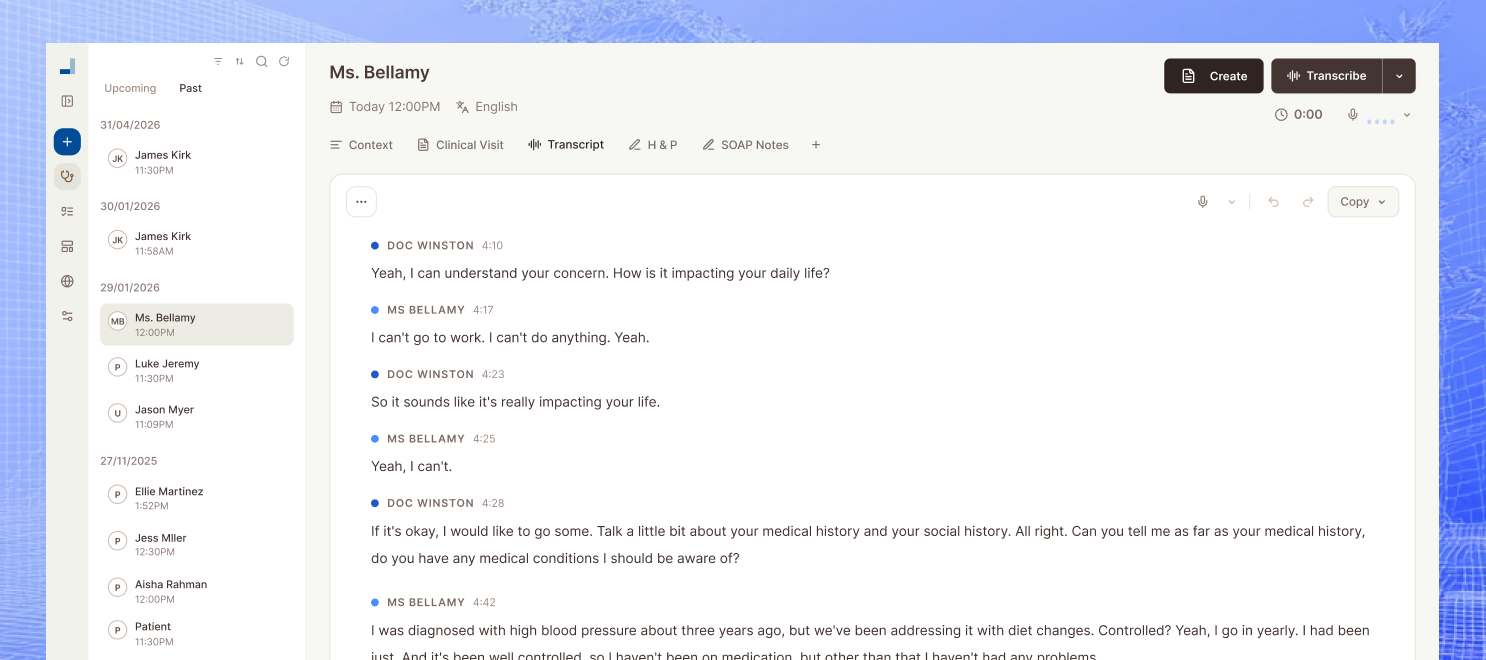
While the SOAP note is the industry standard, modern healthcare demands a wider variety of documentation styles. A comprehensive system for secure audio and transcript storage allows for the generation of History and Physical (H&P) reports, consult notes, and complex procedure notes with high precision. By capturing the full context of a visit, practitioners can ensure that specialized reports reflect the actual clinical narrative rather than just a generic template.
Structure matters immensely for continuity of care and audit readiness. When a patient moves from a primary care setting to a specialist, or when a discharge summary is sent to a home-care team, the quality of that handover can dictate patient outcomes. Using transcription-based drafting ensures that follow-up notes and referral letters are populated with specific details discussed during the encounter, reducing the risk of communication gaps during transitions.
- Supports H&P, progress notes, and detailed consult reports.
- Streamlines the creation of discharge summaries and referral letters.
- Improves audit readiness through consistent, structured documentation.
- Facilitates better continuity of care across different specialties.
How to implement secure audio and transcript storage step-by-step in a real clinic
Starting a new documentation workflow should be an incremental process. Begin by selecting one specific visit type—perhaps routine follow-ups or standard physical exams—to test the system. This allows the staff and clinicians to familiarize themselves with the recording process without the pressure of complex cases. Ensure that the environment is conducive to clear audio capture, minimizing background noise that could interfere with the transcription quality.
Next, configure your templates based on your specific specialty requirements. A cardiologist will need different data points highlighted than a pediatrician. Once the templates are set, perform the encounter as you normally would, either in-person or via telehealth. The system captures the dialogue, and the transcription is processed immediately into the pre-selected format. This automation turns a conversation into a structured draft in seconds.
The critical step is the review and edit phase. Clinicians should spend two to three minutes scanning the generated draft to ensure all medications, dosages, and specific patient concerns are accurately reflected. Once verified, these outputs can be instantly repurposed. A single transcript can generate a progress note for the EHR, a referral letter for a colleague, and a summary for the patient, maximizing the utility of a single recording session.
- Start with one visit type to build confidence in the workflow.
- Customize templates to match specialty-specific documentation needs.
- Review and edit drafts immediately to ensure 100% clinical accuracy.
- Repurpose the transcript for letters, forms, and patient summaries.
How to keep note quality high and reduce mistakes
Technology is not immune to errors, and typical failure points in automated notes often include missing secondary medications or incorrectly transcribing specific numerical lab values. To maintain high standards, clinics must move away from a ‘set and forget’ mentality. Developing a lightweight review habit is essential; treated like a quick proofread, this step ensures that ‘note bloat’—the inclusion of unnecessary or repetitive information—is kept to a minimum.
Establishing team standards for documentation also helps. If every practitioner in a university clinic follows a similar review protocol, the overall quality of the medical records remains high. This consistency is vital for legal defense and for ensuring that any other provider reading the note can quickly grasp the clinical picture without sifting through irrelevant data.
- Perform a focused review of medications, dosages, and lab values.
- Avoid note bloat by using concise, specialty-specific templates.
- Standardize documentation review habits across the entire clinical team.
- Focus on the clinical narrative rather than just automated checklists.
Privacy, consent, and patient trust (plain English)
Patient trust is the bedrock of any successful clinical implementation. While consent requirements vary by region, the best practice is always to be transparent. Explain to patients that the system is a digital assistant used to ensure their records are accurate and to allow the doctor to focus entirely on them rather than a computer screen. Most patients are receptive when they understand that the technology enhances their care.
A simple script might sound like: ‘I’m using a secure system to help me take notes today so I can focus on our conversation. It records and transcribes our talk into your medical chart, and I’ll review everything for accuracy afterward. Is that okay with you?’ This approach centers the patient’s benefit and respects their autonomy while maintaining general security and data retention principles.
- Always follow local regional policies regarding recording and consent.
- Use a transparent, patient-centric script to explain the process.
- Ensure data is handled according to high security and retention standards.
- Position the technology as a tool for better clinical focus.
Rolling it out across a clinic without disruption
A successful rollout requires a clear pilot plan, usually spanning about two weeks. During this time, the primary goal is not volume, but rather fine-tuning the integration between the recording process and the existing Electronic Health Record (EHR). Tracking metrics such as time saved per note and the reduction in after-hours charting can provide the necessary data to justify a full-scale adoption across the clinic.
Training should focus on template alignment and the nuances of voice capture. When clinicians see the immediate benefit of having a referral letter ready the moment a consult ends, resistance typically fades. By aligning the templates with existing clinical workflows, the transition becomes a natural evolution of the practice rather than a disruptive overhaul.
- Launch with a two-week pilot to identify and solve workflow bottlenecks.
- Measure success through time saved and reduced after-hours work.
- Align AI templates with existing clinical and EHR workflows.
- Provide brief, practical training on voice capture and review habits.
Mcoy AI is an AI medical scribe that records and transcribes patient encounters, then generates multiple clinical note types including H&P, progress notes, consult notes, follow-up notes, procedure notes, discharge summaries, referral letters, and more. With over 200 customizable templates and an interactive AI chat feature, clinicians can instantly create professional letters, forms, and complex documents from their talk, significantly reducing administrative overhead and allowing more time for direct patient care.
Conclusion
Implementing a system for secure audio and transcript storage is a transformative step for any modern clinic. By moving away from manual typing and toward an assistive AI workflow, clinicians can reclaim their time and focus on what truly matters: the patient. The transition requires a thoughtful approach to consent, a commitment to quality review, and the right set of templates, but the rewards are a significant reduction in burnout and a higher standard of clinical documentation. Start with a small pilot today and see how secure audio and transcript storage can revitalize your practice.
What a serious review table should cover
| Decision area | Common mistake | Better clinic-ready approach | Metric to watch |
|---|---|---|---|
| Workflow design | Treat secure audio & transcript storage for clinics | guide as a one-off documentation task | Build a repeatable process with clear ownership and review points |
| Team adoption | Assume every clinician will naturally use the same process | Train for consistency and define exception handling early | Active user adoption |
| Quality review | Only check notes when a problem is reported | Audit a sample of notes weekly and review edge cases | Edit rate per note |
| Operational follow-through | Leave admin actions outside the documentation workflow | Use the same encounter data for referrals, letters, and follow-up tasks | Completion rate for next-step tasks |
Related reading
If you are working through secure audio & transcript storage for clinics | guide, it helps to read this alongside Practice Operations: How Clinics Can Streamline Daily Operations, Practice Operations: How Clinics Can Improve Workflow Without Changing Their EHR, and Specialty Guides: AI Scribe for Gastroenterology: Master GI Clinical Notes. Those guides cover adjacent workflow, implementation, and evaluation questions so the decision does not sit in isolation.
FAQ
How accurate are AI medical scribes in real clinics?
In a live clinical setting, AI scribes are remarkably accurate at capturing the core narrative and clinical facts of a conversation. Most advanced systems achieve high levels of precision, though they may occasionally struggle with very thick accents or heavy background noise. This is why a quick clinician review is always the final step in the process. When used correctly, they capture nuances that manual note-taking often misses.
Do I still need to review every note?
Yes, reviewing every note is a fundamental requirement for clinical safety and legal compliance. The AI generates a highly accurate draft, but the clinician is the one with the medical license and the ultimate responsibility for the record’s accuracy. A typical review takes only a minute or two, which is still significantly faster than typing a note from scratch.
What note types can an AI scribe generate besides SOAP?
Beyond standard SOAP notes, AI scribes can generate a vast array of documentation including History and Physicals (H&P), detailed procedure notes, consult reports, and progress updates. They are also incredibly efficient at drafting referral letters and discharge summaries. This flexibility allows the scribe to be useful across various medical specialties and encounter types.
Will this work for telehealth and in-person consults?
Most modern AI scribe solutions are designed to be platform-agnostic, meaning they work equally well for in-person visits using a mobile device or for telehealth consults via computer audio. The key is ensuring a clear audio input. For telehealth, most clinicians find that the AI captures the digital audio stream with high clarity, leading to excellent transcription results.
How do I explain recording/transcription to patients?
The best approach is to be direct and highlight the benefits for the patient. You can explain that the tool allows you to look at them instead of a screen and ensures that every detail of their care is recorded accurately. Most patients appreciate the extra attention and the focus on modern technology to improve their healthcare experience.
How do clinics prevent note bloat?
Note bloat is prevented by using concise templates that are specifically tuned to the necessary clinical information. Instead of transcribing every single word of a 20-minute conversation, the AI is trained to extract and summarize relevant clinical data into the appropriate sections. Clinicians can further customize these templates to ensure only the required information is exported to the EHR.
How long does template setup take?
Basic template setup can be done in minutes, as most systems come with a library of pre-built options for common specialties. Customizing a template to fit your specific ‘voice’ or clinic requirements might involve a few small tweaks over the first week of use. Once settled, these templates automate the formatting process entirely for every subsequent visit.
What’s the safest way to start if I’m skeptical?
The safest and most effective way to start is with a ‘shadow’ pilot. Use the tool during a few straightforward encounters while still keeping your traditional notes. This allow you to compare the AI-generated draft against your own manual notes side-by-side. You will quickly see the accuracy and time-saving potential without any risk to your current workflow or patient records.