Practice Operations: Run a 2-Week AI Medical Scribe Pilot: The Full Guide
Learn how to pilot an AI medical scribe in your clinic. Save time, reduce burnout, and improve note quality with this step-by-step 2-week implementation guide.
Introduction: Reclaiming Your Time from the Charting Burden
For most clinicians, the workday doesn’t end when the last patient leaves. Instead, it transitions into hours of ‘pajama time’ spent catching up on after-hours charting, wrestling with EHR interfaces, and worrying about the medico-legal implications of rushed notes. This administrative weight is a primary driver of burnout among GPs, specialists, and university clinic staff. Whether you are managing a high-volume private practice or a complex academic setting, the need for a sustainable documentation workflow has never been more urgent.
This guide provides a comprehensive roadmap for implementing an AI medical scribe through a structured 14-day pilot. We will explore how to transition from traditional manual entry to an automated workflow that handles diverse note formats beyond the standard SOAP note. From selecting your first patient visit types to establishing quality control and ensuring patient privacy, this plan is designed to minimize disruption while maximizing clinical efficiency. By the end of this pilot, you will have a clear understanding of how to integrate this technology into your daily routine without sacrificing the quality of care or patient trust.
What a medical scribe solves in modern practice
The real cost of documentation is measured in more than just minutes; it is measured in cognitive load. When a doctor is forced to type while a patient speaks, the therapeutic alliance suffers. Clinicians often find themselves mentally divided—trying to listen intently while simultaneously structuring a coherent history of present illness. This fragmentation frequently leads to delayed notes, missed nuances in the patient’s story, and a cumulative fatigue that carries over into the next encounter.
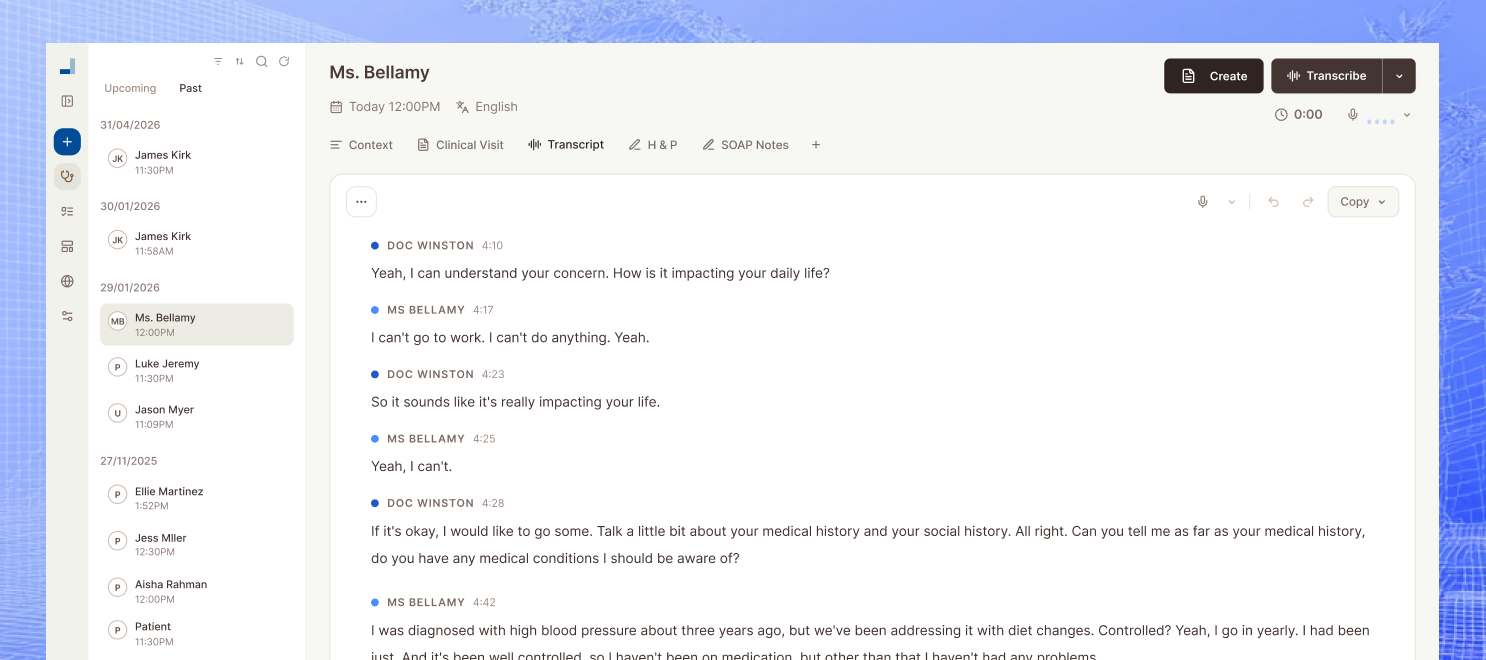
An AI medical scribe acts as an assistive layer, not a replacement for clinical judgment. It captures the raw dialogue of the encounter and structures it into professional medical language, allowing the clinician to remain fully present. It is important to remember that the AI serves as a high-powered assistant; the practitioner remains the ultimate authority, responsible for reviewing, editing, and signing off on every document. This shift from ‘creator’ to ‘editor’ significantly reduces the friction of the charting process.
- Eliminates manual data entry during and after patient encounters.
- Reduces cognitive fatigue by allowing full focus on the patient.
- Ensures more detailed and accurate capture of the clinical narrative.
- Maintains the clinician as the final verifier for medical accuracy.
Note types you can generate beyond SOAP (H&P and more)
While many practitioners are accustomed to the standard SOAP (Subjective, Objective, Assessment, Plan) format, modern clinical practice requires a much wider range of documentation. A robust AI documentation system should be capable of producing comprehensive History and Physical (H&P) reports for new admissions, detailed consult notes for specialist referrals, and concise follow-up notes for chronic disease management. Each of these formats serves a specific purpose in the continuum of care, and the AI’s ability to adapt its output is crucial for diverse clinical settings.
The value of structured documentation extends to procedure notes and discharge summaries, which are often the most time-consuming to draft. In a university clinic or hospital setting, the clarity of a discharge summary or a referral letter can determine the success of a patient’s transition between departments. Using the right format ensures audit readiness, satisfies insurance requirements, and improves the quality of handovers between multidisciplinary teams. By automating these varied outputs, clinics can maintain a high standard of documentation across all visit types.
- H&Ps and Consult Notes for comprehensive initial evaluations.
- Procedure Notes and Discharge Summaries for acute care transitions.
- Referral Letters and Follow-up Notes for integrated care coordination.
- Customizable structures to meet specific department or insurance audits.
How to implement AI medical scribe step-by-step in a real clinic
To begin your 2-week pilot, start by selecting just one or two visit types. Instead of trying to use the AI for every complex encounter on day one, choose routine follow-ups or standard physical exams. This allows you to get comfortable with the recording process and the layout of the generated notes without the pressure of a high-stakes diagnostic mystery. Once you have selected your initial visit types, ensure your digital templates are aligned with your specialty, whether you are in family medicine, orthopedics, or psychiatry.
During the encounter, whether it is an in-person visit or a telehealth session, simply capture the conversation in the background. You do not need to change how you talk to patients; in fact, the more natural the conversation, the better the AI typically performs. After the patient leaves, spend two to three minutes reviewing and editing the output. This is the time to add specific physical exam findings or lab values that may not have been spoken aloud during the conversation.
The final step in the daily workflow is to reuse the generated outputs for ancillary tasks. If the AI has produced a solid assessment and plan, use that text to quickly generate referral letters or patient instruction forms. By the second week of the pilot, you should be expanding the use of the tool to more complex cases, gradually replacing your old charting habits with this streamlined review-based process. This narrative-driven rollout ensures that the technology adapts to the clinic, rather than forcing the clinic to adapt to the technology.
- Start small by piloting with one or two specific visit types.
- Align AI templates with your specific specialty requirements.
- Review and edit notes immediately while the encounter is fresh.
- Leverage note data to quickly create referrals and patient letters.
How to keep note quality high and reduce mistakes
AI-generated notes are only as good as the review process that follows them. Typical failure points include missing specific dosages, misinterpreting complex laboratory values, or creating ‘note bloat’ with redundant information. To maintain high standards, clinicians should develop a lightweight review habit—skimming for clinical accuracy rather than perfect prose. It is essential to ensure the ‘Problem List’ and ‘Assessment and Plan’ accurately reflect the specific medical decisions made during the encounter.
Establishing team standards within a clinic or department also helps maintain quality. Discuss as a group how much detail is required for specific visit types and ensure that everyone is using the same template versions. By standardizing the ‘Review of Systems’ or ‘Physical Exam’ subsections, you reduce the variability that can lead to errors. Consistent feedback to the system—such as correcting recurring errors—often helps the AI learn your specific dictation style or clinical preferences over time.
- Focus review on dosages, lab values, and the Final Plan.
- Standardize templates across the clinic for consistent documentation.
- Adopt a ‘review-and-sign’ habit immediately after each consult.
- Provide feedback to the system to improve future note accuracy.
Privacy, consent, and patient trust (plain English)
Patient privacy is a cornerstone of clinical trust. Consent requirements for recording or transcribing encounters vary by jurisdiction, so it is vital to follow your local healthcare regulations and clinic policies. Generally, most patients are receptive to the technology when they realize it allows their doctor to look at them instead of a computer screen. Transparency is key; a simple mention at the start of the visit is often all that is needed.
You might say: ‘I’m using an AI assistant today to capture our conversation so I can focus on you instead of typing on my computer. It helps me make sure my notes are completely accurate. Is that alright with you?’ This framing positions the technology as a tool for better care rather than a data-collection device. Behind the scenes, ensure your solution adheres to industry-standard encryption and data retention principles to keep patient information secure at all times.
- Always follow local legal and clinic guidelines regarding patient consent.
- Use transparent, patient-centric language to explain the tool’s benefits.
- Ensure the transcription service uses high-level data encryption.
- Position the AI as a bridge to better eye contact and engagement.
Rolling it out across a clinic without disruption
Transitioning an entire clinic requires a phased approach to prevent workflow bottlenecks. A 2-week pilot involving a single ‘champion’ clinician or a small team allows you to work out the kinks before a full-scale launch. During this period, track specific metrics like the time spent charting after-hours and the speed of note completion. If the pilot shows a 50% reduction in documentation time, the data provides a compelling case for the rest of the staff to adopt the change.
Training should focus on template alignment and the bridge from transcription to the EHR. Once the champion clinician feels confident, they can serve as a peer mentor for others. Aligning everyone on the same set of 200+ templates ensures that the clinic’s output remains professional and uniform, regardless of which provider is seeing the patient. By the end of the 14 days, the objective is to have a proven workflow that feels like a natural extension of the exam room.
- Designate a ‘champion’ to lead the initial 14-day pilot.
- Track time saved and note completion rates to measure success.
- Host a brief mid-pilot check-in to align on template usage.
- Scale to other providers only after the initial workflow is stable.
Mcoy AI is an AI medical scribe that records and transcribes patient encounters, then generates multiple clinical note types (H&P, progress notes, consult notes, follow-up notes, procedure notes, discharge summaries, referral letters, and more). It features 200+ customizable templates designed to fit various specialties and uses an integrated AI chat to help clinicians instantly create letters, forms, and other essential documents. By streamlining the path from conversation to completed documentation, it helps medical professionals refocus their energy on patient care rather than administrative tasks.
Conclusion
Implementing a new documentation workflow doesn’t have to be a source of stress. By following a structured 2-week pilot, you can systematically reduce the time spent on manual entry while improving the depth and accuracy of your clinical records. The transition to an AI-assisted environment allows you to return to the heart of medicine: the patient encounter. As you evaluate the benefits of this pilot, you’ll find that the right AI medical scribe doesn’t just save time—it restores the joy of practicing medicine. Start your pilot today and see how much time your clinic can reclaim.
What a serious review table should cover
| Decision area | Common mistake | Better clinic-ready approach | Metric to watch |
|---|---|---|---|
| Workflow design | Treat run a 2-week ai medical scribe pilot: the full guide as a one-off documentation task | Build a repeatable process with clear ownership and review points | Time to complete documentation |
| Team adoption | Assume every clinician will naturally use the same process | Train for consistency and define exception handling early | Active user adoption |
| Quality review | Only check notes when a problem is reported | Audit a sample of notes weekly and review edge cases | Edit rate per note |
| Operational follow-through | Leave admin actions outside the documentation workflow | Use the same encounter data for referrals, letters, and follow-up tasks | Completion rate for next-step tasks |
Related reading
If you are working through run a 2-week ai medical scribe pilot: the full guide, it helps to read this alongside Practice Operations: How Clinics Can Streamline Daily Operations, Practice Operations: How Clinics Can Improve Workflow Without Changing Their EHR, and Specialty Guides: How to Use an AI Scribe for Pediatrics Documentation Guide. Those guides cover adjacent workflow, implementation, and evaluation questions so the decision does not sit in isolation.
FAQ
How accurate are AI medical scribes in real clinics?
In most real-world clinical settings, AI medical scribes are highly accurate at capturing the nuances of patient-provider dialogue. They are specifically trained on medical terminology and can distinguish between multiple speakers in an exam room. However, accuracy can be affected by heavy background noise or extremely fast speech, which is why the clinician’s role as an editor is so important. Most providers find that the AI-generated draft is 90-95% accurate, requiring only minor tweaks before finalization.
Do I still need to review every note?
Yes, reviewing every note is a fundamental part of clinical responsibility and medico-legal best practices. While the AI does the heavy lifting of drafting the narrative and organizing sections, the clinician must ensure that the assessments, dosages, and plans are 100% correct. This review process usually takes only a minute or two per note, which is significantly faster than writing a note from scratch. Think of the AI as a draft generator and yourself as the final quality controller.
What note types can an AI scribe generate besides SOAP?
A modern AI scribe is capable of generating a wide array of documentation beyond simple SOAP notes. This includes comprehensive History and Physicals (H&Ps), specialist consult notes, procedure notes, and discharge summaries. It can also produce referral letters and follow-up notes tailored to specific chronic conditions. By using different templates, the AI can reorganize the same encounter data into the specific format required for the clinical situation.
Will this work for telehealth and in-person consults?
Yes, AI medical scribes are designed to be flexible and work across various consultation formats. For in-person visits, the device usually stays on the desk and captures ambient audio. For telehealth, the system can often integrate with the audio output of your computer or run alongside your video conferencing software. In both scenarios, the AI captures the conversation clearly to produce a high-quality clinical note.
How do I explain recording/transcription to patients?
The best way to explain it is to focus on the benefit to the patient: better attention from the doctor. You can simply state that you are using a digital assistant to help with notes so you don’t have to type while they are talking. Most patients appreciate that their doctor is looking at them rather than a screen. Always ensure you have the patient’s verbal or written consent according to your local regulations.
How do clinics prevent note bloat?
Note bloat occurs when an AI includes every single word spoken, including irrelevant small talk. To prevent this, quality AI systems use ‘concise’ templates that filter out non-clinical dialogue. Clinicians can also control note length by selecting specific templates that emphasize brevity or by using the review phase to delete unnecessary sections. Setting clinic-wide standards for what should be included in a ‘final’ note also helps keep documentation concise.
How long does template setup take?
Basic template setup is often instantaneous, as many systems come pre-loaded with standard medical formats. However, customizing templates to fit your specific specialty or personal style usually takes about 15 to 30 minutes. Once a template is saved, it can be used for every subsequent encounter of that type, making it a one-time time investment that pays off significantly in daily efficiency.
What’s the safest way to start if I’m skeptical?
The safest way to start is to use the AI for just one or two non-complex patient visits during a light clinic day. You don’t have to rely on it for your entire schedule immediately. By testing it on routine follow-ups, you can see how it handles your voice and clinical style without any risk. Once you see the quality of the first few notes, you can naturally scale up its use as your confidence grows.