AI & Medicine: Master Review of Systems Faster With AI [Full Guide]
Learn how to optimize your Review of Systems (ROS) using AI scribes. Reduce charting time, improve note accuracy, and eliminate burnout in your clinic.
What a medical scribe solves in modern practice
The modern healthcare landscape is plagued by the ‘pajama time’ epidemic, where clinicians spend hours after their final patient encounter completing documentation. The Review of Systems (ROS) is often one of the most tedious portions of this process, requiring an exhaustive inventory of body systems that can easily be overlooked or rushed during a busy shift. This cognitive load doesn’t just lead to fatigue; it increases the risk of missed clinical details and medico-legal vulnerabilities.
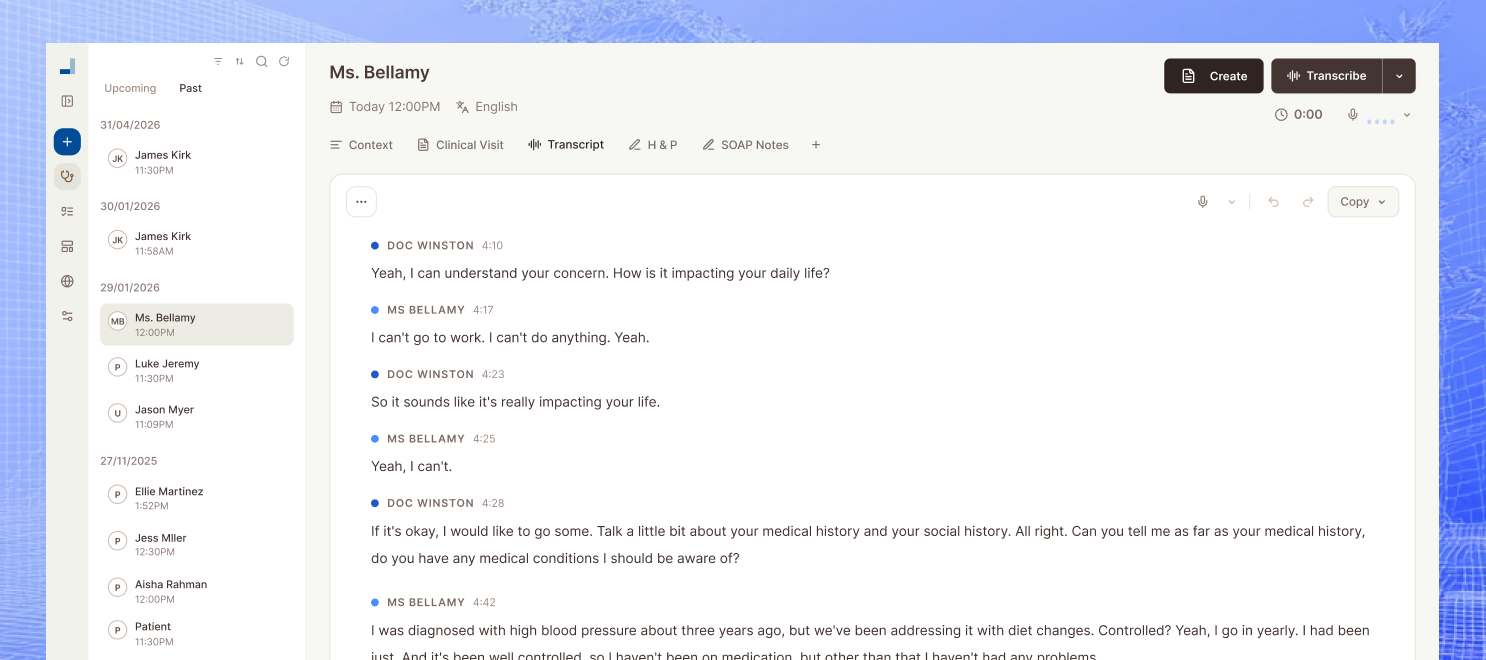
An AI medical scribe serves as an intelligent drafting assistant that captures the nuance of the patient conversation in real-time. It is important to remember that these tools are assistive rather than autonomous; they handle the heavy lifting of organization and transcription, while the clinician remains the final authority on the note’s accuracy. By offloading the mechanical task of writing, doctors can focus on the patient instead of the screen.
- Eliminates manual data entry for repetitive body system checks.
- Reduces cognitive fatigue by tracking verbal cues automatically.
- Ensures clinical notes are completed immediately following the encounter.
- Allows for more eye contact and better patient-provider rapport.
Note types you can generate beyond SOAP (H&P and more)
While the SOAP note is the industry standard, comprehensive care often requires specialized formats that go much deeper. For new patient admissions or complex annual exams, a full History and Physical (H&P) is essential. AI tools can now parse a single conversation into an H&P format, clearly delineating the subjective history from the objective physical exam findings and the detailed Review of Systems.
Structure is vital for continuity of care, especially in university clinics where multiple residents or specialists may interact with one patient record. Beyond the H&P, AI can generate procedure notes, discharge summaries, and consult notes that maintain a consistent high-quality standard. When every note follows a logical, predictable structure, audit readiness improves significantly and the risk of handover errors drops.
- H&P and progress notes specifically tailored to specialty needs.
- Detailed procedure notes and discharge summaries for hospital settings.
- Consult notes and referral letters that summarize key findings.
- Consistent formatting that aids in insurance reimbursement and audits.
How to implement Review of Systems faster step-by-step in a real clinic
Integrating an AI scribe into your workflow should be an incremental process rather than an overnight overhaul. Start by selecting one specific visit type—such as a routine follow-up or a standard physical exam—where the Review of Systems is relatively predictable. This allows you to calibrate the AI’s output to your specific verbal style without the pressure of a complex multi-system trauma case.
Next, configure your templates by specialty. A cardiologist’s ROS will look very different from a dermatologist’s; ensure your digital environment reflects these requirements before the patient enters the room. During the encounter, whether in-person or via telehealth, simply conduct the interview naturally. The AI will capture the mention of symptoms like ‘shortness of breath’ or ‘joint pain’ and categorize them under the correct system automatically.
Review and edit the draft immediately after the patient leaves. Most clinicians find that editing a generated note takes less than 60 seconds, compared to the minutes required to type it from scratch. Finally, reuse those outputs for secondary documents like referral letters or school forms, ensuring all data remains consistent across every piece of paperwork associated with that visit.
- Pilot the technology with a single, common encounter type.
- Use specialty-specific templates to categorize ROS findings instantly.
- Review the draft immediately for maximum recall and speed.
- Repurpose recorded data for various letters and clinical forms.
How to keep note quality high and reduce mistakes
AI is powerful, but it is not infallible. Typical failure points in automated documentation include missing specific dosages, misinterpreting whispered values, or ‘note bloat’ where the AI includes irrelevant conversational filler. To maintain high standards, clinicians should adopt a lightweight review habit—quickly scanning the ROS for ‘denies’ versus ‘reports’ to ensure the AI didn’t flip a clinical finding.
Establishing team standards for documentation also helps. When every provider in a clinic agrees on what constitutes a ‘high-quality’ note, the AI can be trained or prompted to follow those specific guidelines. This ensures that even as different doctors use the tool, the output remains professional, concise, and useful for the next person who opens the patient’s chart.
- Verify ‘positive’ and ‘negative’ findings in the ROS for accuracy.
- Avoid note bloat by using concise, specialty-specific templates.
- Perform weekly spot-checks to ensure documentation meets legal standards.
Privacy, consent, and patient trust (plain English)
Patient privacy is the cornerstone of the clinical relationship. Before using any recording or transcription technology, it is essential to follow your local regional policies regarding patient consent. Most patients are supportive of the technology when they understand it allows their doctor to listen more and type less, but transparency is key to maintaining that trust.
A simple script can bridge the gap: “To help me focus entirely on our conversation today, I’m using a secure AI assistant to draft our clinical notes. Is it alright if I use this tool to record our visit?” This framing highlights the benefit to the patient (the doctor’s full attention) while clearly asking for permission. Always ensure your chosen platform adheres to strict data security and retention principles to protect sensitive health information.
- Always obtain verbal or written consent based on local regulations.
- Frame the technology as a tool for better patient-doctor engagement.
- Ensure data is encrypted and handled via HIPAA-compliant protocols.
Rolling it out across a clinic without disruption
Transitioning a whole clinic requires a structured 2-week pilot plan. Phase one should involve ‘power users’ who are tech-savvy and can troubleshoot minor hurdles. In phase two, the rest of the staff joins once the templates and workflows have been smoothed out. This prevents the frustration that often accompanies poorly managed tech rollouts.
Track specific metrics during this pilot, such as total time saved per day and the reduction in ‘after-hours’ charting. When staff see their colleagues leaving on time and producing more complete notes, adoption happens naturally. Training sessions should focus on template alignment to ensure the AI’s output matches the clinic’s existing electronic health record (EHR) structure.
- Start with a 2-week pilot involving a small group of clinicians.
- Measure time saved and note completeness as key performance indicators.
- Standardize templates across the clinic for uniform documentation.
Mcoy AI is an AI medical scribe that records and transcribes patient encounters, then generates multiple clinical note types, including H&P, progress notes, consult notes, follow-up notes, procedure notes, discharge summaries, referral letters, and more. With over 200+ customizable templates and a built-in AI chat, clinicians can easily create custom letters, forms, and documents from their patient data, ensuring a streamlined administrative workflow.
Conclusion
The transition to automated documentation is the most effective way to address clinician burnout. By following a structured workflow—from initial pilot to template customization—clinics can capture a complete Review of Systems faster than ever before. This technology doesn’t just save time; it restores the human element of medicine by removing the barrier of the keyboard. If you are ready to reclaim your evenings and improve the quality of your clinical records, implementing a Review of Systems faster with AI is the logical next step for your practice. Start small, stay consistent, and watch your clinic’s efficiency soar.
What a serious review table should cover
| Decision area | Common mistake | Better clinic-ready approach | Metric to watch |
|---|---|---|---|
| Workflow design | Treat master review of systems faster with ai [full guide] as a one-off documentation task | Build a repeatable process with clear ownership and review points | Time to complete documentation |
| Team adoption | Assume every clinician will naturally use the same process | Train for consistency and define exception handling early | Active user adoption |
| Quality review | Only check notes when a problem is reported | Audit a sample of notes weekly and review edge cases | Edit rate per note |
| Operational follow-through | Leave admin actions outside the documentation workflow | Use the same encounter data for referrals, letters, and follow-up tasks | Completion rate for next-step tasks |
Related reading
If you are working through master review of systems faster with ai [full guide], it helps to read this alongside AI & Medicine: How to Simplify Clinical Notes for Busy Doctors, AI & Medicine: How Doctors Can Improve SOAP Notes, and Compare & Choose: How to Test AI Scribe Tools Side-by-Side: 2024 Guide. Those guides cover adjacent workflow, implementation, and evaluation questions so the decision does not sit in isolation.
FAQ
How accurate are AI medical scribes in real clinics?
AI medical scribes currently offer high levels of accuracy in capturing the essence of patient-provider dialogue. However, they are most effective when clinicians speak clearly and confirm key findings aloud during the exam. The doctor must always review the generated note to ensure that specific clinical nuances are captured correctly before finalizing the entry in the EHR.
Do I still need to review every note?
Yes, the clinician remains the legally responsible party for the accuracy of every medical record. While AI can draft 90-95% of a note, a quick review is essential to guard against errors or omissions. This review process usually takes less than a minute but is vital for patient safety and medico-legal protection.
What note types can an AI scribe generate besides SOAP?
Modern AI scribes are highly versatile and can generate a wide range of documents. These include History and Physical (H&P) reports, consult notes, procedure notes, discharge summaries, and referral letters. Because the AI captures the entire encounter, it can reformat that data into whichever template is required for the specific clinical situation.
Will this work for telehealth and in-person consults?
AI scribes are designed to be flexible; they can capture audio from a smartphone during an in-person visit or from a computer’s audio output during a telehealth session. This makes them an ideal solution for modern clinics that offer a hybrid model of care, ensuring consistent documentation quality regardless of the visit format.
How do I explain recording/transcription to patients?
Keep the explanation simple and patient-centered. Tell the patient that use of the tool allows you to look at them instead of a computer screen, ensuring they have your full attention. Most patients appreciate the increased engagement and are happy to consent when the privacy protections are clearly explained according to clinic policy.
How do clinics prevent note bloat?
Note bloat is prevented by using highly structured templates that instruct the AI to be concise. By defining specific categories (like cardiovascular, respiratory, etc.) and limiting the AI’s output to relevant clinical facts, the resulting notes are often more readable and professional than traditional dictations or manual typing.
How long does template setup take?
Initial setup for basic templates can be done in minutes, as most platforms come with pre-built options for various specialties. Fine-tuning a template to match your specific clinical style or clinic-wide standards might take an hour or two of testing, but this upfront investment pays off in hours of saved time every week.
What’s the safest way to start if I’m skeptical?
The safest way to start is with a ‘shadow’ pilot. Use the AI scribe during a few encounters but continue your normal charting process as a backup. Compare the AI’s output to your own notes; once you see the consistency and accuracy of the AI, you can gradually transition your workflow to rely on the AI-generated drafts.