Admin Management: Referral Letters From AI Scribe Notes: A Clinician's Guide
Discover how to transform AI scribe notes into professional referral letters. Improve specialist communication and save hours on clinical documentation.
The Hidden Hurdle of Clinical Coordination
For many practitioners, the clinical encounter is only half the battle. The real exhaustion begins after the patient leaves the room, facing a mountain of administrative tasks. Among these, drafting referral letters is often the most time-consuming and prone to delays. Whether it is a GP referring to a cardiologist or a university clinic coordinator seeking specialty help for a student, the pressure to be accurate while staying concise is immense. After-hours charting and the anxiety of missing a critical detail in a rushed note are universal pain points in modern medicine.
This guide provides a comprehensive roadmap for leveraging AI technology to bridge the gap between patient encounters and professional correspondence. You will learn the optimal workflow for high-quality note-taking, how to navigate various document formats beyond the standard SOAP note, and how to maintain rigorous quality control. We will also cover essential privacy considerations and a step-by-step rollout plan tailored for private practices and busy academic clinics alike.
What a medical scribe solves in modern practice
The traditional method of manual documentation carries a heavy cognitive load that often leads to clinician burnout. When a doctor has to memorize details during a visit only to type them out hours later, the risk of data loss increases. Delayed notes don’t just affect the physician’s work-life balance; they can stall the entire care continuum if referrals aren’t sent promptly. An AI medical scribe acts as an assistive layer, capturing the nuance of the conversation in real-time so the clinician can focus entirely on the patient.
It is important to understand that while an AI scribe is a powerful productivity tool, it does not replace medical judgment. The scribe provides the raw material—highly accurate transcripts and structured drafts—but the clinician remains the final authority. By automating the mechanical act of writing, the scribe allows for more detailed documentation than manual typing usually permits, ensuring that the ‘story’ of the patient’s health is preserved without the manual labor.
- Reduces the ‘pajama time’ spent on documentation after shift ends.
- Captures specific patient phrases and symptoms that might be forgotten.
- Allows for eye contact and better patient-provider rapport.
- Provides a structured foundation for all secondary documents.
Note types you can generate beyond SOAP (H&P and more)
While the SOAP note is the industry standard for daily progress, complex cases often require a more robust approach. Comprehensive documentation includes History and Physical (H&P) reports, consult notes for specialist reviews, and detailed procedure notes. Each of these serves a specific purpose in the medical record. For instance, a discharge summary must prioritize transitions of care, while a follow-up note focuses on the interval change in the patient’s condition since the last visit.
The quality of a referral letter is directly tied to the structure of the initial encounter note. When your documentation is organized into clear sections—such as History of Present Illness (HPI), Exam, and Plan—extracting the necessary information for a specialist becomes a matter of seconds rather than minutes. This structural integrity is vital for audit readiness and ensures that anyone reading the file, whether it’s an insurance reviewer or a consulting surgeon, understands the clinical reasoning clearly.
- H&P: Comprehensive baseline documentation for new patients.
- Consult & Referral: Targeted communication for specialty transitions.
- Procedure & Discharge: Detailed logs of interventions and next steps.
- Follow-up: Focused updates on chronic or acute management.
How to implement referral letters from AI scribe notes step-by-step
Transitioning to an AI-enhanced workflow starts with selecting a single visit type to pilot. Many clinics find that routine follow-ups or standard referrals work best. Begin by setting up specialized templates within your software that align with your specialty. Having a template for ‘Orthopedic Referral’ versus ‘Mental Health Referral’ ensures the AI knows which clinical data points to emphasize during the transcription process.
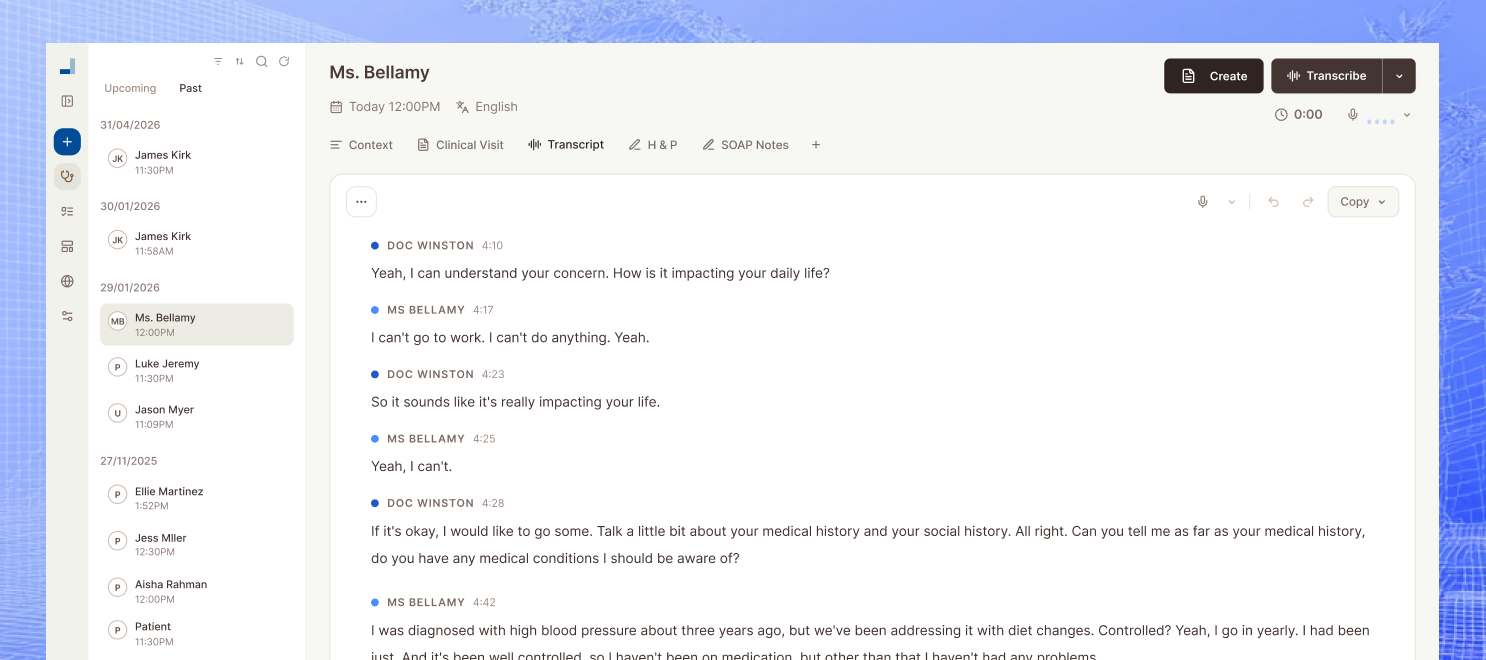
During the encounter, whether it is in-person or via telehealth, simply capture the conversation naturally. Once the visit concludes, the AI processes the audio and generates the clinical note. Review this note immediately while the details are fresh in your mind, making any quick edits for clinical nuance. After the note is finalized, use the output to instantly generate your referral letter, pulling the relevant diagnosis, medication lists, and rationale directly from the encounter data.
- Start with one common referral type to build a repeatable system.
- Utilize specialty-specific templates for higher data accuracy.
- Review AI outputs immediately for the fastest editing turnaround.
- Convert finalized notes into professional letters with one click.
How to keep note quality high and reduce mistakes
AI is a tool, not a substitute for clinical oversight. Common failure points in automated documentation can include ‘note bloat’ or the occasional misinterpretation of complex medication dosages. To maintain high standards, a lightweight review habit is essential. Clinicians should skim for ‘hallucinations’ or missed negatives, ensuring that the logic of the plan matches the findings of the physical exam.
Establishing team standards for documentation also helps. If every practitioner in the clinic uses the same template logic, the quality remains consistent even when patients see different providers. This consistency is particularly important in university clinics where multiple residents or staff members may interact with the same patient file over time. High-quality notes lead to high-quality referrals, reducing the back-and-forth phone calls between offices.
- Always verify medication names and dosages for total accuracy.
- Scan for logic gaps between the history and the assessment.
- Audit a small sample of notes weekly to ensure template alignment.
- Keep descriptions concise to prevent unnecessary note length.
Privacy, consent, and patient trust
Implementing recording technology requires transparency. While privacy laws vary by region, the core principle is always informed consent. Most patients are receptive to the technology when they realize it allows their doctor to listen to them rather than a computer screen. Following local regulations regarding data retention and encryption is non-negotiable for maintaining professional integrity.
A simple way to introduce this to a patient is to say: ‘I’m using an AI assistant to help me capture our conversation today so I can focus on you instead of typing. It’s secure and helps me make sure my notes are perfectly accurate for our records. Are you okay with that?’ This approach builds trust and positions the technology as a benefit to the patient’s care experience.
- Check local and regional guidelines for recording consent.
- Explain the technology as a tool for better clinical focus.
- Ensure the platform used follows enterprise-grade security protocols.
- Document the patient’s verbal consent within the clinical note.
Rolling it out across a clinic without disruption
Success with an AI scribe requires a staged approach rather than an overnight overhaul. Start with a two-week pilot involving one or two ‘tech-forward’ clinicians. During this phase, track specific metrics like the time spent charting after hours and the average time it takes to send out a referral letter. This data provides the ‘proof of concept’ needed to get the rest of the staff on board.
Training should focus on template alignment. When every clinician understands how to prompt or utilize the AI for specific outputs like discharge summaries or referral letters, the administrative efficiency of the entire clinic rises. Transitioning to these workflows systematically prevents the ‘documentation debt’ that typically accumulates in busy private practices or high-volume university health centers.
- Select ‘champion’ users to lead the initial two-week test.
- Measure time savings to demonstrate the return on investment.
- Align templates across the organization for data consistency.
- Address clinician feedback early to refine the workflow.
Mcoy AI is an AI medical scribe that records and transcribes patient encounters, then generates multiple clinical note types (H&P, progress notes, consult notes, follow-up notes, procedure notes, discharge summaries, referral letters, and more). With over 200 customizable templates and an AI chat feature to create letters, forms, and custom documents, it helps clinicians significantly reduce administrative burden while maintaining high-quality medical records.
Conclusion
Mastering the workflow for referral letters from AI scribe notes is a transformative step for any modern clinic. By moving away from manual typing and toward an assistive AI model, you regain clinical time and reduce the mental fatigue that leads to burnout. Whether you are managing a private practice or a university health center, the key is to start small, maintain high review standards, and prioritize patient trust. Implementing this technology ensures your referrals are timely, your notes are complete, and your focus remains exactly where it should be—on the patient.
What a serious review table should cover
| Decision area | Common mistake | Better clinic-ready approach | Metric to watch |
|---|---|---|---|
| Workflow design | Treat referral letters from ai scribe notes: a clinician’s guide as a one-off documentation task | Build a repeatable process with clear ownership and review points | Time to complete documentation |
| Team adoption | Assume every clinician will naturally use the same process | Train for consistency and define exception handling early | Active user adoption |
| Quality review | Only check notes when a problem is reported | Audit a sample of notes weekly and review edge cases | Edit rate per note |
| Operational follow-through | Leave admin actions outside the documentation workflow | Use the same encounter data for referrals, letters, and follow-up tasks | Completion rate for next-step tasks |
Related reading
If you are working through referral letters from ai scribe notes: a clinician’s guide, it helps to read this alongside Admin Management: How to Reduce Admin Errors in Clinical Notes, Admin Management: Medication List Template with Examples, and Practice Operations: Roll Out AI Scribing Without Disrupting Clinic Flow. Those guides cover adjacent workflow, implementation, and evaluation questions so the decision does not sit in isolation.
FAQ
How accurate are AI medical scribes in real clinics?
AI medical scribes are exceptionally accurate at capturing the dialogue of a clinical encounter, often picking up details that a clinician might miss while typing. However, they are assistive tools, meaning they rely on the clarity of the conversation and the clinician’s final review. Most users find that after a short adjustment period, the accuracy far exceeds manual note-taking in terms of detail and structure.
Do I still need to review every note?
Yes, clinical responsibility always rests with the provider. While the AI does the heavy lifting of transcribing and formatting, the clinician must review the output to ensure clinical accuracy and nuance. This review typically takes only a minute or two, which is a fraction of the time it would take to write the note from scratch.
What note types can an AI scribe generate besides SOAP?
Modern AI scribes are highly versatile and can generate specialized documents including History and Physicals (H&P), detailed procedure notes, consult notes, and discharge summaries. They can also be used to draft referral letters and patient instructions by extracting relevant data from the encounter transcript and applying a specific template.
Will this work for telehealth and in-person consults?
Absolutely. AI scribes are designed to work across various settings by capturing audio through a computer, tablet, or smartphone. Whether you are speaking to a patient in an exam room or via a video conferencing platform, the AI can process the audio to create a structured clinical note and subsequent referral letters.
How do I explain recording/transcription to patients?
The best approach is to be direct and highlight the benefit to the patient. Most clinicians say something like, ‘I use an AI tool to record our visit so I can listen to you and stay focused on your care instead of my computer.’ Patients generally appreciate the increased eye contact and provide consent readily when they see the doctor is more engaged.
How do clinics prevent note bloat?
Note bloat is prevented by using concise templates and setting specific parameters for the AI. By choosing templates that prioritize relevant clinical data over verbatim transcripts, the AI generates focused documents. Regularly refining your templates based on specialist feedback for referral letters also helps keep the output sharp and useful.
How long does template setup take?
Initial setup can take as little as a few minutes if you use pre-built templates provided by the platform. Customizing these to fit your specific specialty or regional requirements might take an hour or two of testing. Once established, these templates automate the process for every future encounter, saving hundreds of hours annually.
What’s the safest way to start if I’m skeptical?
The safest way to start is with a ‘shadow’ pilot. Use the AI scribe during a few non-complex follow-up visits while continuing your usual charting method. Compare the results at the end of the day. Once you see the accuracy and the ease with which it generates things like referral letters, you can gradually phase out manual typing for more complex cases.