Admin Management: How to Reduce Admin Errors in Clinical Notes
Full guide on how doctors can reduce admin errors in clinical notes, improve accuracy, save time, and streamline documentation without burnout.
Administrative errors in clinical notes are more common than most clinicians would like to admit. They are rarely caused by a lack of medical knowledge. Instead, they usually come from time pressure, fragmented workflows, fatigue, and documentation systems that were never designed around how doctors actually think or work. Over time, these small errors add up. They can affect patient safety, billing accuracy, compliance, and even a doctor’s confidence in their own records.
Reducing admin errors in clinical notes does not require working longer hours or becoming more meticulous at the end of a long clinic day. In most cases, it requires smarter systems, clearer structure, and better support during and immediately after the patient encounter. This guide breaks down where errors come from, why they persist, and what clinics and private practitioners can realistically do to reduce them without increasing workload.
Why administrative errors happen in clinical notes
Most documentation errors happen outside the actual medical decision-making process. They occur during transcription, summarisation, copying forward old notes, or rushing to complete charts between patients. In busy clinics, notes are often written hours after the encounter, relying on memory rather than real-time context. Important details are missed, while irrelevant information is accidentally carried over.
Another common cause is inconsistent structure. Even within the same clinic, two doctors may document the same encounter in completely different ways. Without a consistent format, it becomes easier to omit key elements such as review of systems, medication changes, or follow-up plans. Over time, this inconsistency increases the risk of both clinical and administrative mistakes.
Finally, fatigue plays a major role. After a full day of patients, attention to detail naturally drops. This is when small admin errors creep in, such as incorrect dates, wrong patient context, duplicated assessments, or incomplete plans. These are not errors of competence, but of cognitive overload.
The hidden cost of small documentation mistakes
Administrative errors are often dismissed as minor issues, but their impact is wider than many clinicians realise. Incomplete or inconsistent notes can lead to billing problems, delayed reimbursements, or audits that require hours of chart review to resolve. In group practices or hospitals, unclear documentation also affects continuity of care, especially when another clinician needs to pick up a case.
From a medico-legal perspective, documentation errors can be particularly risky. Even when care is appropriate, poorly written notes can fail to reflect the clinician’s reasoning. This creates vulnerability in the event of a complaint or legal review. Clear, accurate documentation is not just administrative hygiene; it is professional protection.
There is also a personal cost. Many doctors report frustration and anxiety about their notes, leading to after-hours charting and burnout. Reducing admin errors often goes hand in hand with reducing the mental load of documentation itself.
Standardising structure without losing clinical nuance
One of the most effective ways to reduce admin errors is to standardise note structure while preserving clinical flexibility. Frameworks like SOAP notes work because they guide thinking, not because they restrict it. When every encounter follows a familiar structure, it becomes harder to forget key elements.
Standardisation does not mean rigid templates filled with generic text. Instead, it means having reliable headings, prompts, and flows that match how clinicians conduct consultations. For example, consistently separating subjective complaints from objective findings helps avoid mixing patient-reported symptoms with clinician observations, a common source of confusion and error.
Clinics that invest time in aligning documentation structure across providers often see fewer omissions and clearer records. This also makes it easier for new staff, locums, or trainees to understand existing notes without misinterpretation.
Capturing information during the encounter, not after
A major driver of admin errors is delayed documentation. The longer the gap between the consultation and the note, the more the clinician relies on memory. Memory is selective and biased, especially after multiple similar encounters.
Capturing information during or immediately after the patient encounter significantly reduces this risk. This does not mean typing constantly while the patient is speaking. Instead, it means having tools that can passively capture and organise the conversation, allowing the clinician to focus on care rather than documentation.
This is where modern clinical workflows are shifting. Rather than treating documentation as a separate task, it becomes a byproduct of the encounter itself. When key details are recorded in context, accuracy improves naturally.
Reducing copy-paste and template fatigue
Copying forward previous notes is a common practice, especially in chronic care. While it saves time, it is also a major source of admin errors. Outdated information, incorrect diagnoses, or irrelevant plans can persist for years if not actively reviewed.
The solution is not to eliminate templates, but to make them smarter. Templates should prompt review rather than encourage blind reuse. Clear visual cues, encounter-specific prompts, and dynamic fields reduce the chance of carrying forward incorrect data.
Clinics that regularly audit documentation patterns often find that many errors stem from the same reused phrases. Addressing this at a system level is far more effective than reminding individual doctors to be more careful.
How Mcoy AI helps reduce documentation errors
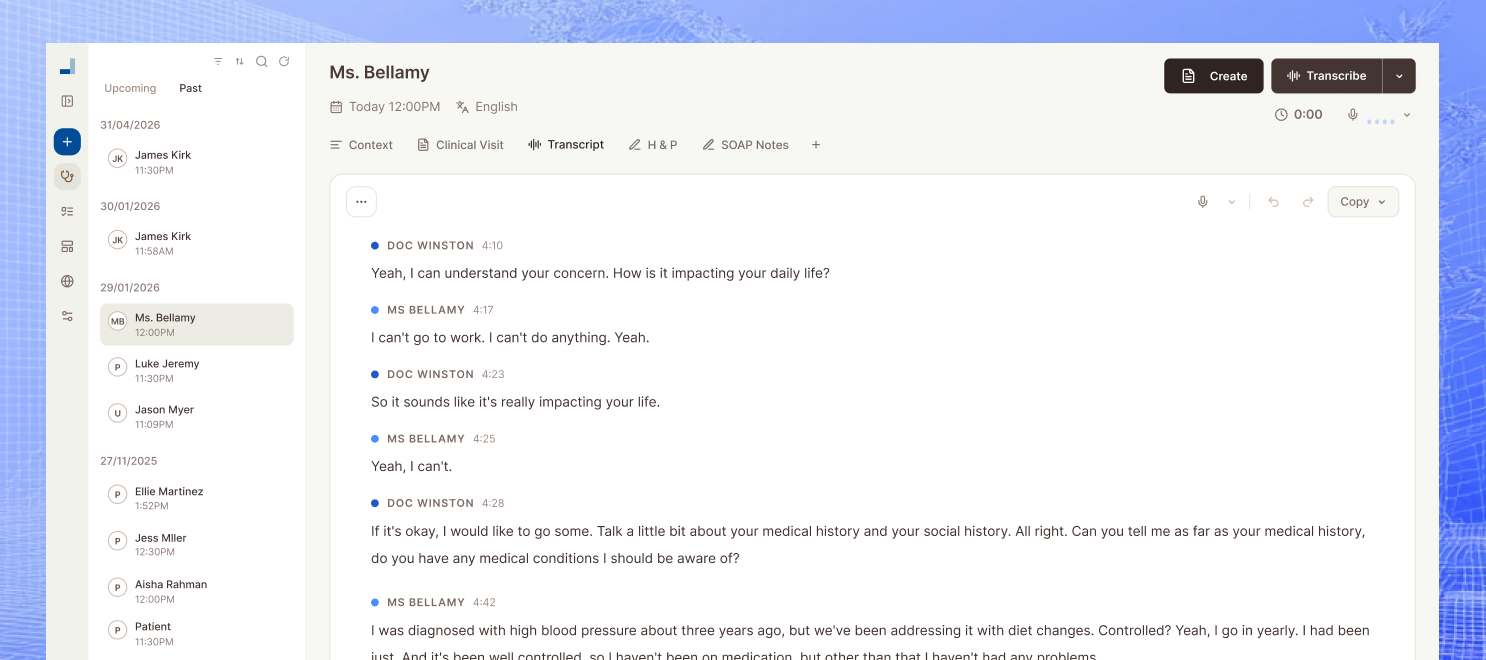
Mcoy AI is designed specifically to reduce administrative errors in clinical notes by supporting doctors at the point where mistakes most often happen. It records and transcribes patient encounters in real time, then turns them into structured clinical notes such as SOAP notes, tailored to each specialty.
Instead of relying on memory after a long clinic session, doctors can review accurate, encounter-based drafts that reflect what was actually discussed. With over 200 customisable templates built for different specialties, Mcoy AI ensures consistency while allowing clinicians to maintain their own documentation style.
Beyond note generation, Mcoy AI allows doctors to chat with their encounters, generate letters, forms, and documents, and manage clinical knowledge without jumping between tools. By reducing manual typing, copy-pasting, and after-hours charting, it helps clinicians focus on care while improving documentation accuracy and reliability.
Training the team, not just the individual
Reducing admin errors is not solely an individual responsibility. Clinics that address documentation as a team process tend to see better results. This includes agreeing on note standards, reviewing anonymised examples, and aligning on what “good documentation” looks like in practice.
Short, focused training sessions are often more effective than long policy documents. Reviewing real cases where documentation caused confusion or rework can help clinicians see the value of improved processes. Importantly, the goal should be support, not blame.
When documentation systems and expectations are aligned across the clinic, individual doctors spend less mental energy trying to remember what to include and more time on clinical reasoning.
Using technology as support, not surveillance
Some clinicians worry that documentation tools add another layer of complexity or oversight. In reality, the right technology should feel invisible. It should reduce clicks, reduce duplication, and reduce cognitive load.
Technology works best when it supports existing workflows rather than forcing clinicians to adapt to rigid systems. Tools that integrate smoothly into daily practice and adapt to specialty-specific needs are far more likely to reduce errors than generic solutions.
The key question to ask is simple: does this tool make it easier to capture accurate information at the right time, or does it add another step to an already crowded workflow?
Building a habit of quick review and validation
Even with better systems, a brief review step remains important. A quick validation of key elements such as diagnoses, medications, and follow-up plans can catch most admin errors before they become part of the permanent record.
This review does not need to be time-consuming. When notes are well-structured and generated from accurate encounter data, reviewing becomes faster and less mentally taxing. Over time, this habit replaces lengthy after-hours charting with short, confident sign-offs.
Long-term benefits of reducing admin errors
Clinics that successfully reduce documentation errors often notice benefits beyond compliance and accuracy. Doctors report less stress around notes, improved confidence in their records, and better communication within care teams.
Patients also benefit. Clear notes support better continuity of care, fewer misunderstandings, and more reliable follow-up. In an environment where healthcare systems are under increasing pressure, small improvements in documentation quality can have a surprisingly large impact.
What a serious review table should cover
| Decision area | Common mistake | Better clinic-ready approach | Metric to watch |
|---|---|---|---|
| Workflow design | Treat how to reduce admin errors in clinical notes as a one-off documentation task | Build a repeatable process with clear ownership and review points | Time to complete documentation |
| Team adoption | Assume every clinician will naturally use the same process | Train for consistency and define exception handling early | Active user adoption |
| Quality review | Only check notes when a problem is reported | Audit a sample of notes weekly and review edge cases | Edit rate per note |
| Operational follow-through | Leave admin actions outside the documentation workflow | Use the same encounter data for referrals, letters, and follow-up tasks | Completion rate for next-step tasks |
Related reading
If you are working through how to reduce admin errors in clinical notes, it helps to read this alongside Admin Management: Medication List Template with Examples, Admin Management: How to Improve Handover Notes with an AI Medical Scribe, and AI & Medicine: How Doctors Can Reduce Administrative Work Without Hiring More Staff. Those guides cover adjacent workflow, implementation, and evaluation questions so the decision does not sit in isolation.
FAQ
What are the most common admin errors in clinical notes?
The most common errors include missing key information, copying outdated data, incorrect dates or patient details, and unclear assessment or plans. These often happen due to time pressure and delayed documentation.
Can better templates really reduce errors?
Yes, when templates are designed around real clinical workflows. Well-structured templates act as cognitive support, reminding clinicians to include essential elements without forcing generic text.
Is real-time documentation intrusive for patients?
When done correctly, no. Tools that capture encounters passively allow doctors to maintain eye contact and focus on the patient, often improving the consultation experience rather than disrupting it.
Do small clinics benefit as much as hospitals?
In many cases, small clinics benefit even more. With fewer administrative resources, reducing documentation errors can significantly lower rework, billing issues, and after-hours workload for doctors.
How long does it take to see improvements?
Clinics often see reductions in admin errors within weeks once workflows are adjusted and supportive tools are in place. The biggest gains usually come from capturing information earlier and standardising structure.