Practice Operations: Roll Out AI Scribing Without Disrupting Clinic Flow
Learn how to implement AI scribing in your clinic without disrupting patient flow. Improve documentation, reduce burnout, and master your workflow today.
What a medical scribe solves in modern practice
The modern clinical landscape is often defined by the ‘pajama time’ phenomenon, where doctors spend hours after clinic finishing charts. This administrative tax lead to significant cognitive load, where the clinician is more focused on the screen than the human sitting in front of them. When notes are delayed, critical details regarding patient history or nuanced symptoms can be lost, potentially impacting the quality of care and increasing medico-legal risks.
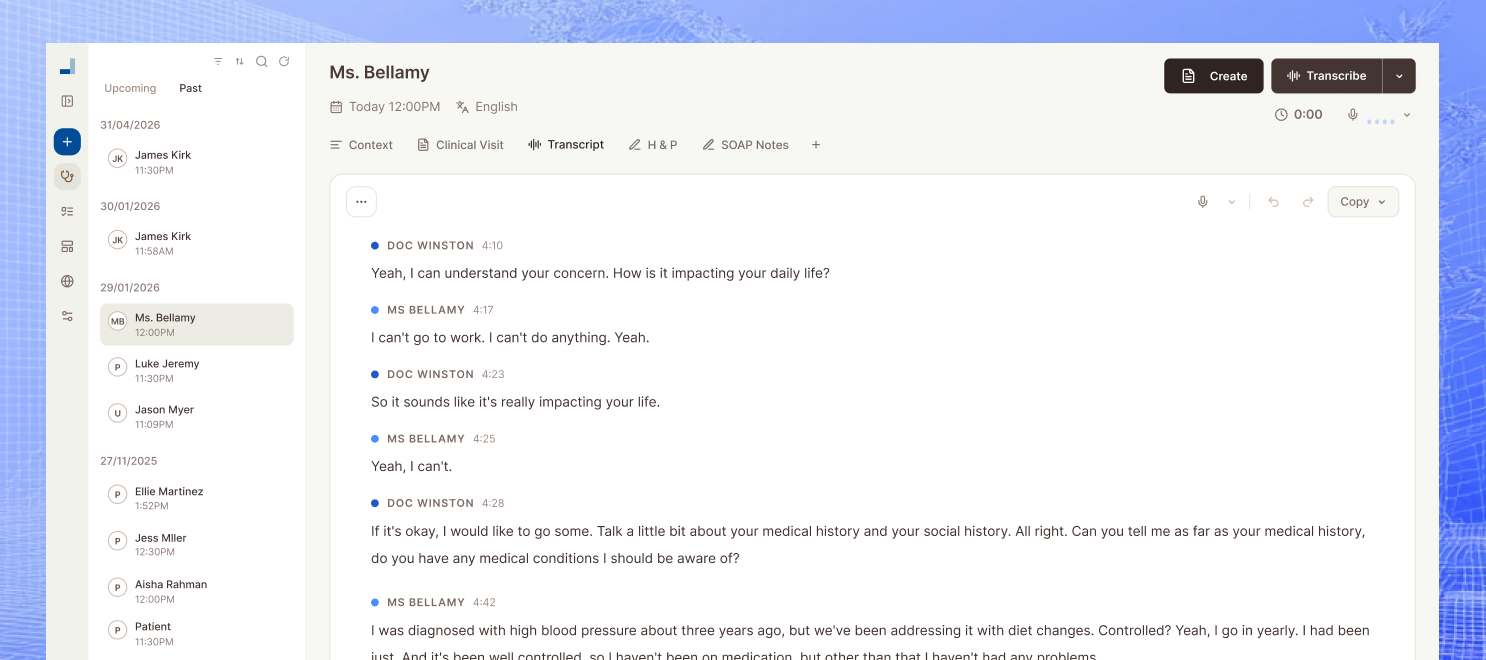
An AI medical scribe acts as an invisible assistant that captures the dialogue of the encounter in real-time. It is important to distinguish that while the technology is powerful, it is strictly assistive. The clinician remains the ultimate authority, responsible for reviewing and signing off on every document. By offloading the mechanical task of typing and formatting, doctors can reclaim their focus, leading to more meaningful patient interactions and more accurate representations of the visit.
- Reduces administrative burnout and eliminates hours of after-clinic charting.
- Enhances patient-provider eye contact by removing the digital barrier.
- Captures granular details that are often forgotten during manual dictation.
- Serves as an assistive tool where the clinician retains final oversight.
Note types you can generate beyond SOAP (H&P and more)
While the SOAP note is the standard for daily progress, complex clinical encounters often require more specialized documentation. For instance, a first-time patient requires a comprehensive History and Physical (H&P) that covers extensive background, while a surgical case needs a detailed procedure note. Using a tool that can pivot between these formats ensures that the documentation matches the clinical intent of the visit rather than forcing every patient into a one-size-fits-all template.
Structure is vital for continuity of care, especially in university clinics or multi-disciplinary environments. Clear consult notes ensure that specialists understand exactly what is being asked of them, and concise referral letters facilitate smoother transitions between care levels. For hospital-based practitioners, discharge summaries that can be generated quickly from encounter data reduce wait times for patients and improve the flow of the entire facility.
- Supports H&P, consult notes, and complex procedure documentation.
- Facilitates better handovers with clear, structured referral letters.
- Improves audit readiness through high-quality, standardized formatting.
- Enables rapid generation of discharge summaries for better hospital flow.
How to implement AI scribing step-by-step in a real clinic
Success starts with a limited scope to prevent overwhelming the staff. Choose one specific visit type, such as routine follow-ups or wellness exams, to pilot the software. This allows you to get a feel for the recording process without the pressure of a complex diagnostic case. Once you are comfortable, you can begin selecting or customizing templates that align with your specialty’s specific requirements.
During the patient encounter, simply place your recording device in a central location where both voices are audible. There is no need to change how you speak; the AI is designed to understand natural conversational flow. After the visit is over, the transcription and initial draft should be available almost instantly. This is the moment to perform a quick review to ensure all key clinical decisions are accurately reflected.
The real efficiency gain happens after the note is finalized. You can immediately reuse the captured encounter data to generate secondary documents like work excuses, referral letters, or patient education summaries. This integrated approach ensures that the time spent in the room with the patient yields all the administrative outputs required, effectively killing several birds with one stone.
- Begin with a pilot phase focusing on one simple visit type.
- Select specialty-specific templates to ensure relevant data capture.
- Capture natural conversation without the need for robotic dictation.
- Repurpose the encounter data for letters and administrative forms.
How to keep note quality high and reduce mistakes
AI tools are highly capable but can occasionally suffer from ‘note bloat’ or documentation of irrelevant details. To maintain high quality, clinicians should establish a habit of ‘active reviewing.’ This means checking for specific data points like medication dosages, specific dates, or numeric values that are critical to the medical record. Relying blindly on any automated output is a risk that is easily mitigated with a sixty-second verification step.
Team standards also play a role in quality control. Setting expectations within the clinic for how notes should look—such as preferred terminology or standardized problem lists—helps the AI learn through consistent editing. Over time, as you refine your habit of correcting the draft, the output becomes more tailored to your unique clinical voice, reducing the time needed for subsequent edits.
- Perform a focused review of dosages, dates, and objective values.
- Prevent note bloat by selecting succinct templates for simple visits.
- Establish clinic-wide standards for documentation terminology.
- Refine your ‘clinical voice’ through consistent, minor edits.
Privacy, consent, and patient trust (plain English)
Transparency is the foundation of patient trust when using recording technology. While laws vary by jurisdiction, the best practice is always to obtain verbal consent. Patients rarely object when they understand that the technology allows their doctor to listen more intently and document their concerns more accurately. It is helpful to frame the conversation around the quality of care rather than the technology itself.
A simple way to explain this to a patient is: “I am using a medical assistant tool today that captures our conversation so I can focus on you instead of my computer. It helps me make sure I don’t miss any of your concerns. Is it alright if I turn it on?” This approach is honest and centers the benefit for the patient. Behind the scenes, ensure that the platform you choose adheres to high-level security standards, ensuring that data is encrypted and handled according to local healthcare privacy regulations.
- Always prioritize transparent, verbal consent with every patient.
- Frame the technology as a way to improve focus and care quality.
- Adhere to regional data security and retention protocols.
- Choose platforms that utilize high-level encryption for patient data.
Rolling it out across a clinic without disruption
A phased rollout is much more effective than a ‘big bang’ implementation. Start with a two-week pilot involving one or two ‘tech-champion’ clinicians who can identify potential friction points. During this time, monitor basic metrics like how much time is saved on charting and whether the clinicians are leaving the office earlier. These small wins build momentum and buy-in from the rest of the medical staff.
Training should be hands-on but brief. Most clinicians today are tech-literate and only need to understand the workflow of starting a recording and selecting a template. Alignment is also key; ensuring that all providers in a university or multi-specialty clinic are using similar templates helps with internal peer reviews and administrative consistency. Once the pilot is successful, roll the system out to other departments one by one.
- Launch with a 14-day pilot using a small group of clinicians.
- Track time-savings and ‘pajama time’ reduction as key KPIs.
- Standardize templates across the clinic for consistent reporting.
- Provide brief, workflow-focused training sessions for all staff.
Mcoy AI is an AI medical scribe that records and transcribes patient encounters, then generates multiple clinical note types (H&P, progress notes, consult notes, follow-up notes, procedure notes, discharge summaries, referral letters, and more). With over 200 customizable templates and an AI chat feature to create letters, forms, and documents, it streamlines the heavy lifting of medical documentation so clinicians can focus on what matters most. It fits into the existing workflow seamlessly, helping practitioners move from patient to patient without a backlog of paperwork.
Conclusion
Implementing a new workflow does not have to be a source of stress. By following a structured approach—starting small, focusing on quality, and maintaining transparency with patients—any clinic can successfully integrate modern technology. The transition from manual typing to automated capture marks a significant shift toward a more sustainable way of practicing medicine. When you decide to roll out AI scribing, you aren’t just buying software; you are investing in the well-being of your staff and the quality of your patient relationships. Start your pilot today and reclaim your clinical focus.
What a serious review table should cover
| Decision area | Common mistake | Better clinic-ready approach | Metric to watch |
|---|---|---|---|
| Workflow design | Treat roll out ai scribing without disrupting clinic flow as a one-off documentation task | Build a repeatable process with clear ownership and review points | Time to complete documentation |
| Team adoption | Assume every clinician will naturally use the same process | Train for consistency and define exception handling early | Active user adoption |
| Quality review | Only check notes when a problem is reported | Audit a sample of notes weekly and review edge cases | Edit rate per note |
| Operational follow-through | Leave admin actions outside the documentation workflow | Use the same encounter data for referrals, letters, and follow-up tasks | Completion rate for next-step tasks |
Related reading
If you are working through roll out ai scribing without disrupting clinic flow, it helps to read this alongside Practice Operations: How Clinics Can Streamline Daily Operations, Practice Operations: How Clinics Can Improve Workflow Without Changing Their EHR, and Specialty Guides: How to Use an AI Scribe for Cardiology Clinic Notes. Those guides cover adjacent workflow, implementation, and evaluation questions so the decision does not sit in isolation.
FAQ
How accurate are AI medical scribes in real clinics?
AI medical scribes currently offer very high accuracy, often exceeding 90% for general transcription. However, accuracy can depend on the clarity of audio and the complexity of medical terminology used. Clinicians should always treat the output as a draft and perform a final check for clinical accuracy. Most users find that while it isn’t perfect, it is significantly faster than typing from scratch.
Do I still need to review every note?
Yes, reviewing every note is a professional and legal requirement for any clinician. The AI is a tool to assist with drafting, but the responsibility for the medical record’s accuracy remains with the provider. A quick review usually takes less than a minute and ensures that critical data like medication changes and diagnoses are correct. This habit is essential for maintaining high standards of care.
What note types can an AI scribe generate besides SOAP?
Modern AI scribes are capable of generating a wide variety of documentation beyond standard SOAP notes. This includes History and Physicals (H&P), complex procedure notes, consult notes, and follow-up summaries. Many systems also allow you to generate non-clinical documents like referral letters or school excuses based on the encounter data. This versatility makes the tool useful for almost every specialty.
Will this work for telehealth and in-person consults?
AI scribes are designed to work seamlessly in both telehealth and in-person environments. For telehealth, the system usually captures audio directly from the computer or through a mobile app. For in-person visits, a simple smartphone or tablet placed on the desk is enough to capture the conversation. The flexibility of these tools allows for a consistent documentation workflow regardless of how the patient is seen.
How do I explain recording/transcription to patients?
The best way to explain it is by highlighting the benefits to the patient, such as better eye contact and more focused attention. You might say, “In order to give you my full attention today, I’m using a secure tool to help me with my notes.” Most patients are very receptive when they see that it results in their doctor spending more time looking at them and less time at the keyboard. Consent should always be documented according to your clinic’s policy.
How do clinics prevent note bloat?
Clinics can prevent note bloat by using concise, specialty-specific templates that only capture relevant information. It is also helpful to train clinicians to perform a quick edit of the generated note to remove repetitive or unnecessary narrative. Setting clear expectations for note length and detail during the rollout phase helps maintain a clean and professional medical record. AI systems with ‘concise’ settings can also help mitigate this issue.
How long does template setup take?
For most clinics, basic template setup takes very little time because many platforms come with pre-built libraries for various specialties. Customizing a template to fit your specific needs can take anywhere from 10 to 30 minutes. Once a template is set, it can be used repeatedly, providing long-term time savings. Most clinicians fine-tune their templates over the first week of use as they see the results of their initial encounters.
What’s the safest way to start if I’m skeptical?
The safest approach is to start with a “shadow pilot” where you use the AI scribe alongside your traditional charting method. Pick your three easiest appointments of the day and use the AI for those just to see the output quality without the pressure of relying on it. You can compare the AI note to your manual note to gain confidence in the system’s ability to capture clinical nuance. Gradually increase usage as your trust in the tool grows.