AI & Medicine: Reduce Missing Details in Clinical Notes With AI | Full Guide
Eliminate clinical documentation gaps. Learn how AI scribes improve note accuracy, capture missed details, and streamline your medical workflow efficiently.
What a medical scribe solves in modern practice
The traditional method of documenting patient encounters is increasingly out of sync with the pace of modern medicine. Doctors and clinic owners often face a staggering cognitive load as they attempt to track complex symptoms, medication histories, and social determinants of health while simultaneously maintaining a human connection with the patient. This leads to the ‘pajama time’ phenomenon, where clinicians spend hours after clinics closing to finish charts, often relying on memory rather than real-time data.
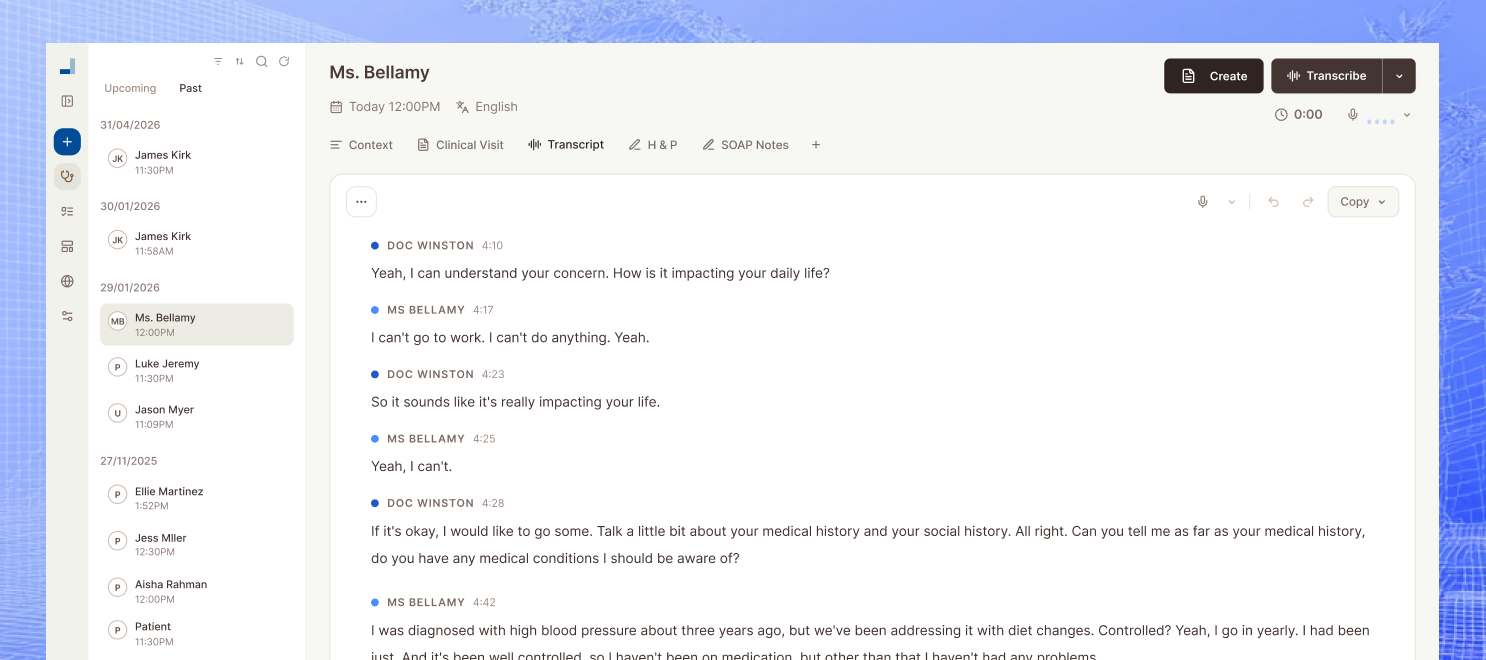
An AI medical scribe acts as a cognitive bridge, capturing the nuance of the conversation without the clinician needing to type or scribble notes during the visit. It is essential to recognize that these tools are assistive technologies; they are designed to provide a comprehensive draft that mirrors the actual encounter. This shift allows the clinician to remain the final arbiter of medical truth while removing the mechanical burden of transcription and organization.
- Eliminates the ‘documentation gap’ caused by delayed charting.
- Reduces clinician burnout by automating the first draft of every note.
- Captures specific patient phrasing and symptoms often missed in manual notes.
- Focuses on accuracy while leaving the final clinical sign-off to the practitioner.
Note types you can generate beyond SOAP (H&P and more)
While the SOAP note is the industry standard, medical practice requires a far more diverse range of documentation to provide high-quality care. Accurate clinical notes must adapt to the context of the visit. For instance, a new patient requires a comprehensive History and Physical (H&P), whereas a recurring surgical patient needs a detailed procedure note or a succinct follow-up summary. Reliance on a single format often results in missing details that are critical for specialist referrals or audit readiness.
Modern AI solutions allow for the seamless generation of consult notes, discharge summaries, and referral letters. By choosing the right structure for the right encounter, clinics ensure that handover quality remains high and continuity of care is never compromised. This diversity in documentation ensures that whether a doctor is in a university clinic or a private practice, the output meets the specific regulatory and clinical standards required for that specific encounter type.
- History and Physical (H&P) for comprehensive new patient intakes.
- Procedure and consult notes for specialized surgical and diagnostic visits.
- Discharge summaries and referral letters to facilitate smooth care transitions.
- Customizable follow-up notes that track progress over long-term treatment.
How to implement clinical notes with AI step-by-step in a real clinic
Taking the first step toward automation shouldn’t disrupt the existing clinic flow. A successful implementation begins by selecting one specific visit type, such as routine follow-ups or initial consultations, to test the workflow. This allows the team to get comfortable with the technology in a lower-stakes environment before scaling it across the entire practice. Once a visit type is chosen, the clinician sets up specific templates tailored to their specialty to ensure the output matches their preferred style.
During the encounter, the clinician captures the conversation through the AI interface, whether the patient is sitting in the room or attending via a telehealth platform. There is no need to change how the doctor speaks or interacts; the AI is designed to understand natural clinical dialogue. Immediately after the patient leaves, the clinician reviews the generated draft, making quick edits to ensure precision and nuance are captured correctly.
Finally, the clinician can reuse these outputs to generate secondary documents like referral letters or school forms without rewriting the data. This narrative flow ensures that the information captured at the point of care flows through every necessary administrative channel. This systematic approach reduces training time and ensures that the transition to AI-supported charting is both sustainable and measurable.
- Begin with a pilot program for one specific visit type to build confidence.
- Configure specialty-specific templates to maintain consistent terminology.
- Review drafts immediately post-encounter for maximum accuracy and speed.
- Leverage the AI output to auto-populate letters, forms, and summaries.
How to keep note quality high and reduce mistakes
Even with advanced technology, maintaining high-quality clinical notes requires a strategy. Common failure points in documentation often include missing medication dosages, incorrect laboratory values, or the dreaded ‘note bloat’ where irrelevant information masks the critical clinical findings. To combat this, clinicians should adopt a lightweight review habit, spending sixty seconds at the end of each draft to verify specific data points against the actual encounter.
Establishing team-wide standards for what a ‘complete’ note looks like helps maintain consistency across multi-provider clinics. This is especially vital in university clinics where multiple residents or specialists may see the same patient. By setting these benchmarks, the clinic ensures that the AI output is not just a transcript, but a structured clinical document that supports better patient outcomes and protects against medico-legal risks.
- Verify high-risk data like medication names and dosages for every note.
- Focus on clarity and brevity to prevent note bloat in EHR systems.
- Establish a standard ‘review checklist’ for all clinical staff members.
- Utilize templates that prioritize the most relevant clinical problem lists.
Privacy, consent, and patient trust (plain English)
The introduction of any recording technology into the exam room requires a foundation of trust. Privacy and consent are not just legal hurdles; they are essential for the patient-provider relationship. While consent requirements vary by region, it is best practice to follow local health privacy regulations. Clinicians should always inform the patient how their data is being used and ensure that recordings are handled according to secure retention principles.
Explaining this to patients doesn’t have to be complicated. A simple script—such as ‘I’m using an AI assistant to help me listen more and type less, so I can focus entirely on you’—is usually all that is needed. Most patients appreciate the extra attention and are happy to know their records will be more accurate. Transparency regarding data encryption and the fact that the AI is purely assistive helps alleviate any concerns about secondary use of information.
- Check local and regional regulations for specific medical consent requirements.
- Use a simple, patient-centered script to explain the AI’s role in the room.
- Ensure the solution follows strict data security and encryption standards.
- Explain that the recording is used only to create a more accurate chart.
Rolling it out across a clinic without disruption
A clinic-wide rollout is a marathon, not a sprint. Start with a two-week pilot involving one or two ‘tech-forward’ clinicians who can provide feedback and establish a baseline for time savings. During this period, track metrics such as the reduction in after-hours charting and the time to note completion. This data serves as a powerful motivator for more skeptical staff members once the pilot concludes.
Training should focus on template alignment so that every physician’s notes look and feel like their own. When the system is finally rolled out to the entire clinic, the transition feels like a natural evolution of the workflow rather than a disruptive change. By aligning the AI’s output with the existing EMR structure, clinics can avoid the friction often associated with new software implementations.
- Run a 14-day pilot with early adopters to gather performance data.
- Measure ‘time saved’ and ‘note completion rates’ to prove ROI.
- Provide template-specific training to ensure high-quality outputs.
- Integrate the workflow gradually to avoid disrupting the daily patient schedule.
Mcoy AI is an AI medical scribe that records and transcribes patient encounters, then generates multiple clinical note types including H&P, progress notes, consult notes, follow-up notes, procedure notes, discharge summaries, referral letters, and more. With over 200 customizable templates and an interactive AI chat, clinicians can quickly create letters, forms, and specialty-specific documents. The platform is designed to be helpful and intuitive, ensuring that practitioners spend less time on manual data entry and more time delivering high-quality patient care.
Conclusion
Transitioning toward an automated workflow is the most effective way to reduce missing details in clinical notes with AI. By capturing the full patient encounter and utilizing diverse templates beyond the standard SOAP format, clinics can ensure higher accuracy and better compliance. High-quality clinical notes with AI not only save time but also enhance the quality of care by allowing doctors to lead with their eyes rather than their keyboards. Starting a pilot today is the first step toward reclaiming your personal time and improving the professional standards of your practice.
What a serious review table should cover
| Decision area | Common mistake | Better clinic-ready approach | Metric to watch |
|---|---|---|---|
| Workflow design | Treat reduce missing details in clinical notes with ai | full guide as a one-off documentation task | Build a repeatable process with clear ownership and review points |
| Team adoption | Assume every clinician will naturally use the same process | Train for consistency and define exception handling early | Active user adoption |
| Quality review | Only check notes when a problem is reported | Audit a sample of notes weekly and review edge cases | Edit rate per note |
| Operational follow-through | Leave admin actions outside the documentation workflow | Use the same encounter data for referrals, letters, and follow-up tasks | Completion rate for next-step tasks |
Related reading
If you are working through reduce missing details in clinical notes with ai | full guide, it helps to read this alongside AI & Medicine: How to Simplify Clinical Notes for Busy Doctors, AI & Medicine: How Doctors Can Improve SOAP Notes, and Compare & Choose: Best Guide: Keeping AI Notes Aligned with Clinic Standards. Those guides cover adjacent workflow, implementation, and evaluation questions so the decision does not sit in isolation.
FAQ
How accurate are AI medical scribes in real clinics?
AI medical scribes are highly accurate in capturing the verbatim dialogue of a clinical encounter, often exceeding the detail found in manual notes. They excel at identifying symptoms, medications, and plans discussed during the visit. However, the accuracy still relies on a clear conversation between the doctor and patient. The clinician must always perform a final review to ensure the AI has correctly interpreted clinical nuances.
Do I still need to review every note?
Yes, reviewing every note is a fundamental requirement for medical and legal accountability. While an AI scribe creates a near-finished draft, the clinician is the only person qualified to verify medical facts and clinical decisions. Treating the AI output as a draft that requires a final sign-off ensures that the medical record remains an accurate representation of the provider’s professional judgment.
What note types can an AI scribe generate besides SOAP?
Modern AI scribes are capable of generating a wide variety of documentation beyond the standard SOAP note. This includes History and Physical (H&P) summaries, specialized consult notes, detailed procedure reports, and discharge summaries. They can also create referral letters and insurance justification forms based on the data captured during the encounter, making them versatile tools for any specialty.
Will this work for telehealth and in-person consults?
AI scribes are designed to be flexible and work seamlessly across both telehealth and in-person environments. For telehealth, the AI typically listens to the audio stream of the virtual meeting, while in-person consults are captured via a mobile device or computer microphone. The technology is capable of filtering out ambient noise to focus on the clinician-patient interaction regardless of the setting.
How do I explain recording/transcription to patients?
The best way to explain the technology is to focus on the benefits to the patient. You might say, ‘I’m using an AI tool to record our conversation so I can focus on listening to you instead of looking at my screen.’ Most patients are comfortable with this when they understand it leads to more focused care and better-quality medical records. Always follow your clinic’s specific protocol for obtaining and documenting patient consent.
How do clinics prevent note bloat?
Clinics prevent note bloat by utilizing concise templates and setting specific AI parameters for brevity. Most AI scribes allow you to choose between ‘narrative’ or ‘concise’ styles to match your preference. By focusing on relevant clinical findings rather than transcribing every single word spoken, the AI helps keep the EHR clean and easy to navigate for other healthcare providers.
How long does template setup take?
Setting up basic templates usually takes only a few minutes, especially when using pre-existing library options. Customizing these templates to fit a specific specialty or a unique workflow might take 30 to 60 minutes of initial configuration. Once these templates are established, they can be used across hundreds of visits with minimal further adjustment, providing long-term time savings for the entire team.
What’s the safest way to start if I’m skeptical?
The safest way to begin is with a small-scale pilot focused on non-complex patient visits, such as wellness checks or routine follow-ups. This allows you to witness the quality of the transcription and the time-saving benefits without the pressure of a complex case. As you build trust in the tool’s ability to capture clinical details, you can gradually expand its use to more complex consultations and various note types.