Specialty Guides: Reduce Medico-Legal Risk with Better Documentation Guide
Learn how to reduce medico-legal risk through precise clinical documentation. Explore note types, AI workflows, and templates for safer medical practice.
The Documentation Burden and Clinical Risk
Every clinician knows the sinking feeling of staring at a blank screen at 8:00 PM, trying to recall the specific nuances of a complex patient encounter from six hours prior. After-hours charting is more than just a time-sink; it is a primary driver of physician burnout and a significant source of medico-legal anxiety. When notes are rushed or written under fatigue, critical details regarding clinical reasoning, negative findings, and patient non-compliance often slip through the cracks, leaving the practitioner vulnerable in the event of an audit or litigation.
This guide provides a comprehensive roadmap for transforming your documentation workflow. We will explore how to diversify your note formats beyond the standard SOAP structure, implement quality control measures that stick, and maintain high standards of privacy. Whether you are a solo GP, a specialist managing complex consults, or an administrator at a university clinic, these strategies are designed to ensure your records are both medically accurate and legally robust.
What a medical scribe solves in modern practice
The real cost of documentation isn’t just the minutes spent typing; it’s the cognitive load that distracts from patient care. Delayed notes lead to ‘recall bias,’ where the clinician inadvertently fills in gaps with what usually happens rather than what actually happened during that specific visit. This inconsistency is exactly what plaintiff attorneys look for. An incomplete record is often interpreted by courts as care that didn’t happen, making meticulous documentation your best defense.
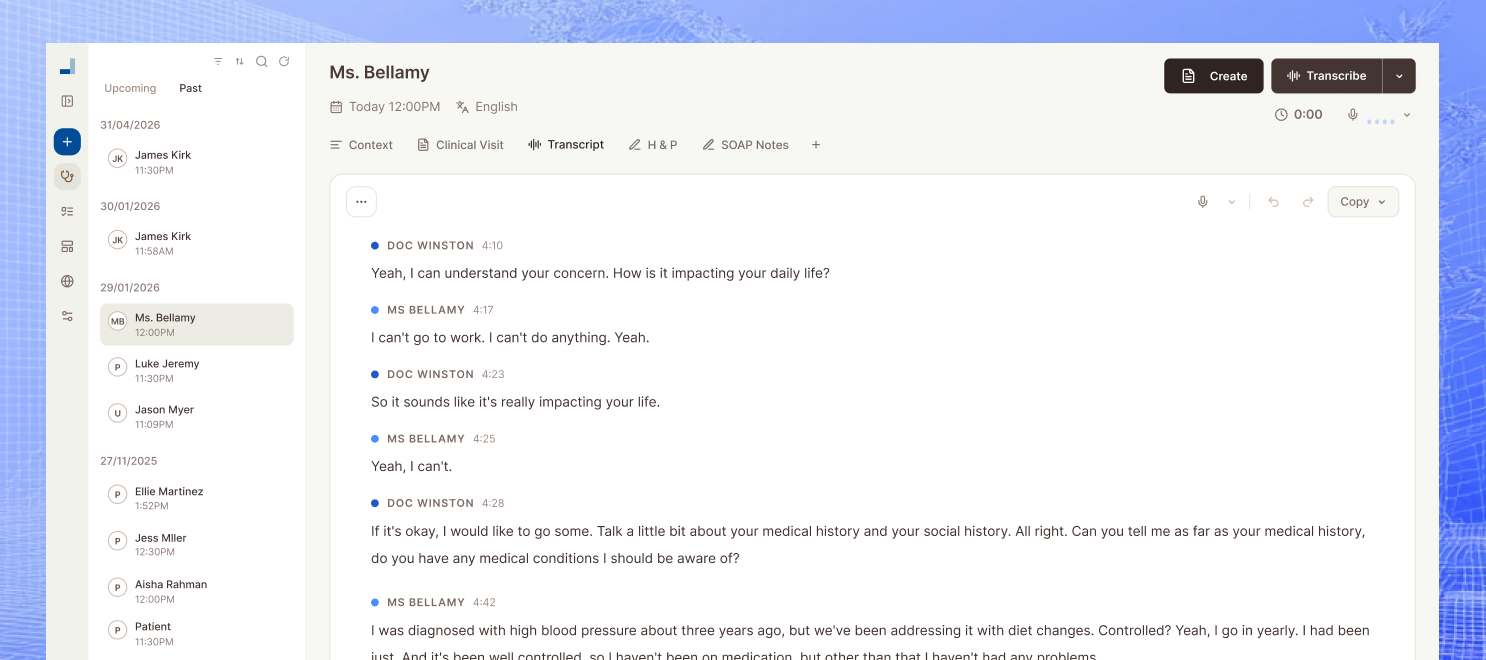
Modern AI medical scribes act as an assistive layer, capturing the raw data of a conversation so the clinician can focus on the human in the room. It is important to remember that these tools are assistive, not autonomous. The clinician remains the ultimate authority, responsible for reviewing and verifying every claim. By capturing the dialogue in real-time, the scribe ensures that the ‘reasoning’ behind a decision—the most vital part of medico-legal defense—is preserved accurately.
- Eliminates recall bias by allowing for real-time data capture during the patient encounter.
- Reduces cognitive load, allowing doctors to maintain better eye contact and patient rapport.
- Provides a detailed transcript that serves as the foundation for various clinical note types.
- Ensures that subtle patient concerns and clinician explanations are not omitted from the final record.
Note types you can generate beyond SOAP (H&P and more)
While the SOAP note is the industry standard, it isn’t always the most effective way to document complex medical histories or specialized procedures. For instance, a detailed History and Physical (H&P) requires a broader narrative of the patient’s past than a standard follow-up. Using the wrong format can lead to ‘note bloat’ or, conversely, a lack of necessary detail that could be crucial during a peer review or legal inquiry. Structure matters because it dictates the clarity of the handover and the readiness of the file for an audit.
Consult notes and referral letters require a different tone and data set, focusing heavily on the specific question asked by the referring physician. Procedure notes must be granular, detailing every step taken and the patient’s immediate response. By diversifying your documentation types—including progress notes, follow-up notes, and discharge summaries—you create a longitudinal record that facilitates continuity of care. High-quality documentation acts as a communication tool that protects both the patient’s health and the provider’s reputation.
- H&P and Progress Notes: Essential for tracking long-term patient trajectories and acute changes.
- Consult Notes and Referral Letters: Vital for professional communication and clear care transitions.
- Procedure Notes: Documenting specific interventions, risks discussed, and immediate outcomes.
- Discharge Summaries: Ensuring the next phase of care is clearly outlined for the patient and other providers.
How to implement reduce medico-legal risk with better documentation step-by-step
To reduce medico-legal risk with better documentation, start small by selecting a single, high-volume visit type. Transitioning your entire workflow overnight is often overwhelming and leads to errors. Begin by using your documentation tool for standard follow-ups before moving to complex new patient intakes. This allows you to calibrate the AI to your specific voice and clinical style without the pressure of a complicated case.
Next, set up specific templates tailored to your specialty. If you are in a university clinic or a specialized private practice, your requirements for a ‘complete’ note will differ from a general practitioner. Ensure your templates include dedicated sections for clinical reasoning and patient education. During the encounter, whether in-person or via telehealth, focus on verbalizing your findings as you go—this acts as an ‘audio’ physical exam that the scribe can accurately transcribe into the note.
Once the encounter is over, establish a ‘Review and Edit’ habit. Never sign off on a note immediately without a quick scan for accuracy, especially regarding medications and dosages. Finally, reuse these outputs to populate referral letters or patient instruction forms. This ensures that the information shared with the patient and other doctors is perfectly aligned with the official clinical record, closing the loop on potential communication errors.
- Start with one visit type to master the workflow before scaling to complex cases.
- Customize templates to ensure all specialty-specific legal requirements are met.
- Verbalize findings during the exam to ensure the scribe captures physical observations.
- Always perform a final human review to verify dosages, dates, and specific patient instructions.
How to keep note quality high and reduce mistakes
Quality documentation is not about length; it is about accuracy and relevance. Typical failure points in medical records include ‘cloning’ or ‘copy-pasting’ previous notes, which can result in the wrong medication list or outdated vitals being carried forward. Note bloat—filling a record with irrelevant auto-populated data—makes it difficult for other clinicians (or a jury) to find the pertinent facts of the case. Focus on the ‘Assessment and Plan’ as the heart of your defense.
To maintain high standards, implement a lightweight review habit. This involves checking that the problem list is updated and that any ‘negative findings’ discussed are actually recorded. Team standards are also helpful; if everyone in the clinic uses the same structure for procedure notes or follow-up summaries, it becomes much easier to identify missing information during internal audits. Quality control should be a proactive habit, not a reactive response to an incident.
- Avoid note cloning by ensuring each encounter note reflects the current visit specifics.
- Focus on the logic behind the clinical plan to prove careful professional judgment.
- Establish clinic-wide documentation standards to ensure consistency across all records.
- Regularly audit a random sample of notes to identify and correct systemic errors early.
Privacy, consent, and patient trust (plain English)
Maintaining patient trust is just as important as the clinical record itself. When using transcription tools, transparency is key. You should follow your local regional policies regarding consent, as these can vary significantly. Generally, patients are supportive when they understand that the technology allows the doctor to pay more attention to them rather than a computer screen. Use a simple, non-preparatory script to explain how the data is handled.
A simple explanation might sound like: ‘To make sure I’m fully present with you today, I’m using a secure system to help me with my notes. It records our conversation and turns it into a medical summary for your chart. Is that okay with you?’ This approach centers the benefit on the patient’s experience. From a security standpoint, ensure that any tool you use adheres to industry-standard retention and encryption principles to protect sensitive health information.
- Always obtain verbal or written consent based on your specific local healthcare regulations.
- Explain the benefits to the patient, emphasizing increased engagement and note accuracy.
- Ensure the software used employs end-to-end encryption and follows data residency laws.
- Document the patient’s consent within the clinical note to maintain a clear legal trail.
Rolling it out across a clinic without disruption
Introducing a new documentation workflow requires a structured pilot plan to avoid clinical slowdowns. A two-week pilot with one or two ‘champion’ doctors allows for the identification of friction points before a full rollout. During this time, the focus should be on template alignment—ensuring the AI outputs match the existing EHR requirements of the clinic. This prevents the ‘double-work’ of editing AI notes to fit rigid EHR fields.
Track specific metrics during the rollout, such as the reduction in after-hours charting time and the speed of note completion. If clinicians are saving two hours a day, the morale boost will drive adoption across the rest of the team. Training sessions should be short and practical, focusing on how to edit and finalize notes rather than the technical backend of the software. A smooth transition preserves the clinic’s operational flow while drastically improving the quality of the legal record.
- Conduct a 14-day pilot with a small group of clinicians to refine note templates.
- Monitor time-saving metrics to prove the value proposition to the wider staff.
- Align AI outputs with existing EHR structures to minimize manual data entry.
- Provide focused training on the final review process to ensure medico-legal integrity.
Mcoy AI is an AI medical scribe that records and transcribes patient encounters, then generates multiple clinical note types including H&P, progress notes, consult notes, follow-up notes, procedure notes, discharge summaries, referral letters, and more. With over 200+ customizable templates and an interactive AI chat feature, clinicians can instantly create professional letters, forms, and documents from their encounter data. It is designed to fit seamlessly into diverse workflows, helping practitioners prioritize patient interaction while maintaining a high standard of clinical documentation.
Conclusion
Better documentation is the most effective shield a clinician has against legal challenges. By moving away from rushed, at-home charting and toward a structured, assistive workflow, you ensure that every clinical decision is recorded with clarity and precision. The goal is to create a record that is not just a summary of facts, but a testament to your professional judgment. Transitioning to modern tools allows you to reduce medico-legal risk with better documentation while simultaneously reclaiming your personal time. Start with a small pilot today and experience how clear, accurate notes can transform your practice and provide the peace of mind you deserve.
What a serious review table should cover
| Decision area | Common mistake | Better clinic-ready approach | Metric to watch |
|---|---|---|---|
| Workflow design | Treat reduce medico-legal risk with better documentation guide as a one-off documentation task | Build a repeatable process with clear ownership and review points | Time to complete documentation |
| Team adoption | Assume every clinician will naturally use the same process | Train for consistency and define exception handling early | Active user adoption |
| Quality review | Only check notes when a problem is reported | Audit a sample of notes weekly and review edge cases | Edit rate per note |
| Operational follow-through | Leave admin actions outside the documentation workflow | Use the same encounter data for referrals, letters, and follow-up tasks | Completion rate for next-step tasks |
Related reading
If you are working through reduce medico-legal risk with better documentation guide, it helps to read this alongside Specialty Guides: How to Run a More Efficient Medical Practice in 2026, Specialty Guides: How to Improve Patient Encounters, and Specialty Guides: How to Use an AI Scribe for Endocrinology Notes | Guide. Those guides cover adjacent workflow, implementation, and evaluation questions so the decision does not sit in isolation.
FAQ
How accurate are AI medical scribes in real clinics?
Modern AI scribes are highly accurate in capturing the nuances of clinical dialogue, often outperforming manual note-taking in terms of detail. However, their accuracy depends on clear verbalization and the quality of the audio captured. They are designed to serve as a robust draft that the clinician must then verify for complete clinical accuracy before signing off.
Do I still need to review every note?
Yes, the clinician remains the legally responsible party for the accuracy of the medical record. While AI significantly reduces the time spent writing, a human-in-the-loop review is essential to ensure that medications, dosages, and specific clinical plans are correctly reflected. This final check is a key step in reducing medico-legal risk.
What note types can an AI scribe generate besides SOAP?
Beyond the standard SOAP note, AI scribes can generate comprehensive History and Physicals (H&P), detailed procedure notes, consult letters to specialists, and discharge summaries. They can also create follow-up notes and referral letters by extracting the relevant data from the recorded encounter and applying it to specific clinical templates.
Will this work for telehealth and in-person consults?
Most AI scribing solutions are built to be versatile, functioning equally well in face-to-face office visits and via digital telehealth platforms. As long as the audio of the conversation is clear, the AI can process the information and generate a structured note, ensuring consistent documentation across all care delivery methods.
How do I explain recording/transcription to patients?
Transparency is the best approach; explaining that the tool allows you to focus 100% on the patient rather than taking notes usually builds rapport. A simple script highlighting the security of the system and the benefit of a more accurate medical record is often enough to gain patient consent and trust.
How do clinics prevent note bloat?
Note bloat is prevented by using smart templates that only include relevant fields and by training clinicians to focus on summary-style reviews. AI tools help by organizing data logically rather than just dumping a transcript into the file, allowing practitioners to keep the record concise and medically focused.
How long does template setup take?
Initial template setup can take as little as a few minutes if using pre-built industry standards, or an hour or two for highly customized specialty requirements. Most clinics find that after the first few days of use, they can fine-tune their templates to perfectly match their existing EHR workflow with minimal effort.
What’s the safest way to start if I’m skeptical?
The safest way to start is with a ‘shadow’ pilot—using the tool to record and generate notes for a small subset of non-complex patients while maintaining your old note-taking method. Once you see the accuracy and quality of the generated notes, you can gradually transition more of your workload to the new system.