Specialty Guides: How to Reduce Duplicate Documentation Using AI [Full Guide]
Learn how to reduce duplicate documentation using AI medical scribes. Streamline H&P, SOAP notes, and clinic workflows to eliminate admin burden and burnout.
What a medical scribe solves in modern practice
The burden of documentation is often cited as the primary driver of clinician burnout. Doctors frequently find themselves spending more time facing a screen than facing their patients, leading to delayed notes and a significant cognitive load that persists long after the clinic doors have closed. When you have to repeat the same patient history in a referral letter, a progress note, and a discharge summary, the inefficiency is palpable.
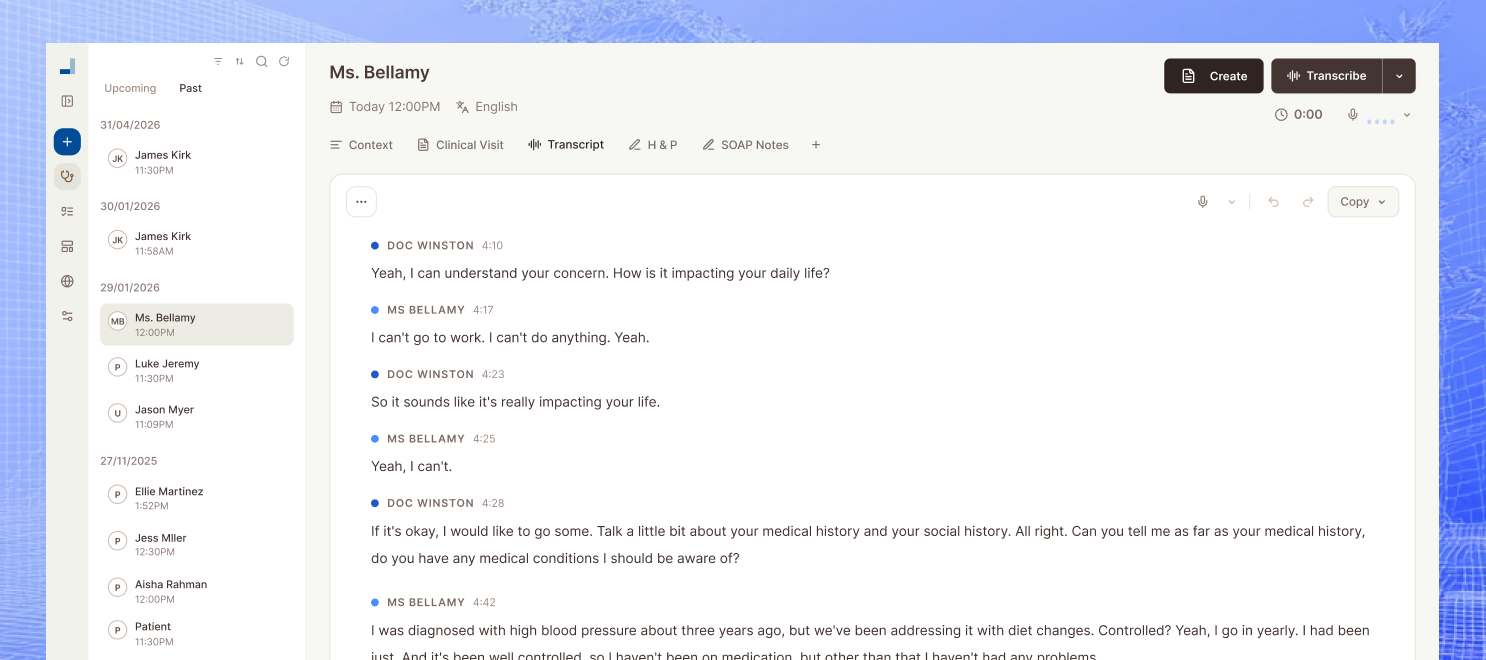
An AI medical scribe serves as an intelligent assistant that captures the nuances of a patient encounter in real-time. It is important to remember that these tools are assistive technologies; while they dramatically reduce the manual labor of typing, the clinician remains the final authority and must review all outputs for clinical accuracy. By automating the heavy lifting of transcription and summarization, providers can reclaim their evenings and focus on the patient in front of them.
- Eliminates the need for manual data entry during and after patient visits.
- Reduces the cognitive burden of remembering specific phrasing for different note types.
- Speeds up the turnaround time for finalized clinical records.
- Allows for a more natural, eye-contact-heavy patient encounter.
Note types you can generate beyond SOAP (H&P and more)
While the SOAP note is the industry standard for traditional clinic visits, modern healthcare requires a much broader range of documentation. Reducing duplicate documentation is about more than just one format; it is about ensuring that the initial data capture can populate various structured outputs without requiring the clinician to rewrite the same information multiple times. History and Physical (H&P) reports, for instance, require a different level of detail than a routine follow-up note.
Specialized documentation like consult notes, procedure notes, and referral letters often share core data points with the primary encounter record. By using an intelligent system, these specialized forms can be generated instantly from the same set of facts recorded during the visit. This ensures that the continuity of care is maintained across various healthcare settings, from the primary care office to the surgical suite.
Proper structure in documentation is not just about compliance; it is about audit readiness and high-quality handovers. When a specialist receives a referral letter that perfectly mirrors the latest encounter note, the risk of clinical error decreases significantly. Transitioning between formats should be a click of a button, not an hour of re-typing.
- H&P and Progress Notes for comprehensive longitudinal patient tracking.
- Consultation and Referral Letters generated from the same encounter data.
- Detailed Procedure Notes and Discharge Summaries for acute care transitions.
- Standardized formatting that improves audit scores and billing accuracy.
How do I reduce duplicate documentation using AI step-by-step in a real clinic
Implementing a new workflow starts with selecting a single, high-volume visit type to pilot. Rather than trying to automate every complex case immediately, focus on routine follow-ups or wellness exams where documentation tends to be repetitive. This allows the staff to build trust in the system and understand how the AI interprets the doctor-patient dialogue.
Next, you should align your digital templates with your specific specialty needs. A cardiologist and a pediatrician require different data points, so customizing the output ensures the AI focuses on what matters most to your practice. Once the template is set, simply activate the capture during the encounter, whether it is happening in-person at a university clinic or via a telehealth platform.
Following the encounter, move immediately to a rapid review phase. Instead of starting from a blank page, you are now an editor. Check the auto-generated note for accuracy, spend sixty seconds making any necessary adjustments, and finalize it. This habit prevents the ‘note debt’ that typically accumulates at the end of a busy shift.
Finally, utilize the ‘reuse’ function of modern systems. The same information captured during the HPI can be used to instantly populate a school note, a work excuse, or a referral form. This eliminate the need to look back at the chart five times just to fill out one simple document for a patient.
- Start with one common visit type to refine your internal workflow.
- Customize templates to match your specialty’s specific reporting requirements.
- Adopt a ‘Reviewer’ mindset to quickly finalize auto-generated drafts.
- Directly output encounter data into forms and letters to stop manual re-typing.
How to keep note quality high and reduce mistakes
One of the biggest risks in clinical documentation is ‘note bloat’—the inclusion of unnecessary information that obscures the critical clinical facts. Quality control starts with clear communication. By narrating your physical exam findings or articulating your assessment and plan out loud during the visit, you provide the AI with the high-quality data it needs to build an accurate note.
Establishing a lightweight review habit is essential for safety. Clinicians should quickly check for common failure points, such as incorrect medication dosages or misattributed symptoms, particularly if multiple problems were discussed in one visit. Over time, as you refine your verbal style, the AI learns to categorize information even more accurately, reducing the need for edits.
- Narrate physical findings out loud to ensure the AI captures objective data.
- Perform a ‘one-minute review’ of every note before signing off.
- Standardize team protocols for how problem lists should be updated.
- Use consistent terminology to minimize ambiguity in AI-generated summaries.
Privacy, consent, and patient trust (plain English)
Patient trust is the foundation of any medical practice. While AI tools are transformative, they must be used with transparent consent. It is helpful to explain to patients that the technology is there to allow you to focus on them rather than a computer screen. Most patients are supportive once they realize the doctor will be more present during the conversation.
A simple way to introduce this is by saying: ‘I’m using an AI assistant today to capture our conversation so I can give you my full attention. It helps me create your medical record without me having to type while we talk. Is that alright with you?’ This approach is professional and centers the patient’s experience.
- Always follow local and regional guidelines regarding recording and consent.
- Explain the benefit to the patient (better eye contact, more focused care).
- Ensure your AI tool adheres to strict security and encryption standards.
- Maintain a clear policy on how long recordings are kept before deletion.
Rolling it out across a clinic without disruption
A successful rollout doesn’t happen overnight. Start with a two-week pilot involving one or two ‘tech-forward’ clinicians. Use this period to identify any friction points in the clinic’s physical layout or workflow. During the pilot, track specific metrics like the time spent after hours on charting and the speed of referral letter generation.
After the pilot, hold a short training session for the rest of the staff to share best practices and template alignments. When the entire clinic uses a unified system, the administrative burden on front-desk and nursing staff is also reduced, as they are no longer chasing doctors for missing signatures or incomplete letters.
- Run a limited pilot to iron out workflow kinks before a full launch.
- Measure ‘Time Saved’ to quantify the return on investment.
- Align templates across the clinic for consistent documentation quality.
- Conduct brief weekly check-ins during the first month to share tips.
Mcoy AI is an AI medical scribe that records and transcribes patient encounters, then generates multiple clinical note types (H&P, progress notes, consult notes, follow-up notes, procedure notes, discharge summaries, referral letters, and more). With 200+ customizable templates and an AI chat to create letters, forms, and documents, it helps clinicians focus more on patients and less on repetitive administrative tasks.
Conclusion
In conclusion, learning how to reduce duplicate documentation using AI is the most effective way for modern practitioners to reclaim their time and improve the quality of patient care. By automating the transition from conversation to a structured H&P or referral letter, you eliminate the repetitive loops that lead to exhaustion. Start by piloting a system in one area of your practice, and experience the difference that AI-driven efficiency can make for your clinic’s health and your own well-being.
What a serious review table should cover
| Decision area | Common mistake | Better clinic-ready approach | Metric to watch |
|---|---|---|---|
| Workflow design | Treat how to reduce duplicate documentation using ai [full guide] as a one-off documentation task | Build a repeatable process with clear ownership and review points | Time to complete documentation |
| Team adoption | Assume every clinician will naturally use the same process | Train for consistency and define exception handling early | Active user adoption |
| Quality review | Only check notes when a problem is reported | Audit a sample of notes weekly and review edge cases | Edit rate per note |
| Operational follow-through | Leave admin actions outside the documentation workflow | Use the same encounter data for referrals, letters, and follow-up tasks | Completion rate for next-step tasks |
Related reading
If you are working through how to reduce duplicate documentation using ai [full guide], it helps to read this alongside Specialty Guides: How to Run a More Efficient Medical Practice in 2026, Specialty Guides: How to Improve Patient Encounters, and Practice Operations: AI Medical Scribe Integration: Step-by-Step Guide for EHR. Those guides cover adjacent workflow, implementation, and evaluation questions so the decision does not sit in isolation.
FAQ
How accurate are AI medical scribes in real clinics?
AI medical scribes have reached high levels of accuracy, particularly in recognizing medical terminology and context. However, they are intended to be assistive, meaning the clinician must always perform a final review. In most settings, they capture over 95% of relevant clinical details accurately when the encounter is clearly audible. Consistent use of medical terms during the visit further enhances this accuracy.
Do I still need to review every note?
Yes, medical and legal responsibility for the clinical record always rests with the licensed provider. The AI provides a comprehensive draft, which usually requires only minor edits or confirmation. This ‘review and sign’ workflow is significantly faster than writing notes from scratch. Most clinicians find that a one-minute review is sufficient for a standard encounter.
What note types can an AI scribe generate besides SOAP?
Modern AI scribes are highly versatile and can generate specialized documents such as History and Physicals, Consultation Notes, and Procedure Notes. They can also create Discharge Summaries and Referral Letters based on the encounter data. This flexibility ensures that the same clinical information is formatted correctly for different administrative and clinical needs without re-typing.
Will this work for telehealth and in-person consults?
Most advanced AI scribing tools are designed to work seamlessly across both environments. For in-person visits, a smartphone or tablet can capture the audio. For telehealth, the system can often integrate with the video platform or capture the audio directly from the computer. The quality of documentation remains consistent regardless of the patient’s physical location.
How do I explain recording/transcription to patients?
Transparency is the best policy for maintaining patient trust. Briefly explain that the tool is an AI assistant that transcriptions the talk so you can focus on the patient instead of a computer. Mention that it helps ensure their medical records are more accurate. Most patients appreciate the increased eye contact and attention they receive as a result.
How do clinics prevent note bloat?
Note bloat is prevented by using smart templates that filter for relevant clinical information rather than transcribing the entire conversation verbatim. Clinicians can also direct the AI to ignore small talk and focus on clinical findings. Setting specific internal standards for what constitutes a high-quality note helps the AI stay focused on the essentials.
How long does template setup take?
Initial setup for basic templates usually takes less than an hour. Most systems come with pre-built templates for common specialties that can be used immediately. Customizing these to match your specific workflow or adding unique fields typically takes just a few minutes per template. Once set, these templates automate the format of every future note.
What’s the safest way to start if I’m skeptical?
The safest way to start is by using the tool for a few non-complex, routine visits. This allows you to see how the AI handles your specific speaking style and clinical logic without the pressure of a complicated case. As you become comfortable with the accuracy and speed of the drafts, you can gradually expand its use to all patient encounters across the clinic.