Practice Operations: AI Medical Scribe Integration: Step-by-Step Guide for EHR
Learn how to seamlessly integrate an AI medical scribe into your EHR workflow. Reduce burnout, improve note accuracy, and save hours on clinical documentation.
Introduction: Reclaiming Your Time from the EHR
For most modern clinicians, the end of the patient day doesn’t mean the end of work. Instead, it signals the start of hours spent in front of a glowing screen, racing to finish after-hours charting while details are still fresh. This administrative burden is a primary driver of physician burnout, leading to rushed notes, clerical errors, and a persistent sense of medico-legal anxiety. Whether you are a solo practitioner or managing a busy university clinic, the weight of documentation often feels heavier than the clinical care itself.
This comprehensive guide will teach you exactly how to navigate the transition toward an automated documentation workflow. We will explore more than just simple SOAP notes, looking at a wide variety of clinical note formats, quality control measures, and the essential privacy protocols required for a professional rollout. By the end of this guide, GPs, specialists, and telehealth providers will have a clear roadmap for integrating an AI medical scribe into their existing EHR environment without disrupting patient flow.
What a medical scribe solves in modern practice
The true cost of manual documentation is rarely measured in just dollars; it is measured in cognitive load and clinical intimacy. When a doctor spends 40% of a consultation typing, the patient feel unheard, and the clinician loses the ability to observe subtle non-verbal cues. An AI medical scribe addresses this by shifting the burden of data entry from the human to the machine, allowing the provider to return to a more natural, observational style of medicine.
It is important to understand that an AI medical scribe is an assistive technology, not a replacement for clinical judgment. The AI handles the heavy lifting of capturing dialogue and structuring it into medical terminology, but the clinician remains the final authority. The tool ensures that no detail is forgotten during a long day of back-to-back appointments, significantly reducing the ‘pajama time’ spent finishing charts at night.
- Eliminates the ‘documentation lag’ that leads to forgotten clinical details.
- Reduces cognitive fatigue by allowing clinicians to focus on the patient, not the keyboard.
- Speeds up the billing cycle by having notes ready for review immediately after the visit.
- Acts as a supportive assistant while keeping the clinician in total control of the final record.
Note types you can generate beyond SOAP (H&P and more)
While the SOAP note is the industry standard, modern medicine requires a diverse array of documentation styles to ensure continuity of care. Using an AI medical scribe allows you to move beyond basic subjective and objective summaries. For instance, a detailed History and Physical (H&P) is essential for new admissions, while concise progress notes serve daily rounds. Consult notes and referral letters require a different tone and level of detail to ensure the receiving physician has all necessary context.
The structure of these notes is vital for audit readiness and high-quality handovers. A well-structured procedure note or discharge summary can significantly reduce the risk of readmission by providing clear, actionable instructions for both the patient and the next tier of care. By automating these varied formats, clinics can ensure that every document, regardless of its purpose, meets the highest professional standards consistently.
- Comprehensive H&P and detailed consult notes for complex cases.
- Concise follow-up notes and progress updates for longitudinal care.
- Specialized procedure notes and discharge summaries for surgical or acute settings.
- Professional referral letters that summarize key findings and recommendations instantly.
How to implement AI medical scribe step-by-step in a real clinic
The key to a successful implementation is starting small. Instead of trying to overhaul every visit type on day one, select a single, common encounter type—such as a routine follow-up or a standard physical. This allows you to calibrate the AI’s output to your specific voice and style without the pressure of an entire schedule. Once you feel comfortable with the initial results, you can begin expanding the tool’s use to more complex sessions.
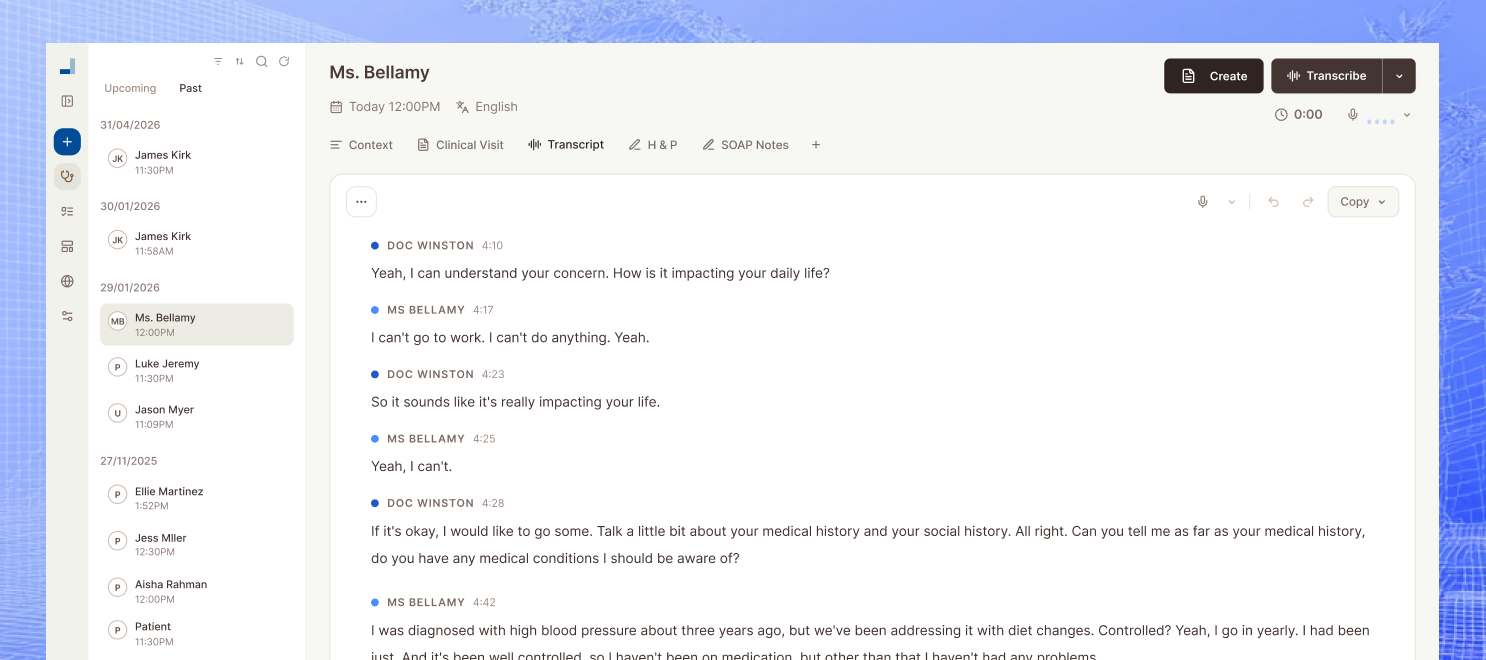
Next, you should focus on your templates. Most clinics have specific ways they like their data presented, especially in specialized fields like orthopedics or psychiatry. Setting up these templates early ensures the AI structures the captured conversation exactly how you need it. Whether the encounter is in-person or via telehealth, the capturing process should be as simple as pressing ‘record’ on your device, allowing the software to listen while you engage with the patient.
After the session, the generated draft appears almost instantly. Make it a habit to review and edit the note immediately while the encounter is fresh in your mind. This is the fastest way to ensure 100% accuracy. Finally, use the AI’s ability to reuse the captured data to generate secondary documents, such as patient instructions or referral letters, which further maximizes the time saved per patient.
- Start with one specific visit type to build confidence and refine the workflow.
- Configure specialty-specific templates to ensure the output matches your clinical needs.
- Review and edit notes immediately post-encounter for maximum efficiency.
- Leverage the AI to generate multiple documents from a single patient conversation.
How to keep note quality high and reduce mistakes
One of the risks of any automated system is ‘note bloat’ or the inclusion of irrelevant information. To keep quality high, clinicians should develop a lightweight review habit. This involves scanning the generated note for key variables such as medication dosages, specific laboratory values, and the primary problem list. While AI is highly capable, the clinician’s eye is needed to ensure the nuance of the medical decision-making process is captured correctly.
Establish team standards for what a ‘perfect’ note looks like in your practice. If you find the AI consistently misses a specific detail, it is usually a sign that the template needs a slight adjustment or that the clinician needs to verbalize that specific point more clearly during the exam. Consistency across the clinic ensures that any provider stepping in to cover a patient can rely on the documentation’s accuracy and format.
- Focus your review on critical data points like medications and dosages.
- Avoid note bloat by using concise templates that emphasize relevant findings.
- Establish a feedback loop to refine templates based on recurring errors.
- Encourage clinicians to ‘think out loud’ during the exam to capture key clinical reasoning.
Privacy, consent, and patient trust (plain English)
Patient privacy is the cornerstone of the therapeutic relationship. When introducing an AI scribe, transparency is the best policy. Most patients are receptive to the technology when they realize it means their doctor will be looking at them instead of a computer screen. Always follow your local regional policies and institutional guidelines regarding consent, as these can vary significantly by state or country.
A simple way to introduce the technology to a patient is by saying: ‘To help me focus entirely on you today, I’m using a secure AI assistant to take my clinical notes. It records our conversation and turns it into a medical record, so I don’t have to type while we talk. Is that okay with you?’ This approach frames the technology as a tool for better care, which it is.
- Always obtain verbal or written consent based on your local regulatory requirements.
- Explain the technology as a tool for improving the doctor-patient connection.
- Ensure your AI provider adheres to modern security and data retention standards.
- Maintain a clear record of consent within the patient’s file if required by policy.
Rolling it out across a clinic without disruption
A successful rollout across a multi-provider clinic requires a phased approach. Start with a two-week pilot program involving one or two ‘tech-forward’ clinicians. During this period, track specific metrics such as the time spent on notes after hours and the overall completeness of the clinical records. This data will be vital for gaining buy-in from more skeptical staff members later on.
Training should focus on template alignment. When every doctor in a department uses the same high-quality templates, it creates a unified standard of care. This is particularly important for university clinics where residents and attending physicians must share and review notes constantly. By the end of the pilot, you can refine your training materials based on real-world feedback before the full-scale launch.
- Begin with a 2-week pilot to iron out workflow kinks and collect data.
- Track time-savings and note quality to demonstrate ROI to stakeholders.
- Align templates across the clinic to ensure documentation consistency.
- Provide brief, hands-on training sessions to reduce the initial learning curve.
Mcoy AI is an AI medical scribe that records and transcribes patient encounters, then generates multiple clinical note types (H&P, progress notes, consult notes, follow-up notes, procedure notes, discharge summaries, referral letters, and more). It features 200+ customizable templates and an AI chat function that allows clinicians to create letters, forms, and other documents effortlessly from the captured encounter data, ensuring that documentation is as efficient as it is accurate.
Conclusion
Integrating an AI medical scribe into your clinic is a journey toward more human-centric care. By automating the mechanical aspects of documentation—from H&P to discharge summaries—you free yourself to focus on the person sitting across from you. The workflow is simple: select a template, record the encounter, and perform a quick review. This systematic approach ensures that your notes stay accurate, your privacy remains uncompromised, and your ‘pajama time’ is significantly reduced. As you begin your pilot, remember that the goal of an AI medical scribe is to make the EHR work for you, rather than the other way around. Ready to transform your practice? Start your pilot today and experience the difference in clinical freedom.
What a serious review table should cover
| Decision area | Common mistake | Better clinic-ready approach | Metric to watch |
|---|---|---|---|
| Workflow design | Treat ai medical scribe integration: step-by-step guide for ehr as a one-off documentation task | Build a repeatable process with clear ownership and review points | Time to complete documentation |
| Team adoption | Assume every clinician will naturally use the same process | Train for consistency and define exception handling early | Active user adoption |
| Quality review | Only check notes when a problem is reported | Audit a sample of notes weekly and review edge cases | Edit rate per note |
| Operational follow-through | Leave admin actions outside the documentation workflow | Use the same encounter data for referrals, letters, and follow-up tasks | Completion rate for next-step tasks |
Related reading
If you are working through ai medical scribe integration: step-by-step guide for ehr, it helps to read this alongside Practice Operations: How Clinics Can Streamline Daily Operations, Practice Operations: How Clinics Can Improve Workflow Without Changing Their EHR, and Physician Wellbeing: How to Minimize Cognitive Load With an AI Medical Scribe. Those guides cover adjacent workflow, implementation, and evaluation questions so the decision does not sit in isolation.
FAQ
How accurate are AI medical scribes in real clinics?
AI medical scribes are remarkably accurate, often capturing more detail than a clinician could manually. They use advanced natural language processing to understand medical terminology and context, even in noisy environments. However, while they are excellent at transcription and formatting, the clinician must always perform a final review to ensure clinical accuracy and nuance.
Do I still need to review every note?
Yes, reviewing every note is a critical step for both quality care and medico-legal protection. The AI provides a highly accurate draft, but the physician is ultimately responsible for the content of the medical record. Most clinicians find that reviewing and editing an AI-generated note takes only 30-60 seconds, which is still a massive time reduction compared to manual entry.
What note types can an AI scribe generate besides SOAP?
Advanced AI scribes can generate a wide range of documents including History and Physicals (H&P), consultation notes, procedure notes, discharge summaries, and referral letters. Because the AI captures the entire conversation, it can repurpose that information into different templates depending on the specific administrative or clinical need of the moment.
Will this work for telehealth and in-person consults?
Yes, AI medical scribes are designed to work across both environments. For in-person visits, a smartphone or tablet is typically used to record the audio. For telehealth, the AI can often be integrated into the communication platform or simply listen to the audio output of the computer, providing the same high-quality documentation regardless of location.
How do I explain recording/transcription to patients?
Transparency is key. Most clinicians simply inform the patient that they are using a secure digital assistant to ensure the medical record is accurate and to allow the doctor to focus more on the conversation than the computer screen. Patients generally appreciate the increased eye contact and attention they receive as a result of the technology.
How do clinics prevent note bloat?
Clinics prevent note bloat by using concise, well-designed templates that prompt the AI to only include relevant clinical information. Educators and clinic managers can set standards for what sections are mandatory and which are optional. Additionally, the brief review process allows clinicians to delete any extraneous details the AI may have captured.
How long does template setup take?
Initial template setup is quite fast, often taking only a few minutes per note type. Most modern AI scribes come with a library of pre-built templates for different specialties that can be used immediately or slightly tweaked to fit a specific clinician’s style. Over time, these can be further refined as your practice needs evolve.
What’s the safest way to start if I’m skeptical?
The safest approach is to run a small pilot with 5-10 patients per day for a single week. Choose non-complex cases initially to get a feel for how the AI transcribes your voice and structured notes. This low-risk trial allows you to see the time savings firsthand and verify the security of the platform before committing to a full clinic rollout.