Specialty Guides: Record and Transcribe Patient Encounters: A Doctor's Guide
Learn how to record and transcribing patient encounters to save hours on charting. Master AI medical scribe workflows for clinics and private practices.
The Hidden Burden of Clinical Documentation
For many clinicians, the workday doesn’t end when the last patient leaves. Instead, it transitions into hours of ‘pajama time’—the grueling process of finishing notes long after clinic hours. This after-hours charting is more than just a nuisance; it is a primary driver of burnout, rushed patient interactions, and persistent medico-legal anxiety. When documentation becomes a secondary thought, important nuances often vanish, leaving notes that feel generic or incomplete.
This guide provides a comprehensive roadmap for providers—whether in private practice, busy multi-specialty clinics, or university health centers—on how to effectively record and transcribe patient encounters. We will cover more than just basic SOAP notes, exploring high-quality note formats, privacy standards, and a step-by-step rollout plan to ensure your documentation is both accurate and efficient. By the end, you will understand how to reclaimed your schedule without sacrificing clinical quality.
What a medical scribe solves in modern practice
The real cost of traditional documentation isn’t just the minutes spent typing; it’s the cognitive load required to recall details while simultaneously engaging with a patient. When doctors are tethered to a keyboard, the ‘human’ element of the visit often suffers. Delayed notes lead to ‘forgetting curves’ where critical clinical reasoning isn’t captured, potentially impacting future care decisions or audit readiness.
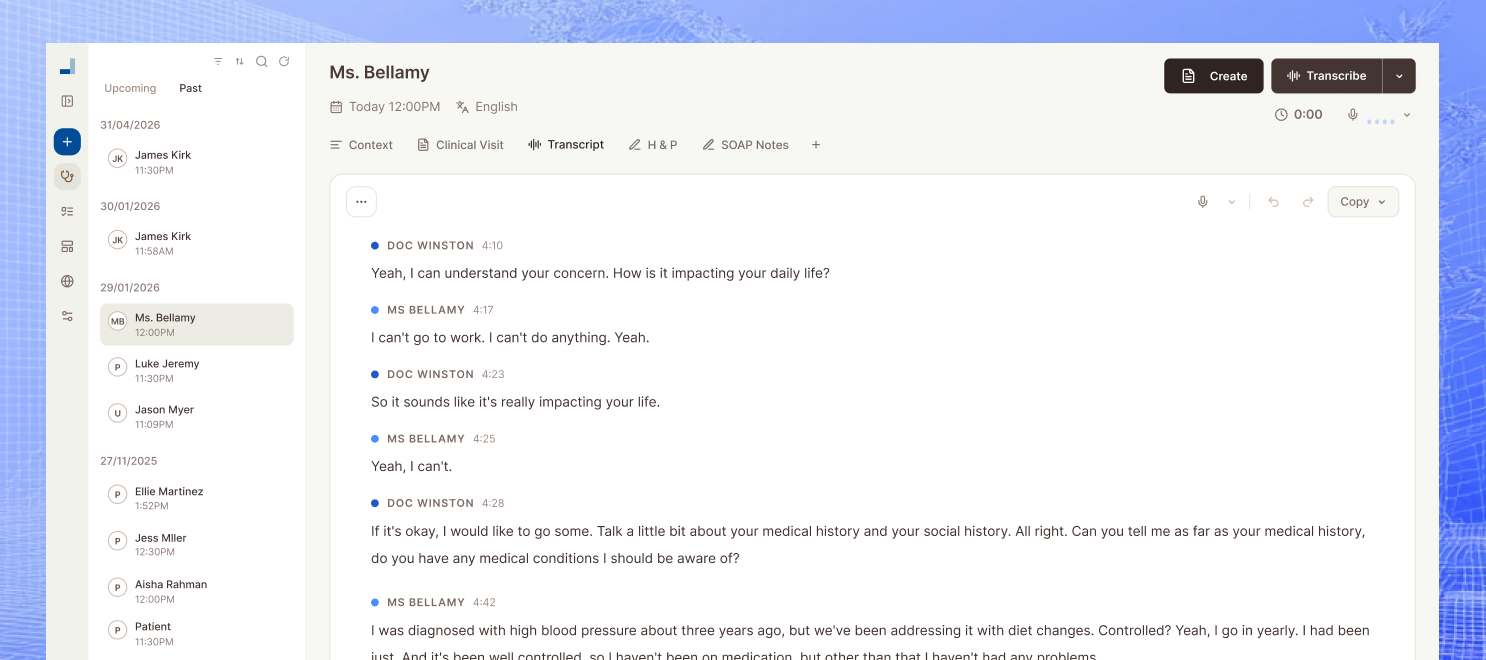
An AI medical scribe serves as an assistive partner in this process, but it is important to distinguish its role. It is designed to capture, organize, and synthesize the conversation into structured clinical data. However, the technology is strictly assistive. The clinician remains the ultimate authority, responsible for reviewing every line and ensuring the medical accuracy of the final output before it enters the health record.
- Reduces documentation time by up to 50-80% per patient encounter.
- Decreases cognitive fatigue by allowing clinicians to focus on the patient, not the screen.
- Ensures clinical details are captured in real-time rather than from memory at the end of the day.
- Improves the quality and specificity of notes for billing and compliance.
Note types you can generate beyond SOAP (H&P and more)
While the SOAP format is a staple in medicine, modern practice requires a much broader array of documentation styles. History and Physical (H&P) notes are essential for new admissions or comprehensive evaluations, requiring a level of detail that a standard progress note might miss. For specialists, consult notes and referral letters are the primary means of communicating complex logic to colleagues, making clarity paramount.
A diverse library of note types ensures continuity of care across different clinical settings. For example, procedure notes must document specific anatomical landmarks and technical steps, while discharge summaries need to synthesize a whole episode of care into actionable instructions. By using varied templates, you ensure that the documentation actually matches the clinical intent of the visit.
Relying on a single format for every encounter leads to note bloat or critical omissions. Proper structure helps in audit readiness and ensures that anyone reading the chart—whether it be a covering physician or a billing specialist—can quickly grasp the patient’s status and the planned trajectory of care.
- H&P and Consult Notes for comprehensive new patient workups.
- Procedure Notes and Discharge Summaries for surgical or acute settings.
- Referral Letters and Follow-up notes to streamline communication.
- Standardized documentation helps mitigate legal risks and improves audit scores.
How to implement record and transcribe patient encounters step-by-step
To begin implementing a system to record and transcribe patient encounters, start small by selecting a single visit type, such as routine follow-ups. This allows you to calibrate the system without the pressure of a complex new patient workup. Familiarize yourself with the recording interface and ensure your environment has adequate audio clarity, as this is the foundation of high-quality transcription.
Next, organize your templates by specialty or encounter type. If you are a cardiologist, you’ll want templates that emphasize cardiac history and physical exams. Having these ready before you start the encounter ensures the AI knows exactly how to categorize the information it hears. Once you are in the room—whether it is an in-person visit or a telehealth session—simply initiate the recording and proceed with your natural clinical workflow.
After the encounter concludes, the draft will be generated in seconds. Spend the first few minutes of your post-visit time reviewing and editing the draft. Because the AI captures the raw data, you only need to ensure the clinical synthesis is correct. Finally, reuse these outputs to quickly generate necessary referral letters or patient instruction forms, effectively doubling your productivity from a single recording session.
- Select one visit type to pilot for the first few days of implementation.
- Configure specialty-specific templates to guide the output structure.
- Capture encounters naturally without changing your bedside manner.
- Review, edit, and repurpose the text for letters and documents instantly.
How to keep note quality high and reduce mistakes
Even with advanced technology, clinical documentation can suffer from typical failure points like missing medications, incorrect dosage values, or ‘note bloat’ where irrelevant dialogue is included. These errors often stem from poor audio quality or a lack of clarity during the verbal portion of the exam. High-quality notes require a partnership between the clinician’s verbal cues and the AI’s synthesis.
Developing a lightweight review habit is the best way to maintain standards. Spend a few moments at the end of each session or block to verify that the assessment and plan reflect your actual clinical judgment. Setting a team standard for what a ‘perfect’ note looks like helps everyone remain aligned, especially in multi-provider university clinics where consistency is vital for academic and clinical records.
- Explicitly state medication names and dosages during the exam for better accuracy.
- Implement a ‘review-before-sign’ protocol to catch synthetic errors or omissions.
- Standardize templates across the clinic to prevent excessive or redundant text.
- Focus on the Assessment and Plan as the most critical sections to verify manually.
Privacy, consent, and patient trust
Patient privacy is the cornerstone of the therapeutic relationship. When you record and transcribe patient encounters, transparency is key. While consent requirements vary by jurisdiction, it is generally best practice to inform the patient and ask for their permission before starting any recording. Most patients are very receptive when they realize it means their doctor will be looking at them instead of a computer screen.
You can use a simple script: ‘To help me focus entirely on our conversation, I’d like to use an AI assistant to take our notes today. It records what we say and turns it into a medical note so I don’t have to type. Is that okay with you?’ This approach frames the technology as a tool for better care, which builds trust rather than suspicion.
- Always check local and regional regulations regarding medical recording and consent.
- Frame the use of AI as a way to prioritize the patient-provider relationship.
- Ensure the platform used meets enterprise-grade security and retention standards.
- Maintain a clear record of patient consent where required by clinic policy.
Rolling it out across a clinic without disruption
A successful rollout starts with a two-week pilot involving a ‘champion’ physician who is comfortable with technology. This pilot phase allows the clinic to identify any logistical hurdles, such as Wi-Fi dead zones in exam rooms or specific template needs, before the entire staff migrates to the new system. It’s better to fix these small issues early than to face a clinic-wide frustration later.
During the rollout, track specific metrics to measure success, such as the total time saved on documentation or the reduction in after-hours work. Feedback from the pilot should be used to align templates across the department. When the rest of the staff sees the tangible benefits—like leaving the office at 5:00 PM—the adoption of the new documentation workflow becomes much smoother and more enthusiastic.
- Start with a 14-day pilot program with one or two lead clinicians.
- Measure time-to-completion for notes before and after the rollout.
- Conduct brief weekly check-ins to refine templates and address user questions.
- Ensure all staff understand the privacy protocols to handle patient inquiries consistently.
Mcoy AI is an AI medical scribe that records and transcribes patient encounters, then generates multiple clinical note types (H&P, progress notes, consult notes, follow-up notes, procedure notes, discharge summaries, referral letters, and more). It features over 200+ customizable templates and an interactive AI chat to help clinicians create letters, forms, and documents instantly. By digitizing the clerical side of medicine, it allows providers to focus on what matters most: the patient.
Conclusion
Mastering the ability to effectively record and transcribe patient encounters is one of the most impactful changes a modern clinic can make. By moving away from manual typing and toward an AI-assisted workflow, you not only improve the quality and depth of your medical records but also protect your own well-being. Whether you are using SOAP notes or complex discharge summaries, the goal is clear: spend less time with the keyboard and more time with the patient. Start your pilot today and see how capturing the encounter in real-time can transform your practice.
SEO description: Learn how to record and transcribe patient encounters with high accuracy. Save time using AI templates for H&Ps, consults, and more. Try Mcoy AI.
What a serious review table should cover
| Decision area | Common mistake | Better clinic-ready approach | Metric to watch |
|---|---|---|---|
| Workflow design | Treat record and transcribe patient encounters: a doctor’s guide as a one-off documentation task | Build a repeatable process with clear ownership and review points | Time to complete documentation |
| Team adoption | Assume every clinician will naturally use the same process | Train for consistency and define exception handling early | Active user adoption |
| Quality review | Only check notes when a problem is reported | Audit a sample of notes weekly and review edge cases | Edit rate per note |
| Operational follow-through | Leave admin actions outside the documentation workflow | Use the same encounter data for referrals, letters, and follow-up tasks | Completion rate for next-step tasks |
Related reading
If you are working through record and transcribe patient encounters: a doctor’s guide, it helps to read this alongside Specialty Guides: How to Run a More Efficient Medical Practice in 2026, Specialty Guides: How to Improve Patient Encounters, and Practice Operations: Free Clinic Policy Template for AI Scribing Guide. Those guides cover adjacent workflow, implementation, and evaluation questions so the decision does not sit in isolation.
FAQ
How accurate are AI medical scribes in real clinics?
AI medical scribes generally reach over 90-95% accuracy in transcribing medical terminology and conversation. However, the accuracy largely depends on the clarity of the audio and the complexity of the encounter. While they are highly reliable for capturing facts, the clinician must always ensure that the clinical synthesis accurately reflects their professional judgment.
Do I still need to review every note?
Yes, reviewing every note is a professional and legal requirement for clinicians. While the AI does the heavy lifting of drafting, the provider must verify that the information is medically accurate and that the treatment plan is correct. A quick review usually takes less than a minute, which is still much faster than writing a note from scratch.
What note types can an AI scribe generate besides SOAP?
Modern AI scribes can generate a wide range of documents including History and Physicals (H&P), Procedure Notes, Consult Letters, Discharge Summaries, and Follow-up notes. They can also assist in drafting referral letters and patient education instructions. This versatility ensures that all aspects of clinical documentation are covered efficiently.
Will this work for telehealth and in-person consults?
Yes, AI scribes are designed to work across both formats. In-person consults are captured via a smartphone or tablet in the exam room, while telehealth sessions can be captured by recording the audio from the computer. In both cases, the AI processes the dialogue to create a structured clinical note regardless of the setting.
How do I explain recording/transcription to patients?
The best approach is transparency and focusing on the benefit to the patient. You can explain that using the tool allows you to look at them and listen more closely rather than typing on a computer. Most patients value the increased eye contact and personal attention and are happy to provide their verbal consent.
How do clinics prevent note bloat?
Note bloat is prevented by using concise templates and setting the AI to focus only on medically relevant information. You can customize templates to exclude ‘small talk’ and concentrate strictly on symptoms, exam findings, and the assessment. Regularly reviewing and refining these templates helps keep the outputs clean and professional.
How long does template setup take?
Basic template setup can take as little as 5 to 10 minutes. Most systems come with pre-built templates for various specialties that can be used immediately. Customizing these to fit your specific workflow or adding unique sections usually only takes one or two clicks within the settings of the tool.
What’s the safest way to start if I’m skeptical?
The safest way to start is to pilot the tool with non-complex, routine follow-up visits. This allows you to see the results in a low-stakes environment. As you gain confidence in the AI’s ability to capture your clinical intent, you can gradually expand its use to more complex new patient evaluations and specialized procedures.