Practice Operations: Free Clinic Policy Template for AI Scribing Guide
Learn how to build a professional clinic policy template for AI scribing. Improve HIPAA compliance, patient consent, and clinician workflows effortlessly.
What a medical scribe solves in modern practice
The modern healthcare landscape is increasingly defined by the weight of administrative tasks. For doctors and private practitioners, the time spent on documentation often rivals the time spent on actual patient care. This ‘pajama time’—the hours spent charting after clinic is closed—leads to significant burnout, cognitive fatigue, and an increased risk of medical errors due to delayed note-taking.
An AI medical scribe acts as a sophisticated digital assistant designed to bridge this gap. By capturing the nuances of a clinical encounter in real-time, it allows the physician to maintain eye contact and build rapport without the distraction of a keyboard. However, it is essential to remember that even the most advanced scribe is an assistive tool; the clinician remains the final authority on the accuracy and clinical relevance of every note generated.
- Eliminates after-hours charting by generating notes in real-time.
- Reduces cognitive load, allowing clinicians to focus on complex decision-making.
- Ensures more detailed and accurate records by capturing details often forgotten.
- Enhances patient satisfaction by allowing for more attentive, face-to-face care.
Note types you can generate beyond SOAP (H&P and more)
While the SOAP format is the industry standard for daily progress notes, a high-functioning clinic requires a much broader range of documentation. Comprehensive care involves capturing the full patient journey, from the initial History and Physical (H&P) to complex procedure notes and meticulous discharge summaries. Effective documentation serves as a roadmap for continuity of care, ensuring that every member of the healthcare team is aligned on the patient’s status and plan.
Reliable structure in documentation is not just about convenience; it is a critical component of audit readiness and medico-legal protection. Using specific templates for consult notes or referral letters ensures that the necessary data points—such as physical exam findings or specific recommendations—are never overlooked. This level of consistency is particularly vital in university clinics where teaching and multidisciplinary coordination are core functions.
Beyond the basics, specialized clinics often require niche documentation like follow-up notes that track chronic disease progression or referral letters that concisely communicate medical necessity to specialists. Having a library of diverse note types allows the practice to scale its operations while maintaining a high standard of professional communication with external partners and insurance payers.
- H&P and Progress Notes: Essential for initial assessments and daily tracking.
- Consultation and Follow-up Notes: Vital for specialized care and longitudinal tracking.
- Procedure and Discharge Summaries: Crucial for surgical records and care transitions.
- Referral Letters: Streamlines communication between primary care and specialists.
How to implement clinic policy template for AI scribing step-by-step in a real clinic
Implementing a clinic policy template for AI scribing begins with a focused approach rather than a total overhaul. Start by selecting one specific visit type, such as routine follow-ups or new patient intakes, to serve as your pilot case. This allows the team to understand how the technology interacts with your existing workflow without overwhelming the entire staff.
The next phase involves setting up your specialty-specific templates. Whether you are in pediatrics, orthopedics, or internal medicine, your documentation needs are unique. Align your AI scribe settings to reflect these needs, ensuring that the generated outputs match the clinical language and structure your team expects. During the encounter, whether in-person or via telehealth, simply activate the capture tool and conduct the visit as you normally would, focusing entirely on the patient.
Once the encounter is complete, the review process should be brief but disciplined. Read through the generated draft to confirm that the clinical reasoning is sound and that all medications and dosages are accurate. Any necessary edits should be made immediately while the encounter is fresh in your mind. Finally, leverage the output to populate other necessary documents, such as patient summaries or school excuses, to maximize the efficiency of a single recorded session.
- Select a single visit type for an initial low-stakes pilot program.
- Configure templates to match your specific medical specialty and style.
- Conduct the patient encounter naturally while the AI captures the dialogue.
- Briefly review and finalize the note immediately following the session.
How to keep note quality high and reduce mistakes
Maintaining high-quality documentation requires identifying typical failure points, such as the omission of specific medications or the inclusion of irrelevant information often referred to as ‘note bloat.’ Even with AI assistance, a system is only as good as the oversight provided. Establishing a lightweight review habit—where the clinician spends two minutes verifying the ‘Assessment and Plan’—is often enough to ensure clinical accuracy.
Team-wide standards play a significant role in quality control. Setting expectations for how problem lists should be formatted and how vitals are recorded ensures that the electronic health record (EHR) remains searchable and clean. Regular, brief audits of a random selection of notes can help identify if the AI is consistently missing specific nuances, allowing you to adjust your templates or dictation style accordingly.
- Perform a focused review of the Assessment and Plan for every note.
- Develop standardized internal protocols for recording medications and vitals.
- Use ‘dot phrases’ or specific templates to prevent repetitive note bloat.
- Conduct monthly peer reviews to ensure documentation consistency across the clinic.
Privacy, consent, and patient trust (plain English)
Patient privacy is the cornerstone of the modern medical practice. While regulations like HIPAA or GDPR provide the framework, building trust requires clear communication. It is essential to follow your local regional policies regarding recording and data retention, ensuring that your clinic policy template for AI scribing clearly outlines how data is handled, stored, and eventually deleted.
When introducing the technology to a patient, keep the explanation simple and patient-centered. You might say: ‘To help me focus entirely on you today instead of my computer, I’m using a secure assistant that listens and helps me write my medical notes. It’s private, secure, and I review everything it writes. Are you comfortable with that?’ Documentation of this verbal consent in the chart is a best practice for liability and transparency.
- Ensure all technology partners sign a Business Associate Agreement (BAA).
- Use a simple, transparent script to obtain verbal patient consent.
- Incorporate consent documentation directly into your daily clinical notes.
- Regularly review data retention policies to ensure local compliance.
Rolling it out across a clinic without disruption
A successful rollout is a marathon, not a sprint. A two-week pilot plan with one or two ‘tech-champion’ doctors allows you to work out the kinks in the workflow before a full-scale launch. During this time, the focus should be on measuring time saved and the reduction in after-hours work. If the pilot group is getting home an hour earlier, the rest of the clinic will be eager to follow suit.
Training should focus on template alignment and the ‘review-and-edit’ workflow rather than just the software buttons. When clinicians see how a clinic policy template for AI scribing can be used to generate referral letters and procedure notes instantly, the adoption rate typically sky-rockets. Consistency in templates across the organization also makes it easier for medical assistants and billing staff to find the information they need.
- Launch with a two-week pilot involving a small group of clinicians.
- Track time-saving metrics to prove the value to skeptical staff members.
- Standardize templates across the clinic to streamline billing and coding.
- Schedule a 30-minute feedback session after the first week to refine workflows.
Mcoy AI: Your Clinical Documentation Partner
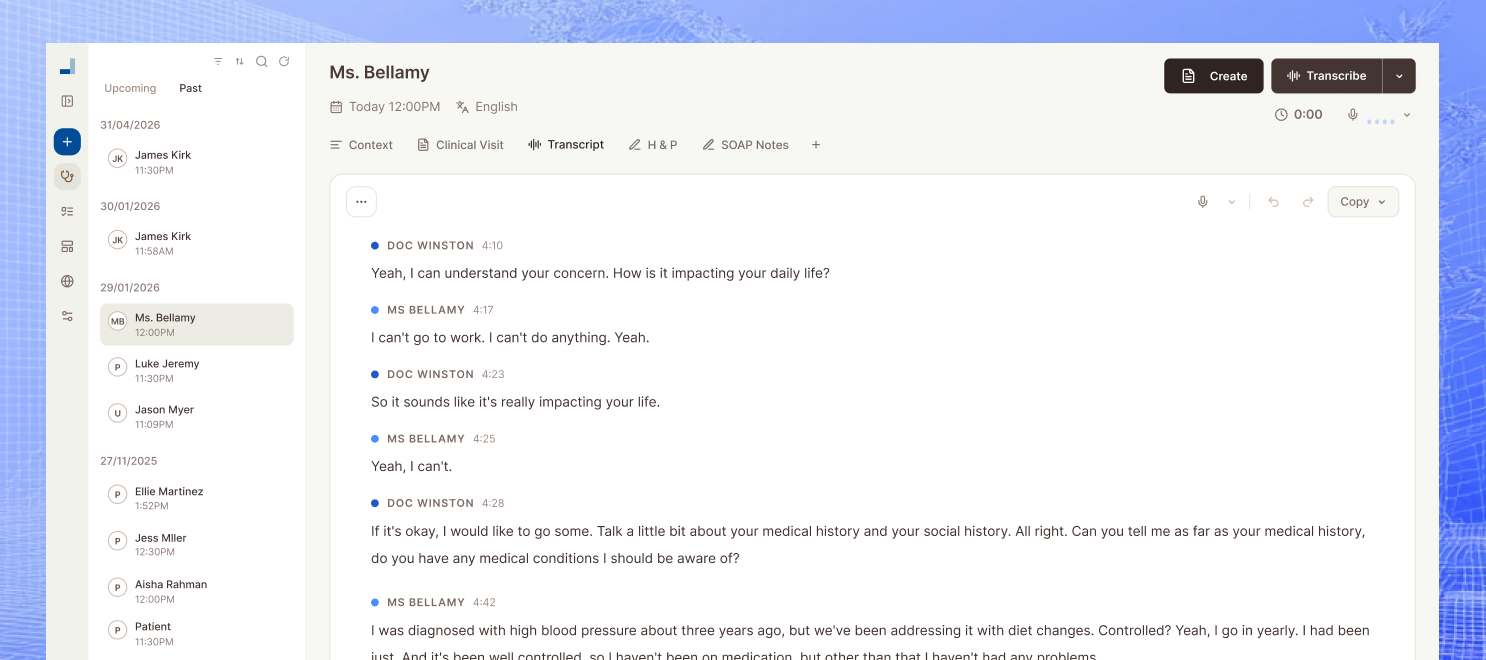
Mcoy AI is an AI medical scribe that records and transcribes patient encounters, then generates multiple clinical note types, including H&P, progress notes, consult notes, follow-up notes, procedure notes, discharge summaries, referral letters, and more. With over 200 customizable templates and an AI chat feature to create letters, forms, and specific documents, it is designed to adapt to the unique needs of any practice. It focuses on helping clinicians reclaim their time while ensuring that every piece of documentation is comprehensive and accurate.
Conclusion
Transitioning to a modern documentation workflow doesn’t have to be a source of stress. By establishing a clear clinic policy template for AI scribing, practitioners can protect their time and their patients’ privacy simultaneously. Start small, use structured templates, and always keep the human-in-the-loop for quality assurance. Implementing these tools is the most effective way to eliminate burnout and return the focus to what matters most: the patient. Take the first step by piloting a clinic policy template for AI scribing today and see how much time your team can save.
What a serious review table should cover
| Decision area | Common mistake | Better clinic-ready approach | Metric to watch |
|---|---|---|---|
| Workflow design | Treat free clinic policy template for ai scribing guide as a one-off documentation task | Build a repeatable process with clear ownership and review points | Time to complete documentation |
| Team adoption | Assume every clinician will naturally use the same process | Train for consistency and define exception handling early | Active user adoption |
| Quality review | Only check notes when a problem is reported | Audit a sample of notes weekly and review edge cases | Edit rate per note |
| Operational follow-through | Leave admin actions outside the documentation workflow | Use the same encounter data for referrals, letters, and follow-up tasks | Completion rate for next-step tasks |
Related reading
If you are working through free clinic policy template for ai scribing guide, it helps to read this alongside Practice Operations: How Clinics Can Streamline Daily Operations, Practice Operations: How Clinics Can Improve Workflow Without Changing Their EHR, and Admin Management: How to Use an AI Medical Scribe to Streamline Clinic Admin. Those guides cover adjacent workflow, implementation, and evaluation questions so the decision does not sit in isolation.
FAQ
How accurate are AI medical scribes in real clinics?
AI medical scribes are remarkably accurate at capturing the dialogue of a clinical encounter, often reaching over 95% accuracy in transcription. However, they rely on the clinician to clearly articulate findings and decisions during the visit. The final note reflects the quality of the verbal exchange, which is why clinician review is always the final step in the process.
Do I still need to review every note?
Yes, reviewing every note is a professional and legal requirement. While the AI does the heavy lifting of drafting the content, the clinician is responsible for the medical accuracy of the record. Most practitioners find that reviewing and editing an AI-generated note takes less than two minutes, which is significantly faster than writing one from scratch.
What note types can an AI scribe generate besides SOAP?
Modern AI scribes go far beyond the standard SOAP format. They can generate comprehensive History and Physicals (H&P), detailed procedure notes, consult letters for specialists, and even discharge summaries for hospital transitions. Many also offer templates for specialized fields like behavioral health or surgical specialties.
Will this work for telehealth and in-person consults?
Yes, AI scribes are highly versatile and work across both modalities. For in-person visits, the device (phone, tablet, or laptop) simply sits on the desk, while for telehealth, the scribe can capture audio directly from the computer. In both cases, the focus remains on the patient-provider interaction rather than manual data entry.
How do I explain recording/transcription to patients?
The best approach is transparency and emphasizing the benefit to the patient. Explain that the tool allows you to listen more closely and spend less time looking at the screen. Most patients are very supportive when they realize it leads to a more attentive doctor and better-documented care.
How do clinics prevent note bloat?
Clinics prevent note bloat by using structured templates that only pull in relevant information. By setting specific parameters for what the AI should focus on—such as only including new findings in a progress note—clinicians can ensure the final output is concise and clinically useful rather than a wall of unnecessary text.
How long does template setup take?
Basic template setup usually takes just a few minutes. Most platforms come with pre-built templates for major specialties that can be used immediately. Customizing a template to fit your specific ‘voice’ or clinic requirements typically takes about 10 to 15 minutes of tweaking after a few pilot sessions.
What’s the safest way to start if I’m skeptical?
The safest way to start is with a ‘shadow’ pilot. Use the AI scribe on a few non-complex cases while still taking your usual brief notes. Compare the AI output to your manual notes at the end of the day. This allows you to build trust in the tool’s accuracy and discover its nuances without any risk to your clinical workflow.