Specialty Guides: Build QA Checks for AI Scribe Documentation: Full Guide
Learn how to build effective quality assurance checks for AI scribe documentation to ensure accuracy, compliance, and clinical safety in your practice.
Professional Documentation Without the Burnout
For many clinicians, the end of the patient day marks the beginning of a second shift: hours of clinical documentation. This after-hours charting is a leading cause of burnout, leading to rushed notes that may lack nuance or fail to satisfy medico-legal requirements. While AI tools promise relief, the fear of inconsistency or hallucinated data creates a new kind of anxiety for private practitioners and university clinic directors alike.
This guide provides a comprehensive framework for implementing AI-assisted charting while maintaining clinical rigor. We will explore how to build QA checks for AI scribe documentation, move beyond the standard SOAP format, and establish a quality control workflow that ensures every note is both accurate and compliant. Whether you are a GP in a busy solo practice or managing a large specialty telehealth team, these strategies will protect your license and your time.
What a medical scribe solves in modern practice
The real cost of documentation isn’t just the minutes spent typing; it is the cognitive load of trying to remember specific patient phrases while navigating complex EHR menus. When notes are delayed, details fade, leading to a higher risk of errors in the medical record. An AI medical scribe acts as a cognitive assistant, capturing the raw dialogue of the encounter so the clinician can focus entirely on the patient’s physical cues and emotional needs.
It is crucial to understand that an AI scribe is an assistive tool, not a replacement for clinical judgment. The clinician remains the ultimate signatory and responsible party for the accuracy of the record. By delegating the initial drafting process, providers can reduce the ‘pajama time’ spent on admin, ensuring that the final output reflects a high standard of care without the manual labor previously required.
- Reduces cognitive fatigue by capturing real-time dialogue.
- Eliminates after-hours charting backlogs for better work-life balance.
- Provides a structured draft that clinicians can refine and approve.
- Enhances patient engagement by removing the screen as a barrier.
Note types you can generate beyond SOAP (H&P and more)
While the SOAP note is the industry standard for daily progress, modern clinical practice requires a much broader range of documentation. AI scribes are now capable of generating comprehensive History and Physical (H&P) reports, consult notes for specialists, and complex procedure notes. Each of these requires a specific structure to ensure continuity of care and audit readiness.
Using specialized templates for follow-up notes or discharge summaries ensures that handover quality remains high. When a patient moves from a university clinic to a primary care setting, the clarity of the referral letter or transition summary can significantly impact outcomes. Building a library of these formats allows the AI to tailor its output to the specific clinical context, rather than forcing every encounter into a generic box.
- H&Ps and Consult Notes for comprehensive initial assessments.
- Procedure Notes and Discharge Summaries for surgical or acute care.
- Follow-up Notes and Referral Letters for seamless care coordination.
- Customizable structures that meet specific specialty coding requirements.
How to implement QA checks for AI scribe documentation step-by-step
The first step in a successful rollout is to start small by choosing one specific visit type, such as routine follow-ups, to test the AI’s performance. This allows you to calibrate your templates without the pressure of complex diagnostic cases. You should begin by selecting or creating templates that align with your specialty’s standard of care, ensuring the AI knows which data points are non-negotiable.
During the encounter, whether in-person or via telehealth, focus on verbalizing your physical exam findings or thought process so the AI can capture the data accurately. Once the draft is generated, develop a habit of rapid review. Instead of rewriting, you should use the AI’s editing features to tweak specific sections, ensuring the final note reflects your professional voice. Finally, leverage the ability to reuse these outputs; a well-checked progress note can be instantly converted into a referral letter or a patient summary with minimal extra effort.
- Pilot with one visit type to establish a baseline of quality.
- Use specialty-specific templates to guide the AI’s data extraction.
- Verbalize key clinical findings during the session for better capture.
- Perform a 60-second rapid review and edit before final signing.
How to keep note quality high and reduce mistakes
Note bloat and missing medications are the two most common failure points in automated documentation. To prevent this, clinicians should implement a lightweight review habit where they verify the ‘Objective’ and ‘Plan’ sections against their actual clinical intent. It is helpful to establish team standards for how vitals or lab values are integrated to avoid cluttering the record with redundant data.
Periodically auditing a random sample of notes within a clinic can reveal if the AI is consistently missing specific nuances, such as medication dosages or specific social history cues. By treating the AI as a highly capable intern, you maintain the necessary oversight while still benefiting from the speed of automation. This level of quality control ensures the problem list remains clean and actionable.
- Identify and prune ‘note bloat’ to keep records concise and readable.
- Verify medication dosages and specific plan instructions manually.
- Audit 5% of notes weekly to ensure template alignment.
- Standardize how the team handles lab results and vitals.
Privacy, consent, and patient trust (plain English)
Patient trust is the foundation of the clinical encounter. Consent basics vary by region, so it is essential to follow your local policies regarding audio recording and data storage. Generally, patients are receptive to technology when they understand it allows their doctor to look at them instead of a computer screen. Most clinics find that a simple, transparent explanation is all that is needed to secure verbal agreement.
You might say: ‘I’m using a digital assistant today to record our conversation so I can focus on you instead of taking notes. It’s secure and helps me make sure your record is 100% accurate. Is that okay with you?’ This approach frames the technology as a tool for better care. Ensure your AI partner adheres to high security and retention principles, keeping data encrypted and strictly managed according to healthcare regulations.
- Always obtain informed consent based on your local regulatory guidelines.
- Frame the AI as a tool that improves the quality of the patient-doctor connection.
- Ensure data encryption and HIPAA/GDPR compliance are in place.
- Maintain a clear policy on how long recordings are retained before deletion.
Rolling it out across a clinic without disruption
A successful rollout across a multi-provider clinic requires a 2-week pilot plan. Start with a small group of ‘super-users’ who can test the templates and identify any friction points in the workflow. During this phase, track metrics such as time saved per note and the reduction in after-hours work to demonstrate the value to the rest of the staff.
Training should focus on template alignment—ensuring every doctor knows how to trigger the right note type for the right patient. By the end of the second week, you can begin scaling to other providers, using the initial feedback to streamline the onboarding process. This phased approach minimizes disruption to the patient schedule while maximizing the long-term efficiency of the entire medical team.
- Identify 1–2 champions to lead a 14-day pilot program.
- Measure ‘pajama time’ reduction to prove ROI to stakeholders.
- Align templates across the department for consistent documentation.
- Schedule brief weekly check-ins to troubleshoot workflow hurdles.
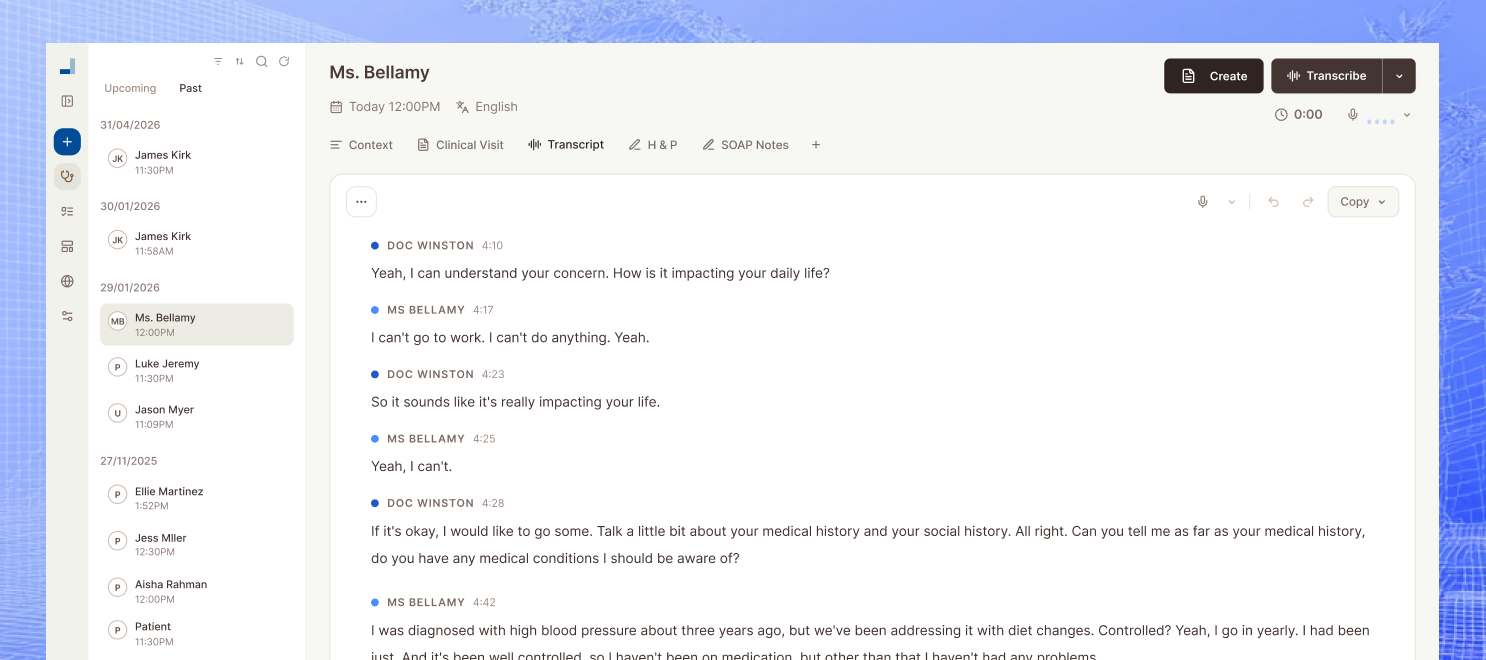
Mcoy AI is an AI medical scribe that records and transcribes patient encounters, then generates multiple clinical note types (H&P, progress notes, consult notes, follow-up notes, procedure notes, discharge summaries, referral letters, and more). It offers 200+ customizable templates and an AI chat feature to create letters, forms, and other essential documents directly from the recorded encounter, helping clinicians ensure their documentation is comprehensive and accurate with minimal manual effort.
Conclusion
Building a robust system of quality checks is the key to successfully integrating AI into your medical practice. By following a structured implementation plan and moving beyond simple SOAP notes, you can reclaim your time without sacrificing clinical excellence. Establishing clear QA checks for AI scribe documentation ensures your records remain a reliable source of truth for both patient care and legal protection. Start your pilot today and experience the shift from data entry to genuine patient connection.
What a serious review table should cover
| Decision area | Common mistake | Better clinic-ready approach | Metric to watch |
|---|---|---|---|
| Workflow design | Treat build qa checks for ai scribe documentation: full guide as a one-off documentation task | Build a repeatable process with clear ownership and review points | Time to complete documentation |
| Team adoption | Assume every clinician will naturally use the same process | Train for consistency and define exception handling early | Active user adoption |
| Quality review | Only check notes when a problem is reported | Audit a sample of notes weekly and review edge cases | Edit rate per note |
| Operational follow-through | Leave admin actions outside the documentation workflow | Use the same encounter data for referrals, letters, and follow-up tasks | Completion rate for next-step tasks |
Related reading
If you are working through build qa checks for ai scribe documentation: full guide, it helps to read this alongside Specialty Guides: How to Run a More Efficient Medical Practice in 2026, Specialty Guides: How to Improve Patient Encounters, and Physician Wellbeing: How to Use AI Scribing to Protect Focus During Consults. Those guides cover adjacent workflow, implementation, and evaluation questions so the decision does not sit in isolation.
FAQ
How accurate are AI medical scribes in real clinics?
AI scribes are highly accurate in capturing the dialogue and context of a patient visit, often exceeding 90% accuracy in draft generation. However, they rely on the clinician to clearly verbalize key findings and provide a final review. Their performance is best when using specialized templates that match the clinical scenario.
Do I still need to review every note?
Yes, the clinician is legally responsible for the medical record. While the AI does the heavy lifting of drafting, you must perform a final check to ensure all medical facts, dosages, and plans are captured correctly. This review typically takes less than a minute compared to ten minutes of manual typing.
What note types can an AI scribe generate besides SOAP?
Modern AI scribes can generate a vast array of documents including History and Physicals (H&P), procedure notes, consult letters, discharge summaries, and even referral letters. This variety ensures that all aspects of the patient journey are documented in the appropriate professional format.
Will this work for telehealth and in-person consults?
Most AI scribing tools are designed to work seamlessly in both environments. For telehealth, the AI can often join the digital meeting or capture audio from the computer, while in-person consults are captured via a mobile device or desktop microphone.
How do I explain recording/transcription to patients?
The most effective way is to be transparent and emphasize that it allows you to focus on the patient. Mention that the system is secure and used only for documentation purposes. Most patients appreciate the extra attention they receive when the doctor isn’t focused on a keyboard.
How do clinics prevent note bloat?
Clinics can prevent note bloat by using concise templates and training the AI to exclude conversational filler. During the review process, clinicians should quickly remove any redundant information that doesn’t add clinical value to the permanent record.
How long does template setup take?
Initial template selection usually takes only a few minutes. Customizing them to your specific practice style might take an hour or two upfront, but this investment saves dozens of hours every month by ensuring the AI output is nearly perfect from the start.
What’s the safest way to start if I’m skeptical?
The safest approach is to run a small pilot with non-complex cases or follow-up visits. Use the AI alongside your traditional method for a few days to compare the results. Once you see the accuracy and the time savings firsthand, you can gradually transition your more complex charting to the AI system.