Physician Wellbeing: How to Use AI Scribing to Protect Focus During Consults
Discover how to implement AI scribing to stop charting after hours. Learn workflows for H&P, progress notes, and consult letters to regain clinical focus.
The Hidden Burden of Clinical Documentation
For many doctors and private practitioners, the most exhausting part of the day isn’t the complex diagnoses or the patient interactions—it’s what happens after the patient leaves the room. After-hours charting, or ‘pajama time,’ has become a primary driver of clinician burnout. The pressure to maintain meticulous records while staying present for the patient often leads to rushed notes, inconsistent documentation, and a constant undercurrent of medico-legal anxiety.
This guide provides a comprehensive roadmap for integrating AI scribing into your daily workflow. Whether you are running a busy specialist practice, a general clinic, or a high-volume university health center, mastering this technology allows you to shift from a secretary-role back to a clinician-role. We will explore how to move beyond basic SOAP notes, maintain high quality control, and roll out a system that respects patient privacy without disrupting your existing pace.
What a medical scribe solves in modern practice
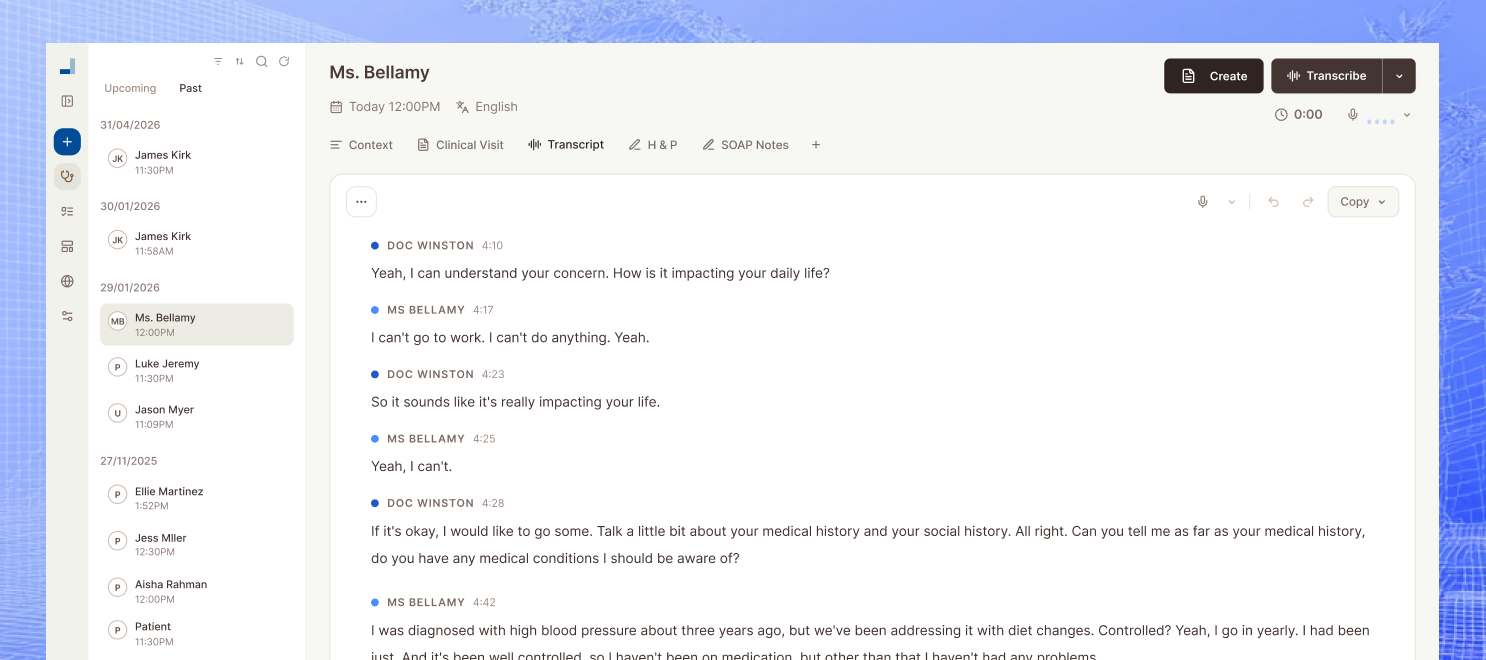
The real cost of traditional documentation is measured in cognitive load. When a doctor has to type while a patient speaks, they lose the ability to observe non-verbal cues and build rapport. This ‘divided attention’ often leads to delayed notes that are finished hours later when memories of nuances have faded. An AI medical scribe acts as an assistive layer, capturing the dialogue in real-time so the clinician can focus entirely on the person sitting across from them.
It is important to understand that an AI scribe is an assistant, not a replacement. While the technology is incredibly adept at organizing medical data and identifying key clinical points, the clinician remains the ultimate authority and person responsible for the final output. The scribe handles the heavy lifting of structure and transcription, while the doctor provides the high-level clinical judgment and final verification.
- Eliminates the ‘screen barrier’ between doctor and patient.
- Reduces cognitive fatigue by handling data organization.
- Ensures notes are completed immediately following the encounter.
- Captures specific details that might be forgotten during late-night charting.
Note types you can generate beyond SOAP (H&P and more)
While the SOAP format is a staple of medical education, modern practice requires a much broader range of documentation. Rigid structures often fail to capture the complexity of an initial History and Physical (H&P) or the surgical nuances of a procedure note. Implementing AI scribing allows you to tailor the output to the specific clinical situation, ensuring that the documentation actually serves the needs of the care team and the patient.
Different encounters demand different structural hierarchies. A consultation note needs to highlight the specialist’s recommendations and the ‘why’ behind a plan, whereas a discharge summary must prioritize clarity for the next provider in the care chain. By using a system that understands these distinctions, clinics can improve the quality of handovers and ensure they are always audit-ready without increasing the time spent on manual formatting.
Beyond the standard progress note, clinicians can generate comprehensive referral letters and follow-up summaries. This consistency in documentation structure creates a more professional clinical record and ensures that follow-up care is based on accurate, detailed information rather than fragmented bullet points. This level of detail is particularly vital for university clinics where multiple providers may be involved in a single student’s care over time.
- H&P and comprehensive initial assessments.
- Specialized consult notes and referral letters.
- Detailed procedure notes and discharge summaries.
- Standardized follow-up and progress tracking.
How to implement AI scribing step-by-step in a real clinic
The journey toward seamless AI scribing starts by choosing a single visit type to pilot. Rather than overhauling your entire schedule on day one, select a common, predictable encounter—such as a standard follow-up or a routine physical. This allows you to get comfortable with the recording process and the AI’s output style without the pressure of a complex multi-system case.
Once you’ve selected your pilot visit type, take the time to set up templates specific to your specialty. If you are a cardiologist, your ‘Review of Systems’ will look very different from a pediatrician’s. Most modern AI tools allow you to customize how the data is displayed. Configuring these templates early ensures that the transcribed data fits perfectly into your existing EHR fields, reducing the need for manual copy-pasting later on.
During the encounter, the process is simple: capture the conversation naturally. Whether the visit is in-person or via telehealth, the microphone should be positioned to catch both the clinician and the patient clearly. You don’t need to change your speaking style; in fact, the more natural the conversation, the better the AI can contextually understand the clinical narrative. Once the session ends, the AI processes the audio into a structured draft almost instantly.
The final and most critical step is the rapid review. Spend sixty seconds scanning the generated note to confirm dosages, confirm lateralities (left vs. right), and add any specific clinical nuances that weren’t voiced aloud. Once verified, you can reuse these outputs to instantly generate referral letters or patient instruction forms, essentially performing five tasks in the time it used to take to do one.
- Start small with a single, common visit type.
- Customize templates to match your specialty’s specific needs.
- Capture natural dialogue without changing your bedside manner.
- Perform a quick 60-second review for final clinical accuracy.
How to keep note quality high and reduce mistakes
AI is powerful, but it is not infallible. Typical failure points in automated documentation often include ‘note bloat’—where the AI includes extraneous banter—or the misinterpretation of complex medication names. To maintain high standards, clinicians should develop a lightweight review habit. Instead of reading the note like a proofreader, scan it like a physician, looking for the ‘Red Flags’: correct medications, accurate lab values, and an updated problem list.
Establishing team standards also helps maintain quality across a larger clinic. Ensure that all practitioners agree on the level of detail required for specific notes. For example, a university clinic might require more detail in the ‘Plan’ section for student health records than a standard private practice. Regular quality checks during the first few weeks of implementation can help the team align on what a ‘perfect’ note looks like.
- Focus the review on high-risk data like meds and labs.
- Establish a standard ‘template style’ for the whole clinic.
- Avoid ‘note bloat’ by choosing templates that summarize effectively.
- Keep a checklist for the final sign-off to ensure clinical safety.
Privacy, consent, and patient trust (plain English)
Patient trust is the foundation of any clinical encounter. When introducing AI scribing, transparency is key. While consent requirements vary by region and local policy, it is best practice to inform the patient that you are using a digital assistant to ensure accurate records so you can focus entirely on their care. Most patients are supportive when they realize the doctor won’t be staring at a screen the whole time.
You might say: ‘I’m using a secure clinical tool to help me record our conversation today. This way, I can give you my full attention instead of typing on my computer, and it ensures your chart is perfectly accurate. Is that okay with you?’ This simple, human approach frames the technology as a benefit to the patient’s care quality rather than a clinical coldness. General security principles, such as data encryption and HIPAA-compliant retention policies, should always be verified with your provider.
- Always explain the benefit to the patient (better focus).
- Follow your specific regional and local consent protocols.
- Ensure the technology provider uses industry-standard encryption.
- Address any patient concerns with transparency and a simple script.
Rolling it out across a clinic without disruption
A successful rollout doesn’t happen overnight. We recommend a 2-week pilot plan where one or two ‘tech-champion’ doctors use the system first. This allows the clinic to iron out any workflow kinks—like where to place the tablet or phone for best audio—before the entire staff adopts the tool. Monitoring metrics such as ‘time spent charting’ and ‘after-hours login time’ during this period provides the data needed to prove the ROI to the rest of the team.
Training should focus on template alignment. When the whole clinic uses the same high-quality templates, the continuity of care improves dramatically. If a patient sees a GP on Monday and a specialist on Wednesday, having clean, standardized notes makes the transition seamless. This collaborative approach ensures that the technology reduces the collective workload rather than adding a new training burden.
- Use a 2-week pilot with a small group of early adopters.
- Track time savings to encourage total staff buy-in.
- Standardize templates across the clinic for continuity of care.
- Schedule a brief weekly check-in during the first month to share tips.
Mcoy AI is an AI medical scribe that records and transcribes patient encounters, then generates multiple clinical note types (H&P, progress notes, consult notes, follow-up notes, procedure notes, discharge summaries, referral letters, and more). With over 200+ customizable templates and an interactive AI chat to help create letters, forms, and documents, it streamlines the administrative burden of modern medicine, allowing clinicians to focus on patient outcomes rather than documentation.
Conclusion
Transitioning to a modern workflow doesn’t have to be overwhelming. By following a structured implementation plan—starting with a pilot, customizing your templates, and maintaining a quick review habit—you can significantly reduce the time spent on administrative tasks. The goal of learning how to use AI scribing is ultimately to reclaim the joy of practicing medicine. When the burden of the blank page is removed, you are free to perform at your highest clinical level while ensuring every patient receives the focused attention they deserve. Start your pilot today and see how much time you can win back for yourself and your patients.
What a serious review table should cover
| Decision area | Common mistake | Better clinic-ready approach | Metric to watch |
|---|---|---|---|
| Workflow design | Treat how to use ai scribing to protect focus during consults as a one-off documentation task | Build a repeatable process with clear ownership and review points | Time to complete documentation |
| Team adoption | Assume every clinician will naturally use the same process | Train for consistency and define exception handling early | Active user adoption |
| Quality review | Only check notes when a problem is reported | Audit a sample of notes weekly and review edge cases | Edit rate per note |
| Operational follow-through | Leave admin actions outside the documentation workflow | Use the same encounter data for referrals, letters, and follow-up tasks | Completion rate for next-step tasks |
Related reading
If you are working through how to use ai scribing to protect focus during consults, it helps to read this alongside Physician Wellbeing: Why Documentation Is the Biggest Time Drain for Doctors, Physician Wellbeing: How Doctors Can Reduce Paperwork Without Compromising Care, and Specialty Guides: Free Telehealth Note Template Pack: Clinical Workflow Guide. Those guides cover adjacent workflow, implementation, and evaluation questions so the decision does not sit in isolation.
FAQ
How accurate are AI medical scribes in real clinics?
AI medical scribes are remarkably accurate, often reaching over 95% accuracy in transcribing medical terminology and conversational context. They excel at capturing the narrative flow of a patient visit and organizing it into a structured format. However, accuracy can be affected by loud background noise or multiple people speaking at once. This is why a quick clinical review by the physician is always the final step in the process.
Do I still need to review every note?
Yes, the clinician is ethically and legally responsible for the documentation in the patient’s record. While the AI does the heavy lifting of drafting the note, you should always perform a quick review to ensure medical accuracy, correct dosages, and specific clinical nuances. Most doctors find that this review takes less than a minute, which is still a massive time saving compared to manual typing.
What note types can an AI scribe generate besides SOAP?
Modern AI scribes are highly versatile and can generate a wide range of documents including History and Physicals (H&P), consultation letters, procedure notes, and discharge summaries. They are also excellent for creating follow-up notes and referral letters. Because the system can be customized with templates, it can be adapted to almost any clinical documentation style used in a medical practice.
Will this work for telehealth and in-person consults?
Yes, AI scribing tools are designed to work across various platforms. For in-person visits, a smartphone or tablet can capture the audio. For telehealth, the AI can often integrate directly with the video platform or record the audio from the computer’s output. The technology is flexible enough to handle the audio quality of both digital and face-to-face interactions seamlessly.
How do I explain recording/transcription to patients?
The best approach is complete transparency focused on patient benefit. You can explain that you are using a secure digital assistant to ensure their medical record is as accurate as possible, which allows you to look at them instead of a computer screen. Most patients appreciate the extra attention and are comfortable with the technology once they understand it is a secure tool used solely for their care.
How do clinics prevent note bloat?
Note bloat is prevented by using concise templates and setting the AI to ‘summarize’ rather than ‘transcribe verbatim.’ By selecting templates that specifically look for clinical findings, assessments, and plans, the AI filters out small talk and extraneous information. Clinicians can further refine this by providing a quick edit to remove any sections that don’t add value to the clinical narrative.
How long does template setup take?
Basic template setup usually takes only a few minutes, especially if you start with pre-built specialty templates. Fine-tuning a template to match your specific ‘voice’ or clinic requirements might involve a few small adjustments over the first week of use. Once the templates are set, they work automatically for every subsequent encounter, saving hours of work over the long term.
What’s the safest way to start if I’m skeptical?
The safest way to start is by running a pilot with non-complex cases or routine follow-up appointments. This allows you to see the quality of the output without the stress of a high-acuity situation. You can even run the AI in the background while you take your usual notes to compare the two outputs. Most skeptics are won over once they see the amount of detail the AI captures that they might have missed.