Practice Operations: Build a Privacy-Safe AI Scribe Workflow: A Complete Guide
Learn how to build an AI scribe workflow that protects patient privacy, improves documentation quality, and cuts charting time for busy medical clinics.
The Hidden Crisis of Modern Medical Documentation
For many clinicians, the workday doesn’t end when the last patient leaves. Instead, it transitions into hours of ‘pajama time’ spent wrestling with electronic health records. The sheer volume of after-hours charting has become a primary driver of physician burnout, leading to rushed notes and a palpable sense of medico-legal anxiety. This fatigue often results in inconsistent documentation that fails to capture the nuances of a complex patient encounter.
This guide provides a comprehensive roadmap for implementing a privacy-safe AI scribe workflow. We will explore how to move beyond basic SOAP notes to sophisticated documentation formats, maintain rigorous quality control, and ensure patient data remains protected. Whether you are a general practitioner, a specialist in a private practice, or a director at a university clinic, these strategies will help you reclaim your time while enhancing clinical accuracy.
What a medical scribe solves in modern practice
The real cost of documentation is measured in more than just minutes; it is measured in cognitive load. When a doctor is forced to act as a data entry clerk during a visit, they lose the ability to maintain eye contact and pick up on subtle diagnostic cues. This ‘clerical burden’ often leads to delayed notes, which significantly increases the risk of omitting critical details that occurred during the encounter.
An AI medical scribe serves as an intelligent assistive partner rather than a replacement for clinical judgment. It captures the raw dialogue of the encounter and structures it into usable data, allowing the clinician to focus entirely on the patient. It is important to remember that while the technology does the heavy lifting of transcription and formatting, the clinician remains the final authority and is legally responsible for the accuracy of every recorded word.
- Reduces the cognitive burden by shifting focus from typing to active listening.
- Eliminates the ‘pajama time’ spent on after-hours charting.
- Captures granular details that are often forgotten in delayed documentation.
- Acts as an assistive tool where the clinician retains full oversight and responsibility.
Note types you can generate beyond SOAP (H&P and more)
While the SOAP note is the industry standard for daily progress, modern medicine requires a diverse range of documentation. History and Physical (H&P) reports, for instance, demand a more comprehensive look at a patient’s background than a standard follow-up. Using an AI-driven workflow allows clinics to seamlessly transition between formats like consult notes for specialists, procedure notes for surgeons, and detailed discharge summaries for hospitalists.
The importance of structure extends beyond the individual visit. Consistent, high-quality documentation is the backbone of continuity of care and effective handovers. When referral letters or follow-up notes are generated with precision, the risk of communication errors between healthcare providers drops significantly. Properly structured notes also ensure that a practice is always audit-ready, providing a clear trail of clinical reasoning.
- H&Ps and comprehensive consult notes for complex new patient intakes.
- Procedural and discharge summaries that bridge the gap between settings.
- Professional referral letters that translate clinical findings for other specialists.
- Standardized formatting that improves audit readiness and continuity of care.
How to implement a privacy-safe AI scribe workflow step-by-step
Start your transition by selecting a single, common visit type to pilot the new system. Choosing a predictable encounter, such as a routine wellness exam or a standard follow-up, allows you to get comfortable with the technology without the pressure of a complex emergency. During this phase, focus on how the AI interprets your specific terminology and clinical style.
Before you begin recording, ensure you have selected or customized templates that align with your specialty. A cardiologist and a pediatrician have different documentation needs, and the workflow should reflect that. Once the encounter begins, whether it is in-person or via a telehealth platform, let the AI capture the dialogue naturally. You don’t need to change how you speak to your patients; the goal is a natural clinical conversation.
After the patient leaves, the next step is a rapid review and edit. Modern AI workflows generate drafts almost instantly, allowing you to scan for accuracy while the conversation is still fresh in your mind. This is the moment to verify dosages, dates, and specific physical exam findings. Once the note is validated, the output can be instantly repurposed for other needs, such as generating patient instructions or formal referral letters.
- Begin with a pilot phase using one simple visit type to build confidence.
- Customize templates to match the specific documentation needs of your specialty.
- Review and edit drafts immediately following the clinical encounter for maximum accuracy.
- Leverage the AI output to automatically populate letters and administrative forms.
How to keep note quality high and reduce mistakes
The primary failure points in automated documentation often include ‘note bloat’ or the occasional misinterpretation of medication names and laboratory values. To combat this, clinicians should adopt a lightweight review habit. This involves a 30-second scan to ensure the problem list is accurate and that the AI hasn’t included irrelevant small talk that occurred during the visit.
Establishing team standards is equally vital, especially in larger clinics. Agree on how specific diagnoses or billing codes should be represented to ensure uniformity across the practice. By setting these parameters early, the AI learns the preferred style of the clinic, which gradually reduces the amount of editing required over time.
- Implement a rapid review habit to catch errors in medications and values.
- Prevent note bloat by ensuring the AI focuses on clinically relevant data.
- Standardize documentation styles across the clinic to ensure consistency.
- Continuous template refinement based on recurring clinical patterns.
Privacy, consent, and patient trust
Privacy is the bedrock of the patient-provider relationship. While consent requirements vary by region, the best practice is to always follow local medical board policies and maintain transparency. Generally, patients are supportive of technologies that allow their doctor to spend more time looking at them and less time looking at a screen, provided they understand their data is secure.
A simple, plain-English script can help introduce the tool: ‘To ensure I catch every detail of our conversation today, I’m using a secure AI assistant to help me with my notes. It’s encrypted and HIPAA-compliant, and it allows me to focus entirely on your care. Is that alright with you?’ This approach frames the technology as a benefit to the patient’s quality of care.
- Always obtain verbal or written consent based on your local regulatory requirements.
- Explain the technology as a tool for better patient-doctor engagement.
- Ensure the solution follows strict security and data retention principles.
- Maintain transparency about how data is used and who has access to it.
Rolling it out across a clinic without disruption
A successful rollout starts with a two-week pilot involving a small group of ‘early adopter’ clinicians. This allows the clinic to identify any workflow bottlenecks—such as Wi-Fi dead zones or template mismatches—before a full-scale launch. During this time, the office manager should track metrics like hours saved on charting and the speed of note completion to demonstrate the return on investment.
Training should focus on template alignment so that every doctor feels the AI output matches their personal ‘voice.’ By showing clinicians the tangible reduction in after-hours work during the pilot phase, you create the internal buy-in necessary for a smooth transition across the entire organization.
- Conduct a 2-week pilot to iron out technical and workflow hurdles.
- Track time saved and the reduction in after-hours charting to measure success.
- Standardize clincal templates to ensure high-quality, uniform documentation.
- Focus on clinician buy-in by highlighting improvements in work-life balance.
Optimize Your Documentation with Mcoy AI
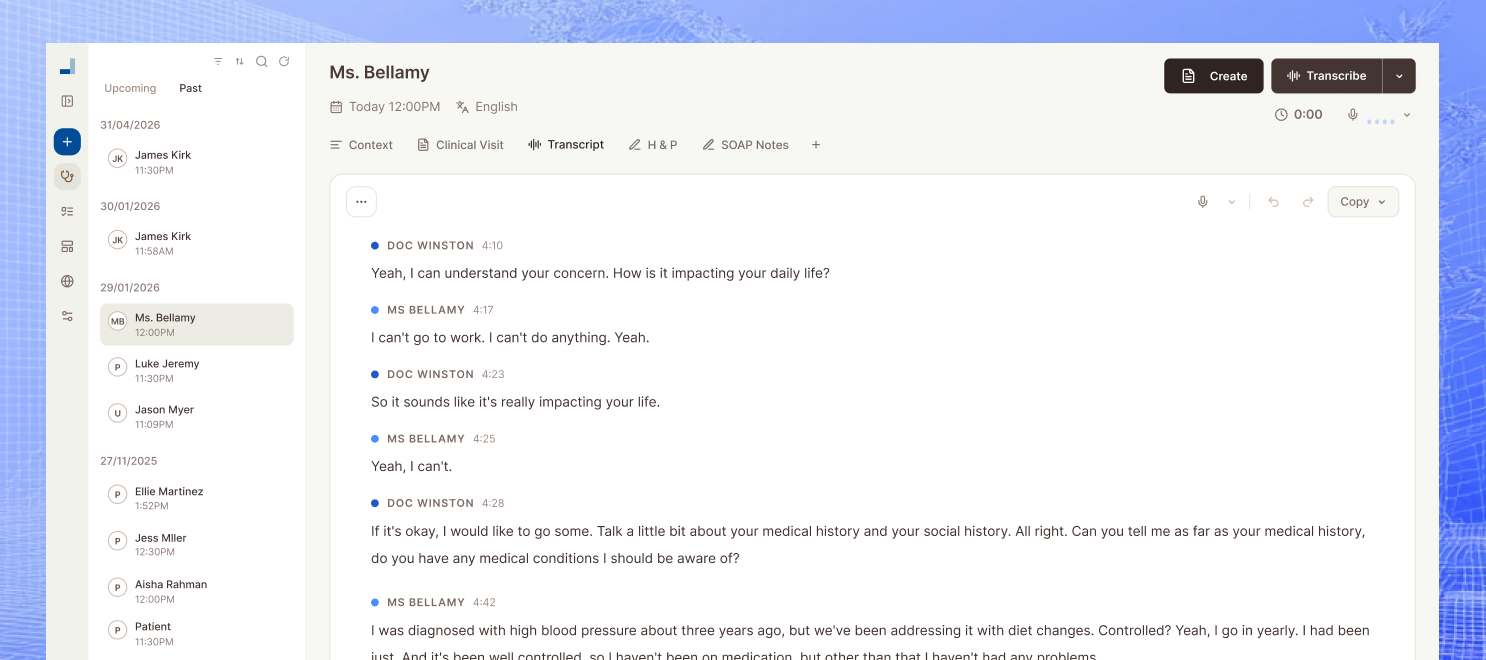
Mcoy AI is an AI medical scribe that records and transcribes patient encounters, then generates multiple clinical note types including H&P, progress notes, consult notes, follow-up notes, procedure notes, discharge summaries, referral letters, and more. With over 200 customizable templates and an AI chat feature to create letters, forms, and documents, it streamlines the administrative burden of modern practice. This helpful tool allows clinicians to focus on care while the AI handles the complexities of documentation.
Frequently Asked Questions
Implementing new technology involves many questions regarding security, efficiency, and clinical accuracy. Below are the most common inquiries from practitioners looking to modernize their workflows.
How accurate are AI medical scribes in real clinics?
AI scribes are remarkably accurate at capturing the substance of a conversation, including medical terminology and drug names. However, they are not perfect and can occasionally misinterpret context or include irrelevant details. That is why they are designed as assistive tools that require a final clinician sign-off.
Do I still need to review every note?
Yes, final clinical responsibility always rests with the provider. While the AI does 90% of the work, you must review the note to ensure all medications, dosages, and clinical assessments are 100% accurate. This review typically takes less than a minute per encounter.
What note types can an AI scribe generate besides SOAP?
Modern AI scribes are capable of generating a wide variety of documents including H&Ps, consult notes, procedure notes, and even referral letters. Most systems allow you to flip between different templates depending on the specific needs of the patient encounter.
Will this work for telehealth and in-person consults?
Most AI scribe workflows are platform-agnostic, meaning they can record audio from an in-person room or a computer’s audio during a telehealth session. The process remains the same: the AI listens, transcribes, and structures the data according to your chosen template.
How do I explain recording/transcription to patients?
The most effective way is to be direct and highlight the benefit to them. Let them know that the tool helps you keep your eyes on them rather than a keyboard, ensuring a higher quality of personal care and clinical accuracy.
How do clinics prevent note bloat?
Note bloat is prevented by using smart templates that instruct the AI to only include ‘medically necessary’ information. Clinicians can also tune the AI to be more concise or to exclude standard ‘small talk’ that occurs during the visit.
How long does template setup take?
Basic setup usually takes just a few minutes, as most systems come with pre-built templates for every major specialty. Customizing a template to fit your specific ‘voice’ or clinic requirements generally takes about 10 to 15 minutes of initial tweaking.
What’s the safest way to start if I’m skeptical?
The safest approach is to run a ‘shadow’ trial for a day. Record a few encounters but complete your notes manually as you always have. At the end of the day, compare your manual notes to the AI-generated ones to see how much detail the AI captured and how much time you would have saved.
Conclusion
Transitioning to a privacy-safe AI scribe workflow is one of the most effective ways to combat clinician burnout and improve the quality of patient care. By automating the heavy lifting of documentation, you can focus on the human element of medicine. Start small, prioritize patient privacy, and use these steps to build a sustainable system. Implementing a privacy-safe AI scribe workflow is not just about saving time; it’s about reclaiming the joy of practicing medicine. Take the first step toward a more efficient clinic by piloting an AI solution today.
What a serious review table should cover
| Decision area | Common mistake | Better clinic-ready approach | Metric to watch |
|---|---|---|---|
| Workflow design | Treat build a privacy-safe ai scribe workflow: a complete guide as a one-off documentation task | Build a repeatable process with clear ownership and review points | Time to complete documentation |
| Team adoption | Assume every clinician will naturally use the same process | Train for consistency and define exception handling early | Active user adoption |
| Quality review | Only check notes when a problem is reported | Audit a sample of notes weekly and review edge cases | Edit rate per note |
| Operational follow-through | Leave admin actions outside the documentation workflow | Use the same encounter data for referrals, letters, and follow-up tasks | Completion rate for next-step tasks |
Related reading
If you are working through build a privacy-safe ai scribe workflow: a complete guide, it helps to read this alongside Practice Operations: How Clinics Can Streamline Daily Operations, Practice Operations: How Clinics Can Improve Workflow Without Changing Their EHR, and Specialty Guides: How to Use an AI Scribe for OB-GYN Notes | Expert Guide. Those guides cover adjacent workflow, implementation, and evaluation questions so the decision does not sit in isolation.
FAQ
How accurate are AI medical scribes?
They are highly accurate for medical terms but require clinician review to ensure 100% clinical correctness.
Is a review mandatory?
Yes, the clinician remains legally responsible for the note and must confirm all details are accurate.
What notes can it make?
It can generate SOAP, H&P, consult notes, procedure notes, and referral letters automatically.
Does it work for telehealth?
Yes, it captures audio from both in-person and digital encounters to create seamless documentation.
How to tell patients?
Explain it as a secure tool that helps you focus on them instead of a computer screen.
What about note bloat?
Advanced templates ensure only clinically relevant data is kept, preventing excessive or unnecessary text.
Setup time?
Standard templates are ready immediately; custom specialty templates take about 15 minutes to refine.
Safest way to start?
Run a side-by-side ‘shadow’ test for one day to compare AI notes with your manual ones.