Specialty Guides: How to Use an AI Scribe for OB-GYN Notes | Expert Guide
Learn how to master AI scribe for OB-GYN notes. Streamline prenatal visits, surgeries, and consults with automated documentation designed for specialists.
The Documentation Burden in Women’s Health
Obstetricians and gynecologists face a unique documentation challenge that often leads to significant after-hours charting. From tracking longitudinal prenatal data to documenting complex surgical procedures, the volume of data is immense. Many practitioners find themselves rushing through notes between patient exams or sacrificing their evenings to catch up on a mountain of digital paperwork. This administrative weight often leads to clinician burnout and a feeling of being disconnected from the patient during the actual exam.
This guide provides a comprehensive roadmap for integrating an AI scribe for OB-GYN notes into your workflow. We will explore how to transition from traditional SOAP notes to specialized formats like H&Ps and discharge summaries, ensuring quality control, and maintaining patient privacy. Whether you are a solo practitioner, part of a large multi-specialty group, or managing a university teaching clinic, these strategies will help you reclaim your time while improving the accuracy of your clinical records.
What a medical scribe solves in modern practice
In the modern clinical environment, the real cost of documentation isn’t just the time spent typing; it is the cognitive load and the potential for delayed records. When a clinician is focused on a screen instead of the patient, subtle non-verbal cues can be missed. An AI medical scribe acts as an assistive layer, capturing the nuances of the conversation so the physician can remain present. It is important to remember that these tools are assistive—the clinician remains the final authority and is responsible for the accuracy of every word generated.
By automating the initial draft of a note, OB-GYNs can reduce the time spent on manual entry by up to 50% or more. This allows for faster turnaround times, meaning notes are often finished before the patient even leaves the building. For university clinics, this means more time for teaching and less time supervising the tedious data entry of residents and medical students.
- Reclaims hours of personal time previously lost to ‘pajama time’ charting.
- Reduces cognitive fatigue by allowing clinicians to focus on the patient encounter.
- Improves note accuracy by capturing details in real-time rather than from memory.
- Ensures clinical notes are finalized promptly, aiding in billing and care coordination.
Note types you can generate beyond SOAP (H&P and more)
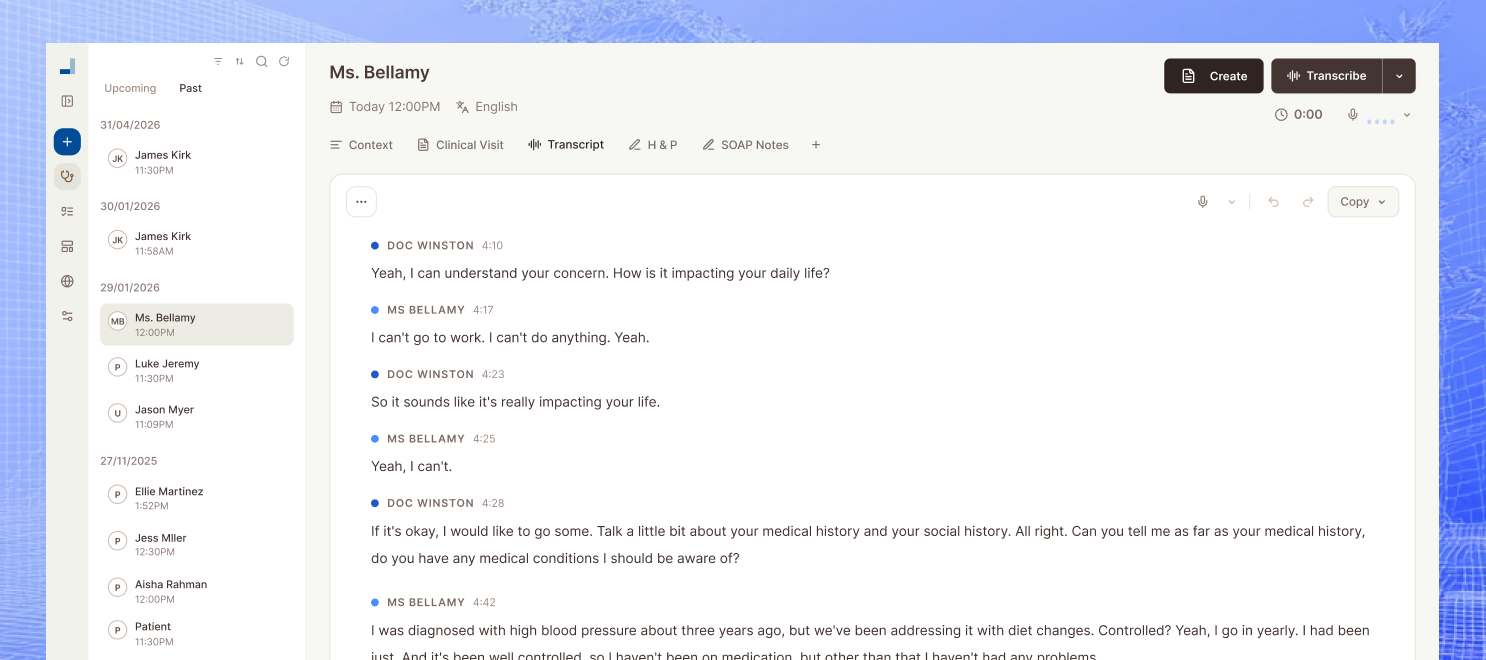
While the SOAP note is a staple of medical education, specialized OB-GYN care requires a much broader range of documentation. AI scribes are now capable of generating comprehensive History and Physical (H&P) reports, which are essential for hospital admissions and preoperative assessments. These tools can also handle complex consult notes that require a synthesis of previous treatments, imaging results, and specialized recommendations for referring physicians.
Furthermore, specialized encounters such as procedure notes for colposcopies or LEEP procedures, and detailed discharge summaries after labor and delivery, can be automated. Maintaining high-quality structure across these various formats is vital for continuity of care and audit readiness. When every note follows a consistent, high-standard template, the entire care team benefits from clearer communication and better-organized patient histories.
- Generates specialized H&Ps, consult notes, and surgical procedure summaries.
- Streamlines discharge summaries following labor, delivery, or gynecological surgery.
- Ensures audit-ready documentation through consistent formatting and structure.
- Facilitates seamless handovers between specialists and primary care providers.
How to implement AI scribe for OB-GYN notes step-by-step
Starting with an AI scribe for OB-GYN notes should begin with a single visit type to build confidence. We recommend beginning with routine prenatal visits or annual well-woman exams. These encounters have a predictable flow, making it easier to see how the AI captures the conversation and maps it to your preferred template. Once you are comfortable with the basic output, you can expand to more complex gyn-oncology consults or postpartum follow-ups.
Before you begin, set up your specialty-specific templates. Most modern systems allow for customization, so ensure your ‘Review of Systems’ and ‘Physical Exam’ sections reflect your specific practice style. During the encounter, simply let the device record the conversation naturally. There is no need to dictate to the machine; just talk to your patient as you normally would. The AI is designed to filter out small talk and focus on the clinical data.
Immediately after the visit, spend sixty seconds reviewing the generated note. This is the best time to catch minor inaccuracies while the conversation is fresh in your mind. Finally, utilize the outputs to generate referral letters or patient education summaries. This one-to-many workflow maximizes the value of the initial recording, turning a single encounter into multiple necessary documents without extra typing.
- Start with predictable visit types like prenatal checks to master the workflow.
- Configure templates to match specific OB-GYN examination standards.
- Review notes immediately post-encounter for maximum accuracy and speed.
- Repurpose the captured data for referral letters and patient instructions.
How to keep note quality high and reduce mistakes
One of the primary failure points in automated documentation is the inclusion of ‘note bloat’ or the occasional misinterpretation of specific medications and lab values. To prevent this, it is helpful to establish a team standard for note length and detail. Clinicians should adopt a lightweight review habit, scanning for critical data points like dosages, dates, and laterality (left vs. right) to ensure the AI hasn’t hallucinated or omitted a key detail.
Standardizing the ‘Problem List’ structure is another way to maintain high quality. By directing the AI to follow a specific hierarchy, you ensure that the most pressing clinical issues are always at the top of the assessment. Sharing these standards across the clinic helps maintain a unified voice in the medical record, which is especially important in multi-provider practices.
- Develop a habit of verifying dosages, dates, and specific anatomical locations.
- Set clear internal standards for note length to avoid unnecessary data bloat.
- Use structured ‘Problem Lists’ to keep clinical priorities clear and organized.
Privacy, consent, and patient trust
Maintaining patient trust is paramount, especially in a field as personal as OB-GYN care. Consent requirements for recording vary significantly by region, so it is essential to follow your local healthcare regulations and clinic policies. Generally, patients are quite receptive when they understand that the technology allows their doctor to look at them instead of a computer screen.
A simple way to explain this to a patient is: ‘I’m using a secure digital assistant today to take notes for us. This allows me to focus entirely on you rather than typing on my computer. The recording is encrypted and used only to create your clinical record.’ Transparency usually alleviates any concerns and often strengthens the patient-provider relationship.
- Always adhere to local and regional consent laws regarding digital recording.
- Use a clear, scripted explanation to inform patients about the technology.
- Ensure the scribe solution meets high security and encryption standards.
Rolling it out across a clinic without disruption
A successful rollout starts with a two-week pilot involving one or two ‘tech-forward’ providers. During this phase, track metrics such as the time spent charting after hours and the overall completeness of the notes. This data provides the ‘proof of concept’ needed to encourage more skeptical staff members to adopt the new system.
Training should focus on template alignment so that every provider is getting the output they expect. By the end of the first month, the goal is to have the AI scribe integrated so deeply into the workflow that it feels as natural as using a stethoscope. Regular check-ins during the first 90 days help identify any friction points in the process.
- Execute a short pilot program to gather data and refine the workflow.
- Track time savings and note quality as key performance indicators (KPIs).
- Conduct group training sessions to align templates across the practice.
Mcoy AI is an AI medical scribe that records and transcribes patient encounters, then generates multiple clinical note types (H&P, progress notes, consult notes, follow-up notes, procedure notes, discharge summaries, referral letters, and more). With over 200+ customizable templates and an integrated AI chat to create letters, forms, and documents, it helps clinicians focus more on patient care and less on administrative tasks.
Frequently Asked Questions
Transitioning to new technology often brings up practical questions about daily use and reliability. Below are the most common inquiries from OB-GYN specialists regarding AI documentation.
How accurate are AI medical scribes in real clinics?
In real-world clinical settings, AI medical scribes are remarkably accurate at capturing the clinical dialogue and medical terminology specific to OB-GYN care. They are designed to distinguish between casual conversation and pertinent medical data. However, accuracy can be influenced by background noise or multiple people speaking at once, which is why a final human review is always part of the process. Most providers find that the drafts are 90-95% accurate right out of the gate.
Do I still need to review every note?
Yes, as the licensed clinician, you are legally and ethically responsible for the content of the medical record. While the AI does the heavy lifting of drafting the note, you must review and sign off on it to ensure all facts, medications, and plans are correct. This review typically takes less than a minute if the note was captured during a standard encounter. The AI is a tool to assist you, not a replacement for your clinical judgment.
What note types can an AI scribe generate besides SOAP?
Modern AI scribes are highly versatile and can generate a wide array of documentation including History and Physicals (H&P), detailed procedure notes, consult letters, and discharge summaries. They are also excellent at creating specialized OB-GYN notes like prenatal flow updates or postpartum assessments. By using different templates, the AI can reorganize the same conversation into various professional formats depending on your needs for that specific encounter.
Will this work for telehealth and in-person consults?
Yes, most AI scribe solutions are designed to work seamlessly across both platforms. For in-person visits, the device (like a smartphone or tablet) sits on the desk and listens to the room. For telehealth, the AI can often be integrated into the audio stream of the video call or listen via the computer’s microphone. This flexibility ensures that your documentation remains consistent regardless of how you are seeing your patients.
How do I explain recording/transcription to patients?
The best approach is complete transparency and focusing on the benefit to the patient. Inform them that the tool allows you to maintain eye contact and listen more effectively because you aren’t busy typing. Most patients appreciate the extra attention and are comfortable once they know the data is secure and used only for their medical record. Having a standard one-sentence explanation makes this a quick and easy part of the rooming process.
How do clinics prevent note bloat?
Note bloat is prevented by using concise templates and setting specific instructions for the AI on what to include or exclude. You can customize your templates to prioritize brevity, focusing only on ‘positive’ findings or pertinent negatives. Clinicians can also train the AI by editing the outputs; many systems learn from your corrections to provide more tailored, succinct notes over time.
How long does template setup take?
Initial template setup for an OB-GYN practice usually takes about 30 to 60 minutes. Most systems come with pre-built templates for the specialty, which you can then tweak to match your specific ‘Review of Systems’ or ‘Physical Exam’ preferences. Once these templates are set, they apply to every future note, meaning the time investment pays off almost immediately through faster charting.
What’s the safest way to start if I’m skeptical?
The safest and most effective way to start is with a ‘shadow’ period. Use the AI scribe during 5-10 visits without relying on it for your primary documentation. Compare the AI-generated notes to your own manual notes to see how much it captures and where it might need adjustment. This risk-free trial allows you to build trust in the technology before fully switching over your workflow.
Conclusion
Implementing an AI scribe for OB-GYN notes is one of the most effective ways to combat the administrative burden of modern medicine. By following a structured rollout, prioritizing patient consent, and maintaining a high standard for note review, practitioners can significantly reduce their charting time while improving record quality. The shift from manual typing to AI-assisted documentation allows OB-GYNs to focus back on what matters most: providing exceptional care to their patients. Start with a pilot today and see how an AI scribe for OB-GYN notes can transform your clinical practice.
What a serious review table should cover
| Decision area | Common mistake | Better clinic-ready approach | Metric to watch |
|---|---|---|---|
| Workflow design | Treat how to use an ai scribe for ob-gyn notes | expert guide as a one-off documentation task | Build a repeatable process with clear ownership and review points |
| Team adoption | Assume every clinician will naturally use the same process | Train for consistency and define exception handling early | Active user adoption |
| Quality review | Only check notes when a problem is reported | Audit a sample of notes weekly and review edge cases | Edit rate per note |
| Operational follow-through | Leave admin actions outside the documentation workflow | Use the same encounter data for referrals, letters, and follow-up tasks | Completion rate for next-step tasks |
Related reading
If you are working through how to use an ai scribe for ob-gyn notes | expert guide, it helps to read this alongside Specialty Guides: How to Run a More Efficient Medical Practice in 2026, Specialty Guides: How to Improve Patient Encounters, and Specialty Guides: Document Mental Health Care Plans with AI: A Full Guide. Those guides cover adjacent workflow, implementation, and evaluation questions so the decision does not sit in isolation.
FAQ
How accurate are AI medical scribes? / Do I still need to review notes? / What note types can it generate? / Does it work for telehealth? / How to explain it to patients? / How to prevent note bloat? / How long is setup? / How to start safely?