Practice Operations: Set Note Quality Standards for Clinic Teams | Guide
Learn how to define, implement, and maintain high note quality standards across your clinic using modern tools and clear clinical documentation workflows.
Introduction
Every clinician knows the dread of the ‘pajama time’ shift—those late hours spent hunched over a laptop finishing charts. Whether it is a GP in a busy private practice or a specialist in a university clinic, the burden of documentation often leads to burnout and rushed, inconsistent notes. When note quality slips, it creates a domino effect of medico-legal anxiety, billing delays, and compromised patient safety.
This guide provides a comprehensive roadmap for clinic owners and lead physicians to establish high note quality standards. We will explore modern workflows, diverse note formats beyond the standard SOAP note, and practical quality control measures. You will learn how to implement a system that ensures privacy, improves accuracy, and scales across your entire team without causing administrative friction.
What a medical scribe solves in modern practice
The real cost of documentation is measured in more than just minutes; it is measured in cognitive load. When a doctor is forced to act as a data entry clerk during a consultation, they lose the ability to maintain eye contact and pick up on subtle patient cues. This divided attention often results in delayed notes that lack specific clinical nuances, ultimately leading to a ‘cloned’ note feel that does not accurately reflect the patient’s unique journey.
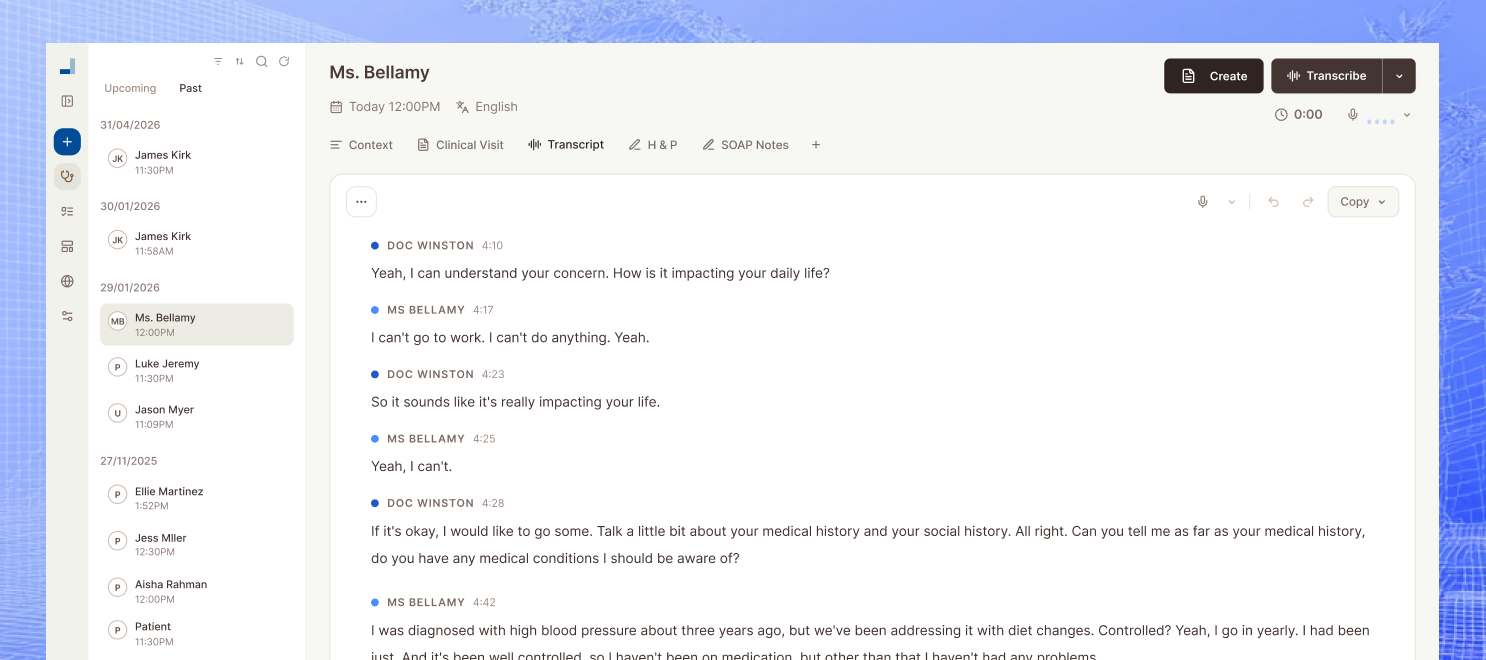
Modern AI medical scribes act as an assistive layer, capturing the nuances of the conversation so the clinician can focus entirely on the patient. It is important to remember that these tools are supportive; the clinician remains the final authority and is responsible for the accuracy of the record. By automating the heavy lifting of transcription and formatting, the scribe ensures that the baseline quality of every note is high before the doctor even begins their review.
- Saves 2-3 hours of administrative work daily per clinician.
- Reduces cognitive fatigue and prevents burnout.
- Ensures clinical details are captured in real-time.
- Acts as a supportive assistant, not a replacement for clinical judgment.
Note types you can generate beyond SOAP (H&P and more)
While the SOAP note is the industry standard for daily progress, complex cases often require more specialized documentation. History and Physical (H&P) reports, consult notes, and procedure notes carry different structural requirements that are vital for specialty care. Using a one-size-fits-all template often leads to ‘note bloat,’ where irrelevant information obscures the actual clinical findings.
Standardizing these different formats across your clinic ensures continuity of care and audit readiness. When a referral letter or a discharge summary follows a predictable, high-quality structure, it simplifies the handover process for other healthcare providers. Consistent structure also makes internal audits and peer reviews significantly faster, as the necessary data points are always where they are expected to be.
- H&P and Consult notes for complex initials and referrals.
- Procedure notes and Discharge summaries for surgical or acute settings.
- Referral letters that automatically pull from the encounter data.
- Standardized structures that simplify internal and external audits.
How to implement note quality standards step-by-step in a real clinic
To begin implementing note quality standards, start by selecting a single visit type, such as routine follow-ups or standard physicals. Narrowing the focus allows the team to master the workflow without the pressure of handling complex emergencies immediately. Once the pilot visit type is chosen, collaborate with your lead clinicians to set up templates specific to their specialties, ensuring that every required data field is accounted for in the AI configurations.
During the patient encounter, whether it is in-person or via telehealth, the clinician simply focuses on the conversation while the capture tool runs in the background. After the visit, the clinician reviews the generated output, which now follows the pre-defined quality standards. This review process should be quick, focusing on verifying specific values like dosages or dates rather than rewriting the entire narrative. Finally, the outputs can be instantly repurposed into referral letters or forms, ensuring that the same high-quality data is used across all secondary documents.
- Pilot with one specific visit type to reduce initial complexity.
- Customize templates to match specialty-specific requirements.
- Focus on the patient while the system captures the encounter logic.
- Adopt a ‘review and edit’ habit to finalize notes within minutes.
How to keep note quality high and reduce mistakes
High-quality documentation often fails at common points: missing medications, incorrect lab values, or an outdated problem list. Note bloat is another common issue, where too much repetitive data makes it difficult to find the actual assessment and plan. To combat this, clinics should adopt a lightweight review habit where clinicians verify high-risk data points before signing off on the chart.
Setting team-wide standards for what constitutes a ‘complete’ note is essential for consistency. This might include a mandatory check for a clear ‘Plan’ section or ensuring that every diagnosis is linked to a specific intervention. By establishing these expectations early, you create a culture of documentation excellence where the team takes pride in the clarity and accuracy of their records.
- Identify and double-check high-risk data like dosages and allergies.
- Avoid note bloat by excluding redundant previous history.
- Perform periodic peer reviews to ensure standard alignment.
- Establish a ‘Definition of Done’ for every patient encounter.
Privacy, consent, and patient trust (plain English)
Patient trust is the foundation of any successful clinical interaction. When introducing capture technology, it is vital to remember that consent requirements vary by region. Clinics should always consult their local medical boards or legal counsel to ensure they are following specific jurisdictional policies. Generally, transparency is the best policy; patients appreciate knowing that their doctor is using tools to ensure they receive a more personalized, attentive experience.
A simple, patient-friendly explanation can be very effective: ‘I’m using a secure digital assistant to help me take accurate notes today so I can focus entirely on you instead of my computer. It transcribes our conversation into a medical note, and I review every word for accuracy.’ This positions the technology as a benefit to the patient’s care rather than an administrative hurdle.
- Always follow local privacy regulations and obtain necessary consent.
- Explain the technology as a tool for better doctor-patient connection.
- Use secure, encrypted systems that prioritize data protection.
- Maintain a clear script for introducing the tool to new patients.
Rolling it out across a clinic without disruption
A successful rollout requires a phased approach, typically starting with a two-week pilot involving one or two ‘tech-champion’ doctors. During this time, the goal is not perfection, but rather identifying which templates need adjustment and where the workflow feels clunky. Tracking metrics such as ‘time spent charting after hours’ or ‘average time to complete a note’ provides the data needed to prove the system’s value to more skeptical staff members.
Once the pilot is complete, training sessions should focus on template alignment so that every doctor in the clinic generates notes that look and feel consistent. This uniformity makes it much easier for cross-covering physicians to understand a patient’s history. By treating the rollout as an evolution of care rather than a high-pressure software launch, you ensure long-term adoption and improved note quality standards.
- Phase implementation with a 2-week pilot for lead clinicians.
- Measure time savings and note completion rates to track success.
- Standardize templates across the team for clinical consistency.
- Provide focused training on the ‘review’ phase of the workflow.
Mcoy AI is an AI medical scribe that records and transcribes patient encounters, then generates multiple clinical note types including H&P, progress notes, consult notes, follow-up notes, procedure notes, discharge summaries, referral letters, and more. With over 200 customizable templates and an interactive AI chat, clinicians can effortlessly create letters, forms, and complex documents, allowing them to spend more time on patient care and less on administrative tasks.
FAQ
Setting up a new documentation system often brings up practical questions about accuracy and efficiency. Here are the most common inquiries from clinic owners.
How accurate are AI medical scribes in real clinics?
AI medical scribes are highly accurate at capturing the factual content of a conversation, including symptoms and plans. However, they are assistive tools and may occasionally misinterpret specific medical jargon or contextual nuances. This is why a quick clinician review is a vital part of the workflow to ensure 100% accuracy before the note is finalized. Most users find that the draft provided is 90-95% complete and only needs minor adjustments.
Do I still need to review every note?
Yes, reviewing every note is a professional and legal requirement for clinicians. The AI serves to create the draft and organize the information, but the doctor must verify that the clinical reasoning, diagnosis, and plan are correctly represented. This review process usually takes less than two minutes, which is significantly faster than writing a note from scratch. Think of it as an editor-in-chief reviewing a reporter’s draft.
What note types can an AI scribe generate besides SOAP?
Modern AI tools go far beyond the SOAP format to accommodate various clinical needs. They can generate complete History and Physical (H&P) reports, consultation letters for specialists, and detailed procedure notes. Additionally, they can create discharge summaries and referral letters by pulling the relevant data directly from the recorded encounter. This flexibility ensures that every type of patient interaction is documented in the most appropriate format.
Will this work for telehealth and in-person consults?
Yes, AI medical scribes are designed to work seamlessly in both environments. For in-person visits, the system captures audio through a mobile device or computer microphone. For telehealth, the system can often integrate with or listen to the audio stream of the virtual meeting. The core technology remains the same: it identifies the different speakers and organizes the medical information regardless of the physical setting.
How do I explain recording/transcription to patients?
Transparency is the most effective approach when explaining the tool to patients. Most clinicians say something like, ‘To make sure I’m giving you my full attention, I’m using a secure tool to help me with my notes.’ Patients generally respond positively when they realize the doctor won’t be staring at a screen for the entire visit. It also helps to mention that the system is secure and the data is handled according to strict privacy standards.
How do clinics prevent note bloat?
Clinics prevent note bloat by using customizable templates that specify exactly what information should be included and what should be omitted. Instead of pulling in the patient’s entire medical history every time, the templates can be set to focus only on the ‘Interval History’ or the ‘Current Problems.’ Training clinicians to edit out unnecessary auto-populated data during the review phase also keeps the records concise and readable.
How long does template setup take?
Initial template setup for a standard specialty usually takes about 30 to 60 minutes. Most systems come with pre-built templates for common specialties that can be tweaked to fit your specific clinic’s preferences. Once the primary templates are set, adjusting them based on real-world usage takes only a few minutes. Over time, these templates become highly refined, reducing the need for manual edits during the working day.
What’s the safest way to start if I’m skeptical?
The safest way to start is with a ‘shadow’ trial on a few non-complex patients. Record the encounter and let the AI generate a note, then compare that note to the one you wrote manually. This allows you to verify the accuracy and the formatting without the pressure of relying on the tool for your primary record immediately. Most clinicians find that after 5 to 10 encounters, they’re confident enough to move to a ‘scribe-first’ workflow.
Conclusion
Establishing high-quality documentation is one of the most effective ways to reduce clinician burnout and protect your practice. By moving toward a workflow that leverages assistive technology, you can ensure that every note meets your clinic’s standards without sacrificing personal time. Implementing note quality standards ensures that your team remains focused on what truly matters: providing exceptional patient care. Start with a small pilot today and see how refined documentation can transform your daily practice.
What a serious review table should cover
| Decision area | Common mistake | Better clinic-ready approach | Metric to watch |
|---|---|---|---|
| Workflow design | Treat set note quality standards for clinic teams | guide as a one-off documentation task | Build a repeatable process with clear ownership and review points |
| Team adoption | Assume every clinician will naturally use the same process | Train for consistency and define exception handling early | Active user adoption |
| Quality review | Only check notes when a problem is reported | Audit a sample of notes weekly and review edge cases | Edit rate per note |
| Operational follow-through | Leave admin actions outside the documentation workflow | Use the same encounter data for referrals, letters, and follow-up tasks | Completion rate for next-step tasks |
Related reading
If you are working through set note quality standards for clinic teams | guide, it helps to read this alongside Practice Operations: How Clinics Can Streamline Daily Operations, Practice Operations: How Clinics Can Improve Workflow Without Changing Their EHR, and Specialty Guides: AI Scribe for Respiratory Clinic Notes: A Complete Guide. Those guides cover adjacent workflow, implementation, and evaluation questions so the decision does not sit in isolation.
FAQ
How accurate are AI medical scribes in real clinics?
AI medical scribes are highly accurate at capturing factual content. However, they are assistive tools and require a clinician’s final review to ensure context and medical jargon are 100% correct. Most users find the draft is nearly complete, requiring only seconds of editing.
Do I still need to review every note?
Reviewing every note is a legal and professional necessity. While the AI creates a robust draft, the clinician must verify the clinical reasoning and plan. This review typically takes less than two minutes per patient, saving significant time compared to manual entry.
What note types can an AI scribe generate besides SOAP?
Beyond SOAP, AI scribes can generate H&Ps, consult notes, procedure notes, discharge summaries, and referral letters. This variety ensures that regardless of the visit type, the documentation is appropriately structured and clinically relevant.
Will this work for telehealth and in-person consults?
Yes, these systems are built for flexibility across environments. They capture audio through standard microphones for in-person visits and can process audio from telehealth platforms, ensuring consistent note quality regardless of how the patient is seen.
How do I explain recording/transcription to patients?
Be transparent and frame it as a patient benefit. Explaining that the tool allows you to focus on the patient rather than the computer screen usually yields high acceptance. Mentioning security and privacy protocols further builds patient trust.
How do clinics prevent note bloat?
Clinics use specific, customizable templates that focus only on necessary data points for that visit type. By avoiding ‘copy-forward’ habits and refining template logic, the resulting notes remain concise and easy for other providers to read.
How long does template setup take?
Setting up basic templates usually takes less than an hour, especially when starting with pre-built specialty options. Continuous refinement happens organically as clinicians use the tool, leading to a perfectly tailored system within the first week.
What’s the safest way to start if I’m skeptical?
The best approach is a ‘shadow’ pilot. Use the tool alongside your traditional charting for a few days to compare results. This low-risk method allows you to gain confidence in the system’s accuracy before fully transitioning your workflow.