AI & Medicine: Faster Progress Notes: Medical Scribe App Guide
Learn how a medical scribe app streamlines progress notes, H&P, and referrals. Improve clinic efficiency and reduce provider burnout with this guide.
The Hidden Burden of Clinical Documentation
For most clinicians, the workday doesn’t end when the last patient leaves. Instead, it transitions into hours of tedious data entry, often referred to as ‘pajama time.’ Whether you are a general practitioner or a specialist in a busy university clinic, the weight of after-hours charting is a primary driver of burnout. The pressure to maintain clinical accuracy while managing high patient volumes often leads to rushed, inconsistent notes that can create medico-legal anxiety and impact the quality of care.
This guide provides a comprehensive roadmap for transforming your documentation workflow. We will explore how to move beyond basic SOAP notes, maintain high quality control, and implement a rollout plan that respects patient privacy. Whether you are managing telehealth encounters or complex in-person consultations, understanding how to leverage a medical scribe app effectively will help you reclaim your time and focus on what matters most: the patient sitting in front of you.
What a medical scribe solves in modern practice
The real cost of traditional documentation extends far beyond the time spent typing. It carries a heavy cognitive load that forces doctors to split their attention between the computer screen and the person seeking help. This distraction can lead to delayed notes, which increases the likelihood of missing subtle clinical details or forgetting the nuances of a patient’s narrative. When documentation becomes a secondary thought, the risk of technical errors or omissions rises significantly.
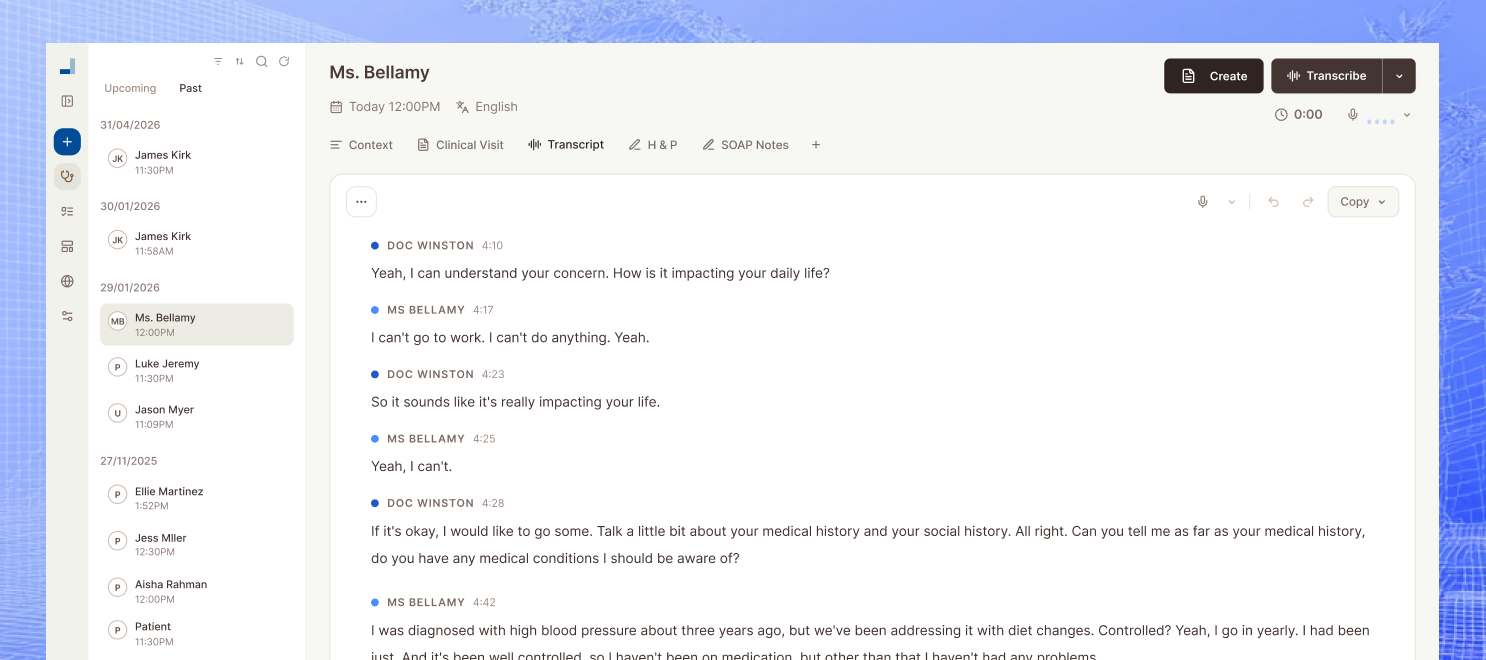
A modern medical scribe app acts as an assistive layer rather than a replacement for clinical judgment. It captures the natural dialogue of an encounter and structures it into a coherent draft, allowing the clinician to remain fully present. It is important to remember that these tools are assistive; the clinician remains the ultimate authority, responsible for reviewing, editing, and signing off on every entry to ensure medical accuracy.
- Reduces the cognitive burden of multitasking during patient visits.
- Minimizes ‘pajama time’ by generating drafts in real-time.
- Ensures more detailed and accurate records by capturing dialogue.
- Allows clinicians to focus on physical exams and patient rapport.
Note types you can generate beyond SOAP (H&P and more)
While the SOAP format is a staple in many practices, modern medicine requires a diverse array of documentation styles to ensure continuity of care. A versatile medical scribe app allows clinicians to generate History and Physical (H&P) reports, consult notes, and complex procedure notes without manual formatting. This versatility is essential for specialists who need to document everything from a routine check-up to a detailed surgical intervention with specific technical parameters.
Structure matters deeply for audit readiness and seamless handovers. When a patient moves from a primary care setting to a specialist or is discharged from a university clinic, the quality of the referral letter or discharge summary dictates the safety of the transition. Well-structured notes ensure that every member of the care team has access to the same high-quality information, reducing the risk of medication errors or redundant testing.
- H&P and Progress Notes: Capture the full clinical picture from admission to daily rounds.
- Consult and Referral Letters: Communicate clearly with the wider medical community.
- Procedure Notes: Document technical details accurately for billing and records.
- Discharge Summaries: Ensure safe patient transitions with concise, actionable data.
How to implement a medical scribe app step-by-step in a real clinic
Starting with a medical scribe app should be a gradual process to avoid overwhelming the staff and patients. Begin by selecting one specific visit type, such as follow-up appointments or routine physicals, to test the workflow. This allows you to calibrate the AI’s performance and get a feel for the recording process without the pressure of a complex multi-system case. Once you are comfortable, you can expand to more detailed encounters.
Before the first patient arrives, set up your templates by specialty. Most apps allow you to define exactly how you want your data organized. During the encounter, whether it is an in-person visit or a telehealth session, simply start the recording. Don’t worry about speaking into the phone like a dictation device; just have a natural conversation with your patient. The AI is designed to filter out the small talk and focus on the clinical facts.
After the encounter, review and edit the generated draft immediately while the details are fresh in your mind. This usually takes less than sixty seconds. Once the note is polished, you can reuse the outputs to generate referral letters or patient instruction forms instantly. This multifaceted use of a single recording significantly multiplies the time saved across the entire administrative workflow.
- Start small with one visit type to master the basic recording flow.
- Customize templates to match your specific specialty requirements.
- Focus on the patient while the app captures the dialogue naturally.
- Edit and finalize notes immediately to ensure maximum clinical accuracy.
How to keep note quality high and reduce mistakes
Artificial intelligence is a powerful tool, but it is not infallible. Typical failure points can include missing a specific dosage for a newly prescribed medication or misinterpreting a complex problem list. To mitigate these risks, clinicians should adopt a lightweight review habit. Instead of reading every word like a proofreader, scan for key data points: medications, dosages, allergies, and the final assessment and plan.
Establishing team standards for note review is also vital, especially in larger clinics or academic settings. Ensuring that every provider follows a consistent verification process helps maintain a high level of clinical integrity. By treating the AI-generated draft as a high-quality ‘first draft,’ you can significantly reduce the ‘note bloat’ that often plagues electronic health records while keeping the documentation concise and relevant.
- Verify high-stakes data like medications, dosages, and lab values.
- Focus on the assessment and plan to ensure clinical intent is clear.
- Establish a standard ‘review and sign’ habit for every encounter.
- Use templates to prevent unnecessary note bloat and keep records concise.
Privacy, consent, and patient trust (plain English)
Maintaining patient trust is the foundation of any successful clinical practice. While privacy laws vary by region, the core principle remains the same: transparency. You should always follow your local health authority’s guidelines regarding recording and data retention. Most patients are incredibly supportive when they realize that the technology is being used so that the doctor can look at them instead of a computer screen.
A simple way to explain this to a patient is to say: ‘I’m using a medical scribe app today to help me take notes so I can focus entirely on our conversation. It records our talk and helps me write my medical report later. Is that alright with you?’ This approach is direct and places the focus on the benefit to the patient’s care. Generally, ensuring that your software follows industry-standard security and encryption protocols will satisfy the technical side of privacy requirements.
- Always check local consent laws and clinic policies before recording.
- Use a simple, patient-centered script to explain the technology.
- Prioritize software that uses end-to-end encryption and secure storage.
- Address patient concerns by highlighting the clinical benefits of undivided attention.
Rolling it out across a clinic without disruption
A successful rollout requires a structured 2-week pilot plan. During the first week, allow a small group of early-adopter clinicians to test the medical scribe app. Gather their feedback on template accuracy and integration. In the second week, begin training the rest of the staff, focusing on how the app aligns with existing EMR workflows. This phased approach prevents the technical ‘hiccups’ that can occur when moving too fast.
Track specific metrics during this period to justify the transition. Look at the reduction in after-hours charting time, the speed of note completion, and the level of detail in the documentation. Comparing these metrics against your baseline will show the tangible value of the tool. Finally, ensure that all templates are aligned across the practice so that the quality of care remains consistent regardless of which provider the patient sees.
- Run a 2-week pilot with feedback loops to identify workflow bottlenecks.
- Measure time saved and note quality before and after implementation.
- Align templates across the clinic for consistent documentation standards.
- Provide brief, practical training sessions for all clinical and admin staff.
Mcoy AI is a powerful AI medical scribe that records and transcribes patient encounters, then generates multiple clinical note types including H&P, progress notes, consult notes, follow-up notes, procedure notes, discharge summaries, referral letters, and more. With over 200+ customizable templates and an interactive AI chat to create personalized letters, forms, and documents, it streamlines the entire administrative side of practice. By automating the heavy lifting of documentation, it allows healthcare providers to return their focus to the clinical excellence their patients deserve.
FAQ
Below are frequently asked questions about integrating AI tools into clinical workflows.
How accurate are AI medical scribes in real clinics?
In real-world settings, AI medical scribes are remarkably accurate at capturing the nuances of clinical dialogue. They excel at filtering out background noise and tangential conversations to focus on relevant medical facts. However, like any assistive technology, they may occasionally misunderstand technical abbreviations or complex brand names for medications. This is why a quick clinician review is always the final and most important step in the process.
Do I still need to review every note?
Yes, reviewing every note is a mandatory part of the clinician’s responsibility. While the app can handle 90% of the transcription and formatting work, the legal and professional responsibility for the accuracy of the medical record remains with the doctor. A quick scan to verify clinical intent, medications, and the treatment plan ensures that the high-quality draft becomes a perfect final record.
What note types can an AI scribe generate besides SOAP?
Modern apps are highly versatile and can generate a wide range of documents including History and Physicals (H&P), procedure notes, consult letters, and discharge summaries. The AI can also be used to draft referral letters to specialists or patient-facing instructions. This flexibility ensures that the tech supports the clinician through the entire patient journey, not just the initial assessment.
Will this work for telehealth and in-person consults?
Most scribe apps are designed to work seamlessly across both environments. For in-person visits, the app uses the device’s microphone to capture the conversation. For telehealth, the app can often be used alongside your video conferencing software to record the digital audio stream. This ensures a consistent documentation experience regardless of how the care is being delivered.
How do I explain recording/transcription to patients?
The best approach is complete transparency. Let the patient know that you are using a tool to help you document the visit more accurately so that you can spend more time looking at them and listening. Most patients are very receptive when they understand that the goal is to improve the quality of human interaction during the appointment.
How do clinics prevent note bloat?
To prevent note bloat, clinicians should use concise templates and instruct the AI to focus on ‘exception-based reporting’ or specific clinical summaries. By setting clear parameters on what the AI should include or exclude, you can ensure that the resulting notes are helpful and readable rather than long-winded and filled with redundant information.
How long does template setup take?
Initial template setup is usually a very fast process. Most clinicians can select and customize their preferred formats in under thirty minutes. Once your core templates for different visit types are saved, the AI will use them every time, meaning the long-term time investment is virtually zero compared to the hours saved each week.
What’s the safest way to start if I’m skeptical?
The safest way to start is to use the app for your most routine, low-risk cases. This allows you to build trust in the technology’s accuracy without any clinical pressure. As you see the consistency and quality of the drafts, you can gradually move toward documenting more complex encounters and utilizing the more advanced features of the app.
Conclusion
Implementing a medical scribe app is one of the most effective ways for modern practitioners to combat burnout and improve clinic efficiency. By following a structured workflow—from template setup to the final review habit—clinicians can ensure their documentation is both thorough and timely. This technology doesn’t just save time; it improves the quality of the medical record and the patient experience. If you are looking to streamline your practice, the best next step is to choose a medical scribe app and pilot it with a few patients today. Reclaim your focus, reduce your administrative burden, and get back to the heart of medicine.
What a serious review table should cover
| Decision area | Common mistake | Better clinic-ready approach | Metric to watch |
|---|---|---|---|
| Workflow design | Treat faster progress notes: medical scribe app guide as a one-off documentation task | Build a repeatable process with clear ownership and review points | Time to complete documentation |
| Team adoption | Assume every clinician will naturally use the same process | Train for consistency and define exception handling early | Active user adoption |
| Quality review | Only check notes when a problem is reported | Audit a sample of notes weekly and review edge cases | Edit rate per note |
| Operational follow-through | Leave admin actions outside the documentation workflow | Use the same encounter data for referrals, letters, and follow-up tasks | Completion rate for next-step tasks |
Related reading
If you are working through faster progress notes: medical scribe app guide, it helps to read this alongside AI & Medicine: How to Simplify Clinical Notes for Busy Doctors, AI & Medicine: How Doctors Can Improve SOAP Notes, and Admin Management: Turn Encounter Notes Into Discharge Summaries | Guide. Those guides cover adjacent workflow, implementation, and evaluation questions so the decision does not sit in isolation.
FAQ
{“How accurate are AI medical scribes in real clinics?”: “In real-world settings, AI medical scribes are remarkably accurate at capturing the nuances of clinical dialogue. They excel at filtering out background noise and tangential conversations to focus on relevant medical facts. However, like any assistive technology, they may occasionally misunderstand technical abbreviations or complex brand names for medications. This is why a quick clinician review is always the final and most important step in the process.”, “Do I still need to review every note?”: “Yes, reviewing every note is a mandatory part of the clinician’s responsibility. While the app can handle 90% of the transcription and formatting work, the legal and professional responsibility for the accuracy of the medical record remains with the doctor. A quick scan to verify clinical intent, medications, and the treatment plan ensures that the high-quality draft becomes a perfect final record.”, “What note types can an AI scribe generate besides SOAP?”: “Modern apps are highly versatile and can generate a wide range of documents including History and Physicals (H&P), procedure notes, consult letters, and discharge summaries. The AI can also be used to draft referral letters to specialists or patient-facing instructions. This flexibility ensures that the tech supports the clinician through the entire patient journey, not just the initial assessment.”, “Will this work for telehealth and in-person consults?”: “Most scribe apps are designed to work seamlessly across both environments. For in-person visits, the app uses the device’s microphone to capture the conversation. For telehealth, the app can often be used alongside your video conferencing software to record the digital audio stream. This ensures a consistent documentation experience regardless of how the care is being delivered.”, “How do I explain recording/transcription to patients?”: “The best approach is complete transparency. Let the patient know that you are using a tool to help you document the visit more accurately so that you can spend more time looking at them and listening. Most patients are very receptive when they understand that the goal is to improve the quality of human interaction during the appointment.”, “How do clinics prevent note bloat?”: “To prevent note bloat, clinicians should use concise templates and instruct the AI to focus on ‘exception-based reporting’ or specific clinical summaries. By setting clear parameters on what the AI should include or exclude, you can ensure that the resulting notes are helpful and readable rather than long-winded and filled with redundant information.”, “How long does template setup take?”: “Initial template setup is usually a very fast process. Most clinicians can select and customize their preferred formats in under thirty minutes. Once your core templates for different visit types are saved, the AI will use them every time, meaning the long-term time investment is virtually zero compared to the hours saved each week.”, “What’s the safest way to start if I’m skeptical?”: “The safest way to start is to use the app for your most routine, low-risk cases. This allows you to build trust in the technology’s accuracy without any clinical pressure. As you see the consistency and quality of the drafts, you can gradually move toward documenting more complex encounters and utilizing the more advanced features of the app.”}