Admin Management: Turn Encounter Notes Into Discharge Summaries | Guide
Learn how to streamline discharge summaries from encounter notes. Improve clinic workflow, documentation quality, and patient safety for private practices.
The Crisis of Clinical Documentation and Post-Encounter Admin
For most clinicians, the actual patient interaction is the most rewarding part of the day, yet it is often eclipsed by the shadow of pending paperwork. After-hours charting is not just a personal inconvenience; it is a primary driver of physician burnout and cognitive fatigue. When practitioners are rushed, the risk of inconsistency in medical records increases, potentially leading to medico-legal anxiety and a lack of confidence in the audit trail. This is particularly true for complex transitions of care, where condensing days or weeks of treatment into a singular summary feels like a monumental task.
This guide provides a comprehensive roadmap for transforming daily encounter notes into discharge summaries efficiently. We will explore optimized workflows, look at essential note formats beyond the traditional SOAP structure, and discuss quality control measures that ensure patient safety. Whether you are a solo GP, a specialist managing a high-volume list, or a clinician in a busy university health center, mastering this transition is the key to reclaiming your time and improving continuity of care.
What a medical scribe solves in modern practice
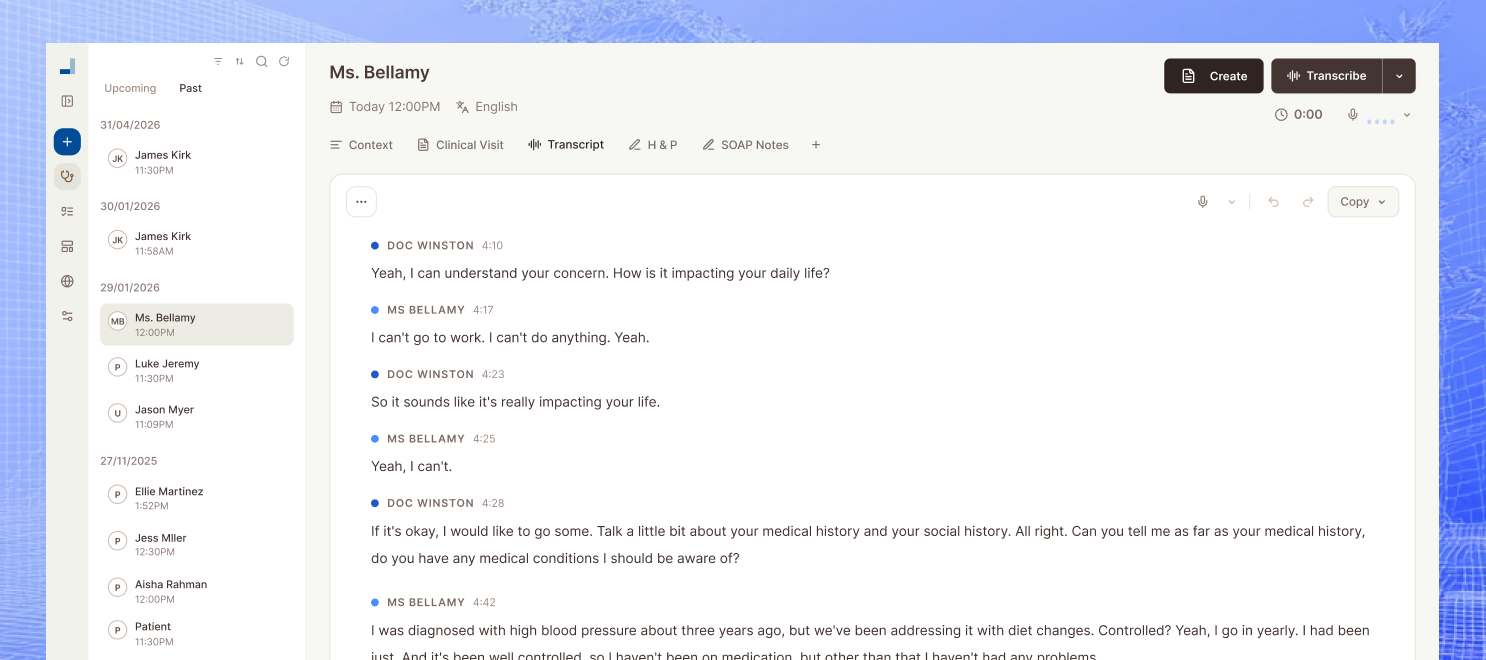
The real cost of documentation extends far beyond the time spent typing. It includes the cognitive load of trying to remember specific patient details while moving between rooms, leading to delayed notes and potentially missed clinical nuances. When a clinician is preoccupied with the keyboard, the therapeutic alliance can suffer. An AI-assisted approach allows the provider to focus entirely on the patient, knowing that the structural backbone of the encounter is being captured in real-time.
It is important to clarify that an AI medical scribe is an assistive tool, not a replacement for clinical judgment. While technology can capture data and organize it into clinical narratives, the clinician remains the final authority and responsible party for the accuracy of every word. By automating the rote task of transcription and initial formatting, these tools free up mental bandwidth for complex diagnostic reasoning and empathetic communication.
- Reduces the burden of after-hours charting and administrative burnout.
- Ensures clinical details are captured immediately, reducing the risk of recall bias.
- Allows clinicians to maintain better eye contact and engagement with patients.
- Functions as a high-level assistant that requires final professional validation.
Note types you can generate beyond SOAP (H&P and more)
While the SOAP note is a staple of medical training, it often falls short for complex cases or specialized transitions. Comprehensive care requires various formats such as History and Physical (H&P) reports, consult notes, and detailed procedure notes. Each of these serves a specific purpose in the clinical ecosystem. For instance, a consult note must be structured to answer the referring provider’s specific questions, whereas an H&P provides the baseline narrative for an entire admission.
Standardizing these different outputs is vital for audit readiness and seamless handovers. When a patient moves from an acute setting to home or a rehabilitation facility, the quality of the discharge summary can determine the success of their recovery. Using structured templates for follow-up notes and referral letters ensures that no critical medication changes or follow-up requirements are lost in translation between different levels of care.
- H&P and consult notes provide essential context for new patient evaluations.
- Procedure notes and progress notes document active interventions and daily changes.
- Discharge summaries consolidate the entire episode of care for external providers.
- Standardized structures improve compliance, billing accuracy, and patient safety.
How to implement encounter notes into discharge summaries step-by-step in a real clinic
To begin implementing a system for turning encounter notes into discharge summaries, start small by focusing on one specific visit type. You might choose standard follow-ups or a specific type of physical exam. This allows you to refine your workflow without overwhelming your staff. Once the process feels natural for one category, you can expand it to more complex encounters across your specialty.
Setting up specialty-specific templates is the next crucial step. A cardiologist’s discharge needs are vastly different from an orthopedic surgeon’s. By pre-configuring structures that prioritize relevant data points—like post-op instructions or cardiac medication titration—you ensure the generated summary is useful for the next provider. During the encounter, ensure the capture device is positioned well to record the dialogue clearly, whether in-person or via a telehealth platform.
Once the encounter is over, move directly to the review and edit phase. Real-time editing is significantly faster than trying to fix a note three days later. After the note is finalized, use the outputs to automatically populate other documents. A well-written encounter note contains 90% of the information needed for a referral letter or a school clearance form, so reusing this data saves hours of redundant typing. As you master this, you will find you can effortlessly turn encounter notes into discharge summaries with minimal manual intervention.
- Start with one clinical visit type to build confidence in the new workflow.
- Customize templates to match your specialty’s specific documentation needs.
- Review and finalize notes immediately to capitalize on fresh memory.
- Repurpose encounter data for letters and forms to eliminate double work.
How to keep note quality high and reduce mistakes
The most common failure points in medical documentation include missing medication dosages, incorrect laboratory values, and the dreaded ‘note bloat’—where irrelevant information obscures the clinical plan. To prevent this, establish a lightweight review habit. Instead of a deep crawl through every sentence, focus on the ‘high-stakes’ sections: the assessment, the plan, and the medication list.
Creating team standards for how nuances are recorded also helps maintain quality. Ensure that if an AI tool misinterprets a specific medical acronym common to your practice, you correct it in the template level. This iterative improvement ensures that the system learns your preferences, leading to higher accuracy over time and a more reliable medical record for every patient in your care.
- Focus reviews on high-stakes areas like medications and the final plan.
- Develop clinic-wide standards for acronyms and specific medical terminology.
- Avoid note bloat by ensuring only pertinent negatives and findings are included.
- Commit to a daily ‘zero-inbox’ policy for clinical notes to ensure accuracy.
Privacy, consent, and patient trust (plain English)
Patient privacy is the foundation of the clinical relationship. While consent requirements for recording vary significantly by region and local jurisdiction, the gold standard is transparency. Most patients are supportive of technologies that allow their doctor to look at them instead of a screen, provided they understand how their data is being secured and who has access to it.
A simple script can ease any patient anxiety. You might say: ‘I’m using a digital scribe today to help me capture our conversation so I can focus on you rather than typing. It’s secure and encrypted. Is that okay with you?’ This approach centers the patient’s benefit—better communication and more focused care—while respecting their autonomy. Always follow your specific institution’s data retention and security policies to the letter.
- Always check local and regional regulations regarding encounter recording.
- Use a patient-centric script to explain the benefits of digital assistance.
- Ensure all data is processed through encrypted, HIPAA-compliant channels.
- Provide patients the option to opt-out at any time to maintain trust.
Rolling it out across a clinic without disruption
A successful rollout requires a phased approach. Begin with a two-week pilot involving one or two ‘tech-champion’ clinicians. This small group can identify potential friction points in the clinic workflow—such as Wi-Fi dead zones or template gaps—before a full-scale launch. During this time, gather feedback on the ease of use and the quality of the outputs generated.
Track specific metrics to measure success, such as the total time saved per day and the reduction in ‘pajama time’ (documentation done at home). When other staff members see the tangible improvement in work-life balance and note completeness, adoption becomes much easier. Aligning templates across the practice ensures that regardless of which doctor a patient sees, the resulting documentation is consistent and professional.
- Run a two-week pilot with a small group to iron out technical hurdles.
- Monitor ‘pajama time’ and time-to-completion as key success metrics.
- Align templates across the clinic for consistent documentation standards.
- Provide brief, hands-on training sessions for the entire clinical team.
Mcoy AI is an AI medical scribe that records and transcribes patient encounters, then generates multiple clinical note types including H&P, progress notes, consult notes, follow-up notes, procedure notes, discharge summaries, referral letters, and more. With over 200 customizable templates and an integrated AI chat, clinicians can easily create custom letters, forms, and complex medical documents. The tool is designed to fit naturally into the clinical workflow, helping practitioners spend more time on patient care and less on administrative tasks.
Frequently Asked Questions
Following is a list of common questions regarding the use of AI tools in clinical settings and how they handle various documentation tasks.
How accurate are AI medical scribes in real clinics?
Modern AI scribes are highly accurate at capturing the nuances of medical dialogue, including complex terminology and multi-speaker conversations. However, accuracy can be affected by background noise or very fast speech patterns. Clinicians find that while the transcription is excellent, the true value lies in how the AI intelligently summarizes the conversation into a structured note. You should always perform a quick final check for clinical precision.
Do I still need to review every note?
Yes, professional responsibility dictates that the clinician must review and sign off on every note generated by an AI tool. The AI acts as a highly efficient draft-writer, but it cannot replace the legal or ethical accountability of the licensed provider. Most users find that the review process takes only a fraction of the time it would take to write a note from scratch. It is a collaborative process between human expertise and machine efficiency.
What note types can an AI scribe generate besides SOAP?
Beyond the standard SOAP format, advanced systems can generate a wide array of documents including H&P (History and Physical), consult notes, and complex discharge summaries. They are also capable of producing procedure notes, referral letters, and specialty-specific follow-up forms. By using different templates, the AI can reformat the same encounter data into various outputs depending on the clinical need. This flexibility is essential for modern multi-disciplinary practices.
Will this work for telehealth and in-person consults?
Most AI scribe solutions are designed to be platform-agnostic, meaning they work equally well for in-person visits and telehealth sessions. For in-person visits, a simple mobile device or microphone is used, while for telehealth, the system can often capture audio directly from the computer. The goal is to provide a consistent documentation experience regardless of how the patient chooses to connect with their provider. This ensures a unified medical record across all touchpoints.
How do I explain recording/transcription to patients?
The best approach is to be direct and highlight the benefits to the patient experience. Inform them that the technology allows you to spend more time listening and less time looking at a computer screen. Most patients respond positively when they realize the doctor’s attention is fully on them. Having a printed flyer or a short verbal script ready can help standardize this process across your entire clinic staff.
How do clinics prevent note bloat?
Clinics prevent note bloat by using well-defined templates that prioritize relevant clinical data over verbatim transcripts. You can instruct the AI to focus on ‘pertinent positives and negatives’ rather than including every conversational filler. By setting these standards at the template level, the generated notes remain concise and high-value. Periodically reviewing your templates ensures they continue to meet the needs of your practice without becoming oversized.
How long does template setup take?
Initial setup for basic templates usually takes less than an hour, as many systems come with pre-built libraries for various specialties. Fine-tuning those templates to match your specific ‘voice’ or clinic preferences might happen incrementally over the first week of use. The process is designed to be intuitive, often requiring no technical background. Once set, these templates save hours of work every single week.
What’s the safest way to start if I’m skeptical?
The safest way to begin is by using the tool for your most routine, low-risk encounters, such as standard follow-ups or wellness checks. This allows you to see the quality of the output without the pressure of a complex medical mystery. As you gain confidence in the system’s ability to capture your clinical intent, you can gradually introduce it to more complex cases. Starting small minimizes risk while allowing you to verify the efficiency gains firsthand.
Conclusion
Successfully learning how to turn encounter notes into discharge summaries is a transformative step for any modern clinic. By moving away from manual transcription and embracing structured, AI-assisted documentation, you can significantly reduce burnout and improve the quality of patient handovers. The key is to start with a solid workflow, choose the right templates, and maintain a consistent review habit. As you integrate these practices, you will find that a high-quality encounter note into discharge summaries process becomes the backbone of an efficient, patient-centered practice. Take the first step today by piloting a structured documentation tool in your next clinic session.
What a serious review table should cover
| Decision area | Common mistake | Better clinic-ready approach | Metric to watch |
|---|---|---|---|
| Workflow design | Treat turn encounter notes into discharge summaries | guide as a one-off documentation task | Build a repeatable process with clear ownership and review points |
| Team adoption | Assume every clinician will naturally use the same process | Train for consistency and define exception handling early | Active user adoption |
| Quality review | Only check notes when a problem is reported | Audit a sample of notes weekly and review edge cases | Edit rate per note |
| Operational follow-through | Leave admin actions outside the documentation workflow | Use the same encounter data for referrals, letters, and follow-up tasks | Completion rate for next-step tasks |
Related reading
If you are working through turn encounter notes into discharge summaries | guide, it helps to read this alongside Admin Management: How to Reduce Admin Errors in Clinical Notes, Admin Management: Medication List Template with Examples, and Specialty Guides: Patient Consent for Recording Consultations: A Full Guide. Those guides cover adjacent workflow, implementation, and evaluation questions so the decision does not sit in isolation.
FAQ
How accurate are AI medical scribes?
Modern AI scribes are highly accurate at capturing medical dialogue, but clinicians must always perform a final review for clinical precision. The true value is in structured summarization.
Do I still need to review every note?
Yes, clinicians are legally and ethically responsible for their notes. The AI provides a 90% complete draft, but human validation is essential for every signed document.
What note types can an AI scribe generate?
They can generate H&Ps, progress notes, consult notes, procedure notes, discharge summaries, and referral letters. The same encounter data can be reformatted for multiple needs.
Will this work for telehealth?
Yes, AI scribes work for both in-person and telehealth consults, ensuring a unified documentation process regardless of the patient interaction mode.
How do I explain this to patients?
Focus on the benefit: ‘This tool lets me focus on you instead of the computer.’ Most patients value the extra eye contact and attention.
How do clinics prevent note bloat?
By using specific templates that emphasize pertinent information and concise summaries rather than verbatim transcripts of the entire conversation.
How long does template setup take?
Basic setup usually takes under an hour. Fine-tuning to your specific clinical ‘voice’ happens naturally over the first few days of use.
What’s the safest way to start?
Start with low-risk, routine follow-up visits. This lets you build trust in the system before applying it to complex diagnostic cases.