AI & Medicine: 200+ Mcoy AI Templates: Guide to Faster Medical Charting
Learn how to use 200+ Mcoy AI templates to automate your medical documentation. Streamline H&Ps, SOAP notes, and more to stop charting after hours.
What a medical scribe solves in modern practice
The burden of clinical documentation is a primary driver of physician burnout in modern healthcare. Between the cognitive load of remembering patient details and the physical time required to type at a workstation, providers often find themselves spending hours after clinics close just to stay caught up. This administrative mountain leads to delayed notes, rushed entries, and a persistent sense of medico-legal anxiety that affects the quality of person-centered care.
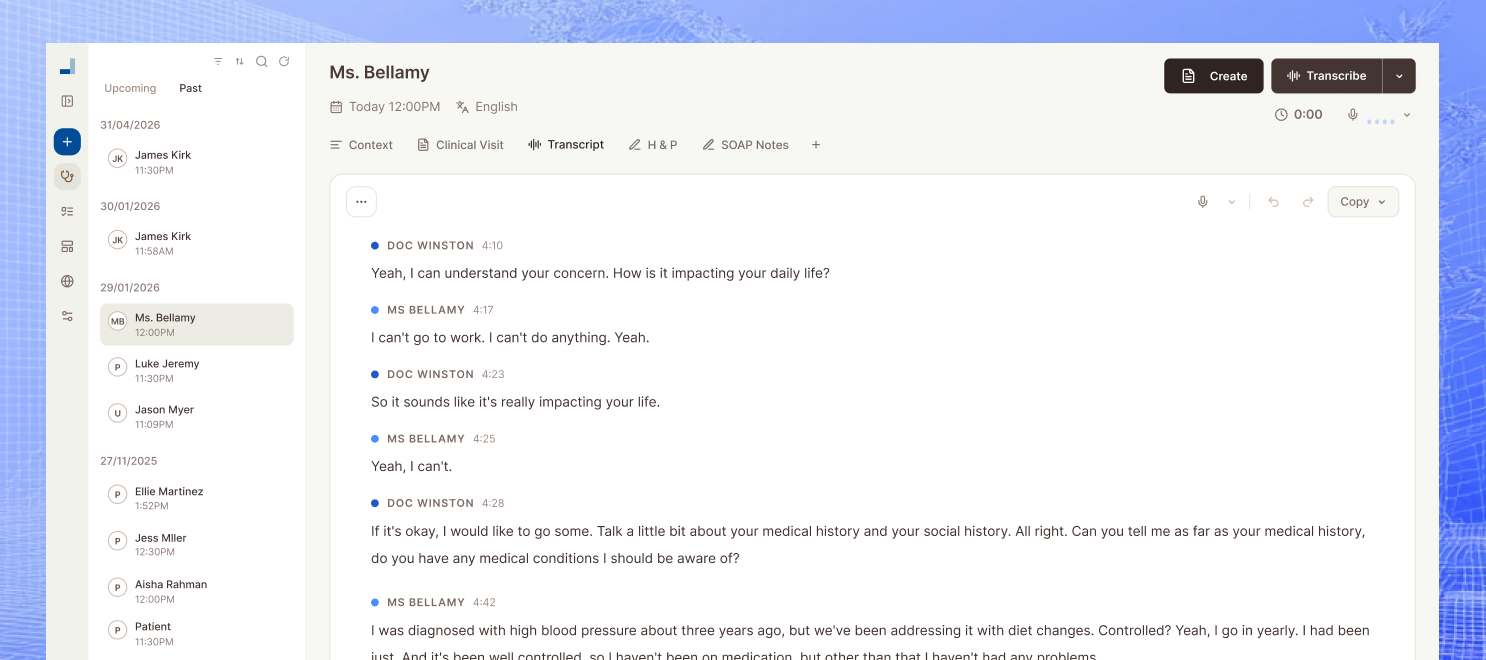
An AI medical scribe addresses these challenges by acting as an intelligent assistant that captures the dialogue of a patient encounter in real-time. It is important to remember that these tools are assistive; while they handle the drafting and organization of data, the clinician remains the final authority and responsible party for the accuracy of the record. By delegating the heavy lifting of transcription and formatting, doctors can return their focus to the patient in front of them.
- Eliminates the ‘pajama time’ spent on charting after clinic hours.
- Reduces cognitive fatigue by capturing details as they happen.
- Enhances patient engagement by removing the screen barrier.
- Provides a consistent structure to every clinical note.
Note types you can generate beyond SOAP (H&P and more)
While the SOAP note remains a staple of general practice, complex clinical environments often require more specialized documentation. Relying solely on one format can lead to missing critical context in specialized fields like surgery or psychiatry. Advanced documentation tools allow for the creation of History and Physical (H&P) reports, which offer a more comprehensive overview of a patient’s status upon admission or for a new consult.
Beyond basic progress notes, clinicians frequently need to generate consult notes that communicate specific findings to referring colleagues, or detailed procedure notes that document the specifics of an intervention. Follow-up notes ensure continuity of care across multiple visits, while discharge summaries provide the necessary bridge for patients transitioning home or to another facility. Using the right format at the right time is essential for audit readiness and professional communication.
Maintaining a high standard of structure across these various note types ensures that any provider who picks up a chart later can quickly understand the trajectory of care. This level of organization is crucial for risk management and ensures that handovers between different medical teams are seamless and safe.
- H&P reports for comprehensive new patient assessments.
- Specialized procedure and surgical notes for operational accuracy.
- Referral letters and consult notes for better professional collaboration.
- Discharge summaries that bridge the gap between hospital and home.
How to implement Mcoy AI templates step-by-step in a real clinic
Integrating a new documentation workflow starts with a focused approach rather than a total overhaul. To begin using Mcoy AI templates, choose one specific visit type, such as routine follow-ups or standard physicals, to pilot the process. This allows your team to get comfortable with the capture process without being overwhelmed by the variety of available options.
Next, take a moment to explore and set up templates that align with your specialty. Whether you are in cardiology, ENT, or mental health, selecting the right template ensures the AI looks for the specific clinical data points relevant to your field. Once selected, you can initiate the encounter capture during either in-person visits or telehealth sessions, allowing the AI to listen to the natural conversation.
Immediately after the patient leaves, review the generated output. The AI organizes the conversation into the selected template instantly, but a quick review ensures that any specific clinical nuances are captured perfectly. Finally, you can reuse these outputs to populate external forms, generate referral letters, or update the patient’s records in your primary EHR system.
- Start with one common visit type to build team confidence.
- Select specialty-specific templates to ensure relevant data capture.
- Review the AI-generated draft immediately while the encounter is fresh.
- Export captured data into letters and documents to save administrative time.
How to keep note quality high and reduce mistakes
While AI provides a massive head start, maintaining high-quality documentation requires intentional habits. Common failure points in automated notes often involve missing specific medication dosages, incorrect laboratory values, or the inclusion of irrelevant ‘note bloat’ that obscures the clinical picture. To prevent this, clinicians should develop a lightweight review habit where they scan the subjective and objective sections for accuracy before finalizing.
Standardizing what your team considers a ‘good note’ is equally important. Setting internal guidelines on how much detail is required in the assessment and plan helps the AI learn what to prioritize. When providers consistently provide feedback and perform minor edits, the system effectively aligns with the specific style and expectations of the practice.
- Conduct a 30-second rapid review of every note for clinical accuracy.
- Verify all medication names and dosages against the verbal record.
- Train staff on high-value templates to stop unnecessary note bloat.
- Establish clear practice-wide standards for documentation quality.
Privacy, consent, and patient trust (plain English)
Patient trust is the foundation of any medical practice, and introducing recording tools requires transparency. Consent protocols vary significantly by region and local jurisdiction, so it is vital to follow your local healthcare board’s specific policies. Most patients are generally receptive when they understand that the technology allows the doctor to listen more closely and document more accurately.
When explaining the tool to a patient, keep the script simple: “I’m using an AI assistant today to capture our conversation so I can focus on you instead of my computer. It helps me make sure I don’t miss any of your concerns. Is that okay with you?” Most patients appreciate the extra attention they receive when the doctor isn’t typing away during the consultation.
- Always secure verbal or written consent based on local regulations.
- Explain the technology as a tool for better patient-doctor focus.
- Ensure the service used adheres to high-level clinical security standards.
- Keep the explanation brief to avoid disrupting the clinical flow.
Rolling it out across a clinic without disruption
A successful rollout involves a structured two-week pilot program. During the first week, let a few ‘super-users’ test the templates and refine the capturing process. During the second week, they can help train the rest of the staff on how to use the outputs effectively. This gradual approach prevents the technical friction that often accompanies new software adoptions.
Track specific metrics to prove the value of the tool, such as the number of hours saved per week on documentation or the speed at which notes are closed after a visit. When clinical staff see that after-hours charting is decreasing while note completeness is increasing, the adoption rate typically skyrockets without further management intervention.
- Launch with a small group of clinicians for a two-week pilot.
- Measure time saved on charting to demonstrate clear ROI.
- Hold a brief training session to align everyone on template usage.
- Gather feedback regularly to refine the choice of templates.
Mcoy AI is an AI medical scribe that records and transcribes patient encounters, then generates multiple clinical note types (H&P, progress notes, consult notes, follow-up notes, procedure notes, discharge summaries, referral letters, and more). With over 200+ customizable templates and an interactive AI chat, clinicians can effortlessly create letters, forms, and documents based on their patient conversations. It is designed to integrate into the workflow, allowing you to spend more time on care and less on administration.
Conclusion
Streamlining your clinical documentation doesn’t have to be a source of stress. By moving from manual entry to a structured, template-driven approach, you can reclaim your time and improve the quality of your patient records. Starting with a pilot and gradually expanding your use of specialized formats like H&Ps and discharge summaries will transform your daily workflow. Using Mcoy AI templates allows you to stop worrying about the clipboard and start focusing on the patient, ending the cycle of endless after-hours charting forever.
What a serious review table should cover
| Decision area | Common mistake | Better clinic-ready approach | Metric to watch |
|---|---|---|---|
| Workflow design | Treat 200+ mcoy ai templates: guide to faster medical charting as a one-off documentation task | Build a repeatable process with clear ownership and review points | Time to complete documentation |
| Team adoption | Assume every clinician will naturally use the same process | Train for consistency and define exception handling early | Active user adoption |
| Quality review | Only check notes when a problem is reported | Audit a sample of notes weekly and review edge cases | Edit rate per note |
| Operational follow-through | Leave admin actions outside the documentation workflow | Use the same encounter data for referrals, letters, and follow-up tasks | Completion rate for next-step tasks |
Related reading
If you are working through 200+ mcoy ai templates: guide to faster medical charting, it helps to read this alongside AI & Medicine: How to Simplify Clinical Notes for Busy Doctors, AI & Medicine: How Doctors Can Improve SOAP Notes, and AI & Medicine: Streamlining Your AI Scribe Workflow [A Physician’s Guide]. Those guides cover adjacent workflow, implementation, and evaluation questions so the decision does not sit in isolation.
FAQ
How accurate are AI medical scribes in real clinics?
AI medical scribes currently offer high levels of accuracy in capturing the nuances of clinical dialogue. They are specifically trained on medical terminology and context, which makes them far more effective than general-purpose transcription tools. However, they are meant to assist, meaning the clinician should always perform a final check for clinical precision.
Do I still need to review every note?
Yes, the clinician is the person responsible for the medical record. While the AI drafts the note and handles the heavy lifting of formatting, it is essential for the provider to review the output for accuracy. This quick review usually takes less than a minute but is vital for patient safety and legal compliance.
What note types can an AI scribe generate besides SOAP?
An advanced AI scribe can generate a wide variety of documentation beyond standard SOAP notes. This includes History and Physical (H&P) reports, consult letters, procedure notes, discharge summaries, and referral letters. These formats ensure that different types of encounters are documented with the appropriate clinical details.
Will this work for telehealth and in-person consults?
Absolutely, AI scribes are designed to be flexible across different practice environments. For in-person visits, the device captures the ambient conversation in the room. For telehealth, the tool can capture the audio from the computer or mobile device used for the virtual consultation, providing the same high-quality notes.
How do I explain recording/transcription to patients?
The best approach is transparency and focusing on the benefit to the patient. You can explain that using the tool allows you to look at them and listen more carefully rather than typing on a computer. Most patients are happy to consent when they realize it improves the quality of the time they spend with their doctor.
How do clinics prevent note bloat?
Clinics prevent note bloat by using specific templates that only extract high-value clinical information. By selecting a template tailored to the specialty or visit type, the AI knows to filter out small talk and focus on symptoms, diagnoses, and treatment plans, keeping the final record concise and readable.
How long does template setup take?
Setting up your clinical templates is remarkably fast. Most providers can select their preferred specialty templates in a few minutes. Because modern AI tools come with pre-built clinical structures, you can start charting with professional-grade formats almost immediately after signing up.
What’s the safest way to start if I’m skeptical?
The safest approach is to start with a ‘shadow’ period where you continue your normal charting but run the AI scribe in the background. Compare the AI-generated note to your own to see the time saved and the accuracy of the details. Once you trust the output, you can gradually transition to the AI-first workflow.