AI & Medicine: Streamlining Your AI Scribe Workflow [A Physician's Guide]
Discover how to implement an AI scribe workflow to eliminate after-hours charting, improve note accuracy, and restore your work-life balance effortlessly.
The Hidden Burden of Clinical Documentation
For many solo practitioners and clinic providers, the end of the patient day is often just the beginning of a long night of charting. After-hours documentation has become a primary driver of clinician burnout, leading to rushed notes, mental fatigue, and a constant sense of being behind. Whether you are managing a busy private practice or a specialized university clinic, the weight of capturing every detail from a complex encounter can feel overwhelming and legally precarious.
This comprehensive guide will teach you how to integrate a streamlined AI scribe workflow into your daily routine. We will explore note formats that go far beyond basic SOAP templates, establish quality control protocols to ensure medical accuracy, and provide a clear roadmap for rollout. By the end of this guide, GPs, specialists, and telehealth providers will have the tools needed to reclaim their time while maintaining high-quality clinical records.
What a medical scribe solves in modern practice
The true cost of documentation is measured in more than just minutes; it is measured in cognitive load. When a provider is forced to split their attention between a patient and a keyboard, the therapeutic alliance suffers. AI medical scribes bridge this gap by capturing the natural conversation of the encounter, allowing the clinician to remain fully present. This reduces the friction of delayed notes and ensures that nuanced details—often lost when charting hours later—are preserved exactly as they occurred.
It is important to understand that an AI medical scribe is an assistive technology, not a replacement for clinical judgment. The tool acts as a highly efficient first-draft generator, transcribing and organizing data into clinical structures. The clinician remains the final authority, responsible for reviewing, editing, and signing off on every record to ensure total accuracy and compliance within the EHR.
- Eliminates the ‘pajama time’ spent on finishing charts at home.
- Enhances patient engagement by removing physical barriers like laptops.
- Captures specific clinical details that are often forgotten by the end of the day.
- Provides a consistent structure across all patient encounters.
Note types you can generate beyond SOAP (H&P and more)
While the SOAP note is a staple of clinical practice, modern medicine requires a diverse range of documentation styles. A robust AI scribe workflow allows providers to generate comprehensive History and Physical (H&P) reports, detailed consult notes for specialists, and precise procedure notes. Each of these formats serves a specific purpose in the continuity of care, ensuring that the next provider in the chain of command has a clear and concise understanding of the patient’s status.
Beyond standard encounter notes, you can utilize the technology to draft discharge summaries that capture the trajectory of an inpatient stay or complex referral letters that highlight the most relevant clinical findings. Having these structured outputs readily available improves audit readiness and streamlines communication between healthcare teams. This versatility ensures that regardless of the encounter type, the documentation is professional and fit for purpose.
- H&Ps, progress notes, and follow-up summaries.
- Specialized consult notes and detailed procedure documentations.
- Automated discharge summaries and professional referral letters.
- Improved handover quality through standardized data formatting.
How to implement an AI scribe workflow step-by-step in a real clinic
Successfully adopting an AI scribe workflow begins with a focused approach rather than a total overhaul. Start by selecting one specific visit type—such as standard follow-ups or new patient intakes—to record for the first few days. This allows you to get comfortable with the recording process without the pressure of documenting your entire schedule. Familiarize yourself with the recording environment, ensuring that the audio quality is clear and that both your voice and the patient’s are easily captured.
Once you are comfortable with the capture phase, begin setting up your preferred templates. Most providers find success by aligning the AI’s output with their specific specialty requirements, such as cardiology-specific physical exams or pediatric developmental milestones. During the encounter, whether in-person or via a telehealth platform, simply let the conversation flow naturally. You do not need to speak in ‘computer-ese’; the AI is designed to extract relevant medical information from organic dialogue.
Immediately following the encounter, take two minutes to review the generated draft. This is the most critical step in the workflow. Read through the HPI, review the suggested assessment, and make any necessary tweaks to the plan. Because the details are fresh in your mind, this review is significantly faster than writing a note from scratch. Finally, use the generated outputs to fill other needs, such as creating patient instructions or formal letters, ensuring that the data you’ve captured works for you in multiple ways.
- Start with one visit type to build confidence and habit.
- Configure specialty-specific templates for precise data mapping.
- Review drafts immediately after the encounter for maximum efficiency.
- Leverage recorded data to generate secondary documents like referral letters.
How to keep note quality high and reduce mistakes
Maintaining high-quality documentation requires an understanding of where automated systems can occasionally falter. Common failure points often involve specific medication dosages, complex lab values, or the inadvertent inclusion of irrelevant conversational ‘fluff,’ known as note bloat. To mitigate this, clinicians should develop a lightweight review habit. Instead of reading every word, scan for high-risk areas like the problem list and medication changes to ensure the AI hasn’t hallucinated or omitted a key digit.
Establishing a team standard for note reviews also helps maintain consistency within a clinic. If multiple providers are using the system, agreeing on a common structure for assessment and plan sections ensures that the entire practice moves toward a unified, high-quality record. This standard of care not only protects the provider legally but also enhances the overall reliability of the medical record for future visits.
- Conduct a focused review of dosages and diagnostic values.
- Edit out irrelevant conversational elements to prevent note bloat.
- Standardize the ‘Assessment and Plan’ structure across the practice.
- Use the AI as a first draft, keeping your clinical eye as the final filter.
Privacy, consent, and patient trust (plain English)
Privacy is the cornerstone of the patient-provider relationship, and introducing recording technology requires transparency. Consent requirements vary by jurisdiction, but a best practice is to always inform the patient and obtain verbal or written consent as per your local regulations. Most patients are receptive to the technology when they realize it allows the doctor to look at them instead of a computer screen.
A simple way to explain this to a patient is to say: ‘To help me focus entirely on our conversation today, I’m using a secure digital assistant to take my clinical notes. Is it alright if I record our talk so I can accurately document our plan?’ This framing emphasizes the benefit to the patient—the doctor’s undivided attention—and usually results in high levels of acceptance. Ensure your chosen tool adheres to regional security standards like HIPAA or GDPR.
- Always follow local legal guidelines regarding patient consent.
- Explain the technology as a way to prioritize patient-centered care.
- Ensure data encryption and secure retention policies are in place.
- Maintain a clear script for introducing the tool to new patients.
Rolling it out across a clinic without disruption
A successful rollout is deliberate and measured. We recommend a two-week pilot plan where the provider gradually increases the number of recorded sessions each day. During the first week, focus on technical comfort; during the second week, focus on refining templates and integration. This phased approach prevents the ‘tech fatigue’ that often accompanies new software acquisitions and allows the clinic staff to adjust to the minor changes in room flow.
To measure success, track specific metrics such as the time spent charting after hours and the time elapsed between the visit and note completion. Many clinics find that after-hours work drops by 50-80% within the first month. Once the primary provider has mastered the AI scribe workflow, they can then act as a mentor for other staff members or university residents, ensuring that the transition is smooth for the entire organization.
- Execute a 14-day pilot to gradually phase in the tool.
- Track ‘Time to Note Completion’ as a primary success metric.
- Align templates across the team for clinical consistency.
- Provide brief training sessions to address common staff questions.
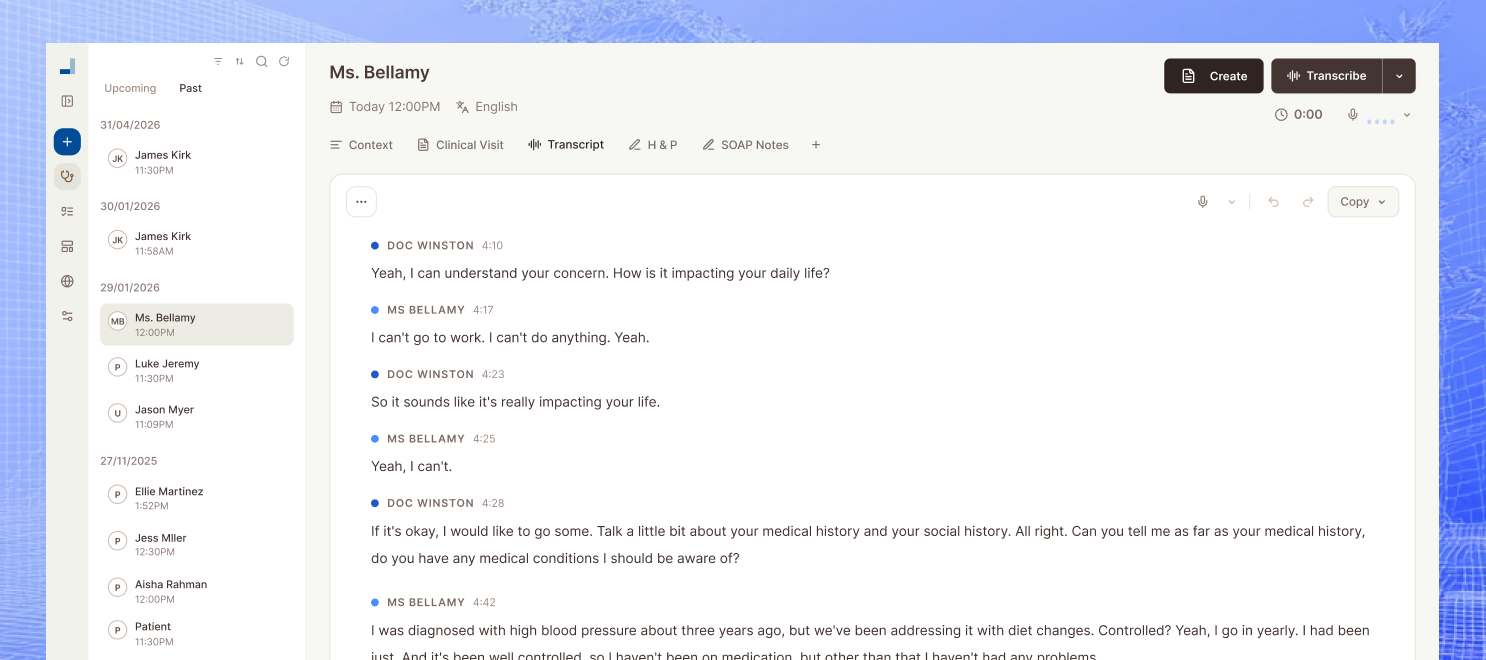
Mcoy AI is an AI medical scribe that records and transcribes patient encounters, then generates multiple clinical note types including H&P, progress notes, consult notes, follow-up notes, procedure notes, discharge summaries, referral letters, and more. With over 200 customizable templates and an interactive AI chat to create letters, forms, and specialized documents, it helps clinicians focus more on the patient and less on the keyboard.
Conclusion
Implementing an efficient documentation system doesn’t have to be a source of stress. By starting small, utilizing diverse note templates, and maintaining a strict review process, you can transform your daily operations. Transitioning to a professional AI scribe workflow allows you to exit the clinic on time with complete, accurate notes already filed in your EHR. If you are ready to eliminate the burden of administrative tasks, starting a pilot program with an AI scribe is the most impactful step you can take today for your practice and your well-being.
What a serious review table should cover
| Decision area | Common mistake | Better clinic-ready approach | Metric to watch |
|---|---|---|---|
| Workflow design | Treat streamlining your ai scribe workflow [a physician’s guide] as a one-off documentation task | Build a repeatable process with clear ownership and review points | Time to complete documentation |
| Team adoption | Assume every clinician will naturally use the same process | Train for consistency and define exception handling early | Active user adoption |
| Quality review | Only check notes when a problem is reported | Audit a sample of notes weekly and review edge cases | Edit rate per note |
| Operational follow-through | Leave admin actions outside the documentation workflow | Use the same encounter data for referrals, letters, and follow-up tasks | Completion rate for next-step tasks |
Related reading
If you are working through streamlining your ai scribe workflow [a physician’s guide], it helps to read this alongside AI & Medicine: How to Simplify Clinical Notes for Busy Doctors, AI & Medicine: How Doctors Can Improve SOAP Notes, and Practice Operations: How to Use an AI Medical Scribe to Scale Your Practice. Those guides cover adjacent workflow, implementation, and evaluation questions so the decision does not sit in isolation.
FAQ
How accurate are AI medical scribes in real clinics?
In real-world clinical settings, AI medical scribes are remarkably accurate at capturing the core of the medical conversation and translating it into clinical terminology. They excel at documenting History of Present Illness (HPI) and the Plan, though they perform best when the clinician speaks clearly. While the accuracy is high, they are designed to assist the provider, not replace their expertise, ensuring that the final output mirrors the clinician’s actual findings.
Do I still need to review every note?
Yes, reviewing every note is a fundamental requirement for both clinical accuracy and legal compliance. As the licensed provider, you are responsible for the content of the medical record. The AI significantly reduces the time it takes to draft the note, but a quick review ensures that specific data points like dosages or lateralities (right vs. left) are 100% correct before they are finalized in the EHR.
What note types can an AI scribe generate besides SOAP?
Modern AI scribes are capable of generating a vast array of documentation beyond the standard SOAP format. This includes comprehensive History and Physical (H&P) reports, consultation notes for specialists, detailed procedure notes, discharge summaries, and referral letters. By using specialized templates, the AI can organize the data into whichever structure best fits the specific encounter type or specialty needs.
Will this work for telehealth and in-person consults?
Yes, the workflow is highly effective for both in-person and telehealth consultations. For in-person visits, the device typically sits on the desk between the provider and patient. For telehealth, the AI can capture the audio directly from the computer or via a secondary device. In both scenarios, the AI filters out background noise to focus on the conversation, ensuring high-quality transcription regardless of the setting.
How do I explain recording/transcription to patients?
The best way to explain it is to focus on the benefit to the patient: better care and more eye contact. You can simply state that you are using a secure, HIPAA-compliant digital assistant to help with notes so you don’t have to spend the whole visit looking at a computer. Most patients appreciate the transparency and are happy that their doctor is fully present and engaged during their appointment.
How do clinics prevent note bloat?
Clinics prevent note bloat by utilizing concise templates and setting specific AI parameters that prioritize ‘meaningful use’ data over every word spoken. Providers should also perform a brief post-encounter edit to remove any non-clinical talk that the AI may have captured. By training the AI on what a ‘good’ note looks like for your specific practice, the output becomes increasingly lean and relevant over time.
How long does template setup take?
Initial template setup usually takes between 15 and 30 minutes. Most systems come with pre-built templates for major specialties that only require minor adjustments to match your personal writing style. Once these are established, the AI applies them automatically to every note, meaning the time investment you make on day one pays off in hours saved every single week thereafter.
What’s the safest way to start if I’m skeptical?
The safest way to start is with a ‘shadow’ pilot. Use the AI scribe for 3-5 encounters per day for one week without relying on it for your primary documentation. This allows you to compare the AI’s output with your existing manual notes. Seeing the quality and consistency of the drafts side-by-side with your own work usually provides the confidence needed to transition fully to the new workflow.