Specialty Guides: Improve Student Health Clinic Documentation with AI Guide
Discover how student health clinics can use AI to streamline clinical notes, reduce burnout, and improve patient care with our comprehensive guide.
The Hidden Burden of Student Health Documentation
Clinicians working in university health centers face a unique set of documentation challenges. Between high-volume acute care visits, mental health screenings, and complex immunization tracking, the administrative overhead can quickly lead to after-hours charting and clinician burnout. When notes are rushed, there is a heightened risk of inconsistency or missing critical details, which can lead to medico-legal anxiety in a high-stakes campus environment.
This guide provides a comprehensive roadmap for transforming student health clinic documentation. We will explore more than just basic note-taking, diving into advanced workflow optimizations, diverse note formats beyond the standard SOAP note, and rigorous quality control measures. Whether you are a general practitioner, a campus specialist, or managing telehealth visits for remote students, this strategy will help you reclaim your time and focus on student wellness.
What a medical scribe solves in modern practice
The real cost of documentation extends far beyond the time spent typing. It involves a heavy cognitive load that pulls a provider’s attention away from the student sitting right in front of them. When clinicians are preoccupied with capturing every detail for the EHR, they may miss subtle non-verbal cues or fail to engage deeply in the therapeutic relationship. This delay often results in “pajama time,” where doctors spend their evenings finishing notes from the morning session.
An AI medical scribe acts as an assistive partner rather than a replacement for clinical judgment. It captures the nuances of the conversation and structures them into a coherent draft, allowing the clinician to remain fully present. It is important to remember that while the technology handles the heavy lifting of transcription and formatting, the clinician remains ultimately responsible for the accuracy and final approval of every entry in the medical record.
- Significantly reduces cognitive load by capturing details in real-time.
- Eliminates the need for extensive after-hours charting or “pajama time.”
- Allows for better eye contact and engagement during student consultations.
- Ensures that even high-volume clinic days result in timely, completed notes.
Note types you can generate beyond SOAP (H&P and more)
While the SOAP note is a staple in medical training, a busy university clinic requires a much broader range of documentation types to ensure continuity of care. History and Physical (H&P) reports are essential for new student intakes or sports physicals, and detailed consultation notes are necessary when students are referred to specialists for chronic issues. Using the right structure for each encounter type ensures that handovers between campus providers and external hospitals are seamless.
Furthermore, student health often involves specific procedure notes for minor injuries, discharge summaries for students returning to the dorms after an observation period, and formal referral letters. Maintaining a consistent structure across these diverse formats is not just about aesthetics; it is about audit readiness and meeting the high clinical standards required by university oversight committees. Having a system that can pivot between an acute flu visit and a complex psychiatric follow-up is a game-changer for efficiency.
- H&P and Detailed Progress Notes ensure thorough longitudinal care records.
- Consultation and Referral Letters improve communication with outside specialists.
- Procedure Notes provide clear documentation for minor clinic interventions.
- Standardized formats improve audit readiness and legal defensibility.
How to implement student health clinic documentation step-by-step
Implementing a new documentation workflow begins with a focused approach rather than a clinic-wide overhaul. Start by selecting one specific visit type, such as routine wellness checks or acute respiratory visits, to test the AI integration. This allows the staff to get comfortable with the technology in a controlled environment before expanding to more complex cases.
Next, configure your templates based on your specialty. University clinics often have specific requirements for screenings or immunization status that should be reflected in the documentation. Once the templates are set, begin capturing encounters during both in-person and telehealth sessions. The goal is to let the conversation flow naturally while the system works in the background to capture the clinical narrative.
After the encounter, the review and edit process should be rapid. Instead of writing from scratch, you are now an editor, verifying the AI-generated draft against your clinical observations. Finally, maximize efficiency by reusing these outputs. The data captured in a progress note can quickly be transformed into a referral letter or a school-excuse form without redundant typing.
- Start small with one visit type to build staff confidence and competence.
- Tailor templates to match university-specific health screening requirements.
- Use the review-and-edit model to finalize notes in seconds rather than minutes.
- Leverage captured data to automatically generate letters and discharge forms.
How to keep note quality high and reduce mistakes
High-quality documentation requires more than just high-tech tools; it requires a culture of precision. Typical failure points in automated notes often include missing medications, incorrect lab values, or “note bloat”—where too much irrelevant information is included. To combat this, clinicians should establish a lightweight review habit, checking key data points like dosages and problem lists before signing off.
Setting team standards is also vital in a university setting where multiple providers might see the same student. Encourage a consistent style and ensure that the most pertinent clinical facts are highlighted at the top of the note. Regularly reviewing a sample of notes as a team can help identify areas where templates might need adjustment to better capture the clinic’s specific needs.
- Always verify objective data such as medications, dosages, and vital signs.
- Prevent note bloat by focusing templates on the most relevant clinical facts.
- Implement a peer-review system to maintain high documentation standards.
- Refine AI templates periodically to reflect updated clinical guidelines.
Privacy, consent, and patient trust
In a university setting, students are often hyper-aware of their digital privacy. While consent laws vary by region, the best practice is always to be transparent and follow your local institutional policy. Explaining to a student that you are using a tool to help you be more present during their visit usually builds trust rather than diminishing it.
Keep the explanation simple: “I am using an AI assistant to help me record our conversation so I can focus on your care instead of my computer screen. The data is encrypted and handled according to our strict privacy standards.” This transparency ensures that students feel comfortable sharing sensitive health information. Always adhere to general security principles regarding data retention and encryption to maintain HIPAA or relevant local compliance.
- Follow 1-on-1 institutional guidelines for obtaining student consent.
- Use simple, transparent language to explain the benefits of AI to students.
- Ensure all documentation tools meet high-level encryption and security standards.
- Maintain student trust by prioritizing data privacy and confidentiality.
Rolling it out across a clinic without disruption
To avoid disrupting a busy student health clinic, use a phased two-week pilot plan. During the first week, have one or two “super-users” test the system and identify potential roadblocks. By the second week, you can begin training the rest of the staff based on the lessons learned during the initial pilot phase.
Track metrics such as time saved on documentation, the reduction in after-hours work, and the level of note completeness. Comparing these metrics against your previous baseline will provide the data needed to justify the full-scale rollout. Regular training sessions and template alignment meetings will ensure that the entire clinic moves toward the same goals of efficiency and quality.
- Launch a two-week pilot with a small group of clinicians to find the best workflow.
- Track time saved to demonstrate the return on investment for the clinic.
- Hold brief weekly check-ins to align on template usage and best practices.
- Gradually scale the rollout to ensure no interruption to student care.
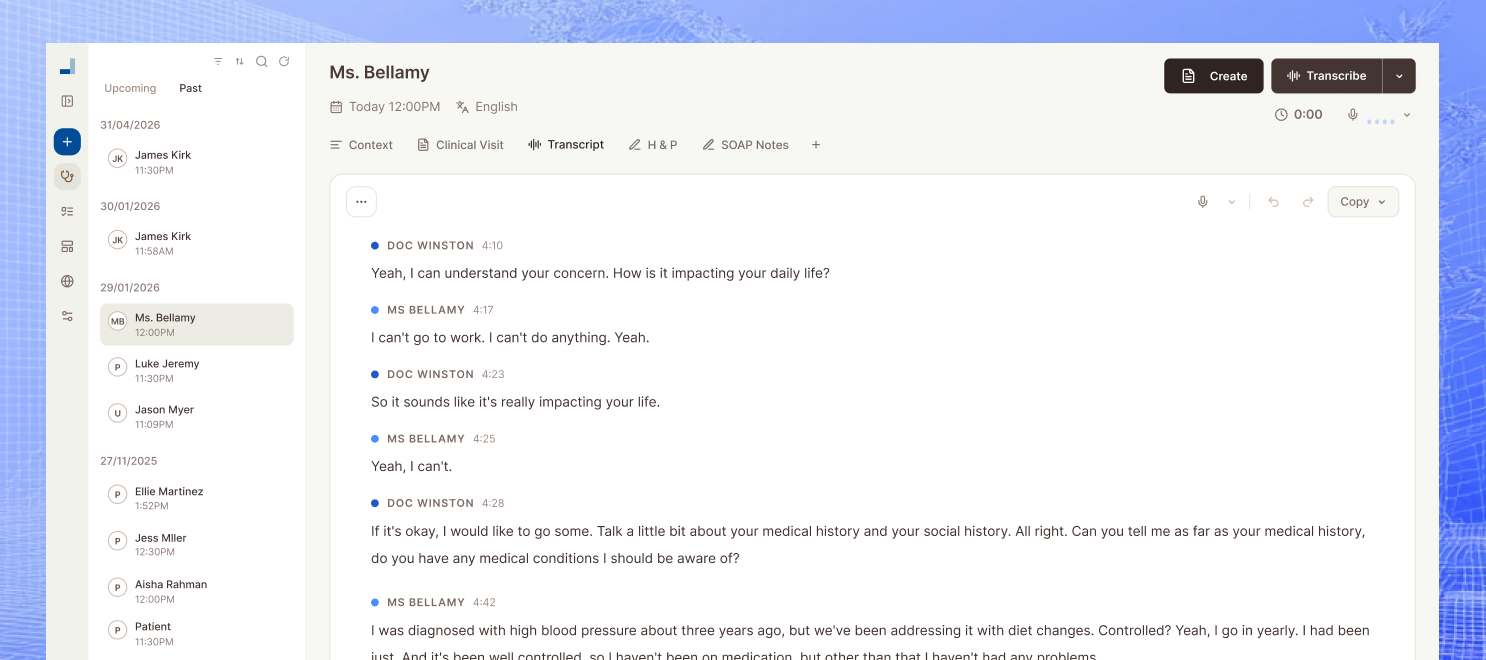
Mcoy AI is an AI medical scribe that records and transcribes patient encounters, then generates multiple clinical note types (H&P, progress notes, consult notes, follow-up notes, procedure notes, discharge summaries, referral letters, and more). With access to 200+ customizable templates and an interactive AI chat, clinicians can easily create letters, forms, and other essential documents. This tool helps student health clinics improve student health clinic documentation by automating the administrative burden, allowing providers to spend more time on patient care and less on paperwork.
Conclusion
Optimizing the documentation workflow in a university setting is no longer an optional luxury—it is a necessity for preventing clinician burnout and ensuring high-quality care. By moving beyond basic SOAP notes and adopting specialized templates for various encounter types, clinics can achieve a new level of efficiency. Implementing student health clinic documentation with the help of AI allows for more accurate records, better student engagement, and more time for actual medicine. Start your journey today by piloting a system that works for your team and your students.
SEO description: Learn how to improve student health clinic documentation with AI to reduce burnout, increase note accuracy, and spend more time with your students.
What a serious review table should cover
| Decision area | Common mistake | Better clinic-ready approach | Metric to watch |
|---|---|---|---|
| Workflow design | Treat improve student health clinic documentation with ai guide as a one-off documentation task | Build a repeatable process with clear ownership and review points | Time to complete documentation |
| Team adoption | Assume every clinician will naturally use the same process | Train for consistency and define exception handling early | Active user adoption |
| Quality review | Only check notes when a problem is reported | Audit a sample of notes weekly and review edge cases | Edit rate per note |
| Operational follow-through | Leave admin actions outside the documentation workflow | Use the same encounter data for referrals, letters, and follow-up tasks | Completion rate for next-step tasks |
Related reading
If you are working through improve student health clinic documentation with ai guide, it helps to read this alongside Specialty Guides: How to Run a More Efficient Medical Practice in 2026, Specialty Guides: How to Improve Patient Encounters, and AI & Medicine: Build Specialist Note Templates | Step-By-Step Guide. Those guides cover adjacent workflow, implementation, and evaluation questions so the decision does not sit in isolation.
FAQ
How accurate are AI medical scribes in real clinics?
AI medical scribes have become remarkably accurate, often capturing over 95% of the clinical details discussed during an encounter. They are particularly good at following the narrative flow of a conversation and organizing it into structured sections. However, accuracy also depends on the clarity of the audio and the specific terminology used. Clinicians should always perform a quick review to ensure that specific names, dosages, or unique clinical nuances are perfectly captured.
Do I still need to review every note?
Yes, reviewing every note is a critical step in the documentation process to ensure patient safety and medico-legal compliance. While the AI does the heavy lifting of drafting the note, the clinician is the only one who can verify the accuracy of the clinical findings and the plan. Think of the AI as a highly competent junior assistant whose work always requires a final signature from the senior physician. Most providers find that this review process takes only a fraction of the time it would take to write the note from scratch.
What note types can an AI scribe generate besides SOAP?
Modern AI scribes are capable of generating a wide variety of documentation beyond standard SOAP notes. This includes comprehensive History and Physical (H&P) reports, consultation notes for specialists, follow-up progress notes, and even detailed procedure notes. They can also assist in drafting discharge summaries and referral letters. By using specialized templates, the AI ensures that each specific note type contains the required headers and information for that particular clinical context.
Will this work for telehealth and in-person consults?
Yes, AI medical scribes are designed to be versatile and work effectively in both in-person and telehealth environments. For in-person visits, the device usually records the room’s audio, while for telehealth, it can often integrate directly with the communication platform or capture audio from the computer’s output. The core technology—turning speech into structured clinical data—remains the same regardless of how the audio is captured, making it an ideal solution for modern hybrid clinics.
How do I explain recording/transcription to patients?
Explaining AI transcription to patients is best handled with transparency and a focus on the benefits to their care. Most patients are supportive when they understand that the technology allows their doctor to listen more closely and ignore the computer screen. A simple statement such as, “I’m using a secure tool to help me document our visit so I can focus entirely on you,” is usually sufficient. It is also helpful to mention that the recordings are encrypted and handled with the highest level of privacy.
How do clinics prevent note bloat?
Clinics can prevent note bloat by utilizing concise templates that prioritize high-value clinical information over verbatim transcripts. Training the AI to focus on the assessment and plan, while summarizing the subjective history, helps keep notes professional and readable. Clinicians should also be encouraged to remove redundant information during the final review phase. Setting a clinic-wide standard for note length and structure ensures that the medical record remains a useful tool rather than an overwhelming pile of data.
How long does template setup take?
Setting up templates typically takes very little time, especially if you start with pre-built clinical libraries. Most clinicians can customize their primary templates in about 15 to 30 minutes. Once the core templates are in place, they can be refined over time as you notice specific patterns in your documentation needs. The goal is to create a library that covers 80-90% of your common visit types, which significantly speeds up the daily workflow.
What’s the safest way to start if I’m skeptical?
The safest way to start is with a small, low-risk pilot program involving a few routine wellness visits. Use the AI alongside your traditional methods for a few days to compare the results and gain confidence in its accuracy. This “shadowing” approach allows you to see the quality of the notes without the pressure of changing your entire workflow overnight. Once you see the time savings and note quality firsthand, you can gradually expand its use to more complex patient encounters.