Specialty Guides: Identify Hallucinations in AI Clinical Notes | Full Guide
Learn how to detect and prevent AI hallucinations in medical documentation. Improve clinical note accuracy with our comprehensive verification guide for clinicians.
Identifying Hallucinations in AI Clinical Notes
For many doctors and private practitioners, the burden of after-hours charting has become the primary driver of burnout. While AI tools promise a solution to rushed notes and medico-legal anxiety, they introduce a new challenge: the risk of AI hallucinations. These are instances where an AI model generates factually incorrect information or clinical details that never occurred during the patient encounter. Failing to catch these errors can compromise patient safety and professional integrity.
This guide will teach you how to implement a robust identification workflow, understand note formats beyond the standard SOAP structure, and develop quality control measures to ensure your documentation remains airtight. Whether you are a GP, an orthopedic surgeon, or a clinician at a busy university clinic, mastering the art of verifying AI-generated outputs is essential for modern practice. By the end of this guide, you will have a clear rollout plan for safe AI adoption in your clinical daily life.
What a medical scribe solves in modern practice
The real cost of medical documentation is measured in more than just hours; it is measured in cognitive load and decreased patient engagement. When a clinician is forced to type while a patient shares their history, the quality of both the note and the therapeutic relationship suffers. Delayed notes often lead to forgotten details, whereas clinical documentation assistance provides a way to capture the encounter in real-time without the distractions of a keyboard.
It is crucial to understand that an AI medical scribe is a supportive tool, not a replacement for clinical judgment. The technology acts as a highly efficient secretary that listens and organizes, but the clinician remains the ultimate authority and responsible party for every word in the chart. Relying on AI without a structured review process is where most errors occur, specifically when the system fills in gaps with plausible but incorrect clinical data.
- AI significantly reduces the time spent on administrative tasks and after-hours charting.
- It helps prevent ‘note bloat’ by focusing on relevant clinical details from the conversation.
- The clinician must always remain the final reviewer to ensure absolute factual accuracy.
- Improved documentation quality leads to better continuity of care and audit readiness.
Note types you can generate beyond SOAP (H&P and more)
While the SOAP format is a staple in medical training, practicing clinicians often require a much wider variety of documentation styles. A robust AI system should be able to handle complex History and Physical (H&P) reports, detailed progress notes for chronic care, and specialized consult notes for referrals. Each of these formats serves a distinct purpose in the medical ecosystem, from justifying insurance claims to providing a clear roadmap for the next provider in the care chain.
Structure matters immensely for handover quality and long-term patient tracking. For instance, procedure notes require a level of technical specificity that differs significantly from a standard follow-up note. Discharge summaries must prioritize clarity and actionable instructions for the patient, while referral letters need to synthesize the most relevant clinical findings into a persuasive and informative narrative for a specialist colleague.
- A variety of note types (H&P, consults, follow-ups) ensures documentation matches the clinical intent.
- Specialized formats like procedure notes improve accuracy in surgical and diagnostic settings.
- Referral letters generated from encounter data save hours of duplicate data entry.
- Properly structured notes reduce the risk of billing audits and legal complications.
How to implement Identify Hallucinations in AI Clinical Notes step-by-step in a real clinic
To successfully integrate a verification system for Identify Hallucinations in AI Clinical Notes, start by applying the technology to a single visit type, such as routine follow-ups. This allows you to calibrate the AI’s performance in a controlled environment before moving to complex diagnostic presentations. By starting small, you can identify patterns in how the AI interprets your specific terminology or patient demographics.
Next, ensure you have set up templates specific to your specialty. A pediatric clinic will have vastly different documentation needs than a university-based neurology department. As you capture the encounter—whether in-person or via telehealth—ensure the audio is clear, as poor sound quality is the leading cause of AI errors and subsequent hallucinations. Clear communication during the exam often leads to a more accurate draft.
Once the draft is generated, develop a habit of rapid review. Never sign off on a note without scanning for ‘hallucinated’ medications or dosages that weren’t discussed. Finally, once you have verified the primary note, use the validated data to generate secondary outputs like referral letters or patient instruction forms. This ensures that the accuracy you just verified is propagated throughout all patient-related documents.
- Start with low-complexity visits to build trust in the AI’s transcription accuracy.
- Use specialty-specific templates to guide the AI toward the correct note structure.
- Maintain high audio quality to minimize the risk of the AI ‘guessing’ missed words.
- Always perform a final scan for specific data points like dosages, dates, and lateralities.
How to keep note quality high and reduce mistakes
Typical failure points in AI-assisted documentation often involve the ‘hallucination’ of negative findings that weren’t explicitly stated, or the inclusion of medications from a patient’s past history as if they were current. These mistakes are often subtle, such as the AI assuming a patient is ‘non-smoker’ simply because smoking wasn’t mentioned. To maintain high quality, clinicians should adopt a ‘trust but verify’ mindset.
A lightweight review habit—such as the ‘top-to-bottom’ scan focusing on the Assessment and Plan—saves more time than it consumes. Setting team standards for how AI notes are reviewed within a private practice or university clinic ensures that every practitioner is held to the same level of medico-legal safety. Standardizing the way you dictate or discuss findings during the exam can also dramatically improve the AI’s output quality.
- Focus your review on the ‘Assessment and Plan’ as this carries the most clinical weight.
- Be wary of ‘implied’ negatives that the AI might add without a verbal prompt.
- Establish clinic-wide standards for reviewing and editing AI-generated drafts.
- Regularly update your custom templates to reflect changes in your clinical workflow.
Privacy, consent, and patient trust (plain English)
Privacy is the cornerstone of the patient-provider relationship, and introducing recording technology requires transparency. Consent basics vary by region, so it is vital to follow your local healthcare privacy laws, such as HIPAA or GDPR. Most patients are comfortable with technology if they understand that it allows their doctor to focus on them rather than a screen.
A simple way to explain this to a patient is: ‘I’m using a secure AI assistant today to help me capture our conversation so I can sit face-to-face with you instead of typing on my computer. It helps me ensure your medical record is perfectly accurate.’ This framing positions the technology as a benefit to the patient, increasing trust and making the process feel collaborative.
- Always obtain verbal or written consent based on your local regulatory requirements.
- Explain the technology as a tool for better clinical focus and note accuracy.
- Ensure your chosen AI provider uses enterprise-grade encryption and data protection.
- Maintain a clear policy on how long recordings are kept before being deleted.
Rolling it out across a clinic without disruption
Rolling out AI documentation should be treated as a two-week pilot rather than an overnight switch. Start with one or two ‘champion’ clinicians who are tech-savvy and can provide feedback on the AI’s performance. During this phase, track metrics such as time saved per note, reduction in after-hours work, and the frequency of necessary edits to identify any recurring hallucination patterns.
Training is the final piece of the puzzle. Ensure that all staff, from medical assistants to senior partners, understand how to prompt the AI and use the templates correctly. When the whole team is aligned on how to Identify Hallucinations in AI Clinical Notes, the transition leads to a significantly more efficient and less stressed clinical environment.
- Conduct a 14-day pilot with a small group of users to iron out workflow kinks.
- Monitor ‘time-saved’ metrics to quantify the return on investment for the clinic.
- Align all team members on template usage to ensure consistency across the practice.
- Gather weekly feedback to refine the AI’s performance and template accuracy.
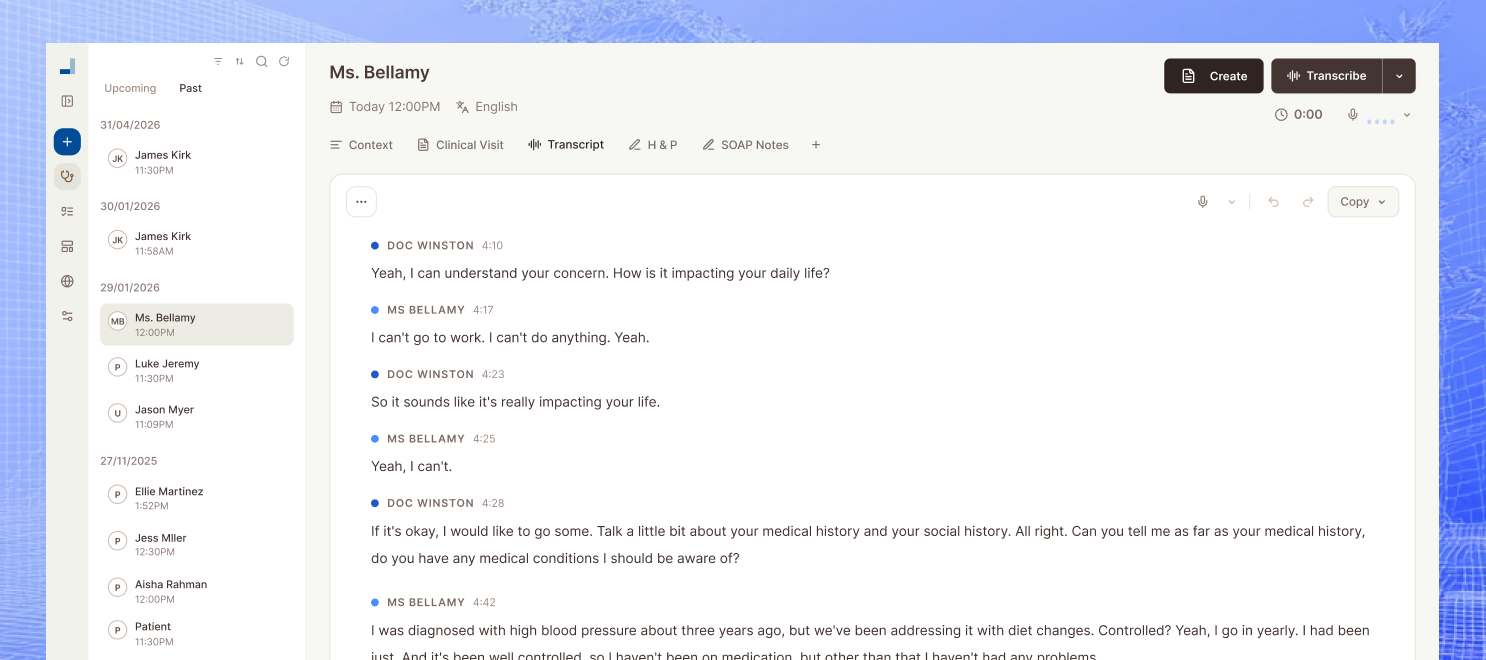
Mcoy AI is an AI medical scribe that records and transcribes patient encounters, then generates multiple clinical note types (H&P, progress notes, consult notes, follow-up notes, procedure notes, discharge summaries, referral letters, and more). With access to over 200+ customizable templates and an AI chat feature to create letters, forms, and other documents, it allows clinicians to focus on the patient while the AI handles the complex administrative burden of documentation.
FAQ
Understanding the nuances of AI in a clinical setting is the best way to ensure safety and efficiency.
How accurate are AI medical scribes in real clinics?
In most real-world clinical settings, AI scribes are remarkably accurate at capturing the narrative flow of a conversation. However, the accuracy can fluctuate based on background noise, the complexity of the medical terminology used, and the clarity of the speakers. While they typically achieve over 95% accuracy in transcription, the clinical interpretation of that data must always be verified by a human professional to ensure no critical nuances are lost.
Do I still need to review every note?
Yes, the clinician is legally and ethically responsible for the accuracy of the medical record. While AI can do the heavy lifting of drafting and organizing, a final review is necessary to catch any potential hallucinations or omissions. This review usually takes less than sixty seconds and is a safeguard that ensures patient safety and protects against potential medico-legal issues.
What note types can an AI scribe generate besides SOAP?
Modern AI scribes are highly versatile and can generate a wide range of documents including History & Physical (H&P) reports, consult notes, discharge summaries, and even procedure notes. They can also assist in drafting referral letters and patient education materials based on the encounter data. This versatility makes them useful for both general practitioners and specialized surgeons who have unique documentation requirements.
Will this work for telehealth and in-person consults?
Most advanced AI scribe systems are designed to work seamlessly in both environments. For telehealth, the system can often integrate with the audio output of the video call, while for in-person visits, it uses the microphone of a smartphone or tablet. The key to success in both formats is ensuring a stable internet connection and clear audio input to minimize transcription errors.
How do I explain recording/transcription to patients?
The best approach is to be direct and highlight the benefits to the patient experience. Inform the patient that you are using a secure tool to help you document the visit so that you can focus entirely on them rather than your computer screen. Most patients respond positively when they realize the technology allows for better eye contact and a more focused consultation.
How do clinics prevent note bloat?
Note bloat is prevented by using specialized templates that instruct the AI to only include relevant clinical information. Instead of a verbatim transcript, the AI summarizes the encounter into structured sections. Clinicians can further refine this by providing clear verbal cues during the exam, such as stating ‘On physical exam, there is no evidence of edema,’ which gives the AI a direct fact to record.
How long does template setup take?
Basic template setup can take as little as a few minutes if you are using pre-built specialty templates. However, customizing them to perfectly match your specific workflow or the requirements of your university clinic might take an hour or two of initial testing. Once these templates are set, they serve as a permanent foundation for consistent and fast documentation for all future visits.
What’s the safest way to start if I’m skeptical?
The safest way to start is by using the AI for your last few patients of the day on non-complex follow-up visits. This allows you to compare the AI-generated note against how you would normally document the encounter without the pressure of a full waiting room. As you see the consistency and accuracy of the drafts, you can gradually expand its use to more complex cases and different visit types.
Conclusion
Adopting AI documentation is a transformative step for any modern medical practice, significantly reducing the administrative weight on clinicians. However, the key to a successful implementation is learning how to Identify Hallucinations in AI Clinical Notes through a structured review and verification process. By treating the AI as a powerful assistant rather than an autonomous provider, you can enjoy the benefits of faster charting while maintaining the highest standards of patient safety. Start with a pilot today, use your templates wisely, and regain the time you deserve for patient care.
What a serious review table should cover
| Decision area | Common mistake | Better clinic-ready approach | Metric to watch |
|---|---|---|---|
| Workflow design | Treat identify hallucinations in ai clinical notes | full guide as a one-off documentation task | Build a repeatable process with clear ownership and review points |
| Team adoption | Assume every clinician will naturally use the same process | Train for consistency and define exception handling early | Active user adoption |
| Quality review | Only check notes when a problem is reported | Audit a sample of notes weekly and review edge cases | Edit rate per note |
| Operational follow-through | Leave admin actions outside the documentation workflow | Use the same encounter data for referrals, letters, and follow-up tasks | Completion rate for next-step tasks |
Related reading
If you are working through identify hallucinations in ai clinical notes | full guide, it helps to read this alongside Specialty Guides: How to Run a More Efficient Medical Practice in 2026, Specialty Guides: How to Improve Patient Encounters, and Physician Wellbeing: Improve Patient Flow with Faster Documentation Guide. Those guides cover adjacent workflow, implementation, and evaluation questions so the decision does not sit in isolation.
FAQ
How accurate are AI medical scribes in real clinics?
Modern AI scribes are highly accurate but depend on audio quality and terminology clarity; clinicians must always perform a final factual check.
Do I still need to review every note?
Yes, clinicians remain legally responsible for their notes, and a quick verification scan is essential to catch any rare hallucinations or errors.
What note types can an AI scribe generate besides SOAP?
AI can generate H&Ps, consult notes, referral letters, procedure notes, and discharge summaries using specialized clinical templates.
Will this work for telehealth and in-person consults?
Yes, AI scribes are designed to capture audio from both face-to-face mobile devices and computer-based telehealth platforms seamlessly.
How do I explain recording/transcription to patients?
Tell patients the technology allows you to focus on their care instead of a computer screen, ensuring a more personal and accurate visit.
How do clinics prevent note bloat?
By using structured templates and concise summarization settings, AI captures only the clinically relevant data rather than every spoken word.
How long does template setup take?
Initial setup takes minutes with pre-built templates, while custom clinical workflows can be fully optimized within a few hours of use.
What’s the safest way to start if I’m skeptical?
Begin with a pilot on routine follow-up visits to build confidence in the AI’s drafting capabilities before moving to complex diagnostic cases.