Physician Wellbeing: Improve Patient Flow with Faster Documentation Guide
Discover how faster clinical documentation improves patient flow and reduces burnout. Learn to implement AI scribing for H&P, SOAP, and referral notes.
What a medical scribe solves in modern practice
The modern healthcare landscape is often defined not by the minutes spent with patients, but by the hours spent staring at a screen. Clinicians in private practices and university clinics face an overwhelming cognitive load as they attempt to balance diagnostic accuracy with the grueling pace of administrative demands. This documentation debt often results in ‘pajama time’—hours of charting late at night—which leads to burnout and a significant reduction in patient throughput.
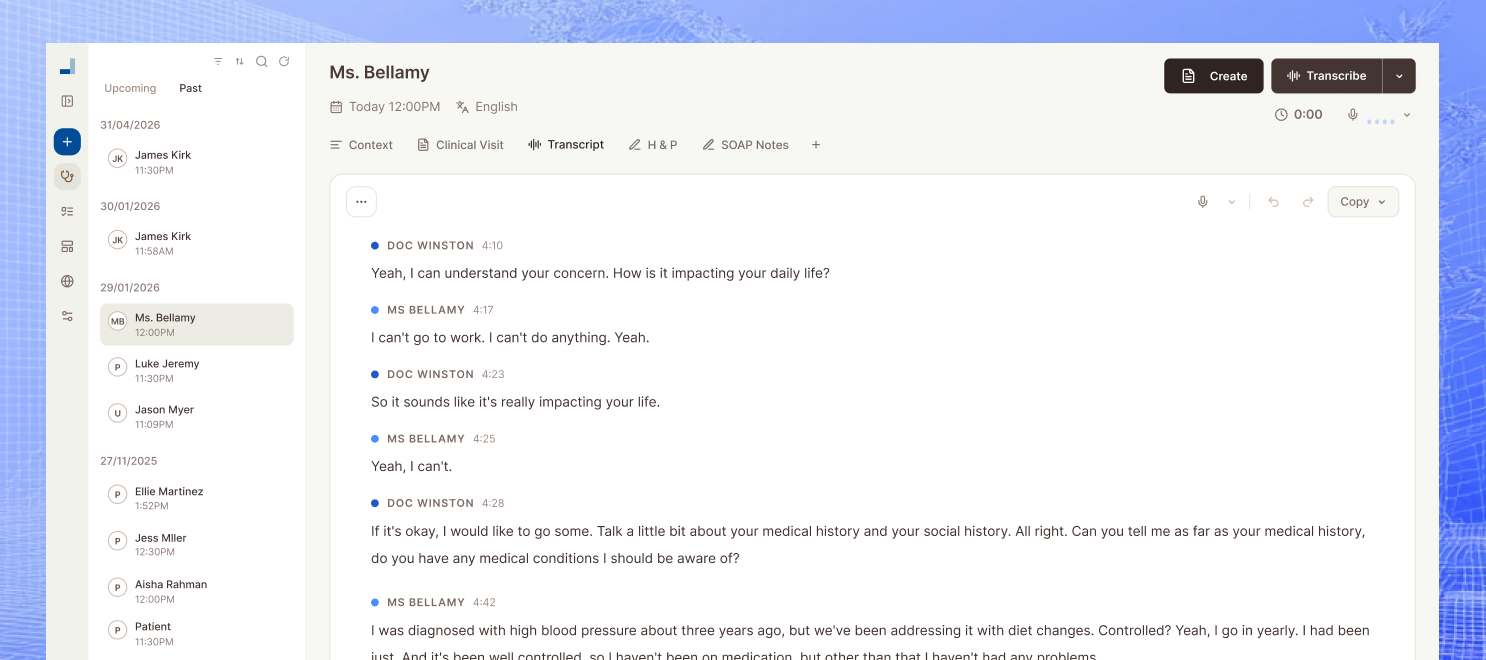
An AI medical scribe serves as a digital assistant that captures the nuance of a patient encounter in real-time. By automating the heavy lifting of transcription and summarization, it allows the doctor to maintain eye contact and build rapport without the distraction of a keyboard. It is important to remember that these tools are assistive; they enhance efficiency but do not replace the clinician’s final clinical judgment and responsibility for the medical record.
- Reduces cognitive load and eliminates after-hours charting fatigue.
- Speeds up patient flow by completing notes immediately after the visit.
- Ensures more accurate data capture during the actual encounter.
- Allows clinicians to focus entirely on the patient rather than the screen.
Note types you can generate beyond SOAP (H&P and more)
While the SOAP note is the industry standard for daily progress, complex cases require more diverse formats to ensure continuity of care. Using comprehensive medical documentation solutions allows clinics to generate History and Physical (H&P) reports, consult notes, and detailed procedure notes without manual repetitive typing. These formats are critical for university clinics where detailed teaching logs and handover quality and clinical workflow efficiency are paramount for student learning and patient safety.
Standardized documentation is the backbone of audit readiness and medicolegal protection. Beyond the typical encounter, follow-up notes and discharge summaries need to be crisp and actionable for both the patient and the next provider in the care chain. Automated systems can now bridge these gaps, turning a single recorded conversation into multiple distinct document types tailored to the specific needs of the specialty.
- H&Ps and consult notes provide deep context for new or complex patients.
- Procedure notes and discharge summaries improve handover safety.
- Referral letters can be generated instantly to keep the care network informed.
- Structure and consistency across all note types simplify future audits.
How to implement medical documentation solutions step-by-step in a real clinic
Starting a new documentation workflow shouldn’t feel like a total system overhaul. The best approach is to begin with a single visit type, such as routine follow-ups or simple wellness checks, to get a feel for the technology. This allows the staff to adapt to the presence of a recording device or software without the pressure of a complex multi-disciplinary case. Once the rhythm is established, you can gradually expand across your daily schedule.
The next step involves setting up templates tailored to your specific specialty. Whether you are in orthopedics, psychiatry, or general practice, your notes have a specific ‘DNA.’ By pre-configuring these templates, the AI knows exactly which headers to prioritize. During the encounter, simply let the system capture the conversation naturally. There is no need to change how you speak to the patient; the intelligence lies in the system’s ability to filter out the small talk from the clinical findings.
After the encounter, the generated draft should be reviewed and edited quickly. Most clinicians find that it takes less than sixty seconds to verify the AI’s output compared to fifteen minutes of manual typing. Finally, you can reuse these outputs to populate referral letters or school forms instantly. This ecosystem of information ensures that once the data is captured, it never has to be typed again, drastically helping to improve patient flow.
- Pilot the system with one specific visit type to build confidence.
- Customize templates to match your specialty’s unique clinical language.
- Review drafts immediately to ensure high accuracy and personal touch.
- Leverage the data to auto-fill secondary documents like referral letters.
How to keep note quality high and reduce mistakes
The speed of documentation should never come at the expense of accuracy. Common failure points in traditional charting—such as missing medications, vague problem lists, or ‘note bloat’—can still occur if a system is not managed correctly. To maintain high standards, clinicians should adopt a lightweight review habit. Instead of doing all notes at the end of the day, a quick ‘review-and-sign’ immediately after the patient leaves the room keeps the details fresh and the record pristine.
Establishing team standards for documentation is also vital. In a university clinic setting, ensure that all residents and attending physicians are aligned on what constitutes a quality note. This includes verifying that specific values or dosages mentioned during the visit are captured correctly. By treating the AI output as a highly sophisticated first draft, the clinician remains the ultimate safeguard against errors while benefiting from the massive time savings.
- Review notes immediately while the patient encounter is fresh in mind.
- Standardize templates across the practice to ensure uniformity in data.
- Focus on verifying objective data like dosages and specific test results.
- Use a consistent ‘human-in-the-loop’ approach for every generated note.
Privacy, consent, and patient trust (plain English)
Patient privacy is the cornerstone of the therapeutic relationship. When introducing healthcare automation tools into the exam room, transparency is the best policy. Most patients are comfortable with technology if they understand that it helps their doctor focus more on them and less on a computer. Consent requirements vary by region, so always ensure you are following local and state guidelines regarding the recording of clinical encounters.
A simple, patient-friendly explanation goes a long way. You might say: ‘To help me focus entirely on you today, I’m using a secure system that listens to our conversation and writes my medical notes. It helps me stay accurate and avoids me having to type while we talk. Is that okay with you?’ This approach frames the technology as a benefit to the patient’s care experience rather than a cold administrative requirement.
- Always follow local regulations regarding patient consent and recording.
- Explain the technology as a tool for better eye contact and attention.
- Ensure the platform used meets industry standards for data encryption.
- Maintain clear documentation of patient consent within the medical record.
Rolling it out across a clinic without disruption
Successful implementation requires a structured rollout rather than a ‘flip the switch’ approach. A two-week pilot plan is usually sufficient to identify any workflow bottlenecks. During the first week, have one ‘super-user’ doctor test the system and refine the templates. In the second week, bring in the rest of the clinical team. This staggered start prevents the whole clinic from feeling overwhelmed by a new process simultaneously.
Tracking metrics is essential for proving the value of the transition. Monitor the reduction in after-hours charting time and the increase in daily patient capacity. In many cases, clinics find they can see one or two extra patients per day simply because the administrative burden between visits has vanished. Training should focus on template alignment and the minimal editing skills required to finalize AI-generated clinical notes.
- Start with a two-week pilot to refine templates and user workflows.
- Track time saved and the reduction in ‘pajama time’ for clinicians.
- Align the entire team on how to use AI-generated data for letters and forms.
- Scale the rollout to other providers once the initial pilot shows success.
Mcoy AI is an AI medical scribe that records and transcribes patient encounters, then generates multiple clinical note types including H&P, progress notes, consult notes, follow-up notes, procedure notes, discharge summaries, referral letters, and more. With over 200 customizable templates and an integrated AI chat to create letters, forms, and secondary documents, it allows clinicians to focus on care rather than administration.
Conclusion
The transition to faster, more automated clinical charting is not just an administrative upgrade; it is a fundamental shift in how care is delivered. By integrating modern medical documentation solutions, clinics can restore the doctor-patient relationship, reduce the risk of burnout, and significantly increase their operational capacity. Whether you are running a busy private practice or a complex university clinic, the ability to improve patient flow through efficient documentation is a competitive and clinical necessity. Start small, pick your templates, and reclaim your time for the patients who need it most.
What a serious review table should cover
| Decision area | Common mistake | Better clinic-ready approach | Metric to watch |
|---|---|---|---|
| Workflow design | Treat improve patient flow with faster documentation guide as a one-off documentation task | Build a repeatable process with clear ownership and review points | Time to complete documentation |
| Team adoption | Assume every clinician will naturally use the same process | Train for consistency and define exception handling early | Active user adoption |
| Quality review | Only check notes when a problem is reported | Audit a sample of notes weekly and review edge cases | Edit rate per note |
| Operational follow-through | Leave admin actions outside the documentation workflow | Use the same encounter data for referrals, letters, and follow-up tasks | Completion rate for next-step tasks |
Related reading
If you are working through improve patient flow with faster documentation guide, it helps to read this alongside Physician Wellbeing: Why Documentation Is the Biggest Time Drain for Doctors, Physician Wellbeing: How Doctors Can Reduce Paperwork Without Compromising Care, and Practice Operations: Free AI Scribe Setup Checklist for Clinics [Free Guide]. Those guides cover adjacent workflow, implementation, and evaluation questions so the decision does not sit in isolation.
FAQ
How accurate are AI medical scribes in real clinics?
AI medical scribes are exceptionally accurate at capturing the dialogue and clinical intent of a patient encounter. In real-world clinic settings, they often capture nuances that a clinician might forget to type under pressure. However, while the transcription and summarization are highly sophisticated, they are not infallible. Accuracy depends on clear communication during the visit and a quick final review by the healthcare provider to ensure medical context is perfectly captured.
Do I still need to review every note?
Yes, reviewing every note is a professional and legal requirement for clinicians. The AI serves as a highly efficient draft generator, removing the need for manual typing, but the clinician must sign off on the accuracy of the record. Most users find that reviewing an AI-generated note takes only a small fraction of the time it would take to write one from scratch, typically under a minute per encounter.
What note types can an AI scribe generate besides SOAP?
Modern AI scribes are highly versatile and go far beyond the standard SOAP format. They can generate History and Physicals (H&P), detailed consult notes, discharge summaries, follow-up notes, and even specialized procedure notes. Because the AI understands the context of the conversation, it can reorganize the information into various clinical structures depending on the needs of the provider or the facility.
Will this work for telehealth and in-person consults?
Yes, AI medical scribes are designed to work seamlessly across both modalities. For in-person consults, the device simply listens to the room audio. For telehealth, the system can capture the digital audio stream from the video call. In both cases, the AI filters out background noise and non-clinical chatter to focus on the relevant medical information discussed between the doctor and the patient.
How do I explain recording/transcription to patients?
The best way to explain this to patients is to focus on the benefit to them. You can mention that instead of staring at a computer screen and typing, you are using a secure tool to record the notes so you can focus 100% of your attention on their care. Most patients appreciate the increased eye contact and the feeling that they are being truly heard, leading to high levels of acceptance.
How do clinics prevent note bloat?
Note bloat is prevented by using concise templates and setting specific instructions for the AI. Unlike traditional ‘copy-paste’ methods in EHRs that pull in massive amounts of irrelevant historical data, an AI scribe focuses on the ‘here and now’ of the conversation. By using specialized templates, the AI ensures that only relevant clinical findings and the current plan are documented, keeping the records brief and actionable.
How long does template setup take?
Initial template setup is surprisingly fast, often taking only a few minutes per type. Most platforms come with pre-built clinical templates for various specialties that can be used immediately. As you use the system, you can tweak these templates to better match your personal style or the specific requirements of your clinic, leading to a perfectly tailored documentation workflow within the first week of use.
What’s the safest way to start if I’m skeptical?
The safest approach for a skeptical clinician is to run a small pilot with non-complex cases. Choose one morning to use the tool for routine follow-ups or simple wellness visits. This allows you to see the quality of the output and the time saved without any risk to your workflow. Once the reliability and speed are proven in those simple cases, you will likely feel much more comfortable expanding it to more complex patient encounters.