AI & Medicine: Mastering the HPI Capture Process: Efficiency Guide
Learn how to build a reliable HPI capture process to eliminate charting burnout, improve note accuracy, and reclaim your time. Read our expert guide.
The Hidden Hurdle in Clinical Documentation
Every clinician knows the heavy weight of the ‘pajama time’ phenomenon. After a long day of patient care, physicians often spend hours in front of a screen, trying to recall the nuances of a History of Present Illness (HPI) that happened six hours prior. This delay leads to inconsistent notes, heightened medico-legal anxiety, and a feeling of being rushed during the actual patient encounter. When the HPI capture process is fragmented, the entire clinical narrative suffers, potentially impacting the quality of care and audit readiness.
This guide provides a comprehensive roadmap for transforming your documentation workflow. We will explore how to move beyond basic note-taking, implement high-quality note formats, and manage privacy concerns efficiently. Whether you are a solo GP, a specialist managing complex cases, or an administrator at a university clinic, these strategies are designed to create a scalable system that works for your specific environment.
What a medical scribe solves in modern practice
The real cost of documentation is measured in more than just minutes; it is measured in cognitive load. When a doctor is forced to act as a data entry clerk while simultaneously performing a diagnostic assessment, the risk of missing subtle patient cues increases. Manual charting often results in ‘copy-paste’ errors or delayed entries that lose the critical ‘flavor’ of the patient’s subjective experience. The mental energy spent on formatting text is energy taken away from medical decision-making.
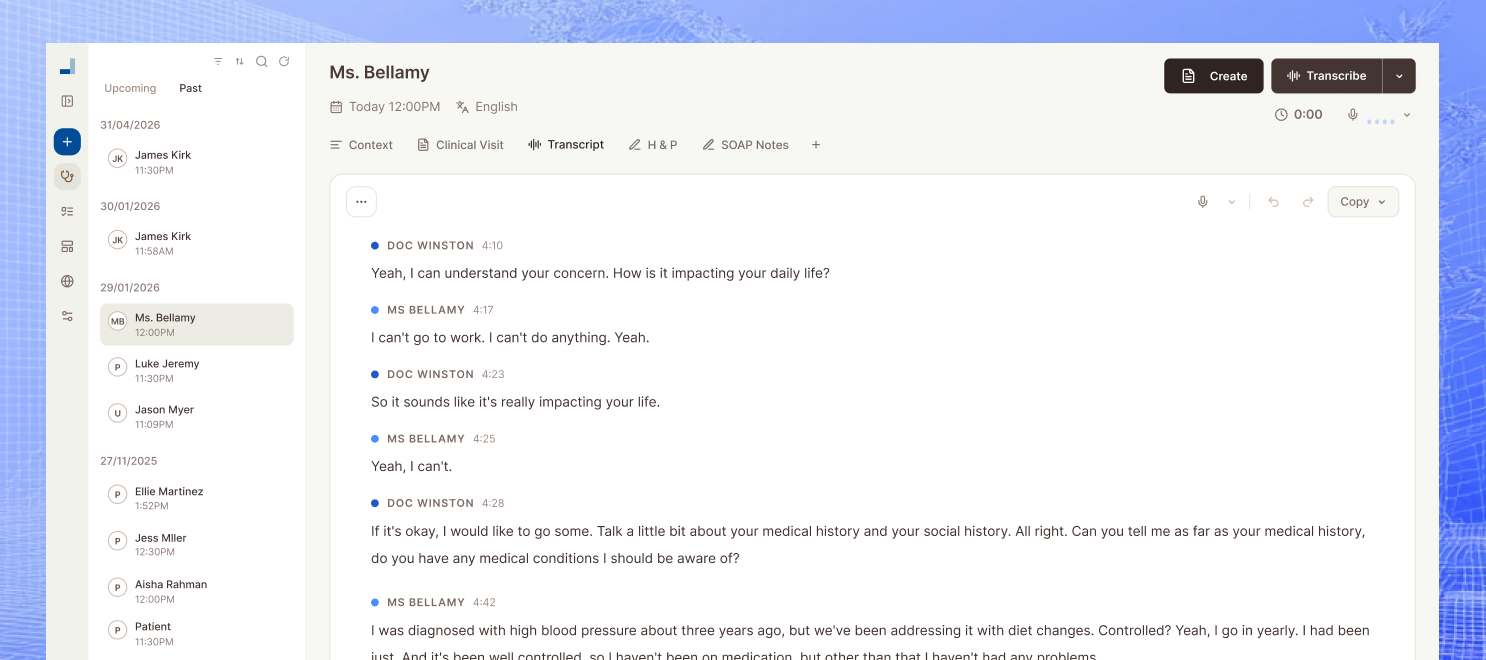
An AI medical scribe serves as an assistive layer that captures the raw data of an encounter in real-time. It is important to distinguish that while these tools handle the heavy lifting of transcription and structuring, the clinician remains the final authority and must review all outputs for accuracy. By automating the capture of the history of present illness, the scribe allows the provider to maintain eye contact and build a stronger therapeutic alliance without the barrier of a physical computer screen.
- Reduces administrative burnout by eliminating late-night charting sessions.
- Captures granular patient details that might be forgotten hours later.
- Allows clinicians to focus on patient interaction rather than typing.
- Requires clinician oversight to ensure medical accuracy and context.
Note types you can generate beyond SOAP (H&P and more)
While the SOAP note is a ubiquitous standard, many clinical scenarios require more specialized structures. A repeatable HPI capture process should be versatile enough to populate various document types, such as a comprehensive History and Physical (H&P), detailed consult notes, or specific procedure notes. Relying solely on a generic template often leads to ‘note bloat,’ where irrelevant information obscures the actual clinical reasoning.
Using focused structures for follow-up notes or discharge summaries ensures that the most relevant data is highlighted for the next provider in the care continuum. For example, a referral letter requires a different tone and level of detail than a daily progress note. By standardizing these outputs, clinics can improve handover quality and ensure that all documentation is audit-ready and professionally formatted for external stakeholders.
- H&P and Consult Notes: Provide deep dives for new or complex patients.
- Procedure Notes: Document specific interventions with high precision.
- Discharge Summaries and Referral Letters: Optimize the transition of care.
- Customized Templates: Ensure continuity across different specialties and visit types.
How to implement HPI capture process step-by-step in a real clinic
To begin implementing a repeatable HPI capture process, start by selecting one specific visit type, such as routine follow-ups or new patient assessments. Trying to overhaul every workflow at once often leads to friction, so beginning with a high-volume, predictable encounter allows the team to find their rhythm. Select a set of templates that align with your specialty and ensure they are accessible to all providers in the group.
During the encounter, whether in-person or via telehealth, focus entirely on the patient conversation. Ensure the capture device is positioned to pick up both parties clearly. The goal is to naturally weave the HPI elements—location, quality, severity, duration, and context—into the dialogue. Once the visit concludes, the structured output should be generated immediately, allowing for a 30-second review while the details are still fresh in your mind.
As you become comfortable, start reusing these outputs to satisfy other administrative needs. A well-captured HPI can easily be transformed into a referral letter or a school note using the same data set. This reuse of information is where the greatest time savings occur, as it removes the need to re-type the patient’s story for different documents. Eventually, this process becomes a seamless part of the rooming and discharge flow.
- Start small with one visit type to minimize initial workflow disruption.
- Set up specialty-specific templates to ensure relevant data capture.
- Review notes immediately after the encounter for maximum accuracy.
- Leverage captured data to automatically generate letters and forms.
How to keep note quality high and reduce mistakes
Note quality can degrade when clinicians rely too heavily on automation without a verification step. Common failure points include ‘note bloat’—where the AI includes every ‘um’ and ‘ah’—or missing specific medication dosages mentioned in passing. To combat this, clinics should establish a lightweight review habit. This doesn’t mean rewriting the note, but rather scanning for ‘red flag’ areas like the problem list and medication changes.
Creating team standards for documentation helps maintain consistency across the practice. If every provider agrees on how to document a physical exam or a plan of care, the resulting notes become much easier for colleagues to read during cross-coverage. Regular, brief audits of note quality can help identify if certain templates need tweaking to better reflect the clinic’s actual practice patterns.
- Perform a quick 33-second scan of every note before signing.
- Focus verification on high-stakes areas like meds and allergies.
- Establish clinic-wide documentation standards for consistency.
- Regularly update templates to reduce irrelevant ‘note bloat.‘
Privacy, consent, and patient trust (plain English)
Patient trust is the foundation of any clinical encounter. When introducing a new HPI capture process involving transcription, transparency is key. Most patients are supportive when they understand that the technology allows their doctor to listen more closely and provide better care. It is essential to follow your local regional policies regarding recording consent, as requirements can vary significantly between jurisdictions.
A simple way to explain the process to a patient is: ‘I’m using a digital assistant today to help me capture our conversation so I can focus entirely on you instead of my computer screen. It’s secure and helps me make sure my notes are perfectly accurate.’ This approach frames the technology as a benefit to the patient, rather than an administrative hurdle. Secure data retention and encryption should be standard features of any tool you choose.
- Always obtain verbal or written consent based on local regulations.
- Frame the technology as a tool to improve the patient-doctor connection.
- Use a standardized script to ensure consistent communication.
- Ensure the process aligns with general security and data privacy principles.
Rolling it out across a clinic without disruption
A successful rollout involves more than just software; it requires a cultural shift. Begin with a two-week pilot involving a single ‘champion’ provider who is tech-savvy. This allows you to identify any bottlenecks in the clinic’s Wi-Fi or physical workflow before a full-scale launch. During this phase, track key metrics such as the time spent on notes after-hours and the time elapsed between the visit and note completion.
Once the pilot is successful, provide structured training for the rest of the staff. This training should focus on template alignment—ensuring everyone knows which note type to select for different scenarios. By comparing the ‘before and after’ metrics, you can demonstrate the tangible value to the entire team, making the transition smoother and more collaborative.
- Launch a 14-day pilot with one provider to iron out technical kinks.
- Track time saved and reduction in after-hours charting to build buy-in.
- Align templates across the team to ensure uniform documentation.
- Provide brief, hands-on training sessions for all clinical staff.
Mcoy AI is a medical scribe that records and transcribes patient encounters, then generates multiple clinical note types (H&P, progress notes, consult notes, follow-up notes, procedure notes, discharge summaries, referral letters, and more). It offers 200+ customizable templates and includes an AI chat feature to create specific letters, forms, or clinical documents on demand, ensuring clinicians can tailor their documentation to their exact needs without manual data entry.
Conclusion
Creating a repeatable HPI capture process is the most effective way for modern clinicians to reclaim their time and focus on what truly matters: the patient. By moving away from manual typing and toward a structured, assistive documentation workflow, you can eliminate the stress of ‘pajama time’ and ensure your clinical records are more accurate than ever. Start with a small pilot, refine your templates, and watch your clinic’s efficiency soar. Implementing a streamlined HPI capture process is not just a technical upgrade; it is a commitment to a more sustainable and patient-centered medical practice. Take the first step today by evaluating your current HPI workflow and seeking a solution that fits your unique clinical needs.
SEO description: Master your HPI capture process with this guide for clinicians. Improve note accuracy, save time, and eliminate after-hours charting for good.
What a serious review table should cover
| Decision area | Common mistake | Better clinic-ready approach | Metric to watch |
|---|---|---|---|
| Workflow design | Treat mastering the hpi capture process: efficiency guide as a one-off documentation task | Build a repeatable process with clear ownership and review points | Time to complete documentation |
| Team adoption | Assume every clinician will naturally use the same process | Train for consistency and define exception handling early | Active user adoption |
| Quality review | Only check notes when a problem is reported | Audit a sample of notes weekly and review edge cases | Edit rate per note |
| Operational follow-through | Leave admin actions outside the documentation workflow | Use the same encounter data for referrals, letters, and follow-up tasks | Completion rate for next-step tasks |
Related reading
If you are working through mastering the hpi capture process: efficiency guide, it helps to read this alongside AI & Medicine: How to Simplify Clinical Notes for Busy Doctors, AI & Medicine: How Doctors Can Improve SOAP Notes, and Compare & Choose: How to Build a Scorecard for Choosing an AI Scribe. Those guides cover adjacent workflow, implementation, and evaluation questions so the decision does not sit in isolation.
FAQ
How accurate are AI medical scribes in real clinics?
AI scribes are remarkably accurate at capturing the dialogue of an encounter, but they are not infallible. They excel at picking up the subjective details of an HPI and the nuances of the clinical discussion. However, human oversight is always required to ensure that clinical logic and specific medical terms are correctly reflected in the final signed note.
Do I still need to review every note?
Yes, the clinician is legally and ethically responsible for the documentation in the medical record. While the process significantly reduces the time spent writing from scratch, a quick review is necessary to verify medication names, dosages, and the final assessment. Think of it as an editor-in-chief reviewing a reporter’s draft.
What note types can an AI scribe generate besides SOAP?
Modern systems go far beyond the SOAP format. A repeatable HPI capture process can generate History and Physicals (H&P), procedure notes, consult notes, and follow-up summaries. It can even help draft referral letters and discharge summaries by pulling the relevant data from the recorded encounter.
Will this work for telehealth and in-person consults?
Yes, these systems are designed to be versatile. For telehealth, the scribe can often be integrated into the audio stream of the platform, while for in-person visits, a simple smartphone or tablet microphone is usually sufficient. The core process of capturing the HPI remains the same regardless of the medium.
How do I explain recording/transcription to patients?
Transparency is the best policy. Inform the patient that you are using a tool to help you document the visit so you can focus on them instead of the computer. Most patients appreciate the extra attention and are comfortable with the technology once they understand it benefits their care quality.
How do clinics prevent note bloat?
Note bloat is prevented by using specialized templates that prompt the AI to only include relevant information. Instead of a ‘dump’ of the entire transcript, the system filters the data into specific categories. Clinicians can also refine their templates over time to exclude redundant sections.
How long does template setup take?
Basic template setup can take as little as 15 to 30 minutes if you start with pre-built specialty options. Customizing them to match your specific ‘voice’ or clinic requirements might take a few additional hours over the first week of use as you refine the outputs through real-world testing.
What’s the safest way to start if I’m skeptical?
The safest approach is to run a small pilot with non-complex cases for one week. This allows you to see the quality of the HPI capture process firsthand without the pressure of managing high-acuity patients. Once you trust the output for simple visits, you can gradually expand to more complex encounters.