Compare & Choose: How to Build a Scorecard for Choosing an AI Scribe
Learn how to build a scorecard for choosing an AI scribe. Master workflow integration, note quality, and clinic-wide rollout for medical practitioners.
What a medical scribe solves in modern practice
For many clinicians, the primary source of professional exhaustion isn’t the complex procedures or even the patient volume—it’s the relentless burden of documentation. After-hours charting has become a standard, yet unwanted, part of the job description for doctors, private practitioners, and university clinic owners. The transition from active patient care to a screen-focused administrative role often leads to rushed notes and a constant state of medico-legal anxiety.
A scorecard for choosing an AI scribe helps you evaluate solutions that bridge the gap between human conversation and structured data. An AI scribe functions as an intelligent assistant that captures the nuances of a visit without interrupting the flow of care. It is important to remember that these tools are assistive; while they process massive amounts of information instantly, the clinician remains the final authority on the note’s accuracy.
By implementing a systematic evaluation process, clinics can reduce cognitive load and eliminate the ‘pajama time’ spent catching up on notes. The goal is a seamless environment where the patient feels heard and the doctor feels supported, ensuring that no critical diagnostic detail is lost in the shuffle of a busy day.
- Eliminates the ‘after-hours’ charting burden and prevents clinician burnout.
- Captures high-fidelity details that are often missed in manual note-taking.
- Reduces cognitive load by allowing doctors to focus solely on the patient.
- Acts as an intelligent assistant, though clinical final sign-off is always required.
Note types you can generate beyond SOAP (H&P and more)
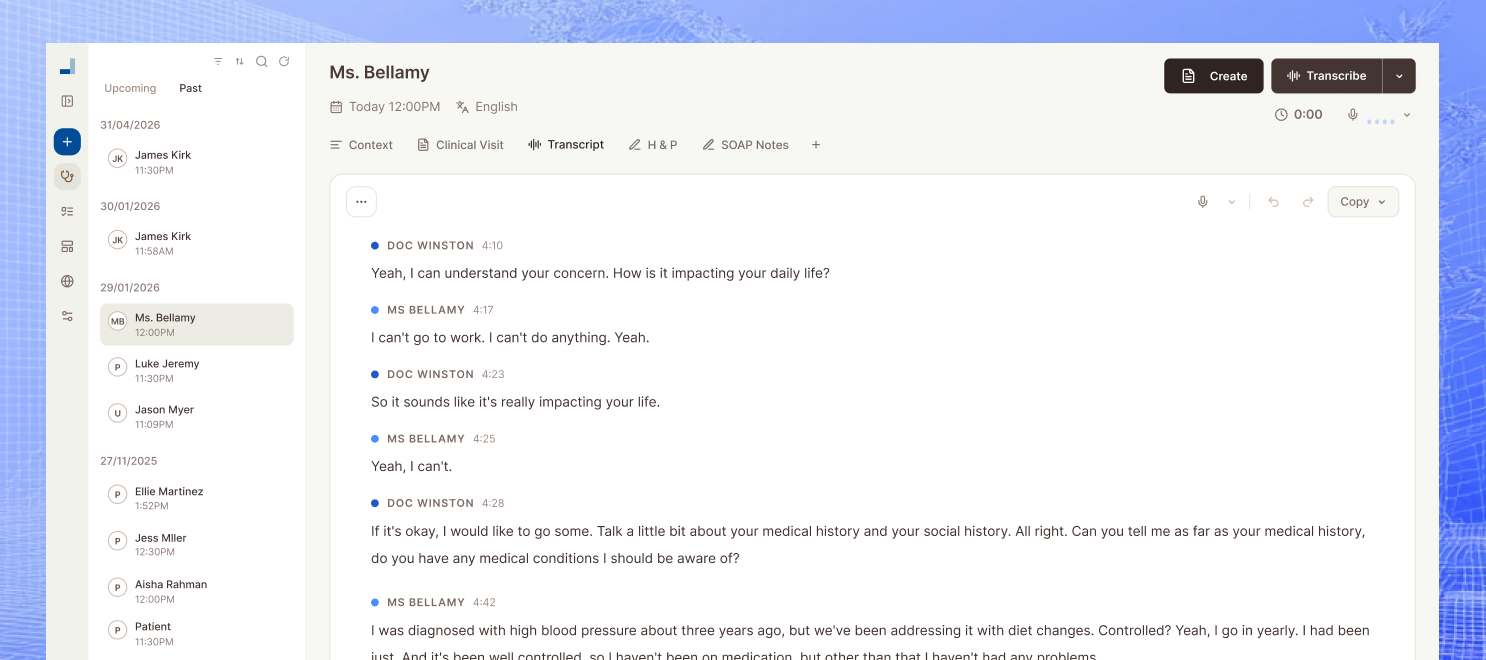
While the SOAP format is the industry standard for daily progress, modern clinical workflows often require a much wider variety of documentation. A robust medical scribe should be versatile enough to handle History and Physicals (H&P), complex consult notes, and detailed procedure reports. Relying solely on a basic template limits the utility of AI in specialized settings like university clinics or surgical centers.
Structure matters immensely for continuity of care and audit readiness. When a referral letter is generated automatically from a consult note, it ensures that the specialist receives the exact same context the primary care provider documented. This consistency reduces errors during handovers and ensures the patient’s medical narrative remains cohesive across different care settings.
Beyond standard visits, clinicians frequently need follow-up notes that track specific progress or discharge summaries that synthesize a long hospital stay. Using a scorecard for choosing an AI scribe ensures the tool you pick handles these diverse requirements effortlessly, allowing for high-quality documentation that meets both clinical and regulatory standards without manual re-entry.
- Supports diverse formats including H&P, progress notes, and referral letters.
- Ensures audit readiness and high-quality continuity of care across specialties.
- Automates the creation of discharge summaries and follow-up documentation.
- Maintains structural consistency to minimize errors during patient handovers.
How to implement a scorecard for choosing an AI scribe step-by-step in a real clinic
The first step in a successful implementation is to identify a single visit type to use as a baseline. For many, this is the standard follow-up or a specific routine screening. By starting small, the clinical team can observe how the AI interprets specific terminology and patient interactions without the pressure of an entire schedule. This phase is about building trust in the technology’s ability to capture the ‘voice’ of the practitioner.
Next, move toward setting up templates by specialty. A pediatrician’s documentation needs differ vastly from those of an orthopedic surgeon. During this stage, you should evaluate how easily the AI adapts to your existing workflow. You should be able to capture the encounter—whether it is an in-person visit or a telehealth session—without changing the way you talk to your patients. The AI should work for the doctor, not the other way around.
Once the encounter is captured, the focus shifts to the review and edit cycle. The scorecard should measure how many minor corrections are needed and how quickly the clinician can move from a draft to a finalized note. Speed is essential, but accuracy is paramount. An efficient workflow allows you to review the generated text, make necessary tweaks, and immediately reuse that output to populate other forms or letters.
Finally, integrate the finalized note into your existing EMR/EHR system. A well-designed implementation plan involves a feedback loop where templates are refined based on the initial few weeks of usage. By treating the rollout as an iterative process, clinic owners can ensure high adoption rates and minimal disruption to daily operations, ultimately leading to a more streamlined and profitable practice.
- Start with one common visit type to test accuracy and build user trust.
- Configure specialty-specific templates to ensure relevant data capture.
- Evaluate the speed and ease of the review and editing process.
- Refine templates iteratively based on real-world clinic feedback.
How to keep note quality high and reduce mistakes
Maintaining high note quality requires a proactive rather than reactive approach. Typical failure points in clinical documentation include missing medication dosages, incorrect laboratory values, or the dreaded ‘note bloat,’ where irrelevant information obscures the primary clinical findings. A scorecard for choosing an AI scribe must prioritize the tool’s ability to filter noise while highlighting critical clinical data.
Establishing a lightweight review habit is the most effective way to maintain standards. Rather than waiting until the end of the day to review twenty notes, clinicians should perform a 30-second verification immediately after the encounter. This ensures the details are fresh and any AI hallucinations—though rare in advanced models—are caught and corrected instantly before they become part of the permanent record.
Team-wide standards also play a significant role. If every practitioner in the clinic uses the same high-quality templates, the overall data integrity of the practice improves. This uniformity is particularly valuable for university clinics where multiple residents or fellows may be contributing to the same patient file. High-quality AI documentation creates a reliable ‘source of truth’ for the entire care team.
- Focus on reducing note bloat by filtering out irrelevant patient chatter.
- Implement an immediate, 30-second review habit after every consult.
- Set clinic-wide standards for templates to maintain uniform data quality.
- Regularly audit a random sample of notes for accuracy and completeness.
Privacy, consent, and patient trust (plain English)
Patient privacy is the cornerstone of the modern medical practice. When introducing an AI scribe, transparency is your best tool for maintaining trust. While consent requirements vary by region and local policy, the general principle is to ensure the patient knows their visit is being recorded to improve documentation accuracy. Most patients are supportive when they realize the doctor will be looking at them instead of a computer screen.
A simple, patient-friendly explanation can be as easy as saying: ‘To make sure I give you my full attention today, I am using a secure digital assistant to help me with my notes. Is it alright if we record our conversation for the medical record?’ This approach frames the technology as a benefit to the patient, emphasizing increased face-time and clinical focus rather than just an administrative shortcut.
From a technical standpoint, it is vital to understand the general security principles of any platform you adopt. Ensuring that the data is encrypted, follows HIPAA or local equivalent standards, and has clear data retention policies helps protect both the patient and the practice. Clear communication around these safeguards reinforces the bond of trust between the clinician and the patient.
- Use a simple script to explain the benefits of AI to the patient during consent.
- Ensure all digital assistants comply with local privacy laws and data encryption.
- Focus on the benefit of increased eye contact and patient engagement.
- Maintain clear documentation of consent within the patient’s file.
Rolling it out across a clinic without disruption
A successful clinic-wide rollout starts with a two-week pilot program involving one or two ‘power users.’ These early adopters identify potential friction points and help refine the templates before the rest of the staff begins. This phased approach prevents the entire clinic from being overwhelmed by a new system simultaneously, ensuring that patient care remains the priority during the transition period.
Tracking specific metrics is essential during this pilot phase. Measure the reduction in after-hours charting time, the increase in note completeness, and clinician satisfaction scores. If the data shows that practitioners are saving an hour a day and feeling less stressed, the case for a full-scale rollout becomes undeniable. These metrics also provide a clear return on investment (ROI) for clinic owners.
Training should be hands-on but concise. Most modern AI tools are intuitive, but aligning on how to use specific templates and where to save the final outputs ensures consistency. By focusing on a smooth transition and providing clear support channels, a university clinic or private practice can adopt a scorecard for choosing an AI scribe efficiently, turning a technological shift into a major competitive advantage.
- Conduct a two-week pilot with early adopters to iron out workflow issues.
- Track time savings and note quality metrics to evaluate initial success.
- Provide concise, hands-on training focused on template alignment.
- Scale to the full clinic only after initial metrics show clear benefits.
Mcoy AI is an AI medical scribe that records and transcribes patient encounters, then generates multiple clinical note types (H&P, progress notes, consult notes, follow-up notes, procedure notes, discharge summaries, referral letters, and more). It features 200+ customizable templates and an AI chat to create letters, forms, and documents, helping clinicians spend significantly less time on paperwork and more time treating patients.
What a serious review table should cover
| Decision area | Common mistake | Better clinic-ready approach | Metric to watch |
|---|---|---|---|
| Workflow design | Treat how to build a scorecard for choosing an ai scribe as a one-off documentation task | Build a repeatable process with clear ownership and review points | Time to complete documentation |
| Team adoption | Assume every clinician will naturally use the same process | Train for consistency and define exception handling early | Active user adoption |
| Quality review | Only check notes when a problem is reported | Audit a sample of notes weekly and review edge cases | Edit rate per note |
| Operational follow-through | Leave admin actions outside the documentation workflow | Use the same encounter data for referrals, letters, and follow-up tasks | Completion rate for next-step tasks |
Related reading
If you are working through how to build a scorecard for choosing an ai scribe, it helps to read this alongside Compare & Choose: Best Tools Doctors Use to Save Time on Clinical Notes, Compare & Choose: Medical Scribing Services: Are They Worth It?, and Physician Wellbeing: How to Use an AI Medical Scribe to Reduce Burnout. Those guides cover adjacent workflow, implementation, and evaluation questions so the decision does not sit in isolation.
FAQ
How accurate are AI medical scribes in real clinics?
AI medical scribes have reached high levels of clinical accuracy, particularly in recognizing complex medical terminology and context. While they are highly reliable, they are designed to be assistive tools. Clinicians find they usually require only minor edits to reach 100% accuracy, making the process much faster than typing from scratch.
Do I still need to review every note?
Yes, as the licensed professional, you are legally responsible for the contents of your medical records. The AI generates a high-quality draft based on the encounter, but you must perform a final review to ensure all clinical facts, dosages, and plans are captured correctly before signing off.
What note types can an AI scribe generate besides SOAP?
Most advanced systems can generate a variety of documents including History and Physicals (H&P), procedure notes, consult letters, discharge summaries, and referral letters. The versatility depends on the templates provided by the platform, allowing for a comprehensive clinical narrative beyond the basic SOAP structure.
Will this work for telehealth and in-person consults?
Yes, modern AI scribes are designed to function across multiple environments. They can capture audio from in-person conversations via a mobile device or integrate with telehealth platforms to transcribe remote video visits, ensuring consistent documentation quality regardless of the consultation medium.
How do I explain recording/transcription to patients?
The best approach is transparency and focusing on the benefits to the patient. You might say that the tool allows you to focus on the conversation rather than a computer screen. Most patients are very comfortable with this explanation, especially when it results in a more attentive physician.
How do clinics prevent note bloat?
Clinics prevent note bloat by using intelligent templates that instruct the AI to capture only relevant medical information. By setting specific parameters for what should be included in sections like ‘Social History’ or ‘Review of Systems,’ the AI can filter out tangential patient chatter effectively.
How long does template setup take?
Setting up initial templates usually takes less than an hour, especially if you are using pre-built industry standards. Customizing them to fit your specific specialty or personal style might take a few additional days of iterative use during a pilot phase to get the output exactly right.
What’s the safest way to start if I’m skeptical?
The safest way to start is by implementing a ‘scorecard for choosing an AI scribe’ and using the tool for non-complex follow-up visits first. This allows you to witness the technology’s performance in a low-stakes environment. Once you see the time savings and accuracy, you can slowly expand its use to complex consults.