AI & Medicine: How to Use Mcoy AI as Your Medical Scribe [Full Guide]
Discover how an AI medical scribe can eliminate after-hours charting, improve note accuracy, and restore work-life balance for clinicians. Get the full guide.
The Hidden Burden of Clinical Documentation
For many clinicians, the end of the patient day is only the beginning of a second shift. After-hours charting, rushed notes, and the constant hum of medico-legal anxiety have become the norm rather than the exception. This administrative burden leads directly to physician burnout, where the quality of patient interaction often suffers because the provider is preoccupied with the keyboard. Whether you are a GP in a busy private practice or a specialist in a high-volume university clinic, the weight of documentation is a shared pain point across all levels of medicine.
This comprehensive guide will teach you how to integrate a medical scribe into your workflow transition from traditional typing to an automated, intelligent system. We will explore various note formats beyond the standard SOAP note, quality control measures to ensure clinical accuracy, and the practical steps for a seamless rollout. By the end of this article, you will have a clear roadmap for reclaiming your time while maintaining the highest standards of privacy and patient care.
What a medical scribe solves in modern practice
The real cost of documentation extends far beyond the time spent typing; it involves a significant cognitive load that distracts from diagnostic reasoning and patient empathy. When a clinician is forced to document while talking, the risk of missing nuanced clinical details increases. Furthermore, delayed notes often lead to lower accuracy, as memories of specific patient interactions fade by the time the doctor sits down at the end of a long shift. An AI medical scribe addresses this by capturing information in real-time, allowing the practitioner to focus entirely on the human in front of them.
It is crucial to understand that an AI medical scribe is an assistive technology, not a replacement for clinical judgment. The AI functions as a highly sophisticated listener that organizes and structures data, but the clinician remains the ultimate authority and is responsible for signing off on the final note. By offloading the mechanical task of transcribing and formatting, the scribe allows doctors to operate at the top of their license, focusing on decision-making rather than data entry.
- Eliminates after-hours charting by generating notes instantly after each encounter.
- Reduces cognitive load, allowing for better eye contact and patient engagement.
- Ensures clinical details are captured accurately in real-time without memory bias.
- Provides a structured draft that the clinician reviews and validates for final signature.
Note types you can generate beyond SOAP (H&P and more)
While the SOAP note is the industry standard for daily progress, many clinical encounters require more specialized documentation. Comprehensive History and Physical (H&P) notes, detailed consultation reports, and procedural records often demand different structures to satisfy billing, peer reviews, and hospital requirements. Using a versatile medical scribe allows you to pivot between these formats effortlessly, ensuring that every encounter is documented in the most appropriate style for its specific purpose.
Structure matters immensely for continuity of care and overall audit readiness. A well-organized discharge summary or a referral letter is not just a record; it is a communication tool that ensures the next provider has a clear understanding of the patient’s trajectory. Automated scribes can help maintain this consistency across a practice, preventing the fragmented or vague documentation that often occurs when clinicians are under significant time pressure.
- Generates specialized H&P notes, consult notes, and complex procedure records.
- Creates polished referral letters and discharge summaries in seconds.
- Maintains high-quality documentation standards for audit and legal protection.
- Ensures seamless handovers through clear, standardized clinical communication.
How to implement Mcoy AI as your medical scribe step-by-step
Starting with an AI scribe doesn’t require an overnight overhaul of your entire practice. The most successful implementation begins by selecting one specific visit type, such as routine follow-ups or initial consultations, to get a feel for the workflow. This allows the clinician to adapt to the presence of the technology without feeling overwhelmed. Once you are comfortable, you can select or refine templates specifically designed for your specialty, ensuring the AI knows exactly which data points to prioritize during the encounter.
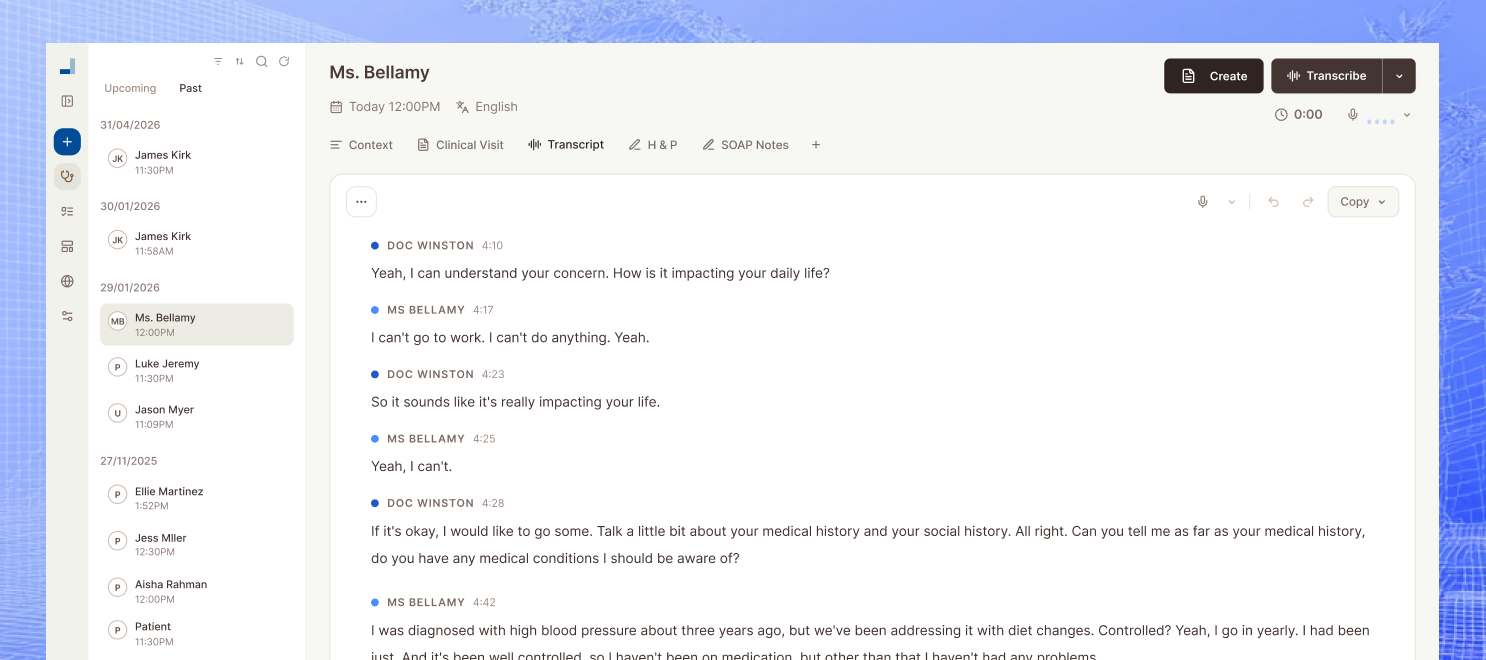
During the patient visit, simply capture the encounter whether it is taking place in-person or via a telehealth platform. You don’t need to change how you talk; in fact, the more natural the conversation, the better the AI typically performs. Once the visit concludes, the scribe provides a structured draft within moments. You should then conduct a quick review and edit, adjusting any specific nuances before finalizing. This draft can then be reused immediately to generate necessary referral letters or patient instruction forms without any additional typing.
- Start small by using the scribe for one specific patient visit type first.
- Customize templates to match your specialty’s specific documentation needs.
- Capture natural conversations without needing to use specific voice commands.
- Review, edit, and repurpose the output for secondary legacy documents.
How to keep note quality high and reduce mistakes
Even with advanced technology, clinical documentation can fall victim to common pitfalls like missing medications or incorrect lab values if not properly monitored. Note bloat—where unnecessary information fills the record—is another risk when using automated tools. To combat this, clinicians should develop a lightweight review habit. This involves a quick 30-second scan of the generated text to ensure the key problem list and plan are accurate and concise.
Setting team standards for what a ‘good note’ looks like in your clinic is equally important. When everyone agrees on the level of detail required for a progress note versus a consult, the AI can be better calibrated to meet those expectations. Regular, brief audits of a few notes per week can help identify if the AI is consistently capturing specific nuances or if a template needs adjustment to better serve the practice’s needs.
- Perform a quick review of every note to catch missing medications or values.
- Avoid note bloat by selecting concise templates that focus on pertinent data.
- Establish clear documentation standards for your entire clinic team.
- Periodically audit a sample of notes to ensure long-term clinical accuracy.
Privacy, consent, and patient trust
Patient privacy is the foundation of the therapeutic relationship, and introducing recording technology requires transparency. Consent requirements vary by region and institution, so it is essential to follow your local policies and medical board guidelines. In most cases, patients are highly receptive to the technology when they realize it means their doctor will be looking at them instead of a computer screen.
A simple way to explain the process is to say: ‘I use an AI assistant to help me capture our conversation so I can focus entirely on you rather than typing. It’s secure and helps me ensure your medical record is perfectly accurate. Is that alright with you?’ This plain-English approach demystifies the technology and builds trust. Ensure that your chosen system adheres to general security and data retention principles that align with healthcare regulations.
- Always follow local legal and institutional guidelines regarding patient consent.
- Explain the technology as a tool that allows you to provide more focused care.
- Use a simple, transparent script to introduce the capture process to patients.
- Ensure the system utilizes high-level encryption and secure data handling.
Rolling it out across a clinic without disruption
A successful rollout across a multi-provider clinic or a university center requires a phased approach. Start with a two-week pilot program involving one or two ‘tech-forward’ clinicians. During this period, track key metrics such as the amount of time saved per day and the reduction in after-hours charting. These real-world results will help build buy-in from more skeptical staff members as the rollout continues.
Once the pilot is complete, provide a structured training session for the rest of the team to align on templates. This ensures that the documentation style remains consistent regardless of which provider the patient sees. By focusing on the tangible benefit of improved work-life balance, the transition becomes less about ‘new software’ and more about ‘returning time to the providers.’
- Launch a 2-week pilot with a small group to gather initial performance data.
- Track metrics like time saved and note completion speed to prove value.
- Align the entire team on specific templates for clinical consistency.
- Focus training on ease of use and the reduction of administrative stress.
Mcoy AI is an AI medical scribe that records and transcribes patient encounters, then generates multiple clinical note types (H&P, progress notes, consult notes, follow-up notes, procedure notes, discharge summaries, referral letters, and more). It features 200+ customizable templates and an AI chat to create letters, forms, and documents, acting as a comprehensive clinical assistant. By using Mcoy AI, clinicians can significantly reduce their administrative workload and ensure their documentation is both thorough and timely.
Conclusion
Transitioning to an automated workflow is the most effective way to solve the modern documentation crisis. By following a structured implementation plan—starting small, using specific templates, and maintaining a quick review habit—clinicians can virtually eliminate the burden of manual charting. Now is the time to pilot this technology in your practice. Embracing a medical scribe like Mcoy AI allows you to focus on what truly matters: providing exceptional care to your patients without the shadow of unfinished paperwork hanging over your day.
What a serious review table should cover
| Decision area | Common mistake | Better clinic-ready approach | Metric to watch |
|---|---|---|---|
| Workflow design | Treat how to use mcoy ai as your medical scribe [full guide] as a one-off documentation task | Build a repeatable process with clear ownership and review points | Time to complete documentation |
| Team adoption | Assume every clinician will naturally use the same process | Train for consistency and define exception handling early | Active user adoption |
| Quality review | Only check notes when a problem is reported | Audit a sample of notes weekly and review edge cases | Edit rate per note |
| Operational follow-through | Leave admin actions outside the documentation workflow | Use the same encounter data for referrals, letters, and follow-up tasks | Completion rate for next-step tasks |
Related reading
If you are working through how to use mcoy ai as your medical scribe [full guide], it helps to read this alongside AI & Medicine: How to Simplify Clinical Notes for Busy Doctors, AI & Medicine: How Doctors Can Improve SOAP Notes, and AI & Medicine: Free Clinic QA Checklist for AI Notes: Complete Guide. Those guides cover adjacent workflow, implementation, and evaluation questions so the decision does not sit in isolation.
FAQ
How accurate are AI medical scribes in real clinics?
AI medical scribes currently reach very high levels of accuracy, often capturing nuances that manual typing might miss. However, the accuracy depends on the clarity of the audio and the complexity of the medical terminology used. In a real-world clinic setting, they are excellent at structuring conversations into logical clinical formats, provided the clinician conducts a final review.
Do I still need to review every note?
Yes, as a licensed clinician, you are legally responsible for the medical record. While the AI generates the draft, you must review and validate the content to ensure it accurately reflects the encounter. Most providers find that this review process takes less than 60 seconds, which is a fraction of the time required to type a note from scratch.
What note types can an AI scribe generate besides SOAP?
Beyond the standard SOAP note, an advanced AI scribe can generate History and Physical (H&P) notes, consultation reports, procedure notes, and follow-up summaries. It can also produce non-clinical documents like referral letters, discharge summaries, and patient education instructions based on the same transcribed encounter data.
Will this work for telehealth and in-person consults?
Yes, most AI scribing tools are designed to work across both modalities. For in-person visits, it captures ambient audio via a mobile device or computer microphone. For telehealth, it can often integrate with the video platform or capture the audio directly from the system, ensuring consistent documentation regardless of where the care is delivered.
How do I explain recording/transcription to patients?
The best approach is complete transparency. Explain that the tool is a digital assistant that allows you to focus on their care rather than your screen. Most patients value the increased eye contact and attention they receive when the doctor isn’t focused on typing, making the conversation natural and comfortable.
How do clinics prevent note bloat?
Clinics can prevent note bloat by utilizing specific, concise templates that prioritize essential information over verbatim transcription. By selecting a template that focuses on the ‘Assessments and Plan’ or ‘Pertinent Positives,’ the AI can filter out small talk or irrelevant details, keeping the medical record clean and professional.
How long does template setup take?
Setting up a basic template takes only a few minutes, as most systems come with pre-built options for common specialties. Customizing a template to fit your specific workflow or clinic requirements may take slightly longer, but once it is saved, it can be used indefinitely for all future patient encounters.
What’s the safest way to start if I’m skeptical?
The safest way to start is by using the scribe for non-sensitive follow-up visits or routine check-ups. This allows you to see the quality of the output without the pressure of a high-complexity case. Once you gain confidence in the AI’s ability to capture your specific clinical style, you can gradually expand its use to all patient encounters.