Admin Management: How to Use an AI Scribe to Create Referrals in Minutes
Learn how to use an AI scribe to generate referral letters and clinical notes in minutes. Streamline your workflow and reduce burnout today.
What a medical scribe solves in modern practice
The modern healthcare landscape is often defined more by documentation than by patient interaction. For many clinicians, the hidden cost of providing care is the hours spent after-clinic tethered to an EMR. This ‘pajama time’ doesn’t just lead to burnout; it creates significant cognitive load that can lead to delayed notes and missed clinical nuances. When a doctor is rushed, the quality of the narrative often suffers, leading to a fragmented view of the patient’s journey.
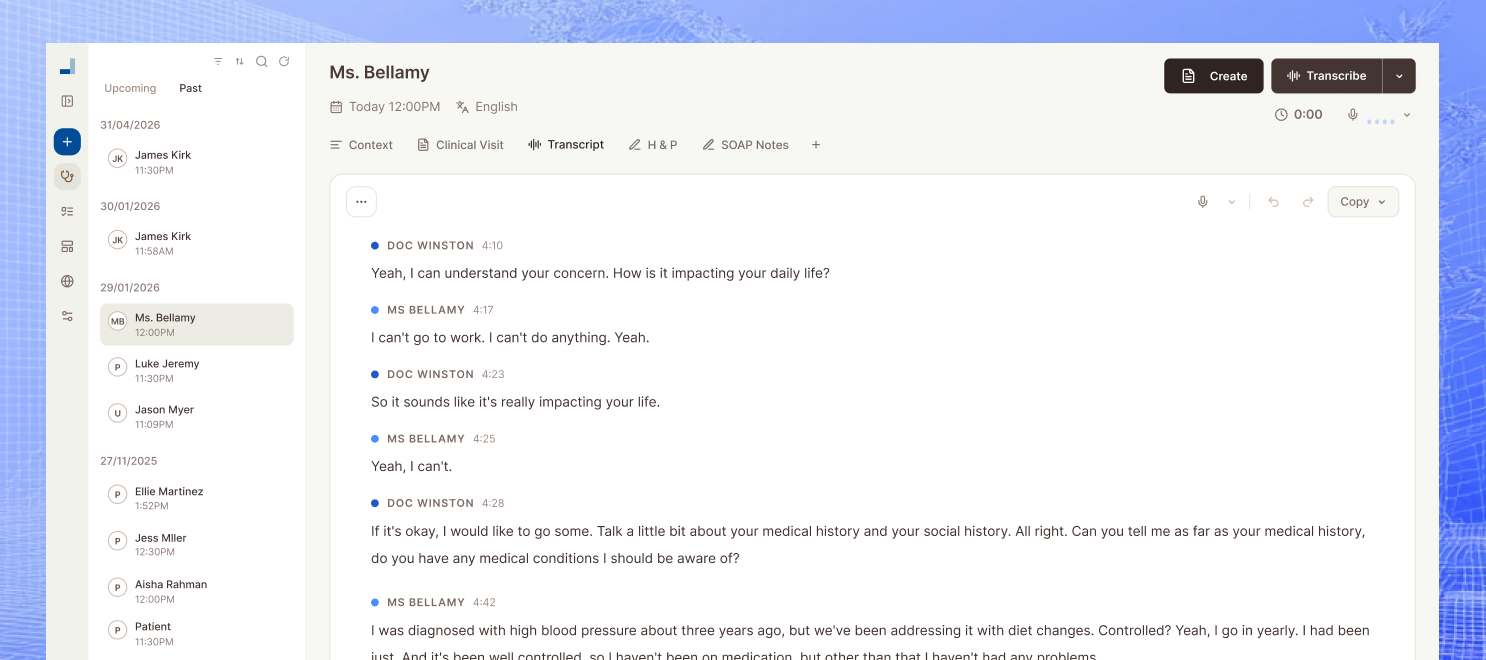
An AI medical scribe acts as an intelligent assistant that captures the dialogue of a patient encounter in real-time. It is important to remember that these tools are assistive, not autonomous. While the AI handles the heavy lifting of transcribing and structuring information into drafts, the clinician remains the final authority. By shifting the focus from ‘typing’ to ‘reviewing,’ practitioners can reclaim their time and focus on the person sitting across from them.
- Reduces administrative burnout by automating draft creation.
- Improves note accuracy by capturing details in real-time.
- Decreases ‘pajama time’ by finishing documentation during the workday.
- Enhances patient eye contact by removing the screen barrier.
Note types you can generate beyond SOAP (H&P and more)
While the SOAP note is the industry standard for daily progress, complex clinical scenarios require diverse documentation styles. Comprehensive History and Physical (H&P) reports are essential for admissions, while detailed procedure notes are critical for specialists. If a practitioner only relies on simplified formats, they risk losing the depth required for medicolegal safety and continuity of care.
Using an AI scribe allows for the seamless generation of consult notes, discharge summaries, and follow-up notes without manual repositioning of data. Referral letters, in particular, often take the most time because they require synthesizing a patient’s history into a succinct summary for another provider. A structured AI-driven approach ensures that the receiving clinician gets exactly what they need to provide informed care.
High-quality documentation is also a cornerstone of audit readiness and hospital compliance. When notes are structured correctly, they reflect a clear clinical thought process that is easy for other members of the care team to follow. Transitioning beyond simple SOAP notes ensures that every encounter—whether a quick follow-up or a complex surgical consult—is recorded with the appropriate level of detail.
- Supports diverse formats like H&P, Consults, and Discharge Summaries.
- Streamlines the creation of professional referral letters in seconds.
- Ensures audit-ready documentation through structured templates.
- Improves communication between specialists and general practitioners.
How to implement an AI scribe for referrals step-by-step in a real clinic
Starting with an AI scribe doesn’t require a total overhaul of your current systems. The most successful implementations begin with a single visit type, such as standard follow-ups or a specific specialty consult. This allows the clinician to get used to the voice-capture process without the pressure of a full patient load. By focusing on one area, you can identify how the AI interprets your specific terminology and clinical style.
Next, you should select or customize AI scribe for referrals templates that align with your specialty. Whether you are in cardiology, pediatrics, or a university health center, your referral needs will be unique. Once the template is set, simply activate the capture during the encounter. The AI works in the background, listening to the conversation between you and the patient, noting symptoms, history, and the proposed care plan.
After the encounter, the AI provides a structured draft. This is where the clinician reviews and edits the content to ensure clinical accuracy. Once satisfied, the output can be instantly repurposed. A single recorded session can generate a progress note for the EMR and a polished referral letter for a specialist simultaneously. This ‘one-capture, multiple-output’ workflow is the secret to reclaiming hours of administrative time.
- Start with one appointment type to build confidence and habits.
- Select specialty-specific templates to ensure relevant data capture.
- Review the AI-generated draft immediately after the patient encounter.
- Repurpose the transcript to create both EMR notes and referral letters.
How to keep note quality high and reduce mistakes
The primary concern with automated documentation is ‘note bloat’ or the inclusion of irrelevant information. To maintain high quality, clinicians should develop a lightweight review habit. Instead of reading the note as a blank canvas, look for specific failure points such as incorrect dosages, missing medications, or old problem lists that the AI might have pulled from context. A quick thirty-second scan is usually enough to verify that the intent of the visit is accurately reflected.
Standardizing what constitutes a ‘good note’ within your clinic can also mitigate errors. When every practitioner follows the same review protocol, the data integrity of the clinic remains high. Encouraging builders to utilize the AI’s ability to ‘summarize’ rather than ‘transcribe word-for-word’ helps in creating concise, readable documents that colleagues actually want to read. Quality control is a partnership between the clinician’s expertise and the AI’s processing power.
- Perform a focused review for specific details like dosages and dates.
- Set clinic-wide standards for note length and clinical detail.
- Use summarization features to avoid excessive note bloat.
- Provide feedback to the AI system to improve future outputs.
Privacy, consent, and patient trust (plain English)
Patient privacy is the foundation of the clinical relationship. While AI tools are designed with security in mind, transparency with the patient is paramount. Most regions require verbal or written consent before recording an encounter. When explained simply, most patients are supportive of the technology because they appreciate that their doctor is looking at them rather than a computer screen during the visit.
A simple script can bridge the gap: ‘I’m using an AI assistant today to help me take accurate notes so I can focus entirely on our conversation. It transcribes our talk into my medical record, and then the recording is deleted. Is that okay with you?’ This approach frames the technology as a benefit to the patient’s care. Always ensure that your chosen provider complies with local regulations like HIPAA or GDPR regarding data retention and encryption.
- Always obtain informed consent following local clinical guidelines.
- Frame the technology as a tool to improve doctor-patient focus.
- Ensure the AI provider uses enterprise-grade encryption and security.
- Verify that audio recordings are processed and deleted according to policy.
Rolling it out across a clinic without disruption
A successful rollout starts with a two-week pilot program involving a small group of ‘super-users.’ These individuals can test the workflow, refine templates, and troubleshoot minor issues before the technology is introduced to the entire staff. During this phase, it’s helpful to track metrics like ‘time spent on notes per day’ and ‘after-hours documentation’ to quantify the value of the tool to clinic management.
Training should focus on template alignment and the ‘review-and-edit’ mindset. If the whole clinic uses the same set of templates for a particular specialty, the documentation becomes standardized, which is an enormous benefit for multi-provider university clinics. By the end of the pilot, the efficiency gains usually speak for themselves, making the full-scale adoption a natural next step rather than a forced transition.
- Execute a 14-day pilot with 1–3 clinicians to test the workflow.
- Measure time savings to prove the return on investment.
- Align templates across the clinic for uniform documentation.
- Provide brief, hands-on training sessions for non-technical staff.
Mcoy AI is an AI medical scribe that records and transcribes patient encounters, then generates multiple clinical note types (H&P, progress notes, consult notes, follow-up notes, procedure notes, discharge summaries, referral letters, and more). It offers 200+ customizable templates and an AI chat feature to help clinicians create letters, forms, and other documents instantly. By automating the administrative burden, it allows healthcare providers to spend more time on patient care and less on data entry.
Conclusion
Modern clinical workflows demand efficiency, but not at the expense of accuracy or the doctor-patient relationship. Moving toward an automated documentation system allows you to capture the full scope of a patient encounter without the burden of manual typing. By following the steps outlined in this guide, you can successfully implement an AI scribe for referrals and notes, ensuring your practice remains at the cutting edge of healthcare technology. Start your pilot today and experience the relief of finished notes before the workday ends.
What a serious review table should cover
| Decision area | Common mistake | Better clinic-ready approach | Metric to watch |
|---|---|---|---|
| Workflow design | Treat how to use an ai scribe to create referrals in minutes as a one-off documentation task | Build a repeatable process with clear ownership and review points | Time to complete documentation |
| Team adoption | Assume every clinician will naturally use the same process | Train for consistency and define exception handling early | Active user adoption |
| Quality review | Only check notes when a problem is reported | Audit a sample of notes weekly and review edge cases | Edit rate per note |
| Operational follow-through | Leave admin actions outside the documentation workflow | Use the same encounter data for referrals, letters, and follow-up tasks | Completion rate for next-step tasks |
Related reading
If you are working through how to use an ai scribe to create referrals in minutes, it helps to read this alongside Admin Management: How to Reduce Admin Errors in Clinical Notes, Admin Management: Medication List Template with Examples, and Specialty Guides: Build a Template Pack for Patient Letters | Free Tips. Those guides cover adjacent workflow, implementation, and evaluation questions so the decision does not sit in isolation.
FAQ
How accurate are AI medical scribes in real clinics?
AI medical scribes are remarkably accurate in capturing the clinical narrative, often exceeding the detail found in manual notes. However, accuracy depends on the clarity of the audio and the complexity of the medical terminology used. Clinicians should always treat the AI output as a highly advanced draft that requires a final professional review.
Do I still need to review every note?
Yes, clinical responsibility always rests with the licensed provider. The AI provides a draft based on the conversation, but the practitioner must ensure that the clinical findings, diagnoses, and plans are documented correctly. Most clinicians find that reviewing a pre-written note takes a fraction of the time it takes to write one from scratch.
What note types can an AI scribe generate besides SOAP?
Beyond standard SOAP notes, an AI scribe can generate History and Physicals (H&P), detailed procedure notes, consult letters, and discharge summaries. It can also be used to create specific referral letters and follow-up instructions for patients. The versatility depends on the templates and the context of the recorded encounter.
Will this work for telehealth and in-person consults?
AI scribes are highly effective in both settings. For telehealth, the system can often capture audio directly from the computer output. For in-person consults, a smartphone or tablet microphone is usually sufficient to capture the dialogue between the doctor and patient, provided there is minimal background noise.
How do I explain recording/transcription to patients?
The best approach is to be transparent and emphasize the benefits to the patient. Explain that the tool allows you to listen more closely and maintain better eye contact. Most patients are comfortable with the process once they understand it is a secure way to ensure their medical record is as accurate as possible.
How do clinics prevent note bloat?
Clinics can prevent note bloat by using concise templates and training the AI specifically to summarize main points rather than transcribing every filler word. Choosing templates that focus on ‘pertinent positives and negatives’ helps keep the documentation focused and professional.
How long does template setup take?
Most clinicians can get started with pre-built templates in just a few minutes. Customizing a template to fit a specific specialty or personal style usually takes about 10 to 15 minutes. Once a template is saved, it can be used indefinitely for all future encounters of that type.
What’s the safest way to start if I’m skeptical?
The safest way to start is with a ‘shadow’ pilot. Record a few non-complex encounters and compare the AI-generated note to your manual note. This allows you to verify the accuracy and see the time-saving potential firsthand without any risk to your existing clinical workflow.