Specialty Guides: How to Use an AI Scribe for Telehealth Notes | Full Guide
Discover how to use an AI scribe for telehealth notes. Learn workflows to automate remote documentation, improve accuracy, and reduce clinician burnout.
The Modern Clinician’s Documentation Struggle
Telehealth was supposed to make practice easier, but for many clinicians, it has simply relocated the burnout from the office to the home desk. After-hours charting is now a standard part of the day, with providers often spending more time staring at an EHR screen than at the patient’s face during a virtual call. This digital divide creates a sense of rushed notes and persistent medico-legal anxiety, as the nuance of a remote conversation is often lost in a generic SOAP template.
This guide provides a comprehensive roadmap for integrating automation into your virtual workflow. We will explore how to transition from manual typing to a streamlined system using an AI scribe for telehealth notes. Whether you are a solo practitioner, part of a specialized group, or managing a high-volume university clinic, understanding how to leverage this technology can reclaim hours of your personal time while improving the quality of patient care.
By the end of this article, you will understand the specific note formats available beyond the standard SOAP note, how to maintain strict privacy standards, and the exact steps to roll out this technology across your clinic without disrupting daily operations. We aim to move your documentation from a burdensome chore to a seamless, automated output of the patient encounter.
What an medical scribe solves in modern practice
The real cost of medical documentation isn’t just the minutes spent typing; it is the cognitive load required to recall details while simultaneously managing a clinical diagnosis. When doctors are forced to document manually, they often face a “documentation debt” that accumulates throughout the day. This leads to delayed notes that are less accurate and frequently lack the specific patient details that ensure continuity of care and proper billing compliance.
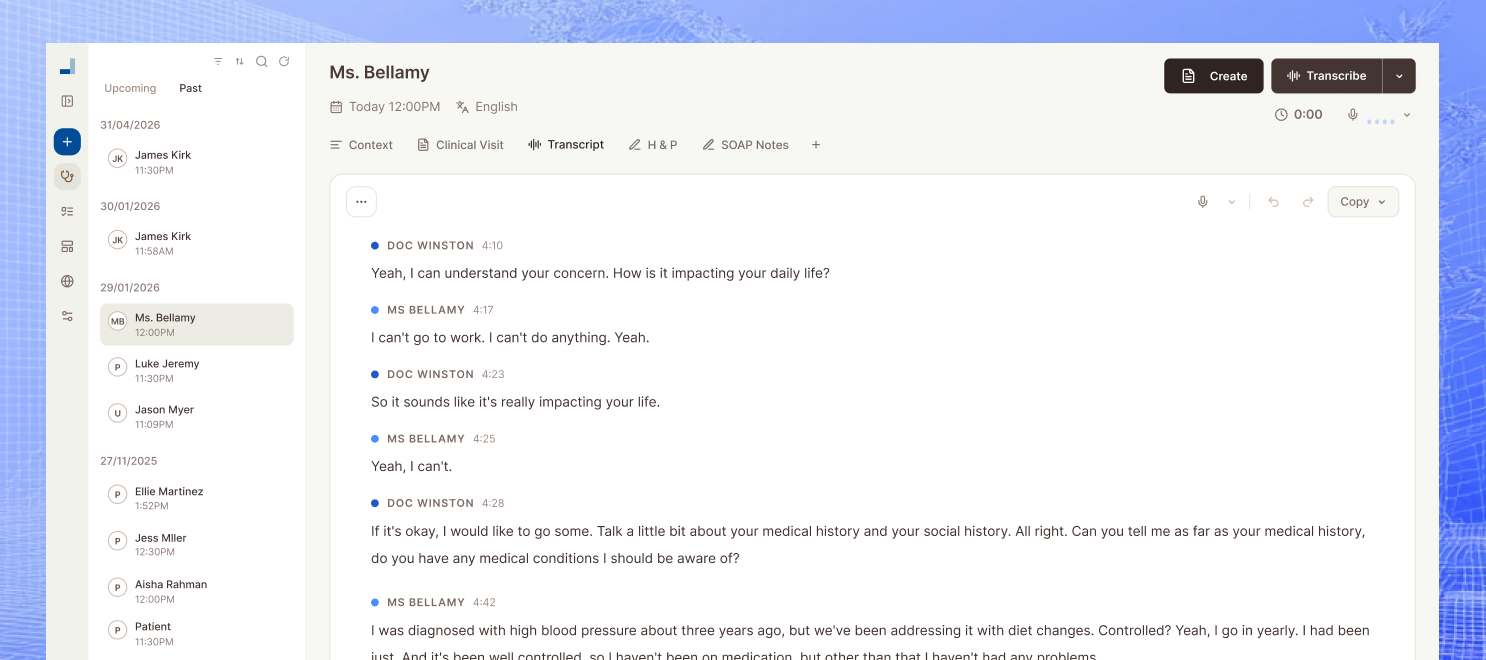
An AI medical scribe acts as an intelligent assistant that captures the dialogue of a consult and structures it into clinical language. It is important to note that these tools are assistive, not autonomous. While the AI can handle the heavy lifting of transcription and formatting, the clinician remains the final authority, responsible for reviewing and verifying the accuracy of every entry before it is finalized in the patient record.
- Eliminates the ‘pajama time’ spent on finishing charts after hours.
- Reduces cognitive load by allowing clinicians to focus entirely on the patient.
- Captures more granular clinical detail than manual memory-based charting.
- Provides a consistent structure across all notes within a multi-provider clinic.
Note types you can generate beyond SOAP (H&P and more)
While the SOAP note is the industry standard, modern medicine requires a wider variety of documentation types depending on the specialty and visit purpose. A robust AI system should be capable of generating comprehensive History & Physical (H&P) reports, which provide a total overview of a patient’s status and medical history. This is particularly vital in university clinics and specialist settings where context is everything.
Beyond standard check-ups, clinicians often need specialized outputs such as procedure notes, consult notes for referring colleagues, and detailed discharge summaries. For telehealth providers, follow-up notes and referral letters are high-frequency tasks that usually require significant manual effort. Automating these ensures that the transition of care is smooth and that any third-party providers receive a clear, professional summary of the encounter.
Structure matters significantly for audit readiness and medico-legal protection. By using standardized templates for various note types, a clinic ensures that its documentation remains robust under scrutiny. Consistent formatting also makes it easier for other members of the care team to find relevant information quickly, reducing the risk of errors during handovers or subsequent visits.
- Generates H&P, consult notes, and complex discharge summaries automatically.
- Facilitates professional referral letters to improve communication with specialists.
- Supports procedure and follow-up notes for comprehensive longitudinal care.
- Ensures audit-ready documentation through structured, consistent templates.
How to implement an AI scribe for telehealth notes step-by-step
The first step in a successful implementation is to start small. Choose one specific visit type—such as routine follow-ups or initial consultations—to pilot the technology. This allows you to get a feel for the AI’s capture quality without overwhelming your entire schedule. Before the first session, select or customize a template that aligns with your specialty’s requirements.
Once your template is set, begin capturing the encounter. For telehealth, this usually involves having the AI tool active during your video call, either through a direct integration or by capturing the audio from your hardware. The AI works in the background, allowing you to maintain eye contact with the screen and the patient, creating a more personal and effective virtual connection.
After the call ends, the transcription and drafting process happens almost instantly. Review the generated note immediately while the details are fresh in your mind. This is the time to make quick edits, add specific nuances, or adjust the clinical plan. Because the AI has already handled the formatting and basic data entry, this review usually takes only a fraction of the time total manual entry would require.
Finally, leverage the output for more than just the EHR. Use the generated summaries to create patient instructions, follow-up forms, or referral letters. By reusing the high-quality data captured by the scribe, you eliminate the need to write the same information multiple times across different documents, further increasing your administrative efficiency.
- Start with a single visit type to master the workflow transition.
- Use specialty-specific templates to ensure clinical relevance from day one.
- Review and edit notes immediately post-encounter for maximum accuracy.
- Repurpose note data for patient instructions and outgoing referrals.
How to keep note quality high and reduce mistakes
Quality control is a shared responsibility between the AI and the clinician. Common failure points in automated documentation often include missing medications, misinterpreted values, or “note bloat”—where the AI includes irrelevant conversational filler. To prevent this, clinicians should adopt a lightweight review habit, checking the ‘Objective’ and ‘Plan’ sections with extra scrutiny.
Establishing team standards is also essential for larger clinics. Ensure that all providers are using agreed-upon templates so that the clinical language remains uniform. Regularly audit a small sample of notes to ensure that no systematic errors are creeping into the documentation, and adjust the AI’s custom instructions or templates accordingly to refine the output over time.
- Scrutinize medications and clinical values for absolute accuracy.
- Adopt a ‘review first’ culture to catch conversational AI hallucinations.
- Standardize templates across the clinic to maintain professional uniformity.
- Periodically audit notes to refine AI performance and template accuracy.
Privacy, consent, and patient trust (plain English)
Privacy is the cornerstone of any medical technology implementation. While specific consent requirements vary by region and local jurisdiction, the general rule is to be transparent. Ensure your chosen AI tool is HIPAA or GDPR compliant and follow your clinic’s existing policies regarding recording or transcription services.
When introducing an AI scribe to a patient, keep the explanation simple: “To give you my full attention today, I’m using an AI assistant to help me with my medical notes. It transcribes our conversation so I don’t have to type while we talk. Is that okay with you?” Most patients appreciate the increased eye contact and focus that results from the doctor not being distracted by a keyboard.
- Verify HIPAA/GDPR compliance and local policy before implementation.
- Use a simple, transparent script to gain patient consent for transcription.
- Ensure data retention policies align with your clinic’s security standards.
- Focus on the benefit to the patient: better eye contact and attention.
Rolling it out across a clinic without disruption
A smooth rollout requires a structured pilot phase, typically lasting about two weeks. During this time, a small group of “super-users” tests the tool and identifies any workflow bottlenecks. This phased approach prevents the entire clinic from experiencing a learning curve simultaneously and allows for the creation of internal FAQs.
Track key metrics during the pilot, such as the volume of notes completed before the end of the shift and the reduction in after-hours EHR activity. If the data shows a significant time saving, it becomes much easier to gain buy-in from more skeptical staff members. Training sessions should focus on template alignment and how to perform rapid edits effectively.
- Implement a 14-day pilot with a small group of clinicians.
- Measure time saved and note completeness to prove ROI.
- Align templates across the clinic before the full-scale launch.
- Provide short, practical training focused on the review process.
Mcoy AI is an AI medical scribe that records and transcribes patient encounters, then generates multiple clinical note types including H&P, progress notes, consult notes, follow-up notes, procedure notes, discharge summaries, referral letters, and more. With over 200+ customizable templates and an interactive AI chat feature, clinicians can easily create letters, forms, and complex medical documents. It is designed to be a helpful partner in the exam room, allowing providers to focus on the patient while the AI handles the administrative heavy lifting.
Conclusion
The transition to digital health doesn’t have to mean a lifelong sentence of manual data entry. By learning how to use an AI scribe for telehealth notes, practitioners can bridge the gap between high-quality documentation and a manageable workload. The key lies in selecting the right note types, maintaining a steady review habit, and ensuring patient trust through transparency. As you move forward, consider starting a small pilot to experience the benefits firsthand. Embracing this workflow is the most effective way to eliminate charting burnout and return your focus to where it belongs: the patient.
What a serious review table should cover
| Decision area | Common mistake | Better clinic-ready approach | Metric to watch |
|---|---|---|---|
| Workflow design | Treat how to use an ai scribe for telehealth notes | full guide as a one-off documentation task | Build a repeatable process with clear ownership and review points |
| Team adoption | Assume every clinician will naturally use the same process | Train for consistency and define exception handling early | Active user adoption |
| Quality review | Only check notes when a problem is reported | Audit a sample of notes weekly and review edge cases | Edit rate per note |
| Operational follow-through | Leave admin actions outside the documentation workflow | Use the same encounter data for referrals, letters, and follow-up tasks | Completion rate for next-step tasks |
Related reading
If you are working through how to use an ai scribe for telehealth notes | full guide, it helps to read this alongside Specialty Guides: How to Run a More Efficient Medical Practice in 2026, Specialty Guides: How to Improve Patient Encounters, and AI & Medicine: Clinical Templates by Specialty: How to Customize Guide. Those guides cover adjacent workflow, implementation, and evaluation questions so the decision does not sit in isolation.
FAQ
How accurate are AI medical scribes in real clinics?
Modern AI scribes are highly accurate at capturing the core clinical facts of a conversation. However, their performance can be affected by audio quality and heavy accents, which is why clinician review is always mandatory. Most providers find the AI-generated drafts are 80-90% ready upon completion.
Do I still need to review every note?
Yes, the clinician is legally and ethically responsible for the content of the medical record. The AI serves as a powerful drafting tool, but you must verify that all medications, dosages, and clinical findings are accurately represented. A quick 60-second review is usually sufficient to ensure high quality.
What note types can an AI scribe generate besides SOAP?
Beyond standard SOAP notes, AI scribes can produce H&Ps, consult notes, procedure notes, and discharge summaries. They are also excellent at drafting referral letters and patient education summaries. This versatility makes them useful for both primary care and highly specialized surgical or diagnostic fields.
Will this work for telehealth and in-person consults?
Absolutely, AI scribes are designed to be flexible across different practice environments. For telehealth, they capture audio directly from your computer or platform, while for in-person visits, they use a smartphone or tablet microphone. The resulting clinical note quality remains consistent regardless of the visit format.
How do I explain recording/transcription to patients?
The best approach is to be direct and highlight the benefits to the patient experience. Tell them that the AI allows you to listen more closely and avoid typing during their appointment. Most patients are very supportive when they realize it leads to a more focused and attentive doctor.
How do clinics prevent note bloat?
Note bloat is prevented by using concise, specialized templates that tell the AI exactly what information to prioritize. Clinicians can also set specific rules for the AI to exclude small talk. Regularly refining your templates based on your specific reporting style is the most effective way to keep notes lean.
How long does template setup take?
Most clinicians can get started with pre-built templates in just a few minutes. Customizing a template to fit a unique specialty or workflow typically takes between 10 to 15 minutes. Once a template is saved, it can be applied to all future encounters with a single click.
What’s the safest way to start if I’m skeptical?
The safest approach is to run a small-scale pilot with just 2-3 non-complex patient visits per day. This allows you to witness the accuracy and time-saving potential without any risk to your overall schedule. As you gain confidence in the AI’s drafting ability, you can gradually expand its use to all consultations.