AI & Medicine: Clinical Templates by Specialty: How to Customize Guide
Learn how to optimize clinical templates by specialty to reduce charting time. Master AI documentation for H&P, SOAP, and specialty-specific workflows.
What a medical scribe solves in modern practice
The modern healthcare landscape is plagued by a silent epidemic: administrative burnout. For most clinicians, the actual time spent providing care is dwarfed by the hours spent documenting it. This shift has led to after-hours charting, often referred to as ‘pajama time,’ which erodes work-life balance and increases the risk of cognitive fatigue. When doctors are rushed to finish notes between patients, the quality of documentation naturally suffers, leading to potential gaps in the medical record and increased medico-legal anxiety.
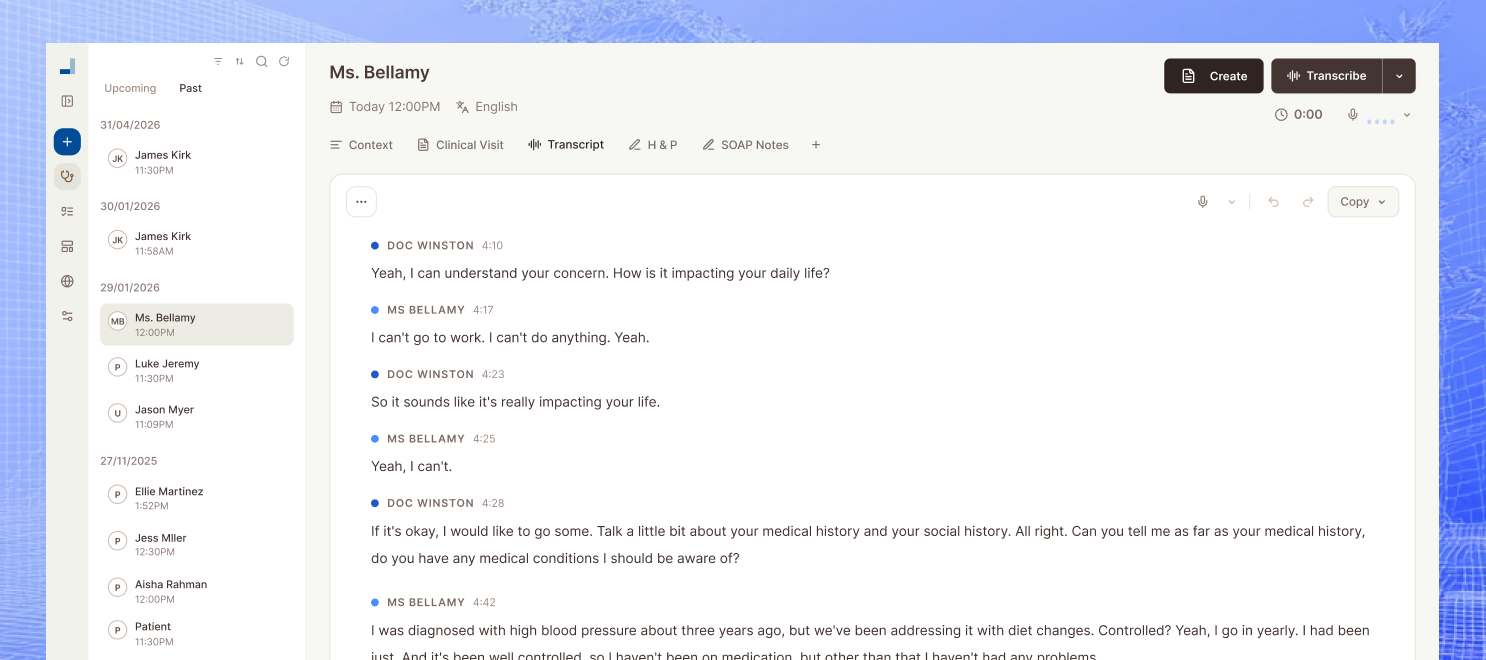
An AI medical scribe acts as a sophisticated digital assistant designed to bridge this gap. It captures the nuances of a patient encounter in real-time, allowing the physician to maintain eye contact and engage deeply with the patient rather than a screen. However, it is essential to understand that these tools are assistive, not autonomous. While they handle the heavy lifting of transcription and initial drafting, the clinician remains the final authority, ensuring all clinical facts are accurate and medically sound.
- Reduces the heavy cognitive load of memorizing patient details for later entry.
- Eliminates hours of manual typing and shorthand interpretation.
- Improves note completion rates, ensuring records are finalized on the same day.
- Enhances patient satisfaction by allowing for a technology-free face-to-face interaction.
Note types you can generate beyond SOAP (H&P and more)
While the SOAP note is the industry standard for daily progress, many specialties require far more complex documentation to satisfy billing, legal, and continuity requirements. Relying solely on a generic format can lead to missing critical data points in specialized care. For instance, a surgical specialty requires detailed procedure notes, while an admitting physician needs a comprehensive History and Physical (H&P) that captures the breadth of a patient’s medical background and acute presentation.
Using more diverse note types like consult notes, follow-up summaries, and referral letters ensures that the next provider in the chain of care has a clear roadmap. Proper structure isn’t just about compliance; it’s about audit readiness and ensuring that the narrative of the patient’s journey is coherent. When documentation is structured correctly from the start, it becomes much easier to extract data for research, quality improvement, and billing accuracy across the entire clinic or university health system.
- History and Physical (H&P) for comprehensive new patient intakes.
- Procedure and Operation notes for surgical or outpatient interventions.
- Consultation and Referral letters for clear inter-provider communication.
- Discharge summaries that ensure a safe and effective transition of care.
How to implement clinical templates by specialty step-by-step in a real clinic
Transitioning to an automated documentation workflow begins with selecting a single, high-volume visit type to pilot. Rather than overhauling every department at once, start where the documentation burden is most predictable. This allows the team to understand how the AI captures specific terminology and patient-doctor interactions without the pressure of a full-scale rollout. Once the baseline is established, you can begin the process to clinical templates by specialty, ensuring that the AI understands the nuances of cardiology versus pediatrics.
Next, focus on setting up specialty-specific templates. A dermatologist needs to document skin lesions and biopsy sites, whereas a psychiatrist focuses on mental status examinations and longitudinal mood shifts. During the encounter, the clinician simply lets the recording device capture the conversation naturally. There is no need for unnatural dictation or ‘thinking out loud’ for the machine; the software is designed to filter out the irrelevant chatter and find the clinical gold.
After the encounter, the draft note is generated almost instantly. This is the critical stage where the clinician reviews the output, making small edits for precision. Because the AI has already formatted the note, this review usually takes only a fraction of the time required for manual typing. Finally, the outputs can be repurposed. A well-drafted follow-up note can be instantly converted into a referral letter or a patient summary, maximizing the utility of every second spent on documentation.
- Identify high-volume visit types for the initial pilot phase.
- Configure specialty-specific templates to capture unique clinical data points.
- Record encounters naturally without disrupting the patient-doctor rapport.
- Review, edit, and repurpose the AI-generated outputs for administrative efficiency.
How to keep note quality high and reduce mistakes
Even the most advanced technology requires human oversight to maintain high standards. Common failure points in clinical documentation often include missing medication dosages, incorrect lab values, or ‘note bloat’—where irrelevant data from previous visits is carried forward. To combat this, clinics should establish a lightweight review habit. Reviewing a note immediately after the encounter while the details are fresh is the most effective way to ensure 100% accuracy.
Standardization is the second pillar of quality. By setting team-wide standards for what a ‘good’ note looks like, everyone remains on the same page. This prevents variations where one provider’s notes are highly detailed while another’s are dangerously brief. Regular spot-checks or peer reviews can help identify if the AI is consistently missing specific specialty terms, allowing for template adjustments that improve future outputs.
- Establish an immediate review workflow to catch errors while memory is fresh.
- Set clinic-wide standards for note length and essential data components.
- Use structured templates to prevent irrelevant data or note bloat.
- Conduct periodic quality audits to ensure documentation remains audit-ready.
Privacy, consent, and patient trust (plain English)
Privacy is the cornerstone of the patient-provider relationship. When introducing recording technology, it is vital to follow local regulations and institutional policies. Most patients are surprisingly receptive when they understand that the technology allows their doctor to listen to them more effectively. Transparency is key; always inform the patient that a digital assistant is being used to help document their visit so the doctor can focus entirely on their care.
A simple way to explain this to a patient is: ‘To make sure I’m giving you my full attention and recording your history accurately, I’m using a secure AI assistant to help with my notes today. Is that alright with you?’ This approach frames the technology as a tool for the patient’s benefit. Beyond the exam room, ensure your clinic adheres to general security principles, such as encrypted data transmission and strict retention policies, to protect all health information.
- Understand and follow regional and institutional consent requirements.
- Explain the benefits of the technology to patients in simple, non-technical terms.
- Frame the use of AI as a way to prioritize patient engagement and safety.
- Incorporate security best practices for data storage and transmission.
Rolling it out across a clinic without disruption
A successful rollout requires a structured phases. We recommend a two-week pilot program involving a small group of ‘champion’ clinicians who are tech-savvy and eager to reduce their admin time. During this time, the focus should be on building familiarity and identifying any workflow bottlenecks. Tracking metrics like total time saved per day and the reduction in after-hours charting provides the data needed to justify a clinic-wide expansion.
Once the pilot is complete, training sessions should focus on template alignment. This ensures that every department is utilizing the clinical templates by specialty effectively. By syncing templates to the specific needs of each specialist, the clinic can ensure a uniform standard of care and documentation that persists even as the team grows or changes.
- Begin with a 14-day pilot involving key clinical champions.
- Track time-saving metrics and note completeness to measure success.
- Provide department-specific training on template customization.
- Align all staff on the legal and privacy standards for AI use.
Mcoy AI is an AI medical scribe that records and transcribes patient encounters, then generates multiple clinical note types including H&P, progress notes, consult notes, follow-up notes, procedure notes, discharge summaries, referral letters, and more. It features over 200 customizable templates and an interactive AI chat to help clinicians create patient letters, forms, and complex documents instantly, ensuring that documentation matches the specific needs of any specialty.
Conclusion
Mastering the workflow of clinical documentation is no longer about typing faster; it’s about working smarter. By learning how to customize clinical templates by specialty, practitioners can reclaim their time and refocus on what matters most: the patient. Implementing these tools requires a thoughtful approach to quality, privacy, and team training, but the rewards are significant—less burnout, better notes, and a more sustainable practice. Start your pilot today and see how clinical templates by specialty can transform your daily routine into a more efficient and fulfilling experience.
What a serious review table should cover
| Decision area | Common mistake | Better clinic-ready approach | Metric to watch |
|---|---|---|---|
| Workflow design | Treat clinical templates by specialty: how to customize guide as a one-off documentation task | Build a repeatable process with clear ownership and review points | Time to complete documentation |
| Team adoption | Assume every clinician will naturally use the same process | Train for consistency and define exception handling early | Active user adoption |
| Quality review | Only check notes when a problem is reported | Audit a sample of notes weekly and review edge cases | Edit rate per note |
| Operational follow-through | Leave admin actions outside the documentation workflow | Use the same encounter data for referrals, letters, and follow-up tasks | Completion rate for next-step tasks |
Related reading
If you are working through clinical templates by specialty: how to customize guide, it helps to read this alongside AI & Medicine: How to Simplify Clinical Notes for Busy Doctors, AI & Medicine: How Doctors Can Improve SOAP Notes, and Specialty Guides: Reduce Medico-Legal Risk with Better Documentation Guide. Those guides cover adjacent workflow, implementation, and evaluation questions so the decision does not sit in isolation.
FAQ
How accurate are AI medical scribes in real clinics?
In real-world clinical settings, AI medical scribes are exceptionally accurate at capturing the narrative and technical details of a conversation. They are trained on vast datasets of medical terminology, allowing them to understand complex diagnoses and treatment plans. However, accuracy can vary based on background noise and the clarity of the audio. Clinicians should always treat the generated note as a high-quality draft that requires a final expert sign-off.
Do I still need to review every note?
Yes, human oversight is a non-negotiable part of the medical documentation process. While the AI does the heavy lifting of transcribing and formatting, the clinician is legally and ethically responsible for the content of the medical record. A quick 30-second review is usually enough to verify that the clinical facts and assessments are perfectly captured before the note is finalized in the EMR.
What note types can an AI scribe generate besides SOAP?
Advanced AI scribes can generate a wide array of documentation beyond the standard SOAP format. This includes comprehensive History and Physicals (H&P), detailed procedure notes, consult letters, and discharge summaries. Because the AI understands the context of the conversation, it can arrange the information into the specific structure required for almost any clinical scenario or specialty-specific template.
Will this work for telehealth and in-person consults?
Most AI medical scribing tools are designed to be flexible, working seamlessly for both in-person and telehealth encounters. For in-person visits, the device captures the ambient audio in the room. For telehealth, the AI can often integrate directly with the video platform or record the audio from the system, ensuring the same level of documentation quality regardless of how the care is delivered.
How do I explain recording/transcription to patients?
The best way to explain this to patients is to focus on the benefit to them. You might say that you are using a secure tool to help you stay focused on their needs rather than your computer screen. Most patients value the increased eye contact and personal engagement. Always ensure you have the patient’s verbal or written consent as per your specific clinic’s policy and local regulations.
How do clinics prevent note bloat?
Centering documentation on the specific encounter rather than pulling in massive amounts of historical data automatically is the best way to prevent note bloat. AI scribes help by focusing only on what was discussed or observed during the current visit. Using structured clinical templates by specialty also ensures that only the necessary fields are populated, keeping the medical record concise and readable for other providers.
How long does template setup take?
Initial template setup is typically very fast, especially when using pre-built libraries. Most clinicians can select and tweak a specialist template in under five minutes. As you use the system, you can continue to refine these templates to better match your personal style or specific institutional requirements, making the system more efficient over time.
What’s the safest way to start if I’m skeptical?
The safest approach is a small-scale pilot. Start by using the AI for your most straightforward follow-up appointments where the documentation is predictable. This allows you to build trust in the technology’s ability to capture medical concepts correctly. Once you see the time savings and the quality of the drafts, you can gradually introduce it to more complex new-patient intakes and specialized procedures.