Specialty Guides: How to Use an AI Scribe for Orthopedics Notes: Full Guide
Discover how to master an AI scribe for orthopedics notes. Learn to streamline H&Ps, procedure notes, and follow-ups to reclaim your time today.
The Orthopedic Documentation Burden
Orthopedic surgeons and specialists face a unique documentation challenge: the sheer volume of physical exam findings, imaging results, and surgical plans that must be recorded with surgical precision. For many in private practice or university clinics, this leads to ‘pajama time’—hours spent after clinics finished typing up notes, resulting in burnout and a constant fear of missing critical details in a medico-legal context.
This guide will teach you the exact workflow for integrating an AI scribe into your orthopedic practice. Beyond the basic SOAP note, we will explore complex formats like H&Ps, procedure notes, and referral letters. Whether you are a solo practitioner or managing a large university clinic, you will learn how to maintain high-quality records, ensure patient privacy, and roll out this technology without disrupting your existing patient flow.
What a medical scribe solves in modern practice
In a high-volume orthopedic clinic, the cognitive load of remembering specific range-of-motion degrees or ligament stability tests while moving between exam rooms is exhausting. An AI medical scribe acts as an assistive digital partner, capturing the nuances of the conversation and the physical exam findings in real-time so the clinician can focus entirely on the patient’s mobility and pain management.
It is important to understand that while these tools are incredibly powerful, they serve an assistive role. The clinician remains the final authority, responsible for reviewing and validating every detail. By offloading the transcription and initial drafting, doctors can reduce the time spent on electronic health records (EHR) by over 50%, ensuring that notes are completed immediately after the encounter rather than at the end of a long day.
- Reclaims hours of personal time by eliminating after-hours charting.
- Reduces cognitive load by capturing exam findings as they are spoken.
- Improves note accuracy by documenting details while they are fresh.
- Enhances the patient experience by allowing for more eye contact and engagement.
Note types you can generate beyond SOAP (H&P and more)
Orthopedic documentation requires much more than a standard SOAP format. From the initial History and Physical (H&P) for a new joint replacement candidate to specific procedure notes for injections or minor surgeries, the structure of these documents is vital for continuity of care. Using an AI scribe allows for the seamless generation of various note types that are specific to the musculoskeletal system.
Consult notes for referring physicians and detailed discharge summaries are also essential in the orthopedic workflow. High-quality structure ensures that your practice is audit-ready and that handovers between the clinic and the surgical center are flawless. Having a system that can adapt to these different needs ensures that every aspect of the patient journey is documented with the appropriate level of detail.
- H&P and comprehensive initial assessments for new orthopedic patients.
- Specialized procedure notes for cortisone injections and minor office surgeries.
- Detailed referral letters and consult reports for primary care providers.
- Progress notes that track rehabilitation and physical therapy milestones.
How to implement AI scribe for orthopedics notes step-by-step
Start your implementation by selecting a single, common visit type, such as follow-up appointments for post-operative patients. This allows you to get comfortable with the technology in a lower-stakes environment before moving on to complex new patient evaluations. Before you begin the encounter, ensure you have selected or configured a template specific to the orthopedics notes you need to generate.
During the patient encounter, simply place your recording device—usually a smartphone or tablet—in a stable location and focus on the patient. As you perform the physical exam, narrate your findings aloud. For example, instead of just feeling for a pulse or testing sensation, state your findings clearly to ensure the AI captures the data accurately for the final report.
Once the encounter is finished, the AI will generate a draft based on your conversation and narration. Take two minutes to review the output for any specific orthopedic measurements or medication dosages. Because the AI has captured the bulk of the narrative, your role shifts from a ‘creator’ to an ‘editor,’ which is significantly faster and less mentally taxing.
Finally, utilize the generated summaries to quickly populate other required documents. A well-constructed progress note can be instantly repurposed into a referral letter or a physical therapy prescription. This workflow ensures that once the data is captured, it works for you across multiple formats without requiring you to re-type the same information twice.
- Begin with a pilot phase using simple follow-up visit types.
- Narrate physical exam findings aloud to ensure high data accuracy.
- Shift your role from manual data entry to a rapid editorial review.
- Repurpose encounter data for letters, forms, and therapy referrals.
How to keep note quality high and reduce mistakes
Despite the advanced nature of AI, typical failure points such as incorrect laterality (left vs. right) or specific drug dosages can still occur if the audio is unclear. Developing a lightweight review habit is the best defense against these errors. A quick scan specifically looking for ‘left/right’ markers and numerical values ensures that your orthopedics notes remain precise and legally sound.
Establishing team standards for how data should be presented also helps maintain quality across a larger clinic. Encourage all providers to use consistent terminology when describing orthopedic tests or surgical plans. This consistency helps the AI learn the specific style of the practice, leading to cleaner drafts over time.
- Always double-check laterality and specific numerical measurements.
- Establish clinic-wide standards for orthopedic terminology.
- Perform a brief 60-second review of every note before signing.
Privacy, consent, and patient trust
Patient privacy is a cornerstone of orthopedic practice. While consent requirements vary by jurisdiction, it is best practice to always inform the patient that you are using an AI assistant to help you stay focused on their care. Most patients are supportive when they realize it means you won’t be staring at a computer screen for the entire duration of their visit.
A simple script can be used: ‘To better focus on our conversation today, I’m using a secure AI assistant to take notes for me. Is that alright with you?’ This transparency builds trust and ensures that the patient feels comfortable sharing their health information. Ensure your chosen tool adheres to regional security standards like HIPAA or GDPR.
- Always obtain verbal or written consent based on local regulations.
- Use a patient-centric script to explain the benefits of AI assistance.
- Verify that the technology meets all necessary data security standards.
Rolling it out across a clinic without disruption
For a smooth rollout, implement a two-week pilot program involving only one or two ‘tech-forward’ clinicians. This allows you to identify any workflow bottlenecks specific to your clinic’s layout or EHR system. During this time, track metrics such as time saved per note and the reduction in after-hours work to demonstrate the value to the rest of the staff.
Once the pilot is successful, provide training for the rest of the team using the templates developed during the first phase. This ensures that everyone is starting from a position of strength and that the documentation style remains unified across the entire orthopedic department, whether in a private clinic or a university setting.
- Start with a small pilot group to refine templates and workflows.
- Track time-saving metrics to prove return on investment.
- Standardize templates before rolling out to the entire clinical team.
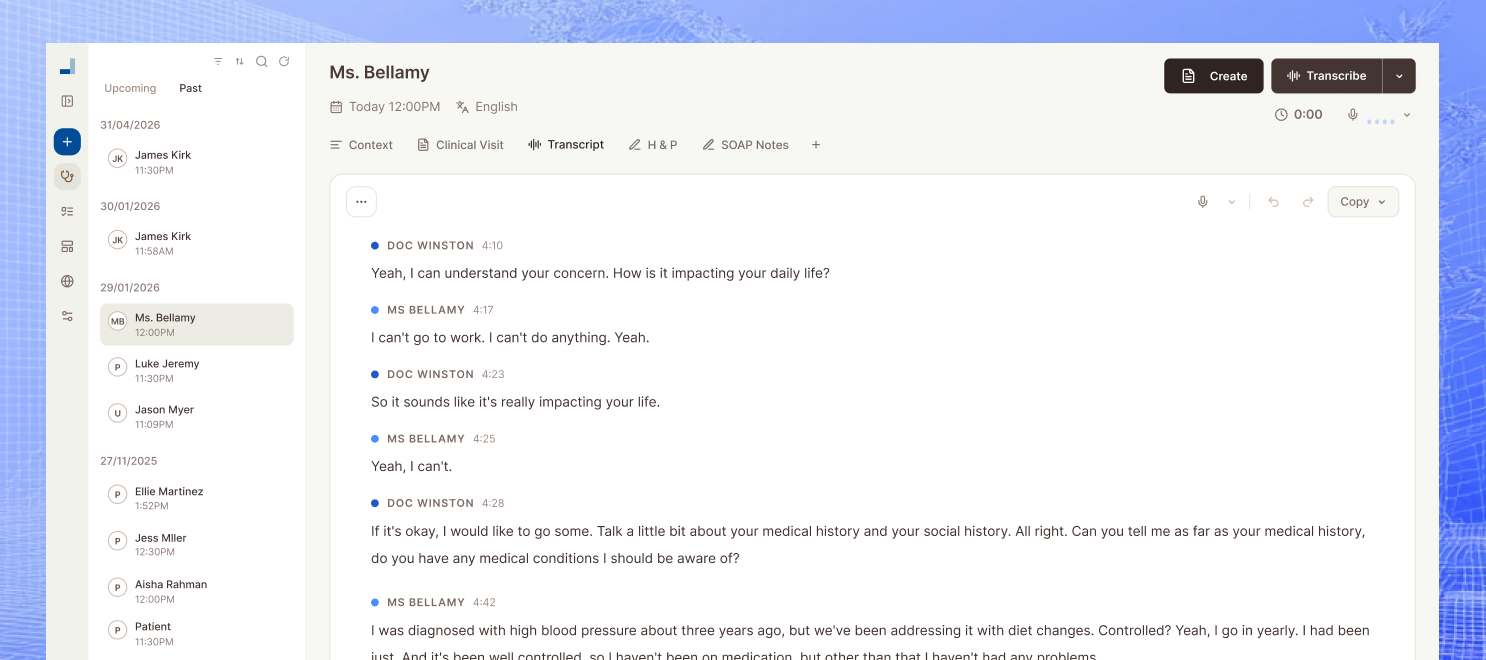
Mcoy AI is an AI medical scribe that records and transcribes patient encounters, then generates multiple clinical note types (H&P, progress notes, consult notes, follow-up notes, procedure notes, discharge summaries, referral letters, and more). With over 200+ customizable templates and an integrated AI chat to create letters, forms, and documents, it allows clinicians to focus on patient outcomes rather than administrative tasks.
Conclusion
Adopting a modern workflow for your orthopedics notes is the most effective way to combat physician burnout while improving the quality of patient care. By following the steps outlined in this guide—from narrating exams to utilizing specialized templates—you can transform your daily clinic routine from a race against the clock into a streamlined, patient-centered experience. Implementing an AI scribe for orthopedics notes is not just about technology; it’s about reclaiming your professional autonomy and your personal time. Start your pilot today and see how much more efficient your orthopedic practice can become.
What a serious review table should cover
| Decision area | Common mistake | Better clinic-ready approach | Metric to watch |
|---|---|---|---|
| Workflow design | Treat how to use an ai scribe for orthopedics notes: full guide as a one-off documentation task | Build a repeatable process with clear ownership and review points | Time to complete documentation |
| Team adoption | Assume every clinician will naturally use the same process | Train for consistency and define exception handling early | Active user adoption |
| Quality review | Only check notes when a problem is reported | Audit a sample of notes weekly and review edge cases | Edit rate per note |
| Operational follow-through | Leave admin actions outside the documentation workflow | Use the same encounter data for referrals, letters, and follow-up tasks | Completion rate for next-step tasks |
Related reading
If you are working through how to use an ai scribe for orthopedics notes: full guide, it helps to read this alongside Specialty Guides: How to Run a More Efficient Medical Practice in 2026, Specialty Guides: How to Improve Patient Encounters, and Specialty Guides: Document Asthma Reviews with AI Scribe: Complete Guide. Those guides cover adjacent workflow, implementation, and evaluation questions so the decision does not sit in isolation.
FAQ
How accurate are AI medical scribes in real clinics?
In real-world clinical settings, AI scribes are remarkably accurate, often capturing nuances that manual typing might miss. However, the quality depends on the clarity of the audio and the provider’s narration of physical findings. They are designed to be 90-95% accurate, requiring only a quick review by the clinician to ensure 100% precision before finalization.
Do I still need to review every note?
Yes, medical responsibility always rests with the licensed clinician. While the AI does the heavy lifting of drafting the note, you must review it for accuracy, particularly regarding laterality, dosages, and specific orthopedic measurements. This review usually takes less than a minute but is vital for patient safety and legal compliance.
What note types can an AI scribe generate besides SOAP?
Modern AI scribes are capable of generating a wide array of documents including History and Physicals (H&P), detailed procedure notes, consult letters, discharge summaries, and referral forms. By using specific templates, the AI can structure the captured information into the exact format required for diverse orthopedic encounters.
Will this work for telehealth and in-person consults?
Yes, AI scribes are highly versatile and work effectively for both in-person visits and telehealth sessions. For telehealth, the AI can often integrate with the audio from the video call software, while in-person visits typically utilize a mobile app or a dedicated microphone in the exam room.
How do I explain recording/transcription to patients?
Most clinicians find that being direct and focusing on the benefit to the patient works best. Simply explain that the tool allows you to look at them instead of a screen. Use a short script like, ‘I use this secure tool to scribe our talk so I can focus entirely on your knee exam,’ to make the patient feel heard and valued.
How do clinics prevent note bloat?
Clinics prevent note bloat by using concise, specialty-specific templates that prioritize relevant orthopedic data over filler text. By setting the AI to focus on ‘pertinent glass’ findings and clinical decision-making, you ensure the notes remain clear, readable, and focused on what truly matters for patient care.
How long does template setup take?
Initial template setup for a standard orthopedic practice can take as little as 30 minutes to an hour. Most platforms come with pre-built orthopedic templates that can be further customized. Fine-tuning these templates usually happens over the first week of use as you refine your personal documentation style.
What’s the safest way to start if I’m skeptical?
The safest way to start is with a ‘shadow’ pilot. Record a few encounters that you were planning to type anyway, and compare the AI-generated note to your manual note. This allows you to verify the accuracy and see the time-saving potential firsthand without any pressure on your live clinic schedule.