Specialty Guides: Document Asthma Reviews with AI Scribe: Complete Guide
Learn how to use an AI scribe for asthma reviews. Improve documentation accuracy, save time on clinical notes, and reduce clinician burnout. Read our guide.
Modern Documentation Challenges in Asthma Management
For many clinicians, the annual or acute asthma review has become a source of administrative dread. Between tracking peak flow readings, assessing inhaler technique, and documenting complex symptom histories, the paperwork often takes longer than the actual patient interaction. Many practitioners find themselves finishing notes long after the clinic has closed, leading to significant burnout and a feeling that they are being buried under a mountain of digital clerical work.
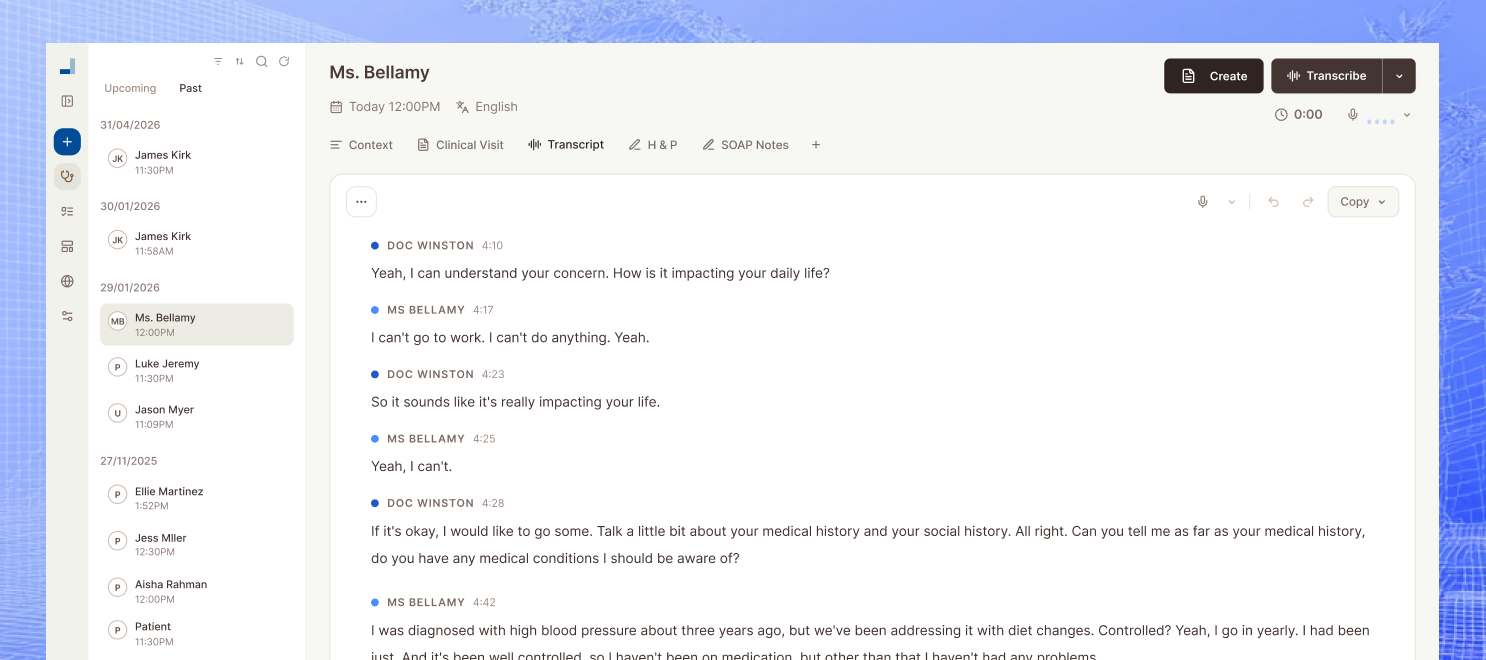
This guide will teach you how to overhaul your clinical workflow using an AI scribe specifically tailored for asthma management. We will explore how to capture various note formats beyond simple SOAP notes, ensure high-quality data for audit purposes, and maintain patient privacy. Whether you are a GP in a busy private practice, a respiratory specialist, or a clinician at a university health center, this roadmap will help you reclaim your time while improving the quality of your care records.
What a medical scribe solves in modern practice
The real cost of documentation isn’t just the minutes spent typing; it is the cognitive load and the loss of face-to-face connection with the patient. When a clinician is focused on a screen to capture every wheeze and trigger mentioned during an asthma review, they may miss subtle non-verbal cues. Late-night charting also leads to ‘note fatigue,’ where important details like specific medication dosages or previous exacerbation frequencies might be omitted or generalized, potentially impacting long-term treatment plans.
An AI medical scribe acts as an assistive layer, capturing the nuances of the conversation in real-time. It is important to remember that these tools are not autonomous practitioners; the clinician remains the final authority on the note’s accuracy. The AI handles the heavy lifting of structure and transcription, allowing the doctor to focus entirely on the patient’s respiratory health and education. This shift transforms the clinical encounter from a data-entry task back into a focused medical consultation.
- Reduces cognitive load by handling real-time data capture.
- Eliminates after-hours charting by generating drafts instantly.
- Enhances patient connection by removing the laptop barrier.
- Ensures clinical notes are detailed, structured, and consistent.
Note types you can generate beyond SOAP (H&P and more)
While the SOAP format is a staple in many clinics, asthma reviews often require more specialized documentation to ensure continuity of care. Using an AI scribe allows you to quickly generate History and Physical (H&P) reports for new patients who are just receiving a diagnosis. These comprehensive notes help establish a clear baseline of symptoms, family history, and environmental triggers that are essential for long-term management strategies.
Beyond basic check-ups, clinicians can generate detailed procedure notes if a nebulizer was administered or if spirometry was performed in-office. Consult notes and referral letters to pulmonologists can be drafted automatically, pulling the most relevant data from the encounter without the doctor needing to summarize the entire history manually. This high level of structure is vital for audit readiness and ensures that follow-up care is based on accurate, high-fidelity data from previous visits.
- H&P notes for comprehensive new patient intake.
- Specialized referral letters for secondary respiratory care.
- Procedure notes for spirometry or acute treatments.
- Detailed discharge summaries for emergency asthma reviews.
How to implement asthma review AI scribe step-by-step in a real clinic
Implementing an asthma review AI scribe begins with selecting a single, predictable visit type to pilot the technology. Start with your routine annual asthma reviews where the questions are standardized and the flow is familiar. This allows you to get comfortable with the recording process without the pressure of a complex, multi-system emergency. You should begin by selecting a template that matches your specialty’s specific needs for respiratory care.
Once the encounter begins, whether in-person or via a telehealth link, simply capture the conversation naturally. Conduct the asthma review as you normally would, discussing asthma triggers, nocturnal symptoms, and medication compliance. The AI works in the background, filtering out the small talk and focusing on the clinical data points required for a robust medical record. You do not need to change how you speak to the patient.
After the patient leaves, the AI provides a structured draft within seconds. Your role shifts from writer to editor; quickly review the generated note to ensure all peak flow numbers and medication changes are reflected accurately. Because the AI has already formatted the data, this review usually takes less than a minute. Finally, reuse the outputs to instantly generate the patient’s personalized asthma action plan or a referral letter if needed.
- Select standardized asthma templates to ensure data consistency.
- Capture natural conversation without altering your bedside manner.
- Review and edit the AI-generated draft immediately after the visit.
- Export clinical data into letters or forms with a single click.
How to keep note quality high and reduce mistakes
Even with advanced AI, the risk of ‘note bloat’ or missing specific values like a numeric FEV1 percentage exists if the clinician is not mindful. Failure points often occur when local medication names or nuanced patient habits are discussed in a disorganized fashion. To maintain high standards, it is helpful to verbalize key findings during the exam—such as ‘I’m noting clear lungs on auscultation today’—which provides the AI with explicit data to anchor the note.
Establishing a lightweight review habit is the most effective way to prevent errors. Clinicians should skim the ‘Assessment and Plan’ section specifically to ensure that the agreed-upon changes to inhaler dosages are correct. Setting team standards for how notes should look across the clinic ensures that every practitioner who opens the file later understands the patient’s exact status at a glance.
- Verbalize key physical findings aloud for the AI to capture accurately.
- Focus your review on the medication and plan sections.
- Standardize templates across the clinic to prevent inconsistent charting.
- Use a ‘verify before signing’ habit to ensure 100% accuracy.
Privacy, consent, and patient trust (plain English)
Patient privacy is paramount when introducing any recording technology into the consult room. Consent requirements vary significantly by region and jurisdiction, so it is essential to follow your local healthcare regulations and clinic policies. Generally, patients are receptive to the technology when they understand it helps their doctor focus more on their health and less on a computer screen.
A simple way to explain this to a patient is: ‘I’m using an AI assistant today to help me take accurate notes so I can focus entirely on your breathing and our conversation. It transcribes our medical discussion into your chart securely. Is that okay with you?’ Most patients appreciate the transparency and the increased eye contact that follows. Ensure your chosen tool adheres to high security and data retention standards to maintain that hard-earned trust.
- Always obtain verbal or written consent based on local laws.
- Explain the technology as a tool for better patient-doctor focus.
- Ensure data is encrypted and stored according to medical standards.
- Maintain a clear policy on how long transcriptions are retained.
Rolling it out across a clinic without disruption
A successful rollout starts with a two-week pilot involving one or two ‘tech-champion’ clinicians. This phase allows the team to iron out any workflow kinks and find the best templates for their specific asthma review protocols. During this time, the clinic should track metrics such as time saved per patient and the reduction in ‘pajama time’ spent charting at home to demonstrate the value to the rest of the staff.
Once the pilot is successful, provide a brief training session for the entire team to align on template usage. This ensures that every asthma review across the university clinic or private practice follows the same high-quality format. By aligning the pilot with the clinic’s existing EMR workflow, the transition feels like an upgrade rather than a disruption.
- Launch a 14-day pilot with a small group of clinicians.
- Measure time saved and note completeness as key KPIs.
- Standardize respiratory templates to ensure data uniformity.
- Integrate the AI output smoothly into your existing EMR.
Mcoy AI is an AI medical scribe that records and transcribes patient encounters, then generates multiple clinical note types (H&P, progress notes, consult notes, follow-up notes, procedure notes, discharge summaries, referral letters, and more). With over 200+ customizable templates and an AI chat feature to create custom letters, forms, and documents, it allows clinicians to focus on patient care while the AI handles the documentation work efficiently.
Frequently Asked Questions
Using an AI assistant for your respiratory documentation can lead to significant questions regarding workflow and accuracy. Below are the answers to the most common queries from clinicians considering this transition.
How accurate are AI medical scribes in real clinics?
AI medical scribes are highly accurate at capturing the clinical dialogue, often picking up details that a busy clinician might overlook. While they are excellent at transcription and summarization, they are not perfect and can occasionally misinterpret complex medical jargon if it is mumbled. This is why the clinician’s role as an editor is vital; you must verify the output for accuracy before the note is finalized. Most users find that the drafts are 90-95% accurate right out of the box.
Do I still need to review every note?
Yes, medical responsibility always rests with the licensed clinician. Even though the AI produces a high-quality draft, you must review and sign off on every note to ensure it accurately reflects your clinical judgment and the patient’s condition. This review process typically takes less than a minute and is much faster than writing a note from scratch. Over time, as you refine your templates, the amount of editing required will decrease significantly.
What note types can an AI scribe generate besides SOAP?
AI scribes are incredibly versatile and can generate specialized documents such as History and Physical (H&P) reports, detailed procedure notes for lung function tests, and discharge summaries for asthma exacerbations. They can also assist in drafting referral letters to specialists and follow-up notes that track symptoms over months. By using different templates, you can ensure that the documentation matches the specific purpose of the patient visit.
Will this work for telehealth and in-person consults?
Modern AI scribes are designed to work seamlessly in both settings. During an in-person asthma review, it uses the device’s microphone to capture the conversation, while for telehealth, it can often integrate with the audio stream of the video call. Regardless of the medium, the AI filters out background noise to focus on the spoken interaction between the provider and the patient. This ensures a consistent documentation standard across all delivery methods.
How do I explain recording/transcription to patients?
The best approach is to be direct and highlight the benefits to the patient’s care. You might say that the tool allows you to stop typing and start listening more closely to their concerns. Most patients are comfortable with this when they see that it leads to a more engaged and attentive doctor. Always respect a patient’s preference if they choose not to be recorded, and have an alternative manual note-taking process ready.
How do clinics prevent note bloat?
Note bloat is prevented by using concise templates that instruct the AI to focus on relevant clinical information rather than transcribing every word of the conversation. Practitioners can guide the AI by summarizing their thoughts aloud at the end of the visit, which the AI then uses as the primary source for the assessment and plan. Setting internal clinic standards for note length also helps maintain a clean, readable medical record.
How long does template setup take?
Initial template selection usually takes only a few minutes, as most platforms offer pre-built options for common specialties like respiratory medicine. Customizing these templates to fit your specific workflow—such as adding specific sections for asthma triggers or inhaler dosages—might take an additional thirty minutes of fine-tuning. Once set, these templates can be used by the entire clinic, saving hours of manual formatting every single week.
What’s the safest way to start if I’m skeptical?
The safest way to begin is to run a small pilot with non-complex cases, such as routine asthma reviews for stable patients. This allows you to see the quality of the notes and build trust in the technology without the pressure of a high-acuity situation. By comparing the AI-generated note with your manual notes for the first few sessions, you can verify its accuracy and adjust your workflow accordingly before fully committing.
Conclusion
Transitioning to an automated documentation workflow for asthma management is one of the most effective ways to reduce administrative burden. By following a structured implementation plan—from piloting with specific visit types to ensuring rigorous quality control—clinics can significantly improve both provider satisfaction and the quality of patient records. When you utilize an asthma review AI scribe, you move from the role of a data entry clerk back to being a clinician, ensuring that every patient receives your full attention. Start your transition today by selecting a pilot group and experience the difference in your daily clinical life.
What a serious review table should cover
| Decision area | Common mistake | Better clinic-ready approach | Metric to watch |
|---|---|---|---|
| Workflow design | Treat document asthma reviews with ai scribe: complete guide as a one-off documentation task | Build a repeatable process with clear ownership and review points | Time to complete documentation |
| Team adoption | Assume every clinician will naturally use the same process | Train for consistency and define exception handling early | Active user adoption |
| Quality review | Only check notes when a problem is reported | Audit a sample of notes weekly and review edge cases | Edit rate per note |
| Operational follow-through | Leave admin actions outside the documentation workflow | Use the same encounter data for referrals, letters, and follow-up tasks | Completion rate for next-step tasks |
Related reading
If you are working through document asthma reviews with ai scribe: complete guide, it helps to read this alongside Specialty Guides: How to Run a More Efficient Medical Practice in 2026, Specialty Guides: How to Improve Patient Encounters, and Admin Management: How to Use an AI Scribe for Follow-Up Letters: Guide. Those guides cover adjacent workflow, implementation, and evaluation questions so the decision does not sit in isolation.
FAQ
{
“How accurate are AI medical scribes in real clinics?”: “AI medical scribes are highly accurate at capturing clinical dialogue, though clinicians must always review the final note for errors. Their accuracy usually exceeds $95%$ for standard medical terminology.”,
“Do I still need to review every note?”: “Yes, as the clinician, you are legally responsible for the medical record. The AI provides a finished draft, but your final oversight ensures patient safety and accuracy.”,
“What note types can an AI scribe generate besides SOAP?”: “Beyond SOAP, AI scribes can create H&P, consult notes, referral letters, procedure notes, and even discharge summaries using specific clinical templates.”,
“Will this work for telehealth and in-person consults?”: “Yes, scribes are designed to work across platforms, capturing clear audio from both virtual video calls and face-to-face office examinations.”,
“How do I explain recording/transcription to patients?”: “Frame it as a way to prioritize their care by reducing laptop time. Most patients are very supportive when they see it increases eye contact and engagement.”,
“How do clinics prevent note bloat?”: “By using structured templates and instructing the AI to focus only on clinical data, clinics avoid unnecessary ‘fluff’ and keep records concise and useful.”,
“How long does template setup take?”: “Most clinicians can set up their primary templates in under 20 minutes, either by using pre-built respiratory models or creating their own custom formats.”,
“What’s the safest way to start if I’m skeptical?”: “Start with a pilot of five routine visits. Compare the AI output to your manual notes to build trust in the system’s accuracy and formatting capabilities.”
}