Specialty Guides: Document Mental Health Care Plans with AI: A Full Guide
Learn how to use AI to document mental health care plans efficiently. Improve note quality and save hours on admin tasks for GPs and clinic owners.
What a medical scribe solves in modern practice
The administrative burden of documenting mental health care plans is one of the most significant contributors to physician burnout and cognitive fatigue. Unlike a standard physical exam, mental health consultations require the capture of nuanced emotional cues, complex social histories, and longitudinal progress that is difficult to summarize in a rushed post-clinic session. When clinicians spend their evenings finishing notes, the risk of missing critical details or losing the conversational flow of a session increases tenfold.
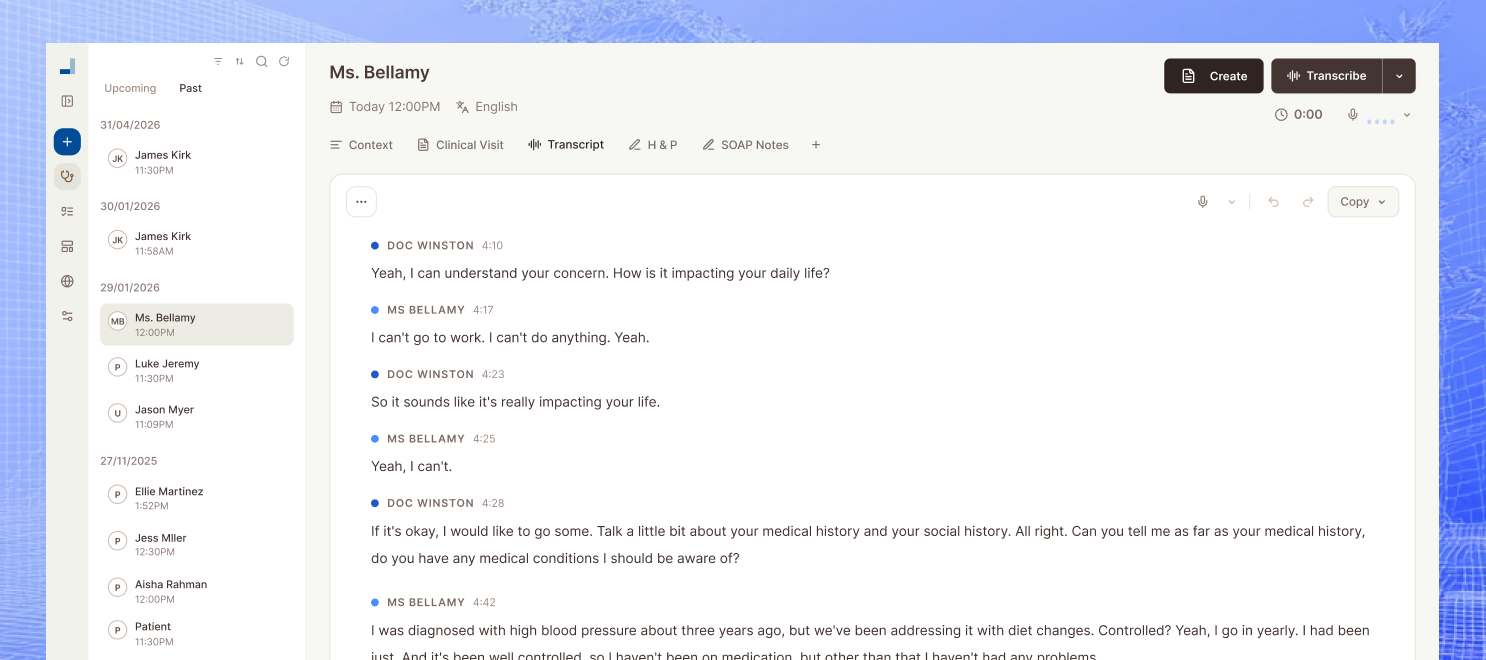
An AI medical scribe acts as a sophisticated digital assistant that listens to the natural dialogue of a consultation, allowing the provider to maintain eye contact and build rapport without being tethered to a keyboard. It is important to remember that these tools are strictly assistive; while they handle the heavy lifting of transcription and structuring, the clinician remains the final authority and must verify all medical data before finalization. By shifting the focus from typing to listening, doctors can reclaim their time and improve the accuracy of their mental health care plans.
- Reduces documentation time by up to 70% per session.
- Improves clinical focus by removing the laptop as a barrier.
- Ensures nuanced patient statements are captured accurately.
- Decreases administrative burnout for solo practitioners and large clinics.
Note types you can generate beyond SOAP (H&P and more)
While the SOAP format is a staple in medical documentation, mental health care plans often require more specialized structures to satisfy insurance requirements and clinical continuity. Comprehensive History and Physical (H&P) reports, for instance, provide a deep dive into the patient’s psychiatric history, family dynamics, and medication trials. These detailed accounts are vital during the initial intake phase of behavioral health management.
Beyond the basics, AI tools can effortlessly generate progress notes that track patient improvement over time, consult notes for specialist referrals, and detailed procedure notes for specific therapeutic interventions. In a university clinic or multidisciplinary setting, discharge summaries and referral letters are equally essential. Having these documents pre-drafted by an AI ensures that every stakeholder in a patient’s care journey has access to high-quality, professional, and consistent data without the clinician needing to rewrite the same information multiple times.
- Comprehensive H&P notes for thorough psychiatric intakes.
- Consultation and referral letters for multidisciplinary care.
- Follow-up and progress notes to track longitudinal outcomes.
- Discharge summaries that ensure safe transitions of care.
How to implement AI for mental health care plans step-by-step in a real clinic
Starting with AI documentation doesn’t require an overnight overhaul of your entire practice. The most effective approach is to begin with one specific visit type, such as an initial mental health screening or a standard review. By narrowing the scope, you can familiarize yourself with how the AI interprets psychiatric terminology and patient narratives without feeling overwhelmed by a full patient load.
Once you are comfortable, you should configure your templates according to your specialty. Mental health care plans have specific requirements, such as risk assessments or mental state examinations. Selecting a template that prompts the AI to look for these specific elements ensures that your documentation meets both clinical and legal standards right from the start. During the encounter, whether it is in-person or via telehealth, the system captures the dialogue naturally.
After the session, the AI quickly drafts the note. You should spend two to three minutes reviewing the output and editing for specific clinical nuances that only a human can discern. Finally, once the primary note is complete, you can reuse the generated data to produce secondary documents like GP management plans or referral letters for psychologists, drastically reducing the total time spent on a single patient case.
- Begin with a pilot phase focusing on one consultation type.
- Select and customize templates for mental health assessments.
- Review and refine the AI-generated draft immediately after the visit.
- Export and sync notes directly into your existing EMR system.
How to keep note quality high and reduce mistakes
High-quality documentation in mental health is not just about length; it is about precision and clarity. A common failure point in manual and even some AI-assisted notes is ‘note bloat,’ where irrelevant dialogue fills the page without adding clinical value. To prevent this, clinicians should establish a lightweight review habit, checking for core metrics such as updated medication lists, correct dosages, and accurate problem lists.
Standardizing what constitutes a ‘good’ note within your team or clinic is also vital. In university clinics where multiple practitioners might see the same student, consistency in how risk is documented can literally be lifesaving. Use the AI to create a unified ‘voice’ for the clinic, ensuring that every mental health care plan follows the same structured logic and meets the necessary audit standards.
- Verify medication dosages and frequency every time.
- Scan for ‘note bloat’ and remove non-clinical dialogue.
- Maintain consistent standards for risk assessment documentation.
- Adopt a 2-minute review rule for every AI-generated draft.
Privacy, consent, and patient trust (plain English)
Patient trust is the foundation of mental health care. When introducing recording or transcription technology, it is essential to be transparent and follow your local health privacy regulations. Explain to the patient that the tool is being used to ensure you can focus entirely on them rather than a computer screen. Most patients appreciate the increased eye contact and perceived presence of their doctor.
A simple way to script this is: ‘I’m using a digital assistant today to take notes so I can focus on our conversation. It’s secure and helps me keep an accurate record of our plan. Is that okay with you?’ This approach frames the technology as a benefit to the patient’s care. Generally, data should be encrypted and processed in compliance with standards like HIPAA or GDPR, ensuring the patient’s most sensitive information remains protected at all times.
- Always obtain verbal or written consent based on local policy.
- Frame the AI as a tool for better clinical focus.
- Ensure the platform uses end-to-end encryption.
- Discard recordings once the medical note is validated.
Rolling it out across a clinic without disruption
A successful rollout across a multi-doctor clinic requires clear milestones and a path of least resistance. Start with a two-week pilot program involving a small group of tech-savvy clinicians. During this phase, track metrics such as time saved on documentation and the reduction in ‘pajama time’ (work done after hours). This data serves as a powerful motivator for more skeptical team members.
Training should focus on template alignment so that every doctor is producing notes that meet the clinic’s quality bar. By the end of the second week, you can begin scaling to other departments or clinicians. The goal is to move documentation from a dreaded end-of-day chore to a seamless part of the workflow that happens in real-time between patients.
- Launch a two-week pilot with measurable success metrics.
- Compare after-hours charting time before and after implementation.
- Hold weekly 15-minute syncs to share template tips.
- Standardize clinical note formats across the whole team.
Mcoy AI: Your Partner in Clinical Documentation
Mcoy AI is an AI medical scribe that records and transcribes patient encounters, then generates multiple clinical note types (H&P, progress notes, consult notes, follow-up notes, procedure notes, discharge summaries, referral letters, and more). With over 200+ customizable templates and an interactive AI chat to quickly create letters, forms, and other essential documents, Mcoy AI allows clinicians to spend significantly less time on administrative tasks while maintaining the highest standard of care.
Frequently Asked Questions
How accurate are AI medical scribes in real clinics?
Modern AI scribes are remarkably accurate, often capturing more detail than a clinician could manually. However, they are designed to be assistive tools. Accuracy can vary based on background noise and speaker clarity, which is why a brief manual review by the clinician is always required to ensure medical safety and the inclusion of specific clinical judgments.
Do I still need to review every note?
Yes, reviewing every note is a professional and legal requirement. While the AI does the heavy lifting of drafting and formatting, the clinician is the only one who can verify the subjective and objective findings are correctly contextually placed. Most users find that reviewing an AI-generated note takes less than two minutes compared to twenty minutes of typing.
What note types can an AI scribe generate besides SOAP?
An AI scribe is highly versatile and can generate H&P notes, mental health care plans, consultation letters, procedure notes, and discharge summaries. By using specialized templates, the tool can rearrange the transcribed information into any medical document format required by your specific specialty or insurance provider.
Will this work for telehealth and in-person consults?
Most AI scribing solutions are designed to work seamlessly across both modalities. For in-person visits, the device stays in the room, and for telehealth, the audio is captured directly from the computer output. This flexibility ensures that documentation remains consistent regardless of how the patient is being seen.
How do I explain recording/transcription to patients?
The best approach is to be direct and highlight the benefits to the patient. Inform them that the technology allows you to listen more closely and ensures that none of their concerns are missed in the documentation. Most patients are comfortable with the process once they understand it leads to a more attentive and present physician.
How do clinics prevent note bloat?
Clinics can prevent note bloat by using concise templates that instruct the AI on which information is essential and which is redundant. Setting internal standards for note length and regularly reviewing a sample of notes can help maintain a high standard of succinct, clinically relevant documentation.
How long does template setup take?
Initial template setup is usually very fast, often taking less than an hour to select or customize the core formats you use daily. Most platforms offer a library of pre-built templates for different specialties, so you rarely need to start from scratch when documenting a mental health care plan.
What’s the safest way to start if I’m skeptical?
The safest way to begin is with a small pilot program. Start by using the AI for your most straightforward or non-complex patients. As you build trust in the system’s ability to capture clinical data accurately, you can gradually expand its use to more complex mental health cases and different document types.
Conclusion
Mastering how to document mental health care plans with AI isn’t just about efficiency; it’s about reclaiming the human connection in medicine. By automating the technical drafting process, clinicians can focus on what truly matters: patient wellbeing and clinical outcomes. Whether you’re in a university clinic or a private practice, the transition to AI-assisted workflows offers a sustainable path away from burnout and toward a more focused practice. Start your pilot today and see how much time you can save with a smarter approach to your documentation.
What a serious review table should cover
| Decision area | Common mistake | Better clinic-ready approach | Metric to watch |
|---|---|---|---|
| Workflow design | Treat document mental health care plans with ai: a full guide as a one-off documentation task | Build a repeatable process with clear ownership and review points | Time to complete documentation |
| Team adoption | Assume every clinician will naturally use the same process | Train for consistency and define exception handling early | Active user adoption |
| Quality review | Only check notes when a problem is reported | Audit a sample of notes weekly and review edge cases | Edit rate per note |
| Operational follow-through | Leave admin actions outside the documentation workflow | Use the same encounter data for referrals, letters, and follow-up tasks | Completion rate for next-step tasks |
Related reading
If you are working through document mental health care plans with ai: a full guide, it helps to read this alongside Specialty Guides: How to Run a More Efficient Medical Practice in 2026, Specialty Guides: How to Improve Patient Encounters, and Specialty Guides: AI Scribe Imaging Requests: Full Implementation Guide. Those guides cover adjacent workflow, implementation, and evaluation questions so the decision does not sit in isolation.
FAQ
How accurate are AI medical scribes in real clinics? Do I still need to review every note? What note types can an AI scribe generate besides SOAP? Will this work for telehealth and in-person consults? How do I explain recording/transcription to patients? How do clinics prevent note bloat? How long does template setup take? What’s the safest way to start if I’m skeptical?