Practice Operations: How to Use an AI Scribe for Multi-Provider Clinics Guide
Learn how to implement an AI medical scribe in multi-provider clinics. Reduce burnout, improve charting efficiency, and master various clinical note formats.
The Hidden Burden of Clinical Documentation
For doctors in busy multi-provider practices and university clinics, the clinical day rarely ends when the last patient leaves. The weight of after-hours charting has become a primary driver of clinician burnout, leading to rushed notes and a persistent sense of medico-legal anxiety. When documentation feels like a secondary shift, the quality of patient interaction often suffers, and the risk of omission in complex cases increases significantly.
This guide provides a comprehensive roadmap for integrating an AI medical scribe into your professional workflow. We will explore how to move beyond basic SOAP notes, maintain rigorous quality control, ensure patient privacy, and execute a seamless rollout across your entire clinical team. Whether you are a general practitioner or a specialist, optimizing your documentation process is the first step toward reclaiming your personal time and professional focus.
What a medical scribe solves in modern practice
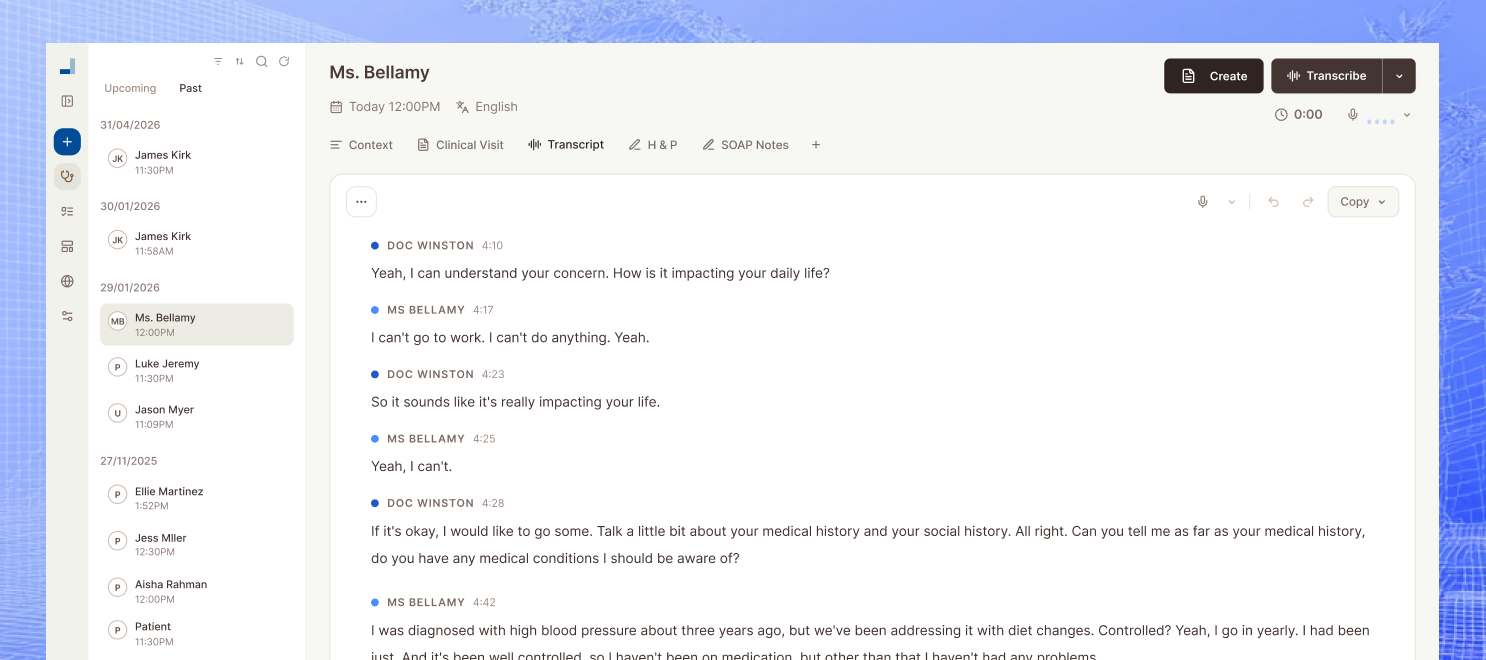
The real cost of documentation is measured in more than just minutes; it is measured in cognitive load and the erosion of the patient-provider relationship. In a multi-provider setting, delayed notes can lead to fragmented care and missed clinical details, especially when multiple specialists are involved in a single patient’s journey. An AI medical scribe acts as a digital assistant that captures the nuances of a conversation in real-time, allowing the clinician to remain fully present during the encounter.
It is important to understand that an AI scribe is an assistive tool, not a replacement for clinical judgment. While the technology handles the heavy lifting of transcription and structuring, the clinician remains the final authority and is responsible for the accuracy of every entry. By automating the mechanical aspects of writing, the tool allows providers to focus on diagnosis and treatment planning rather than typing speed.
- Eliminates the ‘pajama time’ spent on finishing charts at home.
- Reduces cognitive fatigue by capturing details automatically during the visit.
- Ensures clinical notes are completed immediately following the encounter.
- Enhances the patient experience by allowing for direct eye contact.
- Provides a standardized baseline for documentation across all clinic staff.
Note types you can generate beyond SOAP (H&P and more)
While the SOAP format is a staple of medical training, modern practice requires a much broader range of documentation types. Comprehensive History and Physical (H&P) reports, detailed consult notes, and specialty-specific procedure notes are essential for maintaining continuity of care. In university clinics, where teaching and research are paramount, the depth and structure of these notes can significantly impact both education and audit readiness.
Effective documentation also involves the creation of discharge summaries and referral letters that clearly communicate findings to other members of the healthcare team. When notes are structured correctly, they facilitate smoother handovers and ensure that follow-up care is based on accurate, real-time data. Using an AI scribe allows for the rapid generation of these diverse formats without adding to the provider’s administrative burden.
Transitioning between different note styles should be seamless. For instance, a complex follow-up note requires a different emphasis than a brief progress note. By utilizing specialized templates, clinics can ensure that every document meets the specific requirements of the encounter type, improving both clinical clarity and billing accuracy.
- H&P and consult notes for comprehensive initial evaluations.
- Procedure notes and discharge summaries for surgical or acute care.
- Referral letters that summarize findings for external colleagues.
- Follow-up notes that track progress over longitudinal care.
- Audit-ready documentation that supports insurance and legal requirements.
How to implement an AI medical scribe step-by-step in a real clinic
Successful implementation begins with a focused approach rather than a total system overhaul on day one. Start by selecting one common visit type, such as routine follow-ups or standard physicals, to test the workflow. This allows the team to become comfortable with the software in a controlled environment before expanding to more complex clinical scenarios. Creating specialty-specific templates during this phase ensures the output aligns with the specific needs of your practice.
During the encounter, the focus should remain on the patient while the AI captures the audio from the in-person or telehealth visit. Most clinicians find that a brief verbal summary at the end of the exam helps the AI synthesize the objective findings more accurately. Once the encounter ends, the generated text should be reviewed and edited immediately while the details are still fresh in the clinician’s mind.
The efficiency of an AI medical scribe for multi-provider clinics is truly realized when the outputs are reused for administrative tasks. The same data used for the clinical note can be instantly converted into referral letters or patient instruction forms. This secondary use of captured data eliminates redundant typing and ensures consistency across all patient-facing documents, creating a more unified clinical experience.
- Pilot the system with one specific encounter type to build confidence.
- Configure templates to match the unique recording needs of your specialty.
- Review and finalize notes immediately after the patient leaves the room.
- Leverage AI outputs to generate letters and forms with a single click.
- Scale the rollout to other providers once the initial workflow is refined.
How to keep note quality high and reduce mistakes
Even the most advanced technology can fall victim to ‘note bloat’ or missing specific medication dosages if not monitored. Typical failure points often involve the AI misinterpreting complex medical terminology or omitting subtle changes in a problem list. To prevent this, clinicians should adopt a lightweight review habit, scanning the generated note for key clinical indicators such as vitals, medications, and the final assessment plan.
Establishing team-wide standards for what a ‘good’ note looks like is essential for multi-provider clinics. Regular, brief intervals of peer review or quality checks can ensure that every provider is using the tool effectively. By maintaining a high standard of accuracy, the clinic protects itself from medico-legal risks and ensures that the medical record remains a reliable source of truth for future care.
- Develop a 30-second review checklist for every generated note.
- Focus on verifying medications, allergies, and specific physical findings.
- Discourage ‘note bloat’ by choosing concise, relevant templates.
- Hold monthly team meetings to align on documentation standards.
- Report recurring AI errors to improve model performance over time.
Privacy, consent, and patient trust (plain English)
Patient privacy is the foundation of the therapeutic relationship. When introducing an AI scribe, it is vital to follow local regulations regarding recording and data retention. While the technology is designed to be secure, clinicians must ensure they are using platforms that comply with healthcare privacy standards. Always inform the patient that a digital tool is being used to help you focus on their care rather than a computer screen.
Explaining the process to a patient can be simple and reassuring. You might say: ‘I’m using a digital clinical assistant to help me take notes today so I can focus entirely on you. It records our conversation to create my medical report, and then the recording is handled securely according to our privacy policy. Is that okay with you?’ Most patients appreciate the increased attention they receive when the doctor isn’t typing.
- Explain the benefits of the tool in terms of better patient engagement.
- Obtain verbal or written consent based on your local jurisdiction.
- Ensure the AI platform meets industry-standard security protocols.
- Stay updated on regional data residency and retention laws.
- Reassure patients that the clinician retains full control over the final note.
Rolling it out across a clinic without disruption
A phased rollout is the best way to avoid operational friction. We recommend a two-week pilot program involving one or two ‘tech-forward’ providers who can act as internal champions. During this period, track metrics such as time saved per day, the reduction in after-hours work, and the speed of note completion. These data points are crucial for convincing more skeptical staff members of the tool’s value.
Training should focus on both the technical use of the app and the art of ‘narrating’ the exam. Teaching providers to speak their physical exam findings aloud helps the AI capture objective data that might otherwise be missed. By the end of the pilot, the clinic should have a library of refined templates ready for use by the broader team, ensuring a smooth transition for everyone involved.
- Start with a small pilot group of champions for the first 14 days.
- Track ‘pajama time’ reduction to prove the return on investment.
- Create a shared library of templates for common clinical scenarios.
- Provide brief, hands-on training sessions for the entire medical staff.
- Regularly solicit feedback to troubleshoot workflow bottlenecks early.
Mcoy AI is an AI medical scribe that records and transcribes patient encounters, then generates multiple clinical note types (H&P, progress notes, consult notes, follow-up notes, procedure notes, discharge summaries, referral letters, and more). It features 200+ customizable templates and an AI chat function to help you create various letters, forms, and documents effortlessly, allowing you to focus more on patient care and less on administrative tasks.
Conclusion
Implementing an AI medical scribe for multi-provider clinics is more than just a software upgrade; it is a fundamental shift toward a more sustainable way of practicing medicine. By automating the documentation process, clinics can reduce burnout, improve the accuracy of patient records, and allow providers to do what they do best—care for people. Start with a simple pilot, refine your templates, and watch as your afternoon backlogs disappear. Take the first step today and transform your clinic’s documentation workflow forever.
What a serious review table should cover
| Decision area | Common mistake | Better clinic-ready approach | Metric to watch |
|---|---|---|---|
| Workflow design | Treat how to use an ai scribe for multi-provider clinics guide as a one-off documentation task | Build a repeatable process with clear ownership and review points | Time to complete documentation |
| Team adoption | Assume every clinician will naturally use the same process | Train for consistency and define exception handling early | Active user adoption |
| Quality review | Only check notes when a problem is reported | Audit a sample of notes weekly and review edge cases | Edit rate per note |
| Operational follow-through | Leave admin actions outside the documentation workflow | Use the same encounter data for referrals, letters, and follow-up tasks | Completion rate for next-step tasks |
Related reading
If you are working through how to use an ai scribe for multi-provider clinics guide, it helps to read this alongside Practice Operations: How Clinics Can Streamline Daily Operations, Practice Operations: How Clinics Can Improve Workflow Without Changing Their EHR, and Specialty Guides: Mental Health Notes Templates: Build Your Clinic’s Pack. Those guides cover adjacent workflow, implementation, and evaluation questions so the decision does not sit in isolation.
FAQ
Integrating new technology into a clinical workflow often brings up practical questions. Here are the most common inquiries regarding the use of AI in professional medical settings.
How accurate are AI medical scribes in real clinics?
AI medical scribes have reached a high level of accuracy, particularly in capturing the nuances of natural conversation between the doctor and patient. They are trained on vast datasets of medical terminology, allowing them to understand complex diagnoses and treatments. However, accuracy can vary based on background noise and the clarity of the audio. Clinicians should always perform a quick final check to ensure the AI hasn’t misinterpreted specific values or names.
Do I still need to review every note?
Yes, reviewing every note is a critical step in the clinical workflow and a professional requirement. While the AI does the majority of the writing, the clinician is the only one who can verify that the note accurately reflects the medical truth of the encounter. Most providers find that this review takes less than a minute when done immediately after the visit. Think of the AI as a junior assistant that requires your final sign-off.
What note types can an AI scribe generate besides SOAP?
Modern AI scribes are incredibly versatile and can generate a wide array of documentation beyond the standard SOAP format. This includes comprehensive History and Physical (H&P) reports, consult notes, detailed procedure notes, and discharge summaries. Furthermore, the technology can often draft referral letters and patient education instructions based on the data captured during the visit. This flexibility is essential for specialists and multi-provider clinics.
Will this work for telehealth and in-person consults?
Most AI scribing solutions are designed to work seamlessly across both in-person and telehealth environments. For in-person visits, the app typically runs on a smartphone or tablet placed in the room. For telehealth, the AI can often join the virtual call or capture the audio directly from the computer’s output. This consistency ensures that your documentation remains standardized regardless of how the patient is seen.
How do I explain recording/transcription to patients?
The best approach is to be direct and highlight the benefit to the patient. Explain that you are using a digital assistant to help with note-taking so that you can spend the visit looking at them rather than a screen. Most patients respond positively when they realize the technology allows for a more personal and attentive consultation. Simple, transparent communication is key to maintaining trust.
How do clinics prevent note bloat?
Note bloat is prevented by using concise templates and setting clear expectations for what should be included in the final record. Clinicians should choose templates that prioritize relevant information over exhaustive transcripts of every word spoken. Reviewing and editing the AI’s output allows you to remove unnecessary filler while keeping the essential clinical insights. Consistent training across the clinic also helps maintain a standard for brevity.
How long does template setup take?
Setting up initial templates usually takes only a few minutes, especially if the platform offers a library of pre-built options for different specialties. Customizing these templates to fit your specific workflow might take a few trial sessions. Once established, these templates save hours of work by providing a structured framework that the AI fills in automatically for every visit. It is a small time investment that pays off immediately.
What’s the safest way to start if I’m skeptical?
The safest way to start is with a ‘shadow’ pilot. Record a few encounters that you were going to document manually anyway, and compare the AI-generated note to your own. This allows you to evaluate the quality and accuracy without any pressure or risk to your current workflow. Most skeptics are won over once they see the AI capture details they might have forgotten or find that the clinical logic of the drafted note is sound.