Specialty Guides: How to Use an AI Scribe for ENT Consult Notes | Guide
Learn how to use an AI scribe for ENT consult notes to save time. Master specialty-focused documentation for otolaryngology practices today.
For many otolaryngologists, the most exhausting part of the day isn’t the complex sinus surgeries or delicate ear procedures; it’s the hours spent staring at a screen completing documentation. The meticulous nature of ENT work—tracking specific symptoms across the ears, nose, and throat—often leads to significant after-hours charting, clinician burnout, and the anxiety of potentially missing a nuanced detail in a rushed note. For specialists and university clinics, this administrative burden can compromise the quality of patient interactions.
This comprehensive guide will teach you how to use an AI scribe for ENT consult notes to transform your clinical workflow. We will explore beyond the basic SOAP format into specialized ENT documentation, quality control measures, patient privacy protocols, and a realistic rollout plan for your practice. Whether you are a solo practitioner or leading a large department, these strategies will help you reclaim your time while maintaining the highest standards of clinical accuracy.
What a medical scribe solves in modern practice
Documentation in otolaryngology is uniquely demanding because it often involves multi-system examinations and longitudinal data tracking. The real cost of traditional documentation isn’t just the minutes spent typing; it is the cognitive load of trying to remember specific endoscopic findings or hearing test results while simultaneously engaging with the patient. When notes are delayed, details fade, and the risk of medico-legal repercussions or billing inaccuracies increases significantly.
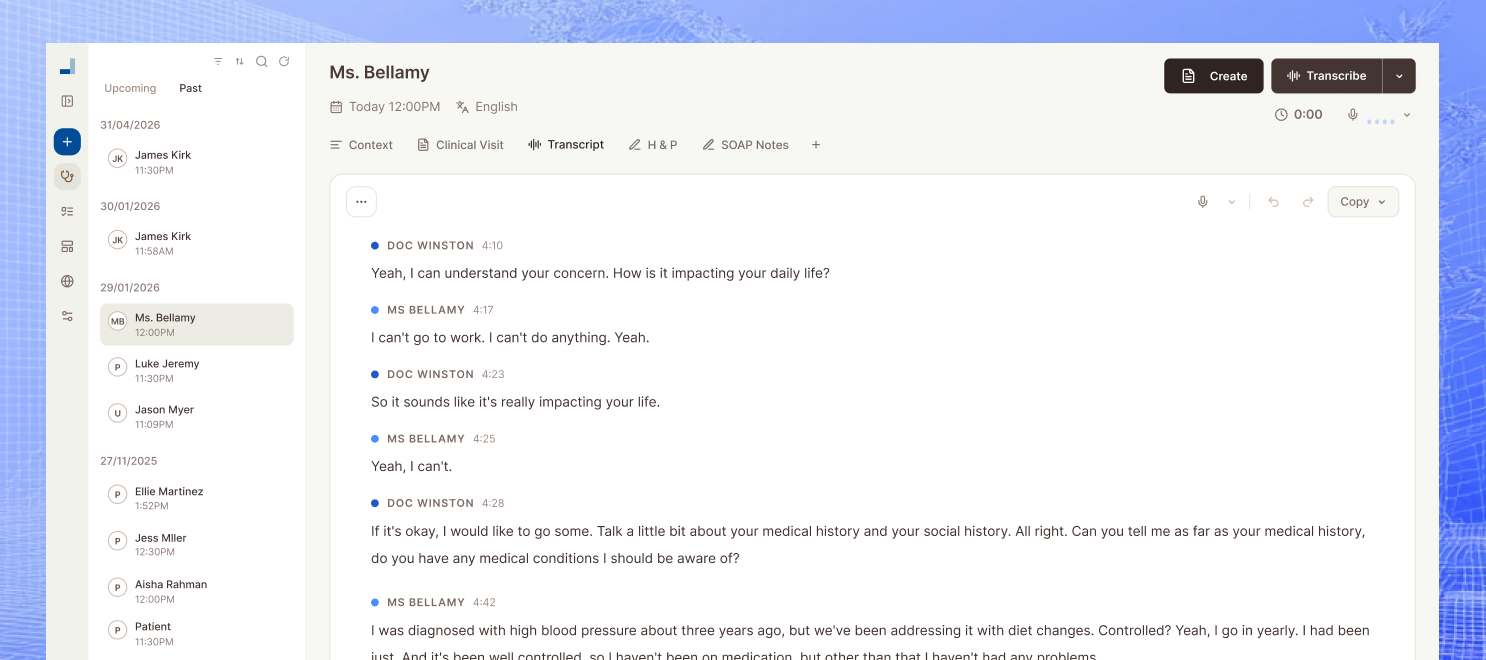
An AI medical scribe acts as an assistive intelligence that captures the natural conversation between the clinician and the patient. It does not replace the doctor’s judgment; rather, it handles the heavy lifting of transcription and structuring. By using an AI scribe for ENT consult notes, doctors can remain fully present with the patient, knowing that the specific descriptors of a tympanic membrane or the history of a voice disorder are being captured accurately in the background.
- Reduces the burden of after-hours charting and administrative burnout.
- Improves note accuracy by capturing details in real-time.
- Allows clinicians to focus on physical exams and patient interaction.
- Decreases cognitive fatigue by automating structural formatting.
Note types you can generate beyond SOAP (H&P and more)
While SOAP notes are the industry standard, ENT specialists frequently require more diverse documentation formats to ensure continuity of care and effective communication with referring physicians. A versatile documentation system allows for the generation of History and Physical (H&P) reports, which are vital for preoperative assessments. It also covers progress notes for chronic conditions like sinusitis or allergies, ensuring that interval changes are clearly documented over time.
Furthermore, consult notes and referral letters are high-stakes documents in the ENT world. A well-structured consult note not only facilitates better care but also serves as an audit-ready record of your clinical reasoning. Procedure notes for in-office tasks—such as ear debridement, laryngoscopy, or nasal endoscopy—need to be precise and standardized to meet billing requirements and professional standards.
- H&P and preoperative summaries for surgical clearance.
- Comprehensive consult notes for referring primary care providers.
- Detailed procedure notes for endoscopic and minor office surgeries.
- Discharge summaries and follow-up notes for post-operative care.
How to implement an AI scribe for ENT consult notes step-by-step
To begin implementing an AI scribe for ENT consult notes, start by selecting one specific visit type to pilot, such as routine follow-ups or initial sinus consultations. This focused approach allows you to get comfortable with the technology without overwhelming your schedule. During this phase, you should identify the common terminology you use frequently so the system can learn your specific clinical style.
Next, configure your templates by specialty focus. ENT documentation requires specific sections for physical exam findings like otoscopy, rhinoscopy, and neck palpation. By setting up these templates early, you ensure that the AI knows exactly where to place information regarding the septum, turbinates, or vocal folds. During the encounter, simply keep your device active, whether you are seeing the patient in person or via a telehealth platform.
Once the patient encounter concludes, the AI will generate a draft based on the captured dialogue. Make it a habit to review and edit these drafts immediately. This review process usually takes less than a minute but ensures that any nuanced clinical interpretations are corrected. Finally, reuse the structured output to instantly generate referral letters or patient education forms, maximizing the utility of a single recording session.
- Start with one consistent visit type to build workflow confidence.
- Customize templates specifically for ENT physical exam findings.
- Capture the encounter naturally without changing your speaking style.
- Review, edit, and repurpose the output for secondary documentation.
How to keep note quality high and reduce mistakes
Quality control is essential when using automated tools in a medical setting. Typical failure points in documentation include missing medication dosages, incorrect lab values, or note bloat—where the note becomes too long and loses the core clinical narrative. To prevent this, clinicians should adopt a lightweight review habit, scanning the ‘Assessment and Plan’ section specifically to ensure the AI has correctly prioritized the most critical findings.
Setting team standards for how notes should look across the clinic also helps maintain quality. This includes defining how to document ‘negatives’ or how to handle problem lists for patients with multiple comorbidities. By creating a standardized feedback loop, you can refine your templates over time, ensuring the AI aligns more closely with your personal clinical voice and the specific needs of your otolaryngology practice.
- Perform a quick review focus on medications and clinical plans.
- Establish clinic-wide standards for documentation formatting.
- Use structured templates to prevent unnecessary note bloat.
- Provide feedback to the system to refine future note generations.
Privacy, consent, and patient trust
Integrating recording technology into the exam room requires a transparent approach to patient consent. While specific consent requirements vary by region, it is essential to follow your local healthcare policies and board guidelines. Most patients are receptive to the technology when they understand it allows their doctor to spend more time looking at them rather than a computer screen.
A simple, patient-friendly explanation goes a long way. You might say: ‘I’m using a secure AI assistant today to help me take accurate notes so I can focus entirely on our conversation. It transcribes our talk into my medical records and then deletes the audio.’ This builds trust by emphasizing the benefit to the patient while clarifying the security measures in place. General security principles, such as encrypted storage and data retention policies, should also be clearly outlined in your practice’s privacy policy.
- Always follow local legal guidelines for patient recording consent.
- Use a transparent script to explain the technology’s benefits.
- Ensure the platform adheres to high-level security and encryption.
- Maintain clear documentation of your practice’s data handling policies.
Rolling it out across a clinic without disruption
Successfully rolling out an AI scribe across a multi-physician clinic requires a phased approach. Start with a two-week pilot involving one or two ‘tech-forward’ clinicians. During this period, track key metrics such as time saved per day, the reduction in after-hours charting, and the speed of note completion. This data will be vital for gaining buy-in from the rest of the staff and justifying the transition.
Once the pilot is complete, align your templates across the team to ensure consistency. Provide short training sessions that focus on how to speak naturally while subtly ‘verbally narrating’ physical exam findings for the scribe. This ensures that even the most complex ENT procedures are captured with high fidelity. Gradual scaling prevents the technical friction that often accompanies new software implementation.
- Execute a 14-day pilot with a small group of clinicians first.
- Track time-savings metrics to demonstrate the tool’s value.
- Align templates across the department for consistent records.
- Train staff on verbal narration techniques for physical exams.
Mcoy AI is an AI medical scribe that records and transcribes patient encounters, then generates multiple clinical note types including H&P, progress notes, consult notes, follow-up notes, procedure notes, discharge summaries, referral letters, and more. With over 200 customizable templates and an interactive AI chat, doctors can effortlessly create letters, forms, and specific documents tailored to ENT practices, allowing for professional documentation without the manual labor.
FAQ
Transitioning to automated documentation often leads to several practical questions regarding accuracy and integration. Here are the answers to the most common queries clinicians have when adopting new scribe technology.
How accurate are AI medical scribes in real clinics?
AI medical scribes are remarkably accurate in capturing clinical dialogue, often reaching over 95% accuracy in transcribing medical terminology. They are trained on vast datasets of healthcare conversations, allowing them to distinguish between patient concerns and clinician assessments. However, the final accuracy always depends on the clinician’s final review of the generated note.
Do I still need to review every note?
Yes, the clinician remains the legally responsible party for all medical documentation. While the AI does the majority of the work, a quick review is necessary to ensure the context and clinical nuances are perfectly captured. Most doctors find that this review takes less than 60 seconds compared to the 10-15 minutes spent typing from scratch.
What note types can an AI scribe generate besides SOAP?
Beyond the standard SOAP format, an AI scribe can generate complex History and Physicals, detailed procedure notes, and even specialized specialty-specific consult notes. They can also be used to draft referral letters, discharge summaries, and patient education instructions based on the conversation held during the visit. This versatility makes them useful for both inpatient and outpatient settings.
Will this work for telehealth and in-person consults?
Most modern AI scribes are designed to work seamlessly across both in-person and telehealth environments. For in-person visits, the software typically runs on a smartphone or tablet in the room. For telehealth, it can often integrate with the video platform or capture audio from the computer’s output, ensuring consistent documentation regardless of how the patient is seen.
How do I explain recording/transcription to patients?
The best approach is to be direct and highlight the benefit to the patient’s care. Explain that the tool allows you to maintain eye contact and listen more effectively because you aren’t busy typing. Most patients appreciate the extra attention and are comfortable with the technology once they know it is secure and HIPAA-compliant.
How do clinics prevent note bloat?
Note bloat is prevented by using highly specific templates that instruct the AI only to include relevant information. By defining the structure of the output—such as limiting certain sections to bullet points or specific word counts—clinics can ensure the notes remain concise and readable. Selecting a quality AI tool that prioritizes clinical synthesis over verbatim transcription is also key.
How long does template setup take?
Initial template setup usually takes about 15 to 30 minutes for a standard specialty. Most platforms offer pre-built templates for common specialties like ENT, which can then be tweaked to match your personal preferences. Once the templates are set, they can be used indefinitely and updated as your practice evolves.
What’s the safest way to start if I’m skeptical?
The safest way to start is with a ‘shadowing’ phase where you use the AI scribe alongside your current documentation method for a few days. Don’t rely on it for your official records until you see the quality for yourself. Once you gain confidence in the AI’s ability to capture your findings, you can gradually phase out manual typing and move to a review-only workflow.
Conclusion
Implementing a modern documentation workflow is the most effective way for otolaryngologists to combat the administrative burden of healthcare. By following a structured rollout, customizing templates for specific procedures, and maintaining a quick review habit, you can significantly improve both your work-life balance and the quality of your records. Learning how to use an AI scribe for ENT consult notes is a career-changing step that allows you to return your focus where it belongs: on the patient. Consider starting a pilot program today to see how much time your clinic can reclaim.
What a serious review table should cover
| Decision area | Common mistake | Better clinic-ready approach | Metric to watch |
|---|---|---|---|
| Workflow design | Treat how to use an ai scribe for ent consult notes | guide as a one-off documentation task | Build a repeatable process with clear ownership and review points |
| Team adoption | Assume every clinician will naturally use the same process | Train for consistency and define exception handling early | Active user adoption |
| Quality review | Only check notes when a problem is reported | Audit a sample of notes weekly and review edge cases | Edit rate per note |
| Operational follow-through | Leave admin actions outside the documentation workflow | Use the same encounter data for referrals, letters, and follow-up tasks | Completion rate for next-step tasks |
Related reading
If you are working through how to use an ai scribe for ent consult notes | guide, it helps to read this alongside Specialty Guides: How to Run a More Efficient Medical Practice in 2026, Specialty Guides: How to Improve Patient Encounters, and Specialty Guides: Document ADHD Reviews With an AI Scribe: Complete Guide. Those guides cover adjacent workflow, implementation, and evaluation questions so the decision does not sit in isolation.
FAQ
How accurate are AI medical scribes in real clinics?
AI medical scribes are remarkably accurate in capturing clinical dialogue, reaching over 95% accuracy in transcribing medical terminology. They are trained on vast datasets of healthcare conversations and can distinguish between patient concerns and clinician assessments. However, the final accuracy always depends on the clinician’s final review.
Do I still need to review every note?
Yes, the clinician remains the legally responsible party for all medical documentation. While the AI does the majority of the work, a quick review is necessary to ensure the context and clinical nuances are perfectly captured. Most doctors find this takes less than 60 seconds.
What note types can an AI scribe generate besides SOAP?
Beyond SOAP, it can generate complex H&Ps, detailed procedure notes, and specialty-specific consult notes. They can also draft referral letters, discharge summaries, and patient instructions based on the visit. This makes them useful for both inpatient and outpatient settings.
Will this work for telehealth and in-person consults?
Most modern AI scribes work seamlessly across both environments. For in-person visits, the software runs on a smartphone or tablet. For telehealth, it integrates with video platforms to capture the output, ensuring consistent documentation regardless of the setting.
How do I explain recording/transcription to patients?
The best approach is to highlight the benefit of more focused care. Explain that it allows you to maintain eye contact and listen better by removing the need to type. Most patients are comfortable once they understand it is secure and data-compliant.
How do clinics prevent note bloat?
Note bloat is prevented by using specific templates that instruct the AI only to include relevant clinical data. By defining the output structure—like using bullet points—clinics can ensure notes remain concise. Quality AI prioritizes synthesis over verbatim transcription.
How long does template setup take?
Initial template setup usually takes about 15 to 30 minutes for a standard specialty. Most platforms offer pre-built ENT templates that you can tweak to match your preferences. Once set, they are ready for use across all patient encounters.
What’s the safest way to start if I’m skeptical?
The safest way to start is with a ‘shadowing’ phase, using the AI scribe alongside your current method for a few days. Once you witness the accuracy firsthand, you can move to a review-only workflow and phase out manual typing.