Admin Management: How to Use an AI Medical Scribe to Streamline Clinic Admin
Learn how to use an AI medical scribe to automate documentation, reduce burnout, and streamline admin in your clinic with this comprehensive guide.
What a medical scribe solves in modern practice
Clinical documentation has become one of the most significant contributors to physician burnout and after-hours work. For many practitioners, the ‘pajama time’ spent finishing charts late at night is an exhausting reality that detracts from personal life and professional satisfaction. The sheer volume of data required for compliance, billing, and continuity of care often leads to rushed notes or, conversely, cognitive overload during the actual patient encounter.
An AI medical scribe acts as an intelligent assistant that captures the nuance of the conversation without the doctor needing to be tethered to a keyboard. It is important to remember that these tools are assistive, meant to handle the heavy lifting of drafting, while the clinician remains the final authority and responsible party for the medical record’s accuracy. By shifting the focus back to the patient, clinics can improve the quality of care while simultaneously reducing the administrative burden that leads to errors and fatigue.
- Reduces cognitive load by allowing clinicians to focus on the patient instead of typing.
- Eliminates late-night charting by providing real-time or near-instant drafts.
- Enhances note detail by capturing specific patient descriptions often missed in manual entry.
- Maintains the clinician as the ultimate reviewer and signer of the medical record.
Note types you can generate beyond SOAP (H&P and more)
While the SOAP note is the industry standard for daily progress, complex clinical environments require a much broader range of documentation. History and Physical (H&P) reports are foundational for new admissions or comprehensive annual visits, requiring a level of detail that covers systemic reviews and detailed histories. Consult notes and referral letters, on the other hand, must synthesize specific findings into actionable insights for other specialists, ensuring nothing is lost in translation during care transitions.
Standardized structure across these different note types is vital for audit readiness and high-quality handovers. Whether it is a procedure note detailing a minor in-office surgery or a discharge summary meant for a primary care follow-up, consistency ensures that any provider reading the chart can quickly find the information they need. Using automated tools to generate these diverse formats reduces the friction of switching between different documentation styles throughout a busy clinic day.
High-quality documentation also protects the practice from medico-legal risks. When notes are generated consistently and follow a structured format like follow-up notes or complex consults, the logic behind clinical decisions is clearer. This professional transparency benefits the patient’s health journey and the clinic’s operational security.
- H&P and progress notes serve as the backbone of patient history and daily check-ins.
- Procedure notes and discharge summaries ensure specific interventions and transitions are documented.
- Referral letters and consult notes improve communication between multidisciplinary teams.
- Standardized templates ensure audit compliance and better continuity of clinical care.
How to implement an AI medical scribe step-by-step in a real clinic
Starting with a new technology can feel overwhelming, so the best approach is to begin with a single visit type, such as routine follow-ups or standard wellness checks. This allows the staff to get comfortable with the interface without the pressure of a complex multi-system case. Once the basic recording workflow is mastered, the clinician can begin exploring specialty-specific templates that align with their specific field, whether it is pediatrics, orthopedics, or general practice.
During the encounter, whether it is in-person or via a telehealth platform, the clinician simply activates the capture tool. The goal is to speak naturally with the patient rather than narrating for the machine. After the visit ends, the draft is reviewable within seconds. The clinician should perform a quick review and edit to ensure medical accuracy before finalizing the text. This rapid feedback loop is essential for maintaining a high pace during clinic hours.
The final step is to leverage the generated content for secondary administrative tasks. Once the clinical note is finalized, the data can be reused to create patient instructions, referral letters, or school/work excuse forms. This creates a ‘write once, use many’ workflow that drastically cuts down on redundant data entry across different sections of the patient’s file.
- Select one simple visit type to pilot the technology for the first few days.
- Configure templates that match your specific specialty and preferred note structure.
- Capture the dialogue naturally during both in-person and remote consultations.
- Review, edit, and move the text into the EHR while the encounter is still fresh.
How to keep note quality high and reduce mistakes
Even the most advanced technology requires human oversight to prevent common pitfalls such as ‘note bloat’ or the inclusion of irrelevant social chatter. One of the most common failure points in clinical documentation is the Carry-Forward error, where old medications or resolved problems are accidentally included in a new note. Clinicians must develop a lightweight review habit—spending 30 to 60 seconds checking the drafted ‘Assessment and Plan’ to ensure it aligns perfectly with the actual clinical decision made during the visit.
Setting team standards for what a ‘good note’ looks like is also helpful. For university clinics or larger practices, having a peer-review session where a few notes are checked for clarity and brevity can help align everyone on the best way to utilize AI outputs. Focus on quality over quantity; a concise, accurate note is always superior to a long, rambling one that contains every word spoken in the room.
- Always verify the medication list and problem list for current accuracy.
- Avoid note bloat by selecting templates that prioritize concise clinical findings.
- Develop a quick ‘stop-check’ habit before signing off on any automated draft.
- Align the clinic team on documentation standards to maintain professional consistency.
Privacy, consent, and patient trust (plain English)
Patient privacy is the cornerstone of the therapeutic relationship. When introducing a transcription or scribe tool, it is important to follow local and regional regulations regarding recording and data storage. Generally, patients are quite receptive when they understand that the tool is being used to help the doctor focus more on them and less on the computer screen. Transparency is the best policy for maintaining trust.
A simple way to explain this to a patient is: ‘I’m using a secure digital tool to help me record our conversation so I can focus on you instead of my computer. It helps me make sure my notes are perfectly accurate. Is that okay with you?’ Most patients appreciate the extra attention and the fact that their doctor is looking at them rather than a monitor.
- Adhere to regional HIPAA or GDPR guidelines regarding patient data and consent.
- Use a simple, transparent script to explain the benefits of the tool to the patient.
- Ensure that the technology used prioritizes data encryption and secure processing.
- Include a note in the patient file indicating that consent for administrative assistance was obtained.
Rolling it out across a clinic without disruption
A successful rollout starts with a two-week pilot involving one or two ‘tech-forward’ providers. During this phase, the clinic should track specific metrics like time saved per day, the reduction in after-hours charting, and the speed of note completion. Comparing these metrics against the old manual workflow provides the data needed to encourage adoption among more skeptical staff members.
Training should focus not just on the software itself, but on how to integrate it into the physical flow of the room. This includes where to place the device and how to transition from the conversation to the physical exam. By the end of the pilot, the templates should be refined to the point where the draft requires minimal editing, making the system nearly invisible to the daily operational flow.
- Launch a 14-day pilot with a small group of clinicians to iron out workflow kinks.
- Track time-savings and note-completion speed to measure the return on investment.
- Refine specialty templates during the pilot to minimize the need for manual edits.
- Provide brief, hands-on training sessions focused on room flow and patient interaction.
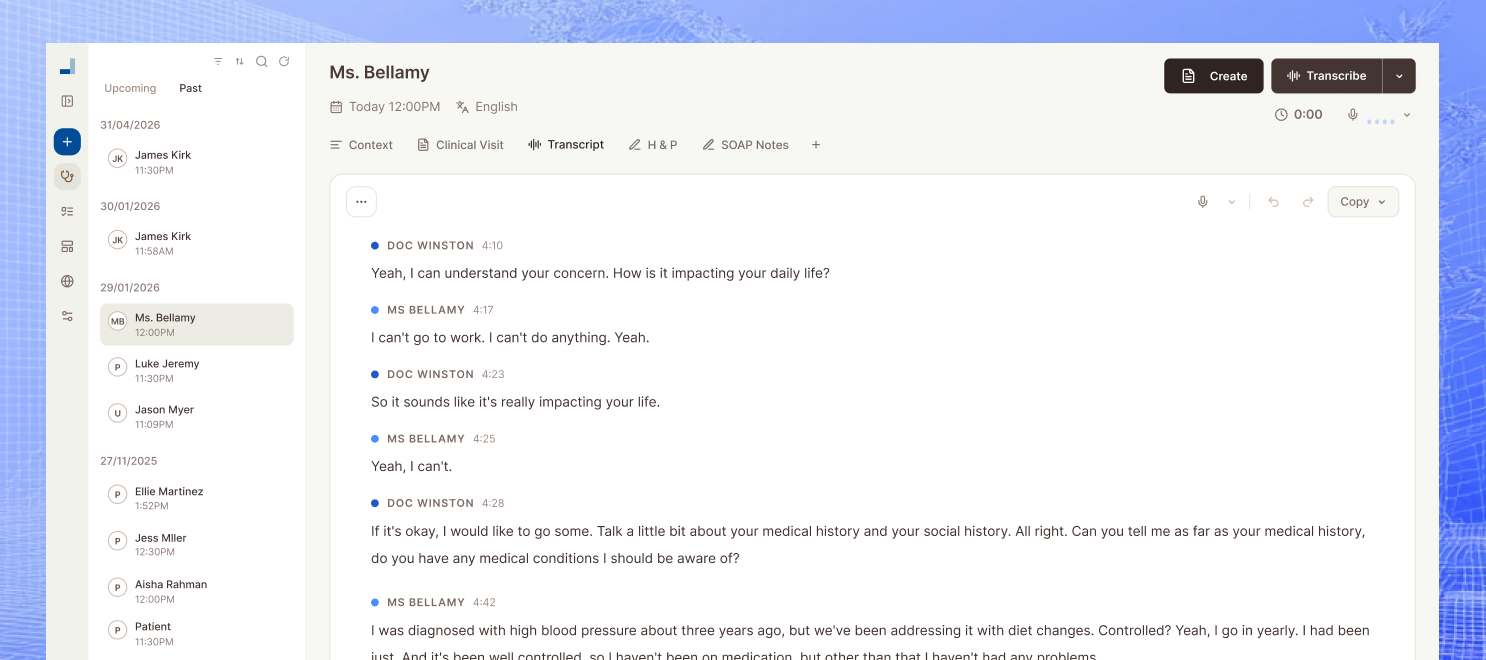
Mcoy AI is an AI medical scribe that records and transcribes patient encounters, then generates multiple clinical note types (H&P, progress notes, consult notes, follow-up notes, procedure notes, discharge summaries, referral letters, and more). With access to over 200+ customizable templates and an AI chat feature to help create letters, forms, and other documents, it streamlines the entire administrative side of practice. It is designed to be a helpful partner in the exam room, ensuring clinicians spend less time on paperwork and more time on patient care.
Conclusion
The transition to a digital-first practice doesn’t have to be a burden. By understanding how to use an AI medical scribe effectively, clinics can reclaim hours of lost time and significantly improve the work-life balance of their providers. From capturing complex H&P notes to drafting referral letters in seconds, the right workflow turns documentation from a chore into a seamless byproduct of great care. Start your pilot today and see how streamlining your admin can transform your clinic’s efficiency.
What a serious review table should cover
| Decision area | Common mistake | Better clinic-ready approach | Metric to watch |
|---|---|---|---|
| Workflow design | Treat how to use an ai medical scribe to streamline clinic admin as a one-off documentation task | Build a repeatable process with clear ownership and review points | Time to complete documentation |
| Team adoption | Assume every clinician will naturally use the same process | Train for consistency and define exception handling early | Active user adoption |
| Quality review | Only check notes when a problem is reported | Audit a sample of notes weekly and review edge cases | Edit rate per note |
| Operational follow-through | Leave admin actions outside the documentation workflow | Use the same encounter data for referrals, letters, and follow-up tasks | Completion rate for next-step tasks |
Related reading
If you are working through how to use an ai medical scribe to streamline clinic admin, it helps to read this alongside Admin Management: How to Reduce Admin Errors in Clinical Notes, Admin Management: Medication List Template with Examples, and Physician Wellbeing: How to Spend More Time With Patients and Less Time on Notes. Those guides cover adjacent workflow, implementation, and evaluation questions so the decision does not sit in isolation.
FAQ
How accurate are AI medical scribes in real clinics?
Modern AI scribes are remarkably accurate, often capturing over 95% of relevant clinical details from a conversation. However, their accuracy depends on the clarity of the audio and the complexity of the medical terminology used. Because they are designed to assist rather than replace, they do an excellent job of drafting the narrative, but a human must always verify the medical facts.
Do I still need to review every note?
Yes, as the licensed clinician, you are legally responsible for every entry in the medical record. While the AI does the heavy lifting of drafting, you must perform a final review to ensure there are no omissions or inaccuracies. This usually takes less than a minute compared to the ten or fifteen minutes it might take to write the note from scratch.
What note types can an AI scribe generate besides SOAP?
Beyond the traditional SOAP format, AI scribes can generate History and Physicals (H&P), procedure notes, consult letters, discharge summaries, and follow-up notes. Many tools also allow for the creation of customized templates for specific specialties like mental health, orthopedics, or oncology. This flexibility ensures that the documentation fits the specific needs of the encounter.
Will this work for telehealth and in-person consults?
Most AI medical scribes are designed to be versatile, working through mobile apps for in-person visits or via browser extensions and virtual audio loops for telehealth. The core technology remains the same: capturing audio, transcribing it, and using medical language models to structure the note. This makes it a great solution for hybrid practices.
How do I explain recording/transcription to patients?
Honesty and transparency are the best approaches when talking to patients. You can explain that you are using a secure tool to help you document the visit so you can give them your full attention. Most patients find this reassuring because they prefer a doctor who looks at them rather than one who is constantly typing into a computer.
How do clinics prevent note bloat?
To prevent note bloat, clinicians should select templates that are designed for brevity and clinical relevance. It is also helpful to speak clearly and stay focused on the medical issues during the recorded portion of the visit. Reviewing the drafted note to remove social pleasantries or redundant information before signing also helps maintain high standards.
How long does template setup take?
Setting up basic templates usually takes only a few minutes if you are using pre-built specialty options. Customizing a template to your specific voice or clinical style might take ten to fifteen minutes of adjustment. Once a template is set, it can be used repeatedly for all similar visit types, providing a massive long-term time investment.
What’s the safest way to start if I’m skeptical?
The safest way to start is to run a small pilot with non-complex cases, such as routine follow-ups or simple wellness checks. Use the tool alongside your traditional method for a day or two to gain confidence in its accuracy. Once you see the quality of the drafts and the time saved, you can gradually roll it out to more complex patient encounters.