Practice Operations: How to Use an AI Medical Scribe to Scale Your Practice
Learn how to use an AI medical scribe to eliminate charting burnout, automate notes, and scale your clinic operations with this comprehensive guide.
What a medical scribe solves in modern practice
The modern healthcare landscape is plagued by a silent epidemic: administrative burnout. For most clinicians, every hour spent with a patient necessitates nearly an hour of documentation. This cognitive load doesn’t just steal time; it leads to rushed notes and a significant decrease in the quality of clinician-patient interactions. When you are mentally drafting a SOAP note during a physical exam, you aren’t fully present for the patient.
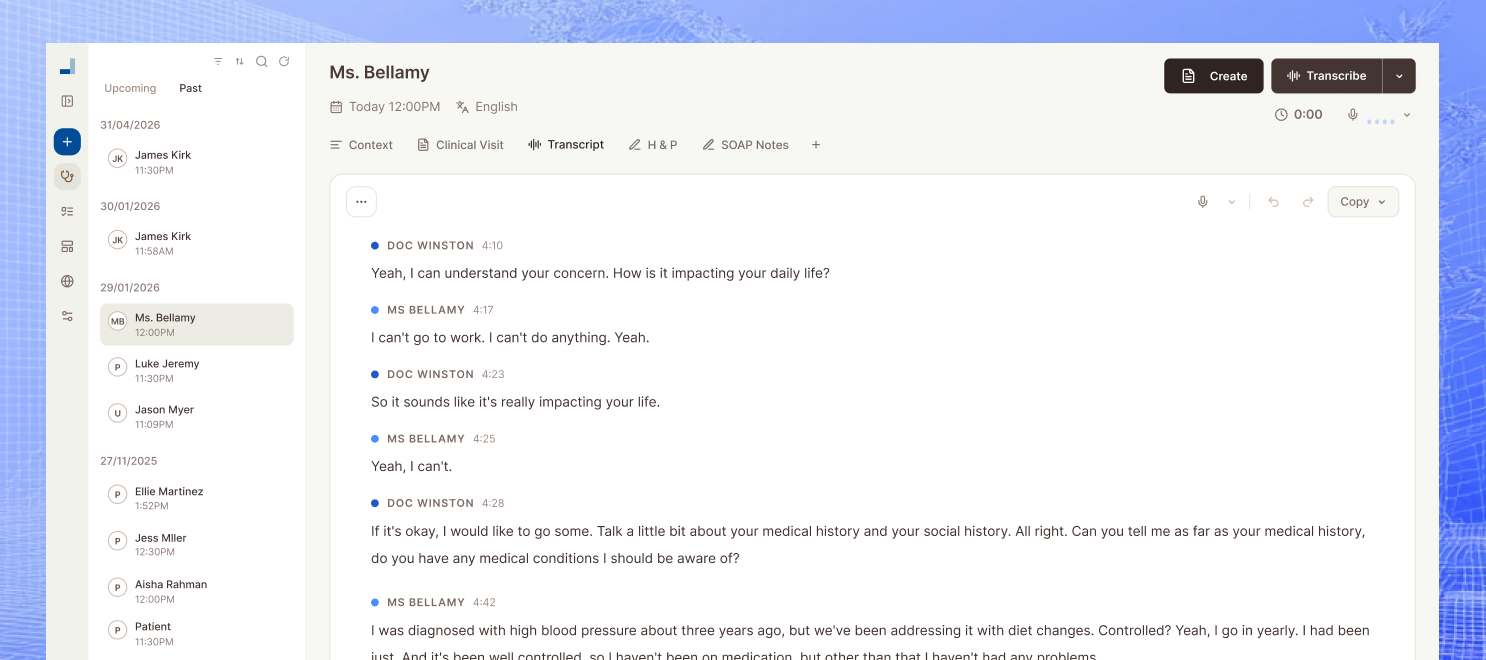
An AI medical scribe serves as an intelligent assistant that bridge the gap between verbal communication and structured documentation. It is designed to capture the nuance of a conversation without the intrusiveness of a keyboard. However, it is essential to remember that these tools are assistive. While they automate the heavy lifting of transcription and formatting, the clinician remains the final authority, ensuring every detail is medically accurate before signing off.
- Eliminates after-hours charting and ‘pajama time’ for providers.
- Reduces cognitive load by allowing clinicians to focus on the patient voice.
- Standardizes note quality across multi-provider university clinics.
- Increases patient satisfaction by facilitating better eye contact and engagement.
Note types you can generate beyond SOAP (H&P and more)
While the SOAP note is a staple of clinical practice, scaling a practice requires a much broader range of documentation. Comprehensive care involves initial History and Physical (H&P) reports, detailed procedure notes, and complex discharge summaries. Traditional manual charting often results in ‘note bloat’ where essential information is buried under repetitive templates, making it difficult for the next provider to find relevant data.
Using advanced AI, practitioners can now generate consult notes that highlight specialist recommendations or follow-up notes that track chronic disease progression over time. For university clinics handling diverse cases, having the ability to instantly draft referral letters or transition-of-care summaries ensures that the paper trail is as professional as the care provided. This variety in documentation is crucial for maintaining audit readiness and ensuring seamless handovers between departments.
- H&P and Progress Notes for inpatient and outpatient longitudinal care.
- Consultation and Referral letters to streamline specialist communication.
- Procedure and Follow-up notes for surgical or specialized interventions.
- Discharge summaries that satisfy both clinical and billing requirements.
How to implement an AI medical scribe step-by-step in a real clinic
The transition to automated documentation should be strategic rather than sudden. Begin by selecting a single visit type, such as routine follow-ups or wellness exams, to test the workflow. This allows your team to get comfortable with the recording process without the pressure of a complex multi-disciplinary case. During this initial phase, focus on how the AI interprets your specific clinical vocabulary and common patient presentations.
Next, move into setting up specialized templates. Most clinics benefit from categorizing templates by specialty—cardiology, pediatrics, or family medicine—to ensure the AI knows which data points to prioritize. When you are ready for a live encounter, simply start the recording on your device. Whether the consult is in-person or via a telehealth platform, the AI captures the dialogue while you remain engaged with the patient. After the visit, the AI provides a draft within seconds.
Reviewing and editing the draft is the most critical step for quality control. You can quickly scan the output, make necessary adjustments to the plan or assessment, and then finalize the document. Finally, the true power of scaling comes from reusing these outputs. The data captured in the note can be instantly converted into patient instructions, work excuses, or specialist letters, effectively turning one conversation into five distinct documents with zero extra effort.
- Start with one manageable visit type to build provider confidence.
- Configure templates specific to your specialty for higher initial accuracy.
- Capture encounters seamlessly across both in-person and digital platforms.
- Review, edit, and repurpose generated text for letters and forms.
How to keep note quality high and reduce mistakes
Quality documentation is the cornerstone of medico-legal safety. A common failure point in clinic scaling is ‘note bloat,’ where AI or human scribes include irrelevant filler that obscures the clinical narrative. To prevent this, practitioners should establish a lightweight review habit. Instead of reading every word like a proofreader, focus on high-stakes areas: medication dosages, specific lab values, and the ‘Assessment and Plan’ section. Consistency across the team ensures that every note reflects the clinic’s standards.
Effective implementation also requires a feedback loop. If the AI consistently misses a specific part of your workflow, adjust your verbal cues during the exam. For example, explicitly stating, ‘I am prescribing 50mg of Losartan today,’ ensures the AI maps the data correctly. Over time, this synergy between the clinician’s speech and the AI’s processing creating a gold-standard medical record.
- Audit high-risk sections like medication lists and physical exam findings.
- Establish clinic-wide standards for note length and clinical detail.
- Use clear verbal cues during the exam to improve AI recognition.
- Regularly update templates to reflect evolving billing or clinical codes.
Privacy, consent, and patient trust (plain English)
Patient privacy is non-negotiable when implementing new technology. While laws vary by region, the core principle remains the same: transparency. Patients generally appreciate the use of technology if they understand it leads to a more focused doctor and better care. Before starting a recording, explain to the patient that you are using a digital assistant to ensure you give them your full attention rather than typing on a screen. Most patients are supportive once they realize the benefit to their own care experience.
Security principles should be based on data minimization and encryption. Ensure your chosen tool adheres to industry standards for data handling and retention. From a clinical perspective, your consent process should be integrated into the check-in or the beginning of the consult. A simple script such as, ‘I use an AI assistant to help me stay focused on you instead of the computer; is it okay if I record our conversation for the medical record?’ is usually all it takes to build trust.
- Obtain verbal or written consent based on your local regulatory requirements.
- Explain the technology as a tool for better clinical focus and engagement.
- Verify that the solution follows standard security and data retention protocols.
- Keep documentation audits regular to ensure compliance with privacy laws.
Rolling it out across a clinic without disruption
Scaling a practice with AI requires a phased rollout to avoid overwhelming the staff. Start with a two-week pilot program involving one or two ‘tech-forward’ providers. This group can identify potential friction points in the clinic’s physical workflow, such as Wi-Fi dead zones or quiet room requirements. During this time, track metrics like time saved per note and the reduction in after-hours work to demonstrate value to the rest of the team.
Once the pilot is successful, align your templates across the organization. This ensures that no matter which doctor a patient sees, the documentation remains uniform. Training staff on how to review and transfer notes into the EMR efficiently will prevent bottlenecks. By the end of the first month, the goal is to shift the culture from ‘writing notes’ to ‘managing patient data,’ freeing up significant time for higher patient volumes or improved work-life balance.
- Begin with a 14-day pilot to iron out workflow and technical kinks.
- Track ‘Time-to-Sign’ metrics to quantify the efficiency gains.
- Standardize clinical templates to ensure brand and medical consistency.
- Ensure the team is trained on the final review and EMR integration process.
Mcoy AI is an AI medical scribe that records and transcribes patient encounters, then generates multiple clinical note types (H&P, progress notes, consult notes, follow-up notes, procedure notes, discharge summaries, referral letters, and more). It features 200+ customizable templates and an AI chat function to help you create various letters, forms, and documents quickly and accurately, allowing you to focus more on patient care and less on the keyboard.
Conclusion
Adopting a modern workflow is the most effective way to scale a medical practice in an era of increasing administrative demands. By transitioning from manual entry to an automated process, clinics can improve note accuracy, reduce provider burnout, and enhance the patient experience. Following a structured rollout—starting small, standardizing templates, and maintaining a high standard of review—is the key to success. If you are ready to reclaim your schedule, learning how to use an AI medical scribe is the first step toward a more efficient, patient-centered future. Start your pilot today and see the difference in your practice’s productivity.
What a serious review table should cover
| Decision area | Common mistake | Better clinic-ready approach | Metric to watch |
|---|---|---|---|
| Workflow design | Treat how to use an ai medical scribe to scale your practice as a one-off documentation task | Build a repeatable process with clear ownership and review points | Time to complete documentation |
| Team adoption | Assume every clinician will naturally use the same process | Train for consistency and define exception handling early | Active user adoption |
| Quality review | Only check notes when a problem is reported | Audit a sample of notes weekly and review edge cases | Edit rate per note |
| Operational follow-through | Leave admin actions outside the documentation workflow | Use the same encounter data for referrals, letters, and follow-up tasks | Completion rate for next-step tasks |
Related reading
If you are working through how to use an ai medical scribe to scale your practice, it helps to read this alongside Practice Operations: How Clinics Can Streamline Daily Operations, Practice Operations: How Clinics Can Improve Workflow Without Changing Their EHR, and Physician Wellbeing: The Complete Guide to Reducing Documentation Time for Doctors. Those guides cover adjacent workflow, implementation, and evaluation questions so the decision does not sit in isolation.
FAQ
How accurate are AI medical scribes in real clinics?
AI medical scribes currently achieve very high levels of accuracy, often capturing over 95% of relevant clinical dialogue. However, they are designed to be assistive tools rather than autonomous replacements. Their accuracy depends heavily on the clarity of the audio and the specific clinical context provided during the encounter. Practitioners should always perform a final check to ensure nuances were captured correctly.
Do I still need to review every note?
Yes, reviewing every note is a professional and legal requirement. While the AI does the majority of the drafting, the clinician is the only one who can verify the medical intent and accuracy of the plan. A quick 30-second review and edit are usually all that is needed to move a note from a draft to a finalized medical record. This habit ensures long-term quality and safety.
What note types can an AI scribe generate besides SOAP?
Modern AI scribes are highly versatile and can generate Histroy and Physical (H&P), procedure notes, consult letters, and discharge summaries. They can also assist with follow-up notes and referral letters for specialists. By using different templates, the AI can structure the same conversation into various formats depending on the specific administrative or clinical need.
Will this work for telehealth and in-person consults?
Absolutely. Most AI scribe solutions are designed to work across multiple environments. For telehealth, the AI can often capture audio directly from the computer’s output, while in-person consults are recorded via a mobile device or tablet. This flexibility allows for a consistent documentation experience regardless of how the patient is being seen.
How do I explain recording/transcription to patients?
The best approach is a transparent and patient-centered explanation. You might say, ‘I am using a digital scribe so I can listen to you and look at you instead of typing on my screen.’ Most patients value the extra eye contact and attention they receive when the doctor isn’t distracted by an EHR, leading to higher satisfaction scores.
How do clinics prevent note bloat?
Clinics prevent note bloat by selecting templates that emphasize brevity and clinical relevance. Advanced AI scribes can be instructed to summarize specifically for a certain specialty rather than transcribing every ‘umm’ and ‘ahh.’ Setting clear internal standards for what constitutes a ‘good note’ also helps the team keep documentation focused and usable.
How long does template setup take?
Setting up basic templates usually takes less than an hour, as many systems come with pre-built clinical standards. Customizing these to fit your specific practice’s unique style or specific specialty requirements might take a few days of intermittent testing. Once established, these templates save hours of manual entry every single week.
What’s the safest way to start if I’m skeptical?
The safest way to start is with a ‘shadow’ pilot. Use the AI scribe during a few non-complex visits while still keeping your traditional notes. Compare the two outputs at the end of the day. You will likely find the AI version is more comprehensive and was produced with far less effort, which usually helps build the necessary trust to fully switch over.