Physician Wellbeing: The Complete Guide to Reducing Documentation Time for Doctors
Complete guide for doctors on how to reduce documentation time using smarter workflows, templates, and AI medical scribe tools.
Documentation has quietly become one of the most time-consuming parts of modern medical practice. For many doctors, charting now extends far beyond the consultation room, filling evenings, weekends, and mental bandwidth that should be reserved for rest, learning, or family. What was once a supporting task has turned into a parallel workload that rivals patient care itself.
This guide is written for doctors, private practitioners, and clinic owners who want to reduce documentation time without compromising clinical quality, compliance, or patient safety. The goal is not to rush notes or cut corners, but to design smarter systems that work with you rather than against you.
Why documentation takes so long today
Medical documentation has expanded for several reasons. Regulatory standards have become stricter, requiring more detailed records. Multidisciplinary care means notes must communicate clearly across providers. Digital health systems, while powerful, often add clicks and duplication rather than removing work.
Many doctors also document defensively, adding extra detail to protect against audits or medico-legal risk. Over time, this leads to longer notes that take more effort to write and review, without always adding clinical value.
The result is a growing gap between time spent with patients and time spent on documentation.
Understanding where documentation time is lost
Before fixing the problem, it helps to understand where time actually goes. In most practices, documentation time is lost in small but repeated moments rather than one single task.
Doctors often start from a blank page, even for routine visits. Information discussed verbally must be remembered and re-typed later. Similar phrases and structures are rewritten multiple times a day. Notes are dictated, then edited, then reformatted to fit templates. Each step adds friction.
Even efficient typists feel the burden because documentation is cognitively demanding. Switching between clinical thinking and clerical work drains energy and slows decision-making.
Reducing documentation is about systems, not speed
Many clinicians try to document faster by typing quicker or staying later. This approach rarely works long term. The real solution lies in reducing unnecessary work rather than pushing harder.
Good documentation systems reduce repetition, capture information once, and reuse it across multiple outputs. They align with how doctors think during a consultation, not how software vendors imagine workflows should look.
When systems are designed properly, documentation becomes a by-product of care rather than a separate task.
Use structured templates without losing flexibility
Templates are one of the most effective tools for reducing documentation time, but only when used correctly. Poorly designed templates can feel rigid and slow. Well-designed templates act as intelligent prompts.
For common visit types such as follow-ups, chronic disease reviews, mental health consultations, or procedure notes, templates ensure that essential elements are covered without rewriting everything from scratch. They reduce decision fatigue by guiding structure while leaving room for clinical nuance.
The key is customisation. Templates should reflect how you practice, not force you into unnatural phrasing. Over time, refining templates can cut minutes off every consultation, which adds up to hours each week.
Capture information during the consultation
One of the biggest causes of after-hours documentation is delayed note-taking. When information is not captured during the consultation, it must be reconstructed later from memory. This is slower and increases the risk of omissions.
Capturing information in real time, whether through structured prompts or automated tools, reduces this burden. It allows doctors to review and finalise notes rather than recreate them from scratch.
This shift alone can dramatically reduce end-of-day documentation backlog.
The role of AI in reducing documentation time
AI has become one of the most impactful tools for reducing documentation workload when used appropriately. Modern AI documentation tools can listen to patient encounters, transcribe conversations, and generate structured medical notes automatically.
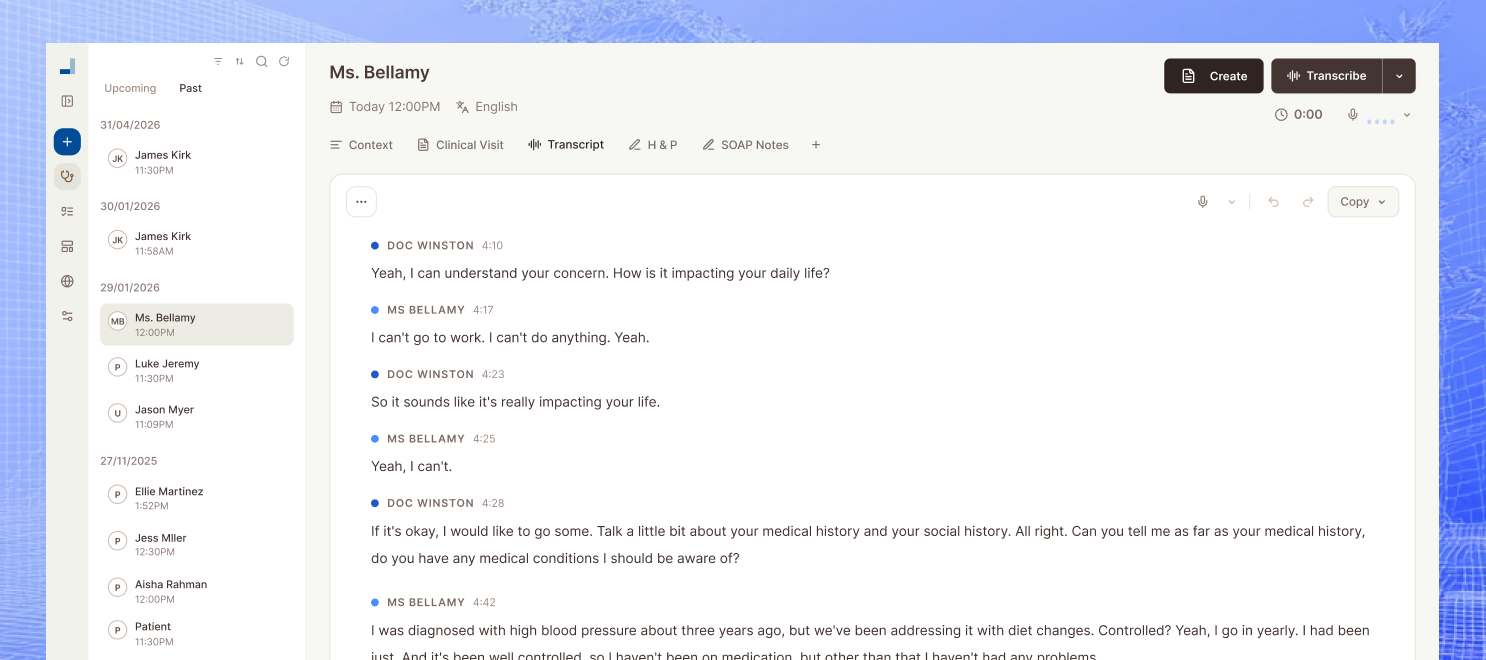
Instead of typing or dictating after the visit, doctors receive a draft note that reflects the actual consultation. The clinician then reviews, edits if needed, and signs off. This changes documentation from a writing task into a review task, which is significantly faster and less mentally taxing.
This is where Mcoy AI plays a meaningful role in clinical workflows.
Mcoy AI is an AI medical scribebuilt to reduce documentation time for doctors across specialties. It can record and transcribe patient encounters, convert conversations into structured SOAP notes, and generate clinical documents using over 200 customisable templates tailored to different medical fields. Doctors can chat with their encounters, create referral letters, reports, and forms, all from the same captured consultation. By handling the heavy lifting of documentation, Mcoy AI helps clinicians spend less time on admin and more time focused on patient care.
Importantly, AI tools like this do not replace clinical judgment. They support it by removing clerical overhead.
Turn one note into many outputs
A common inefficiency in clinics is rewriting the same information in different formats. Details from the consultation are used for notes, referral letters, patient summaries, and sometimes insurance or compliance documents.
Smarter documentation systems allow a single source of truth. Once information is captured, it can be reused automatically to generate multiple documents. This reduces duplication and ensures consistency across communications.
When referral letters and follow-up instructions are generated directly from consultation content, doctors save time and reduce errors caused by retyping.
What a serious review table should cover
| Decision area | Common mistake | Better clinic-ready approach | Metric to watch |
|---|---|---|---|
| Workflow design | Treat the complete guide to reducing documentation time for doctors as a one-off documentation task | Build a repeatable process with clear ownership and review points | Time to complete documentation |
| Team adoption | Assume every clinician will naturally use the same process | Train for consistency and define exception handling early | Active user adoption |
| Quality review | Only check notes when a problem is reported | Audit a sample of notes weekly and review edge cases | Edit rate per note |
| Operational follow-through | Leave admin actions outside the documentation workflow | Use the same encounter data for referrals, letters, and follow-up tasks | Completion rate for next-step tasks |
Related reading
If you are working through the complete guide to reducing documentation time for doctors, it helps to read this alongside Physician Wellbeing: Why Documentation Is the Biggest Time Drain for Doctors, Physician Wellbeing: How Doctors Can Reduce Paperwork Without Compromising Care, and Physician Wellbeing: How to Reduce Documentation Time With an AI Medical Scribe. Those guides cover adjacent workflow, implementation, and evaluation questions so the decision does not sit in isolation.
FAQ
Reduce over-documentation without increasing risk
Many doctors document more than necessary out of caution. While thoroughness is important, excessive detail often increases workload without meaningful benefit.
Clear internal standards help strike the right balance. Decide what level of detail is required for different visit types and stick to it. Templates and AI-assisted tools can help ensure completeness while avoiding unnecessary repetition.
Concise, structured notes are often easier to review, communicate more clearly, and reduce future clarification requests.
Batch review instead of constant switching
Documentation time is not just about minutes spent typing. Constant switching between patients, notes, messages, and forms increases cognitive fatigue.
When possible, batch documentation review into focused blocks. AI-generated notes make this easier by allowing doctors to stay present during consultations and review notes later in a single session.
This approach reduces interruptions and improves both efficiency and mental clarity.
Train systems, not people
Many clinics try to solve documentation problems by asking doctors to document differently or faster. This rarely works long term.
A more sustainable approach is to train systems. Improve templates, refine AI outputs, and adjust workflows so that documentation naturally takes less time. Small improvements compound over weeks and months.
When systems improve, doctors do not need to change how they think or practice medicine. The system adapts to them.
Measure progress and refine continuously
Reducing documentation time is not a one-off project. It is an ongoing process.
Track how long documentation takes before and after changes. Even rough estimates are helpful. Identify bottlenecks and refine templates or workflows accordingly.
Many clinics are surprised by how quickly small changes lead to noticeable improvements in daily workload.
The long-term benefits of faster documentation
Reducing documentation time has benefits far beyond convenience. Doctors experience less burnout, better focus, and improved job satisfaction. Patients benefit from more attentive consultations. Clinics gain efficiency without increasing staff costs.
In the long run, documentation systems that respect clinicians’ time are essential for sustainable healthcare delivery.
The future of medicine is not about working longer hours to keep up with paperwork. It is about designing smarter tools that allow doctors to practice medicine, not administration.
How much time can doctors realistically save on documentation
Many doctors report saving 30 to 60 percent of documentation time with better templates and AI-assisted tools, especially for routine visits.
Does AI documentation work across specialties
Yes. With customisable templates and specialty-specific workflows, AI documentation tools can support a wide range of medical fields.
Will patients notice AI being used
When used properly, patients often notice improved engagement because doctors are less focused on screens and more present during consultations.
Is it safe to rely on AI for medical notes
AI tools assist with drafting, but doctors remain responsible for review and approval. This maintains safety and clinical accountability.
Can small clinics benefit as much as large hospitals
Often more. Smaller clinics feel documentation burden more acutely, and workflow improvements can have immediate impact.